Software Development Agency Statistics: 2026 Benchmarks
Most software development agency statistics get published by outsourcing vendors with something to sell. Line up the same data for the person who actually runs the agency, and one story emerges.
The market is enormous. It's well past half a trillion dollars and climbing toward a trillion, growing every year. And it's so crowded that in the United States, no single firm holds even 5% of it.
Now add the newest variable: AI is collapsing the cost of writing code.
Read those three facts together and you are not looking at a healthy, opportunity-rich industry. You are looking at an industry being commoditized in real time, which is exactly why so many genuinely excellent dev agencies feel like they compete on price and availability instead of expertise.
Below are the numbers behind that story, grouped by theme and sourced so you can cite them. After each cluster, I've added what the data actually means if you're the person running the agency.
Under 5%
Market share held by the largest U.S. web design firm, in a $47.4B market.
IBISWorld, 202670% → 34%
Buyers citing cost as their #1 reason to outsource, 2020 vs. 2024.
Deloitte Global Outsourcing Survey$25–$300
Hourly rate range for what buyers see as the same deliverable.
Clutch / Cleveroad, 2025–2684% / 29%
Developers using AI tools vs. those who trust what it produces.
Stack Overflow Developer Survey, 202576%
Of IT-sector employers can't find the skilled talent they need — the hardest-hit industry.
ManpowerGroup Global Talent Shortage Survey, 2026A $47B Market With No Leader (and Why That's Your Problem)
- The global software development market was an estimated $0.57 trillion in 2025 and is forecast to reach $1.11 trillion by 2031 (~11.7% CAGR). (Source: Mordor Intelligence)
- The U.S. web design services industry is worth $47.4 billion in 2026, spread across 202,692 businesses, and it's so fragmented that no single firm holds more than 5% of it. (Source: IBISWorld)
- There are an estimated ~47.2 million software developers worldwide as of 2025. (Source: SlashData, 2025)
Here's the stat that matters most, and it's not the trillion-dollar projection. It's the 5%.
“That’s not a size problem. It’s a differentiation problem.”
A $47 billion market split across 200,000-plus firms, with no player above 5% share, isn't a market with leaders. It's a market where buyers genuinely cannot tell one agency from another. When every option looks the same, the buyer defaults to the two things they can compare: price and timeline.
That's not a size problem. It's a differentiation problem. It's also the root cause underneath almost every pipeline complaint I hear from technical founders.
Why Buyers Stopped Outsourcing to Save Money
- Cost reduction as the primary reason companies outsource fell from 70% (2020) to 34% in Deloitte's most recent survey. Buyers now outsource to access specialized expertise, not to save money. (Source: Deloitte 2024 Global Outsourcing Survey)
- The global offshore software development market is valued at about $204 billion in 2026 and is forecast to reach ~$348 billion by 2030 (~14% CAGR). (Source: The Business Research Company / Research and Markets)
Sit with the first stat, because it's the most important shift in this entire report.
For two decades, outsourcing was a cost play. You went offshore because it was cheaper. In four years that reason was cut in half. The buyer's motivation flipped from "who's cheapest" to "who has the expertise I can't get locally."
This is enormous news for an independent agency, and most miss it. The market is actively rewarding specialized expertise over low rate, even in the part of the market that used to be a pure race to the bottom. The agencies losing to offshore shops on price are losing a game that buyers are already walking away from.
“The agencies losing to offshore shops on price are losing a game that buyers are already walking away from.”
Why the Same Work Bills From $25 to $300 an Hour
- Agency hourly rates span an enormous range by geography: U.S. senior developers command ~$125–$250+/hr (up to ~$300 in top markets like the Bay Area and NYC), while Eastern European rates run ~$25–$99/hr. (Source: Clutch / Cleveroad rate guides)
Look at that rate range again: roughly $25 an hour at one end, $300-plus at the other, for what a buyer perceives as the same service.
Some of that gap is real cost-of-labor geography. But plenty of it isn't. A U.S. specialist at $250 and a competent Eastern European shop at $60 aren't separated by a 4x difference in skill. They're separated by positioning and perceived risk.
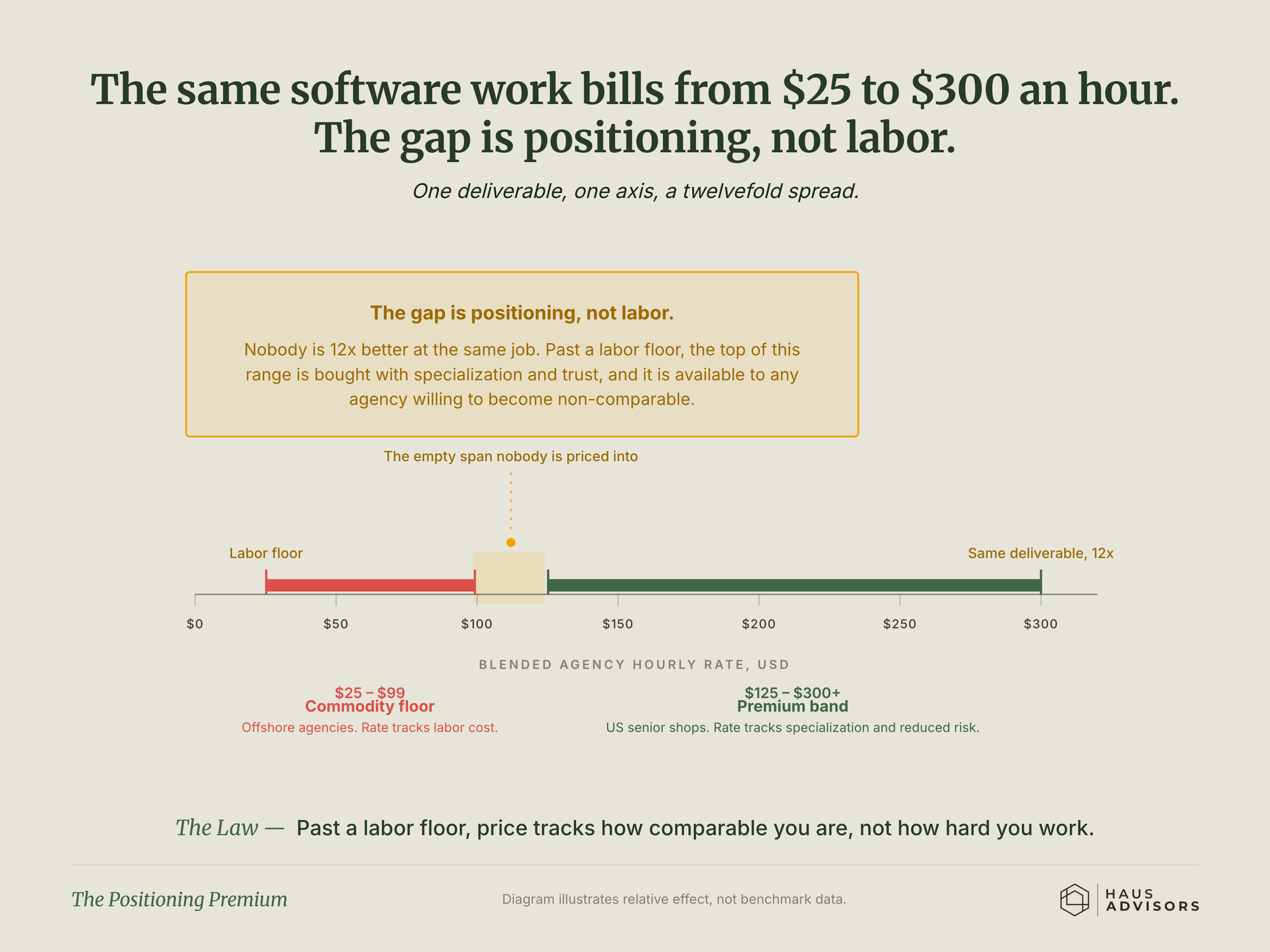
That spread is where differentiation lives. The agencies at the top aren't staffed with developers who are four times better. They've made themselves non-comparable, so the buyer stops rate-shopping and starts asking whether they're the right fit.
If your rates are stuck in the middle of that band, the constraint almost certainly isn't your delivery. It's that buyers can't tell why you'd be worth more.
The Relevance Engineering Program
Your rate is a positioning problem, not a delivery one.
If you want your agency to grow without needing you in every deal, that's what the Relevance Engineering Program is built for.
Book a call to see if it's a fitWhy Headcount No Longer Signals Value
- 72% of employers globally report difficulty filling roles, rising to 76% in the IT sector specifically, the hardest-hit industry. (Source: ManpowerGroup 2026 Global Talent Shortage Survey)
- Roughly 38.5% of agencies deliver a typical software product in a 2–4 month window (average delivery ~4.5 months). (Source: GoodFirms Software Development Research)
The talent story and the AI story are the same story, and this is where they meet.
Senior talent is scarce and expensive. Junior output is about to be nearly free, because AI does more of it every quarter. So the agencies that win the next few years won't be the ones with the most hands on keyboards. They'll be the ones whose expertise can't be reproduced by a model: judgment, architecture, knowing what to build and for whom.
“Headcount is becoming a worse and worse proxy for value.”
Headcount is becoming a worse and worse proxy for value. Plan accordingly.
What Happens to Agencies When Code Gets Cheap
- 84% of developers are using or planning to use AI tools in their workflow (up from 76% the year before), and 51% of professional developers use them daily. (Source: Stack Overflow 2025 Developer Survey)
- But trust is falling: only 29% of developers trust the accuracy of AI tools, down 11 points year over year. (Source: Stack Overflow 2025 Developer Survey)
- Demand for AI and cloud specialists is outstripping local supply, the skills gap driving the 76% IT hiring-difficulty figure above. (Source: ManpowerGroup 2026)
AI compresses the cost of writing code toward zero. That single sentence explains most of the pressure agencies are feeling right now.
When the production of code gets cheap, the value migrates upstream, to deciding what's worth building, for which buyer, and why. A generalist agency experiences that shift as margin erosion, because the thing they sold (capacity to build) is the exact thing getting commoditized. A specialist agency experiences the same shift as leverage, because the thing they sell (expertise about a specific problem for a specific buyer) is the thing AI can't commoditize.
Notice the tension inside those numbers. Developers have adopted AI almost universally, but only 29% trust what it produces. That gap is the job now.
The value isn't generating the code, because everyone can do that. It's the judgment to know when the machine is wrong, which is exactly what a well-positioned specialist gets paid for, and exactly what a commodity shop gives away.
This is what I've called the AI efficiency penalty: the faster and cheaper development gets, the more it punishes agencies that compete on doing the work and rewards the ones that compete on knowing the work. Same technology. Opposite outcomes. The variable is positioning.
“Same technology. Opposite outcomes. The variable is positioning.”
What This Data Means If You Run a Technical Agency
Stack the four findings that matter:
A market past $570 billion. So fragmented no one owns 5% of it. Buyers shifting from "cheapest" to "most expert." And AI collapsing the cost of the thing generalists sell.
Put those together and you get relentless price competition, unless you're differentiated. That's the whole conclusion. Every other page in this category stops at the numbers. A number is only useful if it changes what you do on Monday.
The escape hatch isn't working harder, hiring faster, or shaving your rate to beat an offshore shop. Those are all ways of competing inside the commodity market. The escape hatch is positioning that makes you non-comparable in the first place, so a buyer can't line you up next to four other agencies and pick on price, because none of the four does quite what you do for quite who you do it for.
Competing inside the market
The Commodity Agency
- Priced against the field; buyers compare on rate
- Sells capacity to build — the exact thing AI is making cheap
- Looks like the other 200,000 firms
- Wins deals on price and availability
Outcome: margin erosion, racing the offshore shop to the bottom.
Making yourself non-comparable
The Positioned Agency
- Sets its own rate; buyers stop shopping on price
- Sells expertise and judgment — what AI can't reproduce
- Specific enough that the right buyer self-selects
- Wins on fit and trust
Outcome: pricing power, and getting chosen before the first call.
That's the entire premise of how we work with technical agencies. Relevance Engineering is our name for building an agency the market can't commoditize. And most founders miss this: the thing that makes you non-comparable already exists. It's your judgment, your reputation, and your relationships. The trouble is it lives in your head, so the agency only wins the deals you're in. When founders come to us feeling like a commodity, this data is why. The Relevance Engineering Program is six months of implementation that moves that expertise out of your head and into positioning, offers, and growth plays your team can run. Book a call to see if it's a fit.
You don't need us to take the first step, though. Take one number from this page, your own place in that $25-to-$300 rate spread, and ask the honest question underneath it: if a buyer put you next to three other agencies, could they tell why you'd be worth more? If the answer takes you longer than a sentence, that's the work.
Self-assessment
How commoditized is your agency?
1. If a prospect put you next to three other agencies, could they say why you're worth more?
2. Where do your rates sit?
3. When you pitch, what's the core of it?
4. Where does new business come from?
5. How does cheaper, AI-assisted development affect you?
Answer all five questions to see your result.
Methodology and Sources
These statistics were compiled in July 2026 from current industry research, market-size reports, and developer surveys, then interpreted through the lens of independent technical agencies doing $1M–$10M in revenue.
Primary sources
- IBISWorld — Web Design Services in the US (market size $47.4B; no firm >5% share; 202,692 businesses)
- Mordor Intelligence — Software Development Market ($0.57T 2025 → $1.11T 2031)
- Deloitte — 2024 Global Outsourcing Survey (cost-driver 70% → 34%)
- The Business Research Company / Research and Markets — Offshore Software Development Market ($204B 2026 → ~$348B 2030)
- ManpowerGroup — 2026 Global Talent Shortage Survey (72% overall / 76% IT hiring difficulty)
- GoodFirms — Software Development Research (38.5% deliver in 2–4 months)
- Stack Overflow — 2025 Developer Survey (84% AI adoption; 51% daily; 29% trust)
- SlashData — Global Developer Population 2025 (~47.2M developers)
Keep reading
Browse by topic
- Positioning & Strategy
- Lead Gen & Marketing
- Sales & Biz Dev
- Pricing & Productization
- Research & Data
- Operations & Delivery
- Client Retention & Expansion
- Leadership & Culture
For founders whose agency has outgrown referrals.
One idea a week that makes a hard growth problem obvious, usually with a chart that shows you the mechanism behind it.
Built from conversations with seventy-plus agency founders on the Behind the Agency podcast.