You've Engineered Every Part of Your Clients' Businesses. Except Your Own Growth.
A founder I work with told me something that stuck. He said, "I've built systems that handle millions of transactions per second. But I can't make my phone ring on purpose."
He wasn't exaggerating. His agency had shipped infrastructure for fintech companies processing real money at real scale. He'd solved problems that would make most engineers sweat. And yet the growth of his own business operated on hope. Referrals arrived randomly. Pipeline was either overflowing or empty. Revenue swung between panic and chaos on a cycle he couldn't predict, influence, or explain.
He'd tried the standard fixes. Hired a lead gen firm. Ran LinkedIn ads. Paid for a cold email campaign. Each one produced a burst of activity and no meaningful results. His conclusion was the one I hear from nearly every technical founder who's tried to "do marketing": it doesn't work for agencies.
What he actually meant was: the approaches he'd tried didn't work. And they didn't work because they were pushing a message into a market that had no reason to listen to it. His agency was technically excellent, personally reliable, and strategically invisible. Nobody outside his referral network knew he existed, and the people inside his referral network described him as "a great dev shop," which is the equivalent of a doctor's patients telling friends "he's a good doctor." True, but useless for generating the right kind of demand.
He didn't have a sales problem. He had an architecture problem. His growth had no system, no structure, and no inputs he controlled. He'd engineered every part of his clients' businesses but left his own growth to chance.
The Framework Has a Name
Clients hire an agency because it feels like the right firm for their problem. We call that relevance. In most founder-led agencies, the relevance lives in the founder: their judgment, their reputation, and their relationships.
At Haus Advisors, we call the fix Relevance Engineering: building that relevance into the company instead, in the six places it lives. Who you sell to, what you sell, the proof behind it, how buyers find you, how you win the deal, and who owns the work.
The name is deliberate. Growth, for technical agencies, isn't a personality test. It's not about becoming more charismatic on sales calls or more aggressive with cold outreach. It's an engineering problem: a system with inputs, logic, and outputs that can be designed, measured, and optimized.
Traditional sales is about push: trying to convince strangers that they need what you have. Relevance Engineering is about pull: structuring your positioning, offerings, content, and partnerships so that the right prospects find you, understand what you do, and arrive at the conversation with trust already established.
The distinction matters because technical founders have a deep and justified aversion to push-based sales. It feels manipulative. It feels like the antithesis of engineering, which is logical, deterministic, and honest. The aversion isn't a personality flaw. It's a correct instinct applied to the wrong model. Push-based sales should feel wrong to an engineer, because it is wrong for agencies. Pull-based relevance works because it operates on the same principles engineers already respect: clarity, specificity, evidence, and systems.
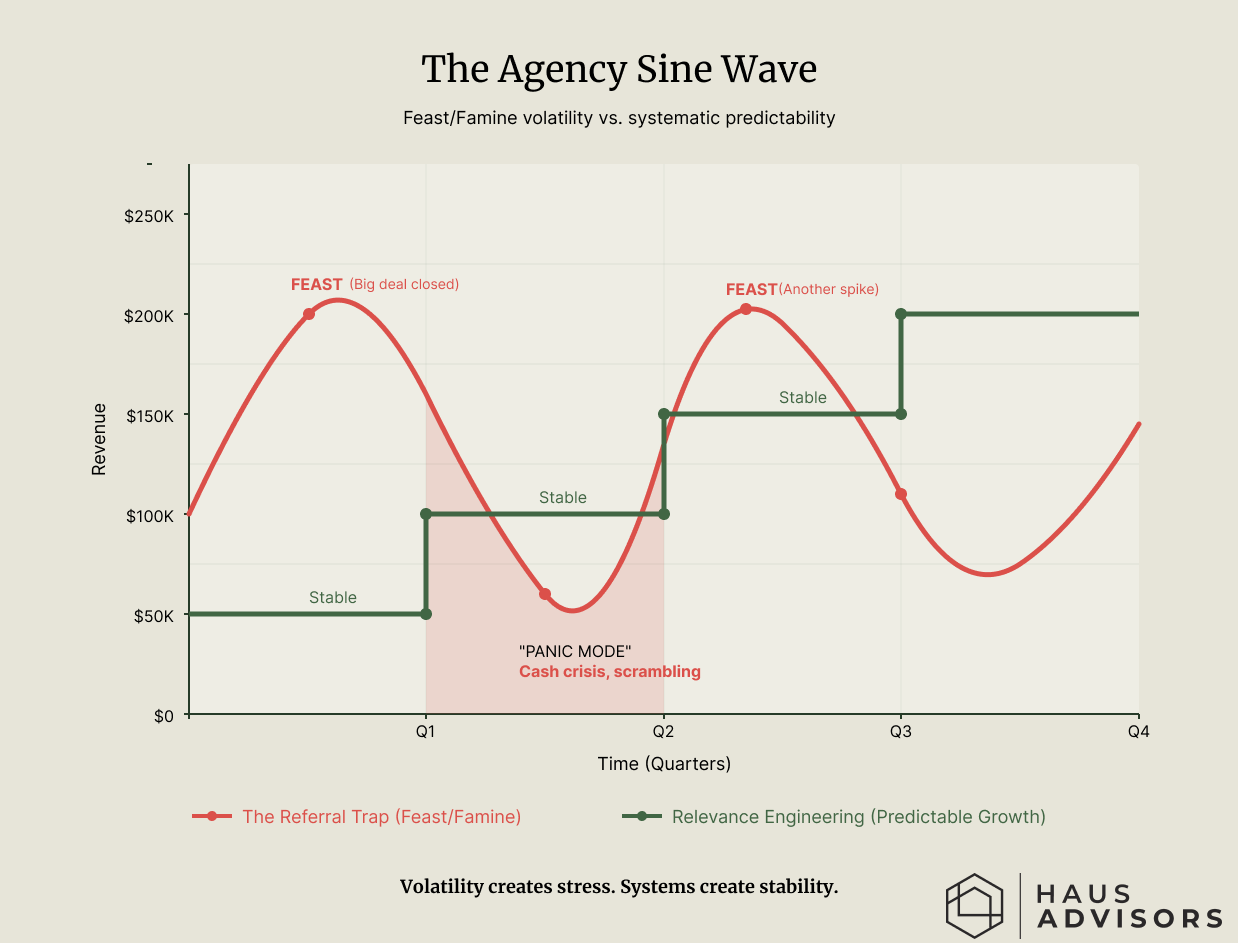
The architecture gap: Red is what growth looks like when it's unengineered: volatile, unpredictable, and entirely dependent on external timing. Green is what growth looks like when it's designed as a system: stepped, compounding, and responsive to inputs you control. The gap between the two isn't effort. It's architecture.
Why Most Growth Attempts Fail for Technical Agencies
Because the standard playbook assumes you're selling a product with visible features, clear pricing, and low buyer risk. When agencies apply that playbook (lead gen firms, LinkedIn ads, cold email blasts, SEO content), the mechanics work but the conversions don't. Traffic flows. Emails get opened. Content gets consumed. Nobody buys.
I've written about this elsewhere as Framework Mismatch: the structural incompatibility between product-shaped growth tactics and services-shaped businesses. But the Relevance Engineering explanation goes deeper. The tactics fail not just because they're product-shaped, but because they're pushing a signal into a market without first engineering the signal's relevance.
A cold email from "a full-service development agency" is noise. The recipient has seen it a hundred times. It carries no information about whether this agency understands their specific problem, serves their specific industry, or has solved their specific challenge before. The email isn't bad. The signal is empty.
The same email from "the agency that fixes onboarding conversion for growth-stage SaaS companies" is a different signal entirely. The recipient either has that problem or they don't. If they do, the relevance is immediate and the email gets read. If they don't, the email gets deleted, which is the correct outcome. Both results are better than what generic outreach produces: a vague maybe that consumes founder time and goes nowhere.
Relevance Engineering doesn't change the tactics. It changes the signal that flows through them. Same channels. Different inputs. Different outcomes.
The Six Places Relevance Lives
Relevance lives in six places. In a founder-led agency, the founder is usually holding most of them. Each section below covers one: what it looks like when it runs through you, and what it looks like once the company owns it.
1. Market: Who You're For
Everything starts here. Positioning is the decision about who you serve, what problem you own, and who you are not for. Without this decision, nothing else in the system works: your content has no focus, your offerings have no shape, your partnerships have no precision, and your sales conversations collapse to price because the prospect can't distinguish you from cheaper alternatives.
The decision is uncomfortable because it requires exclusion. When you say "we help growth-stage SaaS companies fix onboarding conversion," you're implicitly saying "we don't help e-commerce brands with checkout optimization, even though we technically could." That exclusion feels like leaving money on the table.
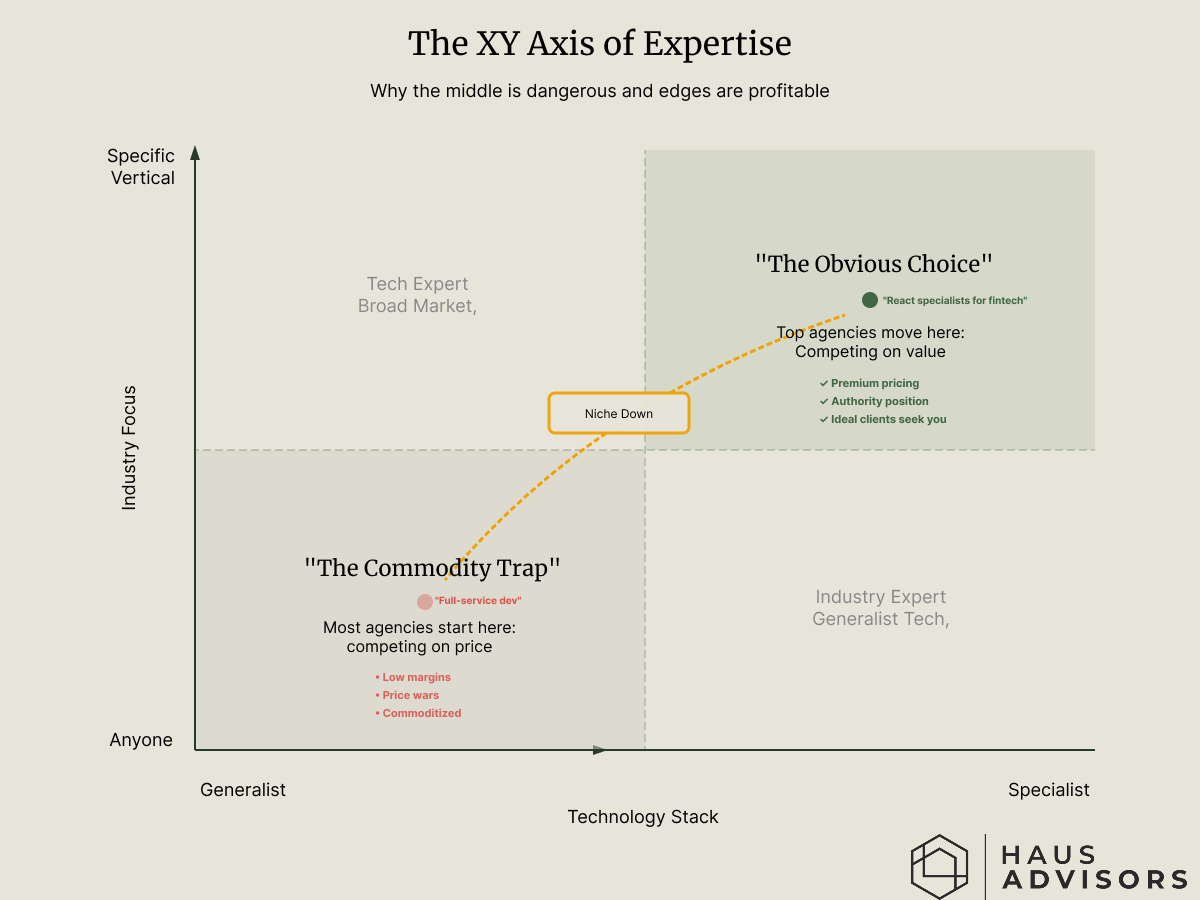
The positioning coordinates: At (0,0), 'We do code for everyone,' you're invisible. As you move along both axes toward specificity, your relevance score to the right buyer approaches 100. Generalists compete on price. Specialists compete on value. The decision to move along these axes is what Positioning is.
In practice, the exclusion expands rather than contracts your market. A "full-service development agency" is relevant to nobody in particular. An agency that "fixes onboarding conversion for growth-stage SaaS companies" is relevant to every VP of Product at a Series B company whose trial-to-paid rate is underperforming. The second positioning is narrower in scope but broader in reach, because it gives the right buyer a reason to pay attention.
Positioning is the foundation because every other component inherits its specificity. Vague positioning produces vague content, vague offerings, vague partnerships, and vague conversations. Sharp positioning produces sharp everything.
2. Offer: What You Sell
Once you know who you serve and what problem you own, you have to fix how people buy from you. Currently, buying agency services is an enormously high-friction experience.
The standard process looks like this: a lead comes in, you book a discovery call, you spend hours custom-scoping the project, and you send a proposal with a large number attached. Then silence. Not because the prospect wasn't interested, but because you asked a stranger to make a high-risk, ambiguous commitment in a single step. You asked them to cross a chasm of trust in one leap.
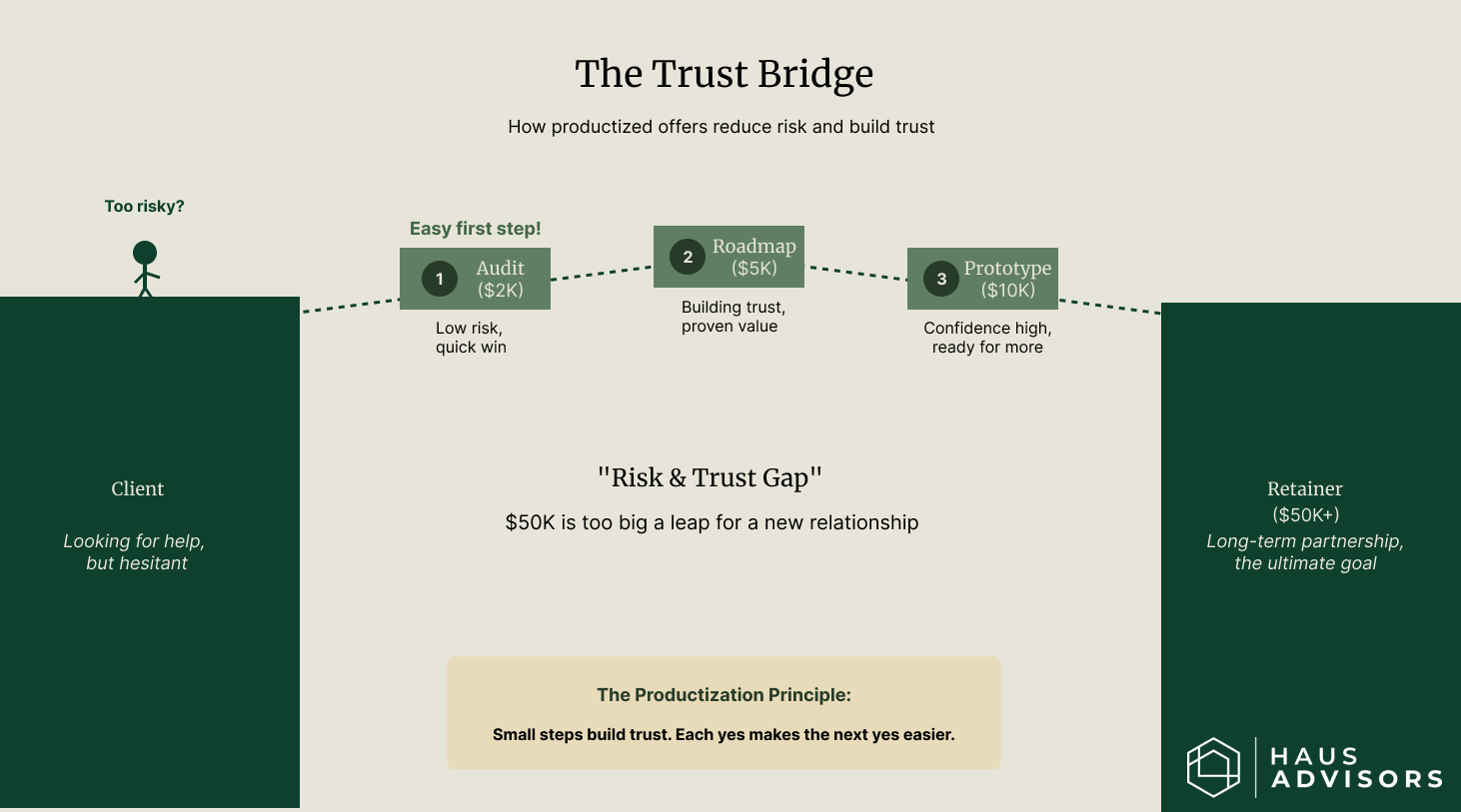
The first-yes problem: Large custom proposals ask prospects to leap across a trust chasm. Productized entry points build a bridge. Each step (Audit → Roadmap → Prototype → Engagement) is small enough that the next one feels natural. The prospect accumulates trust through experience rather than being asked to front-load it through faith.
Productized offerings solve this by creating defined entry points with clear scope, timeline, deliverables, and pricing. A Technical Architecture Audit. A Conversion Diagnostic Sprint. An MVP Scoping Session. Each one is small enough that the prospect can say yes without the risk of a large commitment, and each one demonstrates your expertise in a way that makes the larger engagement feel like a natural next step.
Productization also solves the Custom Scope Spiral that I've written about elsewhere: the cycle where custom proposals consume the founder's time, produce custom engagements that require founder oversight, and prevent standardization from ever taking hold. When the entry point is productized, the sales process is repeatable, the delivery is documented, and someone other than the founder can run it.
3. Proof: Why You
You claim to be the specialist. Now prove it.
Most technical founders recoil at "content marketing" because they imagine writing generic blog posts about best practices. That's not what publishing means in Relevance Engineering. Publishing means documentation: publicly demonstrating your diagnostic expertise by writing about the specific problems your positioning targets.
When your positioning is sharp, content becomes easy. You're not writing about "web development trends." You're writing about the specific patterns you see in SaaS onboarding conversion, the diagnostic frameworks you use to identify friction points, and the outcomes you've produced for companies with similar symptoms. This content serves as pre-built credibility: by the time a prospect reaches a sales conversation, they've already read your thinking and concluded that you understand their problem.
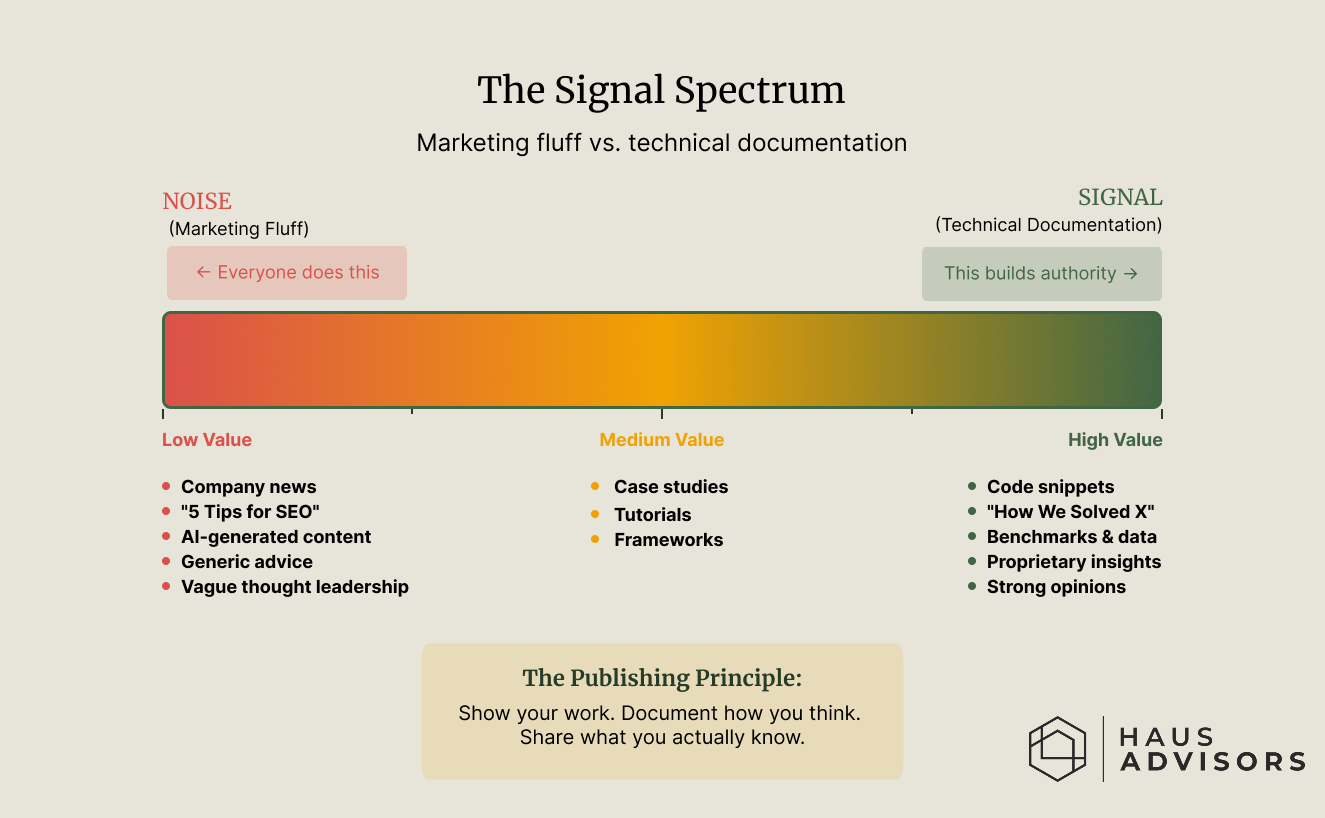
The content relevance spectrum: Most agency content sits on the left: generic material that attracts other developers but not buyers. Relevance Engineering moves publishing to the right: specific, evidence-based content that demonstrates diagnostic expertise to the exact buyer your positioning targets. Noise gets likes. Signal gets clients.
The key insight is that publishing in Relevance Engineering isn't about volume. It's about signal density. One deeply specific article about how you diagnosed and fixed a conversion bottleneck for a Series B SaaS company is worth more than fifty generic posts about React performance. The specific article attracts the specific buyer. The generic posts attract the wrong audience.
4. Demand: How Buyers Find You
If your market is who you're for, and your proof is what you know, demand is how you get found. For most agencies, the best source of demand is partners.
The default growth method for agencies under pressure is cold outreach: hundreds of emails to strangers, hoping for a fraction-of-a-percent reply rate. This is inefficient, demoralizing, and, for most technical founders, temperamentally unbearable.
Relevance Engineering replaces cold outreach with warm distribution. Your ideal clients are already buying from someone else: design agencies, strategy consultants, fractional CTOs, platform partners, investors. These people are nodes in your buyer's trust network. A single relationship with a node is worth a thousand cold emails, because the node can make specific, credible introductions to pre-qualified prospects who already trust the node's judgment.
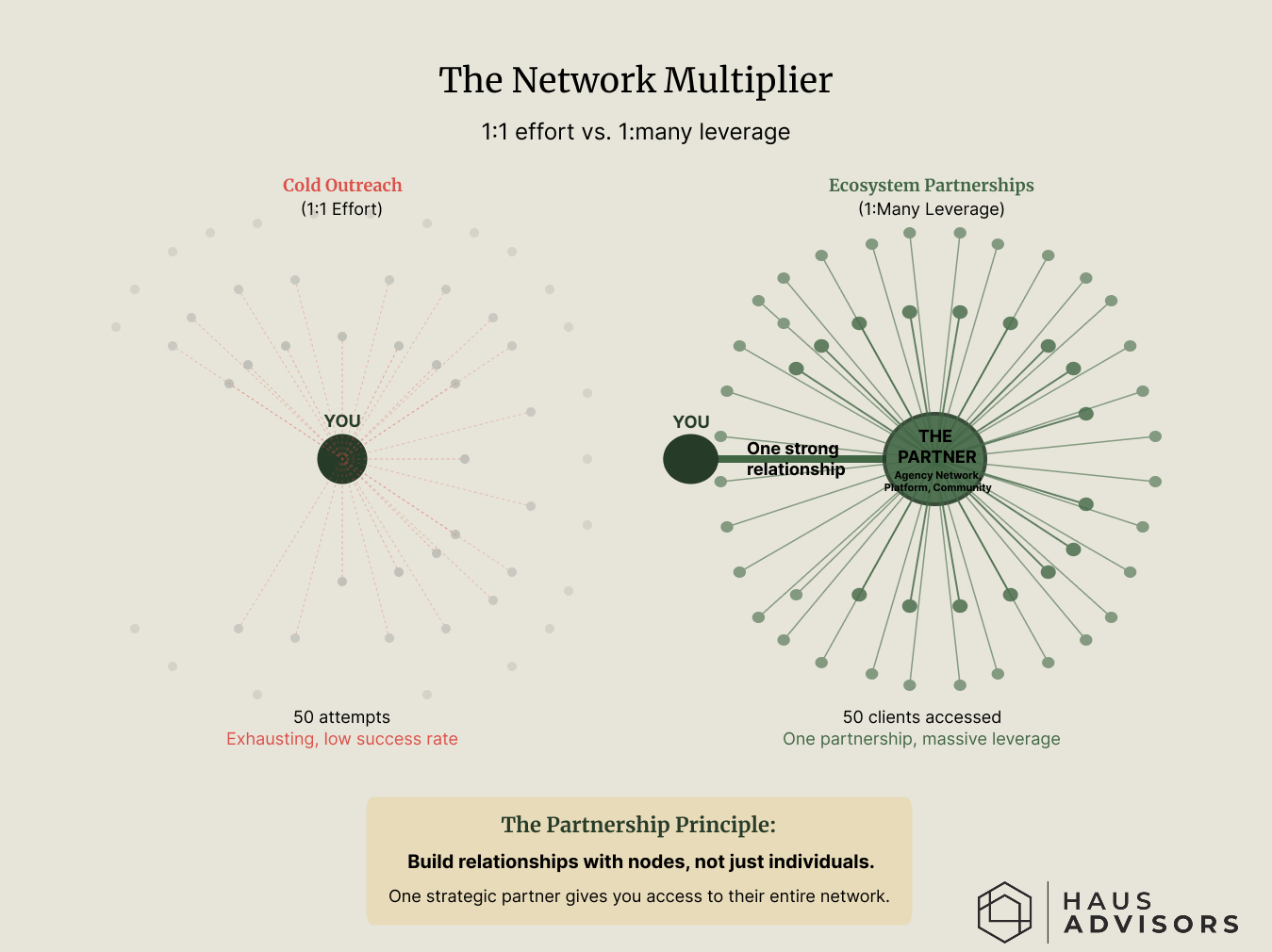
The distribution architecture: Cold outreach creates linear, one-to-one connections. Each new prospect requires new effort. Partnership leverage creates one-to-many connections through hub nodes that already own the trust of your ideal buyers. One partnership with the right node produces more qualified introductions than a year of cold email.
The critical distinction: partnerships in Relevance Engineering aren't generic referral arrangements. They're precision-matched collaborations with firms that serve your exact buyer. When your market is sharp and your offer is packaged, partners can make specific introductions: "You should talk to them about their SaaS Conversion Diagnostic" rather than "I know a good dev shop." The specificity of the introduction determines the quality of the conversation that follows.
5. Sales: How You Win the Deal
This is the pillar founders are proudest of, and it's the one that keeps them stuck. Deals close because you're in the room. You know which leads are real, what to ask on the first call, how to scope it, and what to charge.
None of that is wrong. It's just that none of it is written down. So a salesperson you hire has nothing to run, and every proposal waits for your evenings.
An engineered sales process is boring on purpose. Your team qualifies leads with rules you wrote down together, anyone can run the discovery call, pricing follows a logic instead of your gut, and follow-up happens on a schedule. You still take the big calls. You just stop being the only reason deals close.
6. Ownership: Who Runs It
Every pillar above can still run through you. Ownership is where that ends: a named person on your team runs each piece, every week, whether you're busy or not. This is the pillar where 90% of agencies fail.
The feast-or-famine cycle happens because founders treat growth as a project: something you start when pipeline is empty and stop when pipeline is full. You market when you're hungry, get busy, stop marketing, and then panic when the pipeline dries up ninety days later.
Relevance Engineering requires what I think of as a cron job mentality. You don't manually run server backups only when you remember. You automate them to run in the background, on schedule, regardless of what else is happening. The same discipline applies to growth: publishing continues when you're fully booked, partnership conversations continue when the pipeline is full, the system runs whether you need it right now or not.
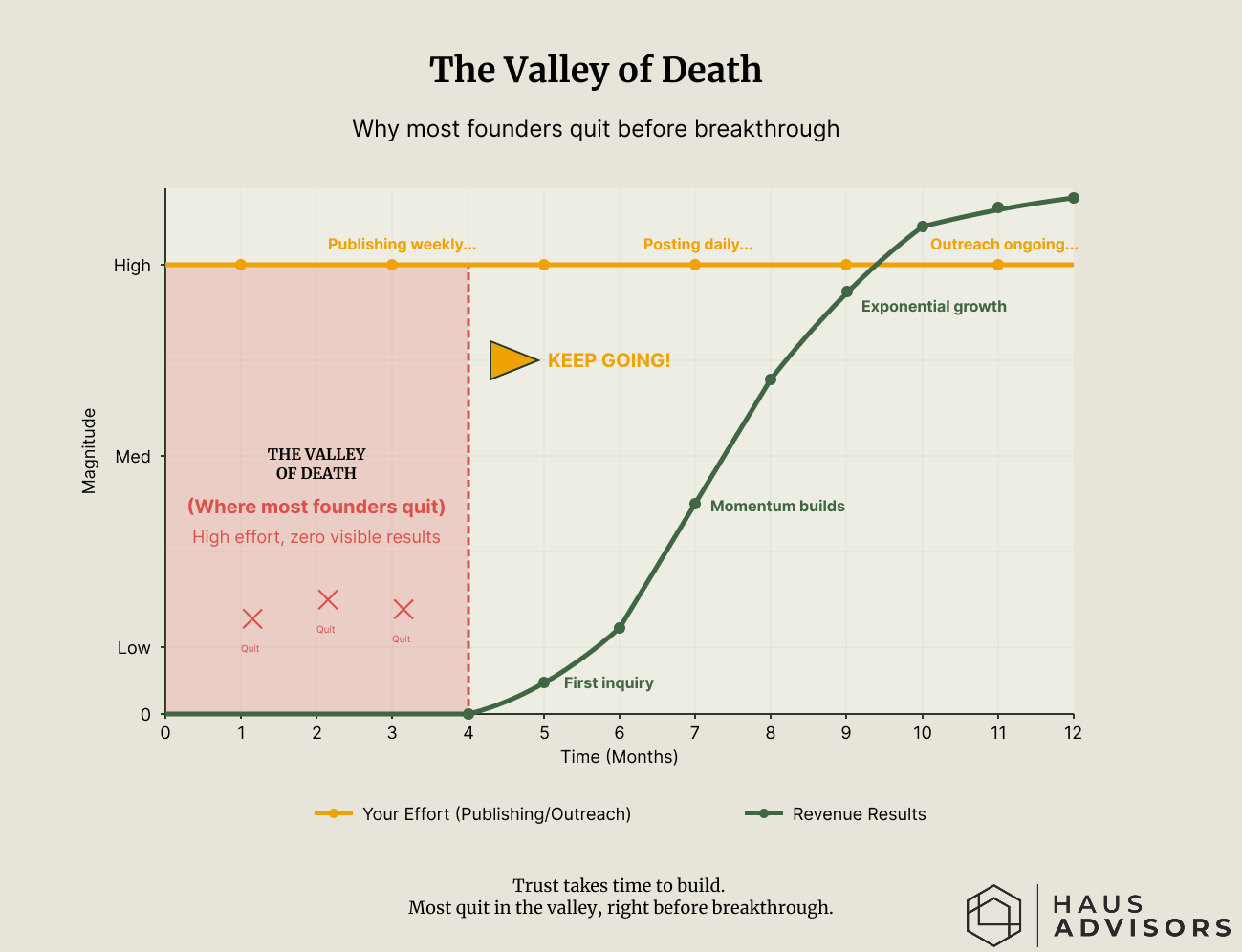
The compound curve. In the first 90 days, effort is high and results are invisible. This is the Valley of Death where most agencies quit, concluding that 'marketing doesn't work for agencies.' The agencies that persist through the valley discover that relevance compounds. The results aren't linear. They're exponential. But the exponential curve only activates if the input doesn't stop.
The results of Relevance Engineering are not linear. They're exponential. A case study published today is still generating credibility a year from now. A partnership cultivated this quarter is still producing introductions next year. Content, credibility, and partnerships compound over time, but only if the inputs persist through the early period where the returns are invisible.
This is the discipline most founders underestimate. Not because they lack work ethic, but because the Valley of Death looks identical to failure. You're doing the work and seeing no results. The rational response feels like stopping. The correct response is continuing. And the only thing that makes continuation possible is trusting the architecture of the system rather than evaluating each individual output.
How the System Works as a System
Each component is necessary. None is sufficient alone.
A sharp market without a packaged offer gives you a clear message and no easy way to buy. Proof without a clear market produces generic content that attracts the wrong audience. Partners without proof produce introductions that go nowhere. And all five without ownership give you a system that still stops when you get busy.
The system works because each pillar amplifies the others. A clear market makes your proof focused. Proof makes partners credible. Partners make your market visible. A packaged offer and a real sales process make the sale repeatable. And ownership keeps all of it running long enough to compound.
The sequence matters. Market comes first, then the offer, then proof and demand side by side, then sales, with ownership built in as you go. You can't publish well without knowing who you're writing for. You can't build partnerships without something specific for partners to recommend. And you can't package an offer without knowing what problem it solves. The system builds forward from the market decision.
The Honest Objection
Here's the strongest argument against Relevance Engineering: it takes time. The compound effects don't materialize for months. In the meantime, you still need revenue. A founder staring at an empty pipeline can't afford to spend three months building positioning, creating content, and cultivating partnerships while the bank account drains.
That's real. The architecture of Relevance Engineering is a medium-term investment, not an immediate fix.
Where That Logic Hits a Wall
But here's the boundary: the short-term alternatives don't produce lasting results either. The lead gen firm, the cold email campaign, the LinkedIn ads. These produce activity. They rarely produce revenue for agencies, because they push an undifferentiated signal into a market that doesn't know why it should care. You spend the money, the pipeline stays thin, and ninety days later you're in the same position minus the budget.
Relevance Engineering takes longer to produce results, but those results compound. The lead gen firm produces nothing after you stop paying. The case study you publish keeps working a year later. The partnership you build keeps producing introductions indefinitely. The productized offering you create keeps closing deals without the founder in the room.
The practical solution for the short-term pressure is to start with the fastest-compounding component: one partnership with a firm that serves your buyer. A well-matched partnership can produce warm introductions within weeks. That buys time for the positioning, content, and productization to mature. You don't have to choose between short-term revenue and long-term architecture. You start with the component that bridges the gap.
The Next Step
You don't need to fix all six at once. You need to find the one that's most broken and fix that first.
Start here: answer six questions honestly.
Can you explain in one sentence who you serve, what problem you solve, and why you're the best option? If not, start with Market.
Do you have at least one defined offering with clear scope, deliverables, and pricing? If not, start with Offer.
Is there published content that demonstrates your expertise in the specific problem your positioning targets? If not, start with Proof.
Do you have at least one strategic partnership producing warm introductions to your ideal buyer? If not, start with Demand.
Could someone other than you run a first sales call and send the proposal? If not, start with Sales.
If you disappeared for a month, would marketing, follow-up, and partner outreach keep happening? If not, start with Ownership.
Whichever question produced the clearest "no" is where you begin. The system builds forward from there.
The principle is simple:
There are agencies that treat growth as a personality trait, and there are agencies that treat growth as an engineering problem.
The first group waits for the phone to ring. The second group engineers relevance and the phone rings itself.
Relevance Engineering is why the New-Business Engine works on these six pillars. We find where your agency's relevance still lives with you, fix the weakest pillars with your team, and hand each one to someone who runs it. If you're a founder who has solved harder engineering problems than this one but hasn't applied that rigor to your own growth yet, a call is where we start. Book one here →
Keep reading
Browse by topic
- Positioning & Strategy
- Lead Gen & Marketing
- Sales & Biz Dev
- Pricing & Productization
- Research & Data
- Operations & Delivery
- Client Retention & Expansion
- Leadership & Culture
For founders whose agency has outgrown referrals.
One idea a week that makes a hard growth problem obvious, usually with a chart that shows you the mechanism behind it.
Built from conversations with seventy-plus agency founders on the Behind the Agency podcast.