Before You Write the Offer Letter: How to Design an Agency BD Comp Plan (Without Borrowing the SaaS Playbook)
Most agency founders design their BD comp plan by Googling "sales commission structures" and copying whatever a B2B software company uses. The result is a plan calibrated for a 30-day SaaS sales cycle applied to a 6-month technical agency retainer. Your hire either quits in six months or spends all their time chasing tiny, low-margin dev projects to hit a volume metric. At Haus, we've watched founders burn through multiple BD hires before realizing the comp plan itself was the structural mismatch, forcing them back into the bottleneck of being the agency's primary salesperson.
Business development compensation plans for agencies aren't a variation on the SaaS model. They're a different category of problem entirely.
The comp plan shapes behavior. If the plan rewards volume, you'll get a hire chasing volume. If it pays commission on gross revenue without regard to deal size or margin, you'll get a hire dragging in small, low-margin engagements that keep the lights on but destroy the business model. The damage isn't always obvious in month three. It shows up in month nine, when you've paid a full year's salary plus commission and your average deal size is smaller than it was before you hired anyone.
Getting business development compensation plans right requires understanding the economics of your specific agency before you write a single number into an offer letter.
Why Agency BD Comp Is Different From Sales Comp
The "10-15% commission on closed revenue" rule comes from transactional, high-volume SaaS sales. It works in that context because the average sales cycle is short, the deal size is predictable, and the number of deals closed per quarter is high enough to make the math work. None of those conditions hold for most independent agencies.
A $150K annual retainer with a 90-day close requires completely different math. If your BD hire closes three of those in a year, the 10% commission model means paying $45K in commission on top of base salary. The math can work. But only if you know your margins, your average retainer value, and how long it actually takes your kind of agency to close its kind of deal.
Agency business development is also structurally relationship-driven in a way that transactional SaaS sales isn't. The best BD outcomes for agencies come from referrals, thought leadership content, conference visibility, and word of mouth inside a defined ICP. Not from outbound calling lists and sequence cadences. A comp plan that rewards "activities" the way a SaaS SDR role does will push a BD hire toward the wrong behaviors.
The third difference is pipeline infrastructure. Most SaaS sales roles drop the hire into an existing CRM, a defined lead source, a trained qualification process, and a playbook. Most agency founders hiring their first BD person have none of that. They have a Rolodex and a reputation. The BD hire isn't just closing deals. They're building the pipeline system at the same time. That changes the ramp curve, and the ramp curve changes the comp structure.
A plan calibrated to agency gross income (AGI) per client and minimum engagement level protects margins. A plan that rewards number of clients attracts the wrong deals. These aren't philosophical preferences. They're the difference between a BD hire that strengthens the business and one that distorts it.
The Three Numbers You Need Before You Design the Plan
If you can't answer these three questions, you're not ready to write a comp plan. You're ready to do pipeline analysis first.
Average Retainer Value (ARV)
What does a typical client generate in annual gross income? Pull your last three to five clients and calculate the average. This number anchors your minimum deal size, which in turn anchors every commission calculation in the plan.
If your ARV is $120K and your minimum engagement is $8K/month, a BD hire who closes two clients at $5K/month hasn't hit quota even if total new revenue looks acceptable. The floor protects your model. ARV is how you set the floor. If you don't know this number, you're designing the plan in the dark.
Time to Close
First conversation to signed agreement, how many days? I've worked with agency founders who have never measured this. They describe their sales process as "relationship-driven" and "case-by-case," which usually means they haven't tracked it.
This number determines how long before your BD hire earns any commission, which determines how much base salary buffer you need to structure into the offer. A 120-day sales cycle means the first commission check doesn't arrive until month four or five at the earliest. If base salary is too low, the hire is financially stressed before they've closed a single deal. That stress drives bad behavior. It pushes them toward faster but smaller engagements.
Your Own Close Rate
Of qualified prospects in the last 12 months, what percentage became clients? This is the hardest number for most founders to produce because most founders haven't defined "qualified prospect" formally enough to track the funnel.
A new BD hire will close at 20-30% below your rate, at least in the first six months. They don't have your relationships, your credibility, or your institutional knowledge of the ICP. Factor in a ramp curve or you'll misread early underperformance as permanent underperformance and make a premature firing decision.
If you can't answer all three, the marketing agency sales process work comes first.
Choosing the Right Compensation Structure
The structure that works depends on your agency's sales cycle, deal size, pipeline maturity, and what you actually need the BD hire to do. Here are three structures with explicit math, and the conditions under which each one fits.
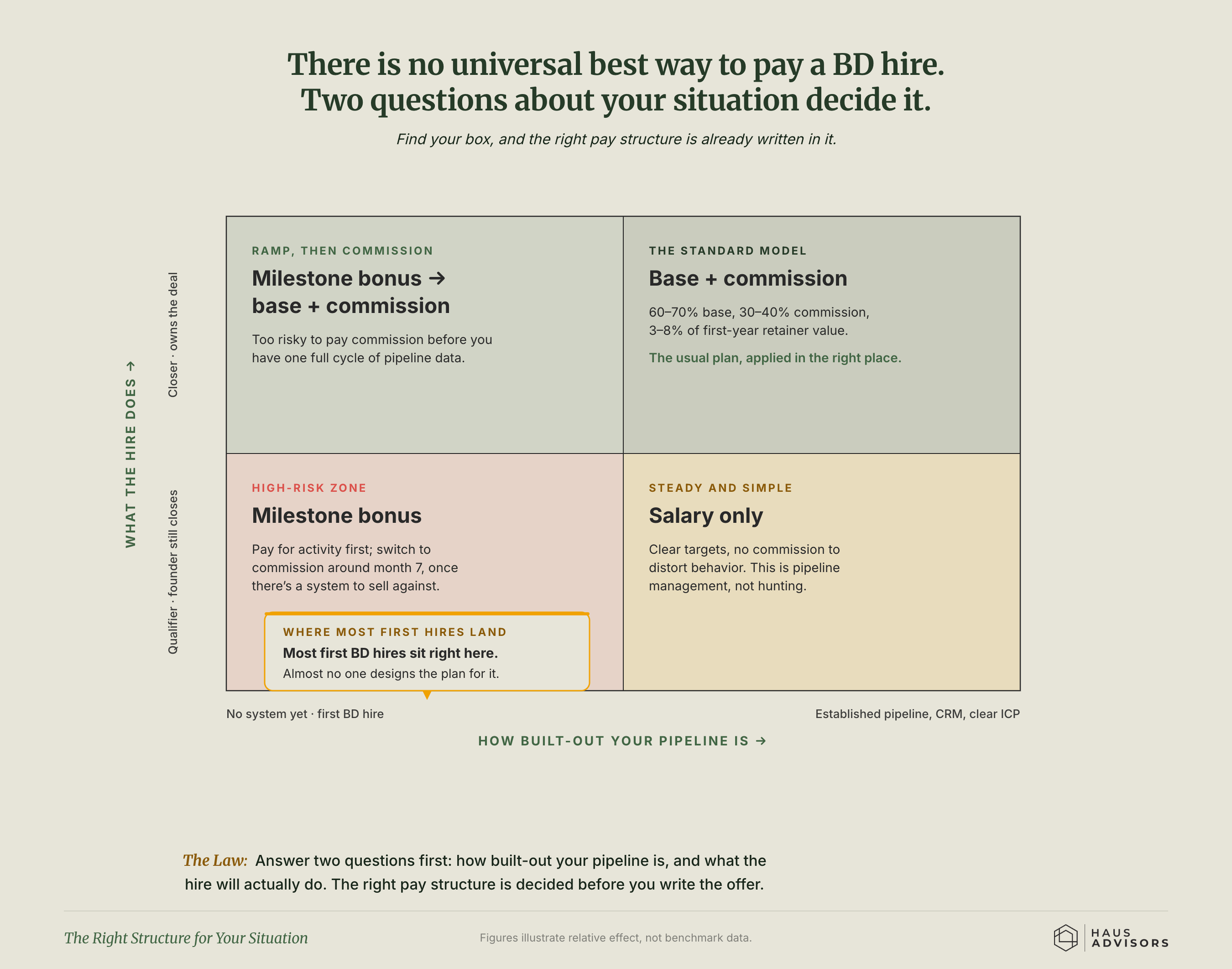
Most founders design their BD comp plan as if they're in the top-right quadrant: established pipeline, hire who closes. Most are actually in the bottom-left: no pipeline infrastructure, a hire who needs to build the system while learning the market. Base plus commission applied to that situation produces a financially stressed hire with nothing to close and a quota designed for a different situation entirely. Find your quadrant before you write the offer letter. The structure follows from there.
Base + Commission (Most Common)
Base salary covers 60-70% of expected on-target earnings (OTE). Commission is the performance kicker, not survival income. That distinction matters. If a BD hire can't cover rent on base, they won't behave like a strategic business developer. They'll behave like someone who needs to close whatever's in front of them.
Commission rates for agency retainers typically land between 3-8% of first-year retainer value, paid at signing or first invoice, not spread across the engagement life. Include a claw-back clause if a client churns under 90 days. Without it, you'll pay commission on clients who were never a real fit.
Software dev or data agency example (long-cycle retainers):
A $2M agency with an average retainer of $180K ARR sets a goal of three new clients per year. That's $540K in new ARR. At 5% commission on first-year retainer value, the hire earns $27K in commission on top of a $75-85K base. Total OTE lands around $105-110K.
The sales cycle is four to five months, which means year one is slow. Budget base salary for nine to twelve months before the first commission check arrives. Don't impose a monthly quota in the first six months. Use activity milestones instead: meetings set, proposals issued, qualified pipeline value. These are leading indicators the hire can actually control during ramp.
Performance marketing shop example (performance-kicker model):
Shorter sales cycles (60-90 days) and smaller average retainers ($6K-$12K/month) support a different structure. Base plus tiered kicker: standard 5% on signed retainers at or above minimum engagement level, plus a 2-3% kicker if the client hits a defined ROAS or CAC improvement threshold in months three through six.
This structure ties BD comp to client quality and retention, not just volume closed. It's a meaningful signal to the BD hire about what kind of client the agency wants. The risk: it requires a defined measurement framework before implementing. Don't offer the performance kicker if the agency doesn't have consistent attribution data. You'll end up in an argument about whether the threshold was hit.
Salary-Only (For Relationship-Building Roles)
Appropriate when the BD role is more "connector and qualifier" than "closer." This most often applies when the founder or a senior partner still closes deals and the BD hire is doing pipeline development, relationship warm-up, and qualification.
Salary-only removes incentive distortion. There's no temptation to rush a prospect, oversell scope, or accept a bad-fit deal to hit a commission threshold. It works best when you've got strong inbound reputation and BD is more pipeline management than hunting.
The accountability mechanism has to be explicit. Without a financial stake in outcomes, you need clear KPIs: meetings set per month, proposals issued, qualified pipeline value at each stage, and conversion from qualified to proposal. The metrics replace the financial incentive.
Milestone Bonus (For First BD Hires)
The right structure for a founder-run agency with no pipeline infrastructure. Base salary plus quarterly bonuses tied to activity milestones, then a switch to revenue-based commission after six months once the pipeline system is built.
This protects the hire during ramp-up and protects the founder from paying commission on deals that take nine months to close when the hire's been on board for three. The milestone structure acknowledges the reality: the first six months is partly system-building, not just selling. Paying someone to build a system and then measuring them only on output from that system before it's built is how you lose good people early.
Setting a Quota That Reflects Agency Reality
Express quota as new ARR from clients at or above minimum engagement level. Not total number of new clients. A client count quota incentivizes small-deal chasing. You want the BD hire focused on clients who move the model forward, not clients who fill calendar slots.
Blair Enns and the Win Without Pitching framework offer a useful benchmark: a firm targeting eight to twelve ideal clients should set new business goals around replacing two to four clients per year at or above average AGI per client. That's a constraint-aware model. It accounts for churn, not just new acquisition.
First-year quota should be ramp-discounted. 50% of full quota in months one through six, full quota in months seven through twelve. A hire who doesn't hit ramp-adjusted quota by month nine is a warning sign worth a conversation. Month nine under quota is a conversation, not a termination. The data point matters, but so does understanding why.
Tie quota to minimum deal size explicitly. Six $20K projects doesn't equal quota even if total revenue matches three $40K clients. The floor protects margins and keeps the BD hire aligned with the agency pricing models and minimum engagement thresholds the business actually needs to be profitable. Review quota annually as pipeline data accumulates.
Common Mistakes to Avoid
Copying a SaaS commission structure. This is the root cause of most BD comp failures at agencies. The model doesn't transfer. SaaS deals close in 30 days. Agency retainers close in 90 to 180. SaaS reps handle 50+ deals per quarter. A BD hire at a mid-size agency might close three to five quality engagements per year. The borrowed framework punishes your hire for working in a slower category and pushes them toward wrong behaviors to compensate.
Setting quota before you have baseline data. That's guessing with formal paperwork. You need close rate, ARV, and time to close before any quota number is defensible. Without that data, you'll either set a quota so low it's irrelevant or so high it demoralizes the hire in month four.
Paying commission on gross revenue instead of gross income. This is how BD comp plans quietly destroy margins. A hire closes a $120K project with $60K in contractor costs. You pay 5% on $120K. The actual contribution to the business is $60K. The commission rate on gross income should be different from the rate on gross revenue. Most SaaS-borrowed templates don't make this distinction because SaaS gross margins are 70-90%. Agency margins are often 40-60%, sometimes lower, and it matters enormously.
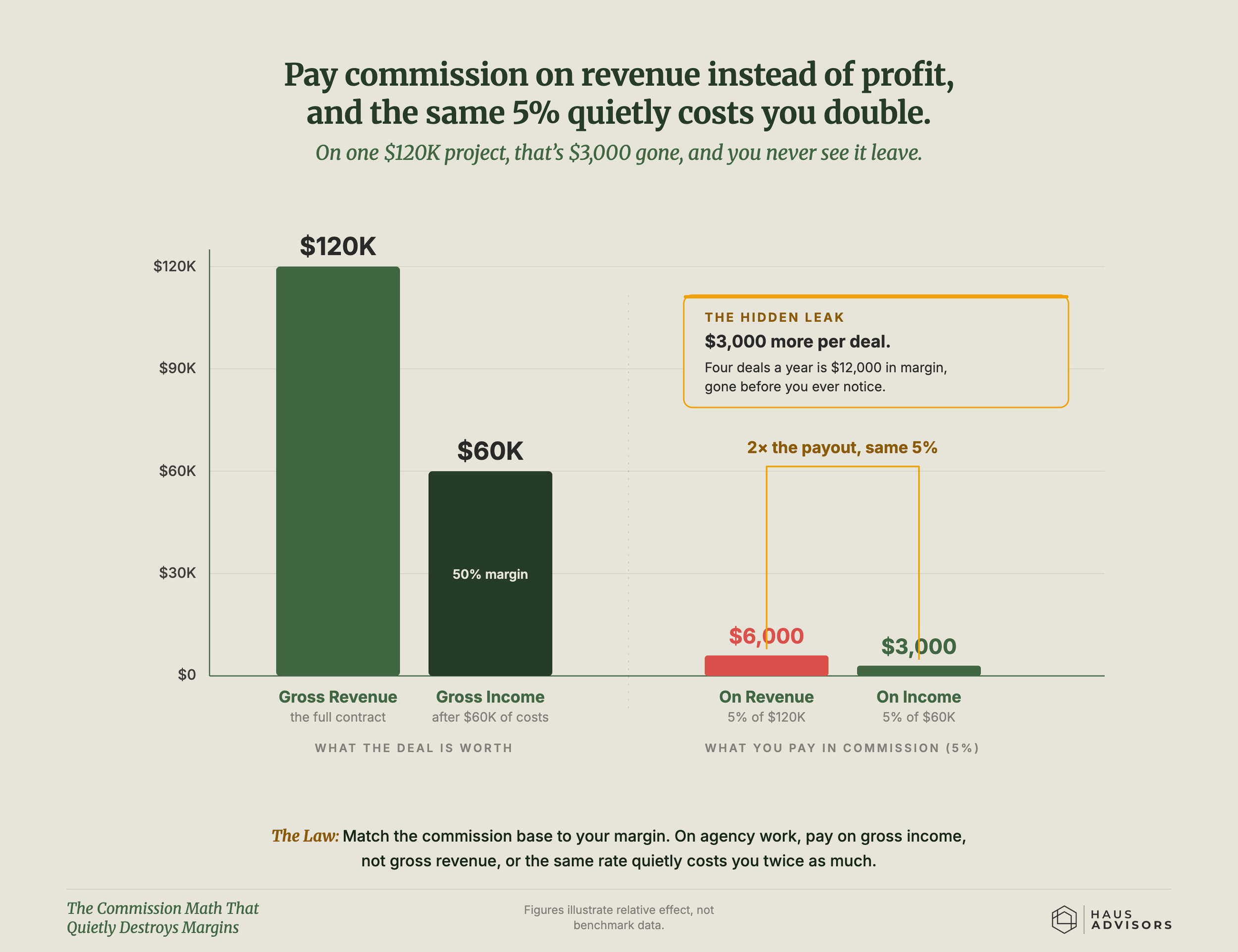
SaaS commission templates assume 70-90% gross margins. Agency work runs 40-60%. When you apply the same commission rate to the full contract value, you're paying 2x what the economics of your business support. On a $120K project with $60K in contractor costs, that's $3,000 per deal in silent margin overpayment. Four deals a year and you've quietly given back $12,000 in margin through a template that was never designed for your business model. Tie commission to gross income. Adjust the rate if needed. The hire earns on the value they actually create, and your P&L reflects what the business actually earned.
No claw-back provision. If a client churns in month two, you paid commission on a relationship that didn't hold. A 90-day claw-back clause is standard practice and protects you from incentivizing the wrong kind of close.
Making base salary too low. Low base attracts hunters. Hunters close deals, sometimes the wrong ones. A BD hire who's financially stressed in month three will make concessions, accept bad-fit clients, and oversell scope to get signatures. The comp plan is supposed to align incentives, not create survival pressure that distorts judgment.
Skipping the ramp curve. A new BD hire at full quota from day one will underperform against that quota for six months regardless of their skill level. They don't have your network, your institutional knowledge, or your track record with prospects. If you fire them at month six for not hitting quota, you've lost the ramp investment and learned nothing. Build the curve in before the offer is made.
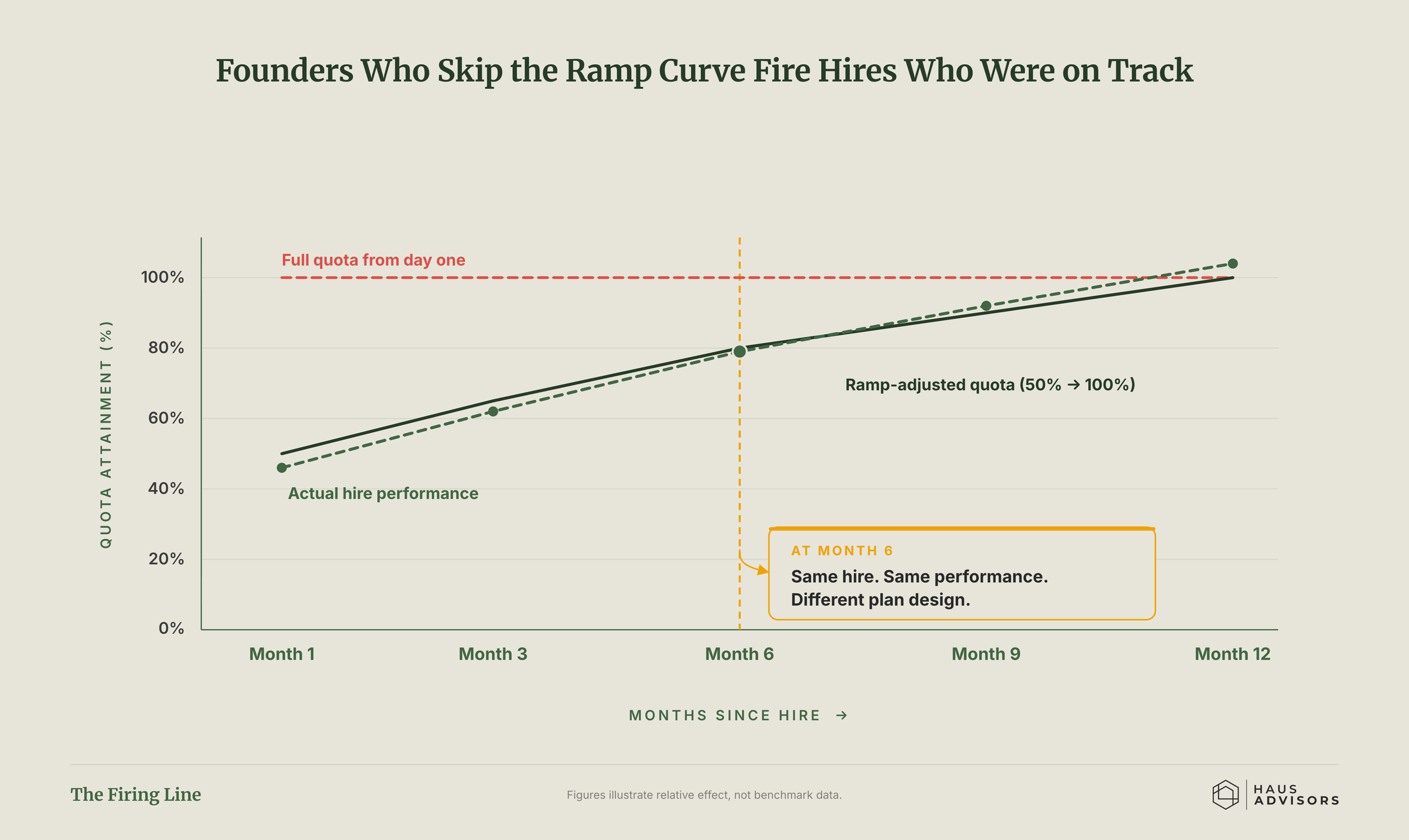
The founder who fires their BD hire at month six almost always fires a hire who was on track. They just didn't know it because the plan had no ramp curve to measure against. Full quota from day one is a number, not a plan. A hire who closes their first deal at month five on a full-quota plan looks like they're failing. That same hire on a ramp-adjusted plan is exactly where they should be. The plan design is what failed, not the hire.
How Haus Advisors Approaches BD Compensation Design
Most founders reading this already know the real problem. It isn't the commission rate. It's that the pipeline the hire is supposed to inherit, along with the relationships, the reputation, and the judgment about who's a fit, still lives in your head. So the business only grows when you're in the room, and the hire ends up selling a system that doesn't exist yet.
That's the work we do at Haus Advisors. The New-Business Engine is six months of implementation, not a strategy document. We pull what makes your agency relevant out of your head, build it into positioning, offers, and growth plays your team can run, and hand ownership to them. If you want an agency that grows without needing you in every deal, book a call to see if it's a fit.
Next Steps
Gather the three baseline numbers before writing anything. ARV, time to close, and close rate. If you don't have clean data, do the pipeline analysis first. The comp plan can wait.
Set the minimum engagement level. This is the floor. Every quota metric and commission calculation anchors to it. Without a defined minimum, you'll get deals that technically count but don't move the model.
Draft the comp structure that matches your situation. Base plus commission fits most established agencies with defined pipeline. Milestone bonus is right for first hires at founder-run shops without infrastructure. Salary-only works when the founder is still closing and BD is support work.
Model the math before making the offer. Run three scenarios: your BD hire closes two clients in year one, three clients, and four clients. Is your margin positive in all three? The two-client scenario is the floor, and it should be survivable. If it isn't, the offer structure needs to change before you extend it.
If you're not confident in the numbers, do the diagnostic work before making the hire. A comp plan built on guesses about your own pipeline is evidence of the same problem the hire was supposed to solve.
The hire isn't the fix. The system is the fix. The hire is how you scale it.
Keep reading
Browse by topic
- Positioning & Strategy
- Lead Gen & Marketing
- Sales & Biz Dev
- Pricing & Productization
- Research & Data
- Operations & Delivery
- Client Retention & Expansion
- Leadership & Culture
For founders whose agency has outgrown referrals.
One idea a week that makes a hard growth problem obvious, usually with a chart that shows you the mechanism behind it.
Built from conversations with seventy-plus agency founders on the Behind the Agency podcast.