You're Losing Deals Because You're Answering the Wrong "Why Us" Question
I sat in on a pitch call a few months ago with an agency founder who had prepared thoroughly. He had a polished deck. He'd rehearsed his differentiators. When the prospect asked "So, why should we go with you guys?" he launched into a confident answer about his tech stack, his Agile methodology, his team's experience with scalable architecture.
It was a solid answer to a question the prospect wasn't actually asking.
The prospect was a VP of Product at a Series B SaaS company whose onboarding flow was hemorrhaging trial users. She didn't need to hear about React and AWS. She needed to hear that this agency had seen her exact problem before, understood why it was happening, and had a specific approach to fixing it. She needed to feel understood, not impressed.
The founder lost the deal to a smaller shop with less experience but a sharper narrative. The winning agency's entire pitch was: "We've fixed onboarding conversion for six SaaS companies at your stage. Here's what we found was causing the drop-off in three of them, and here's the process we used to fix it."
That wasn't a better tech stack. It was a better answer to the real question.
The Pattern Has a Name
I call it The Wrong Question Trap: the habit of preparing your "Why Us" narrative around what makes you different when the prospect is actually evaluating whether you understand their problem better than the other options on the table.
These sound like the same question. They're not.
"What makes you different?" invites a comparison. Your tech stack vs. theirs. Your methodology vs. theirs. Your years of experience vs. theirs. This is a game you can't win, because every competitor has a version of the same answer: experienced team, proven process, quality code. The prospect hears four pitches that all sound substantively identical, and the only remaining differentiator is price.
"Do you understand my problem?" invites a demonstration. It asks you to show that you've seen this situation before, that you know what causes it, that you have a specific approach to solving it, and that you can describe the likely outcomes with credibility. This is a game you can win, because most of your competitors aren't playing it. They're too busy listing their capabilities to demonstrate their comprehension.
The Wrong Question Trap is particularly sticky because founders feel prepared. They've thought about their differentiators. They've polished their pitch. They walk into the room with confidence. But the preparation was aimed at the wrong target, so the confidence lands on the wrong message. The prospect leaves thinking "they seem competent" rather than "they understand exactly what I'm dealing with." Competence doesn't close deals. Comprehension does.
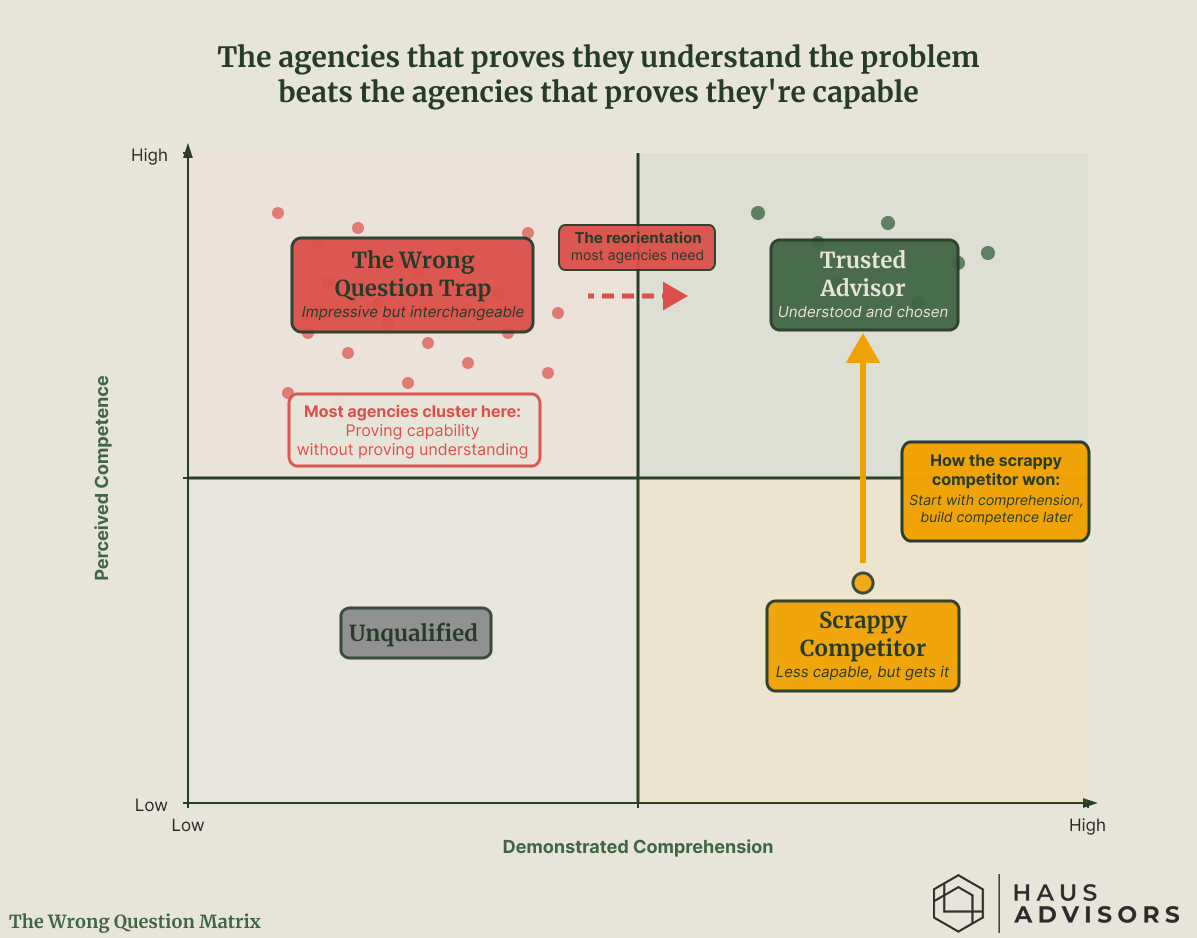
The agency that lost the deal in the opening story was in the upper left. The one that won was in the lower right. Comprehension is a shorter path to trust than competence.
Why You Prepared for the Wrong Question
Because every piece of positioning advice tells you to start with differentiation. Find your unique value proposition. Identify what sets you apart. Articulate your competitive advantage.
That advice isn't wrong in the abstract. But for agencies, it produces a predictable failure mode: founders look at their capabilities, compare them to competitors, and try to find the gap. The gap is almost never in the technical work. It's almost never in the process. It's almost never in the team's experience level. Development agencies are, at the capability layer, remarkably similar to each other.
The 'why us' narrative only lands if you've already done the harder work of figuring out how to position your agency in the market. Differentiation is the output. Positioning is the input.
So the founder reaches for weak differentiators: "We're more reliable." "We communicate better." "We follow best practices." "We treat our clients like partners." These are claims every competitor makes. They carry zero signal. The prospect has heard all of them before, and they've been burned by agencies that said exactly the same things.
The result is a "Why Us" narrative that is technically accurate and strategically useless. It describes what you do without demonstrating that you understand the person sitting across the table.
What the Wrong Question Trap Actually Costs You
Deals lost to less capable competitors. This is the most frustrating outcome, because you know you would have delivered better work. But the prospect chose the agency that demonstrated deeper comprehension of their problem, even if that agency's actual capabilities were thinner. Understanding wins over credentials in high-stakes purchases because understanding reduces the buyer's perceived risk. They're not buying code. They're buying confidence that you'll solve the right problem.
Price-first conversations you can't escape. When your narrative sounds like every other agency's, the prospect has no basis for evaluating you except cost. The conversation collapses to hourly rates and project estimates before you've had a chance to demonstrate the value of your approach. This isn't because the prospect is price-sensitive. It's because your narrative gave them nothing else to evaluate.
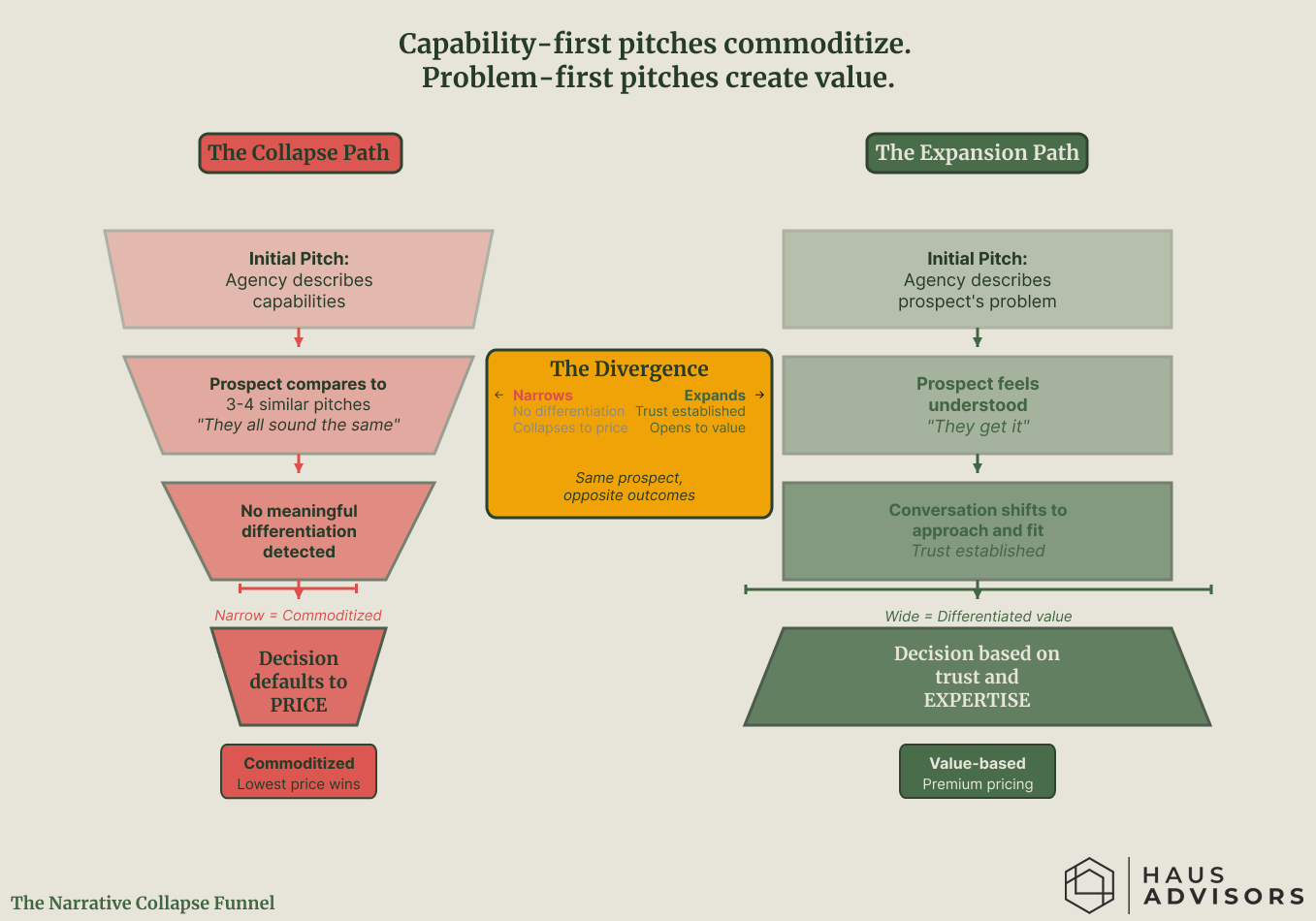
When your narrative sounds like everyone else's, the prospect has no choice but to evaluate on price. Comprehension keeps the conversation in the value lane.
A pitch that works on developers but fails on buyers. Technical founders build "Why Us" narratives that impress other technical people: clean architecture, modern frameworks, scalable infrastructure. But the person making the buying decision is usually a CEO, VP of Product, or CTO who evaluates agencies on business impact, not technical elegance. Your narrative is optimized for an audience that doesn't hold the budget.
These aren't sales skill failures. They're narrative architecture failures. The pitch was built around the wrong question.
Differentiation vs. Comprehension
This is the part most people miss.
A differentiation narrative says: "Here's what makes us different from other agencies." It's inward-facing. It starts with your capabilities and tries to find the angle that separates you from the field.
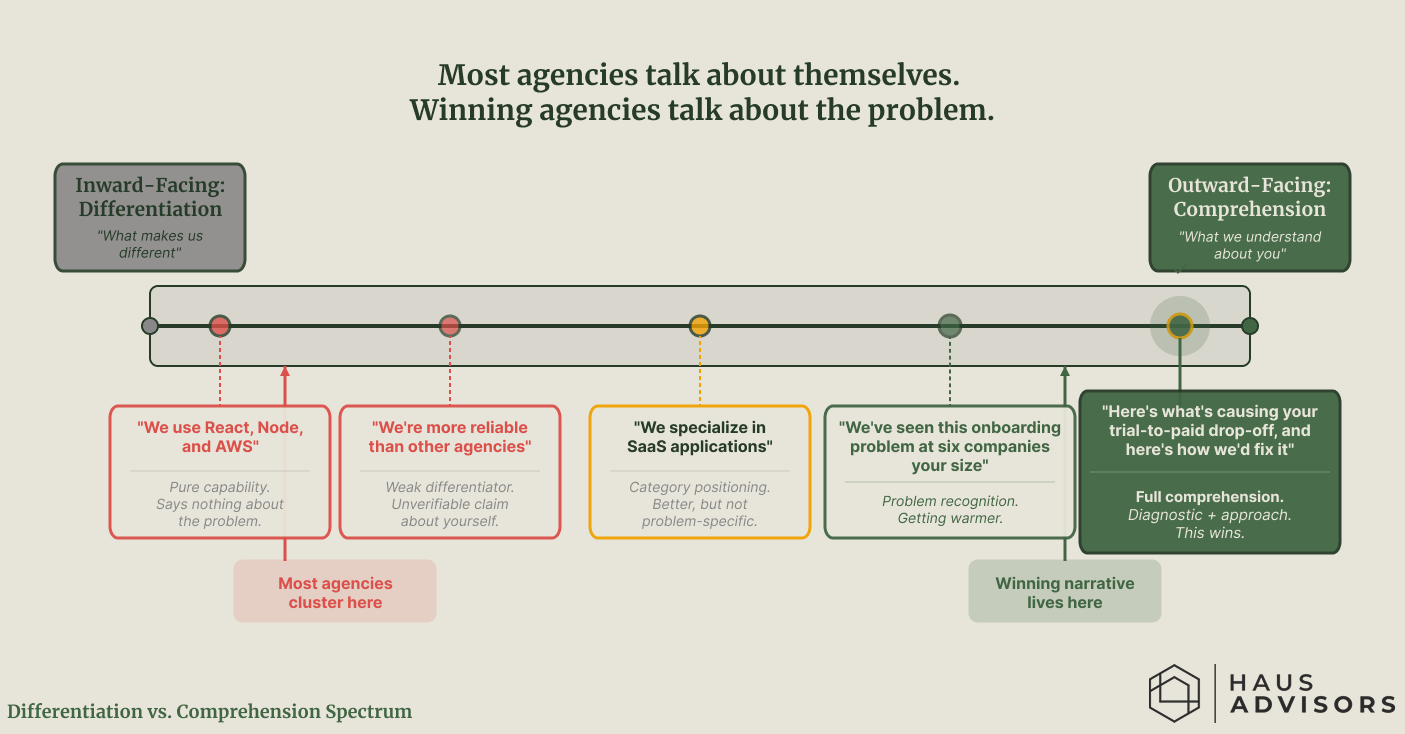
Most agency pitches live on the left side of this spectrum. The deals close on the right.
A comprehension narrative says: "Here's what we understand about your specific situation that others probably don't." It's outward-facing. It starts with the prospect's problem and demonstrates that you've seen it before, you know what causes it, and you have a specific approach to fixing it.
Differentiation is a comparison exercise. Comprehension is a trust-building exercise. And trust is what closes high-stakes deals.
A strong comprehension narrative has four components:
A specific buyer with a specific problem. Not "businesses that need development work." A VP of Product at a growth-stage SaaS company whose onboarding flow is killing trial-to-paid conversion. A CTO at a fintech startup whose API can't handle the transaction volume they're scaling toward. A Director of E-commerce whose checkout page is losing $50K per month in abandoned carts. The more precisely you can describe the person and their pain, the more that person feels understood when they hear it.
Problem ownership, not service description. The shift is from "we build custom software" to "we fix the specific problem that's costing you money." Owning a problem means you can describe its causes, its downstream effects, and the typical patterns you see in companies at this stage. It means the prospect hears you and thinks "they've been in this room before," rather than "they seem like they could probably figure it out."
An approach that connects to business outcomes. Your methodology matters, but only insofar as it produces results the buyer cares about. "We follow Agile best practices" is a process description. "Our diagnostic process identifies the three highest-impact conversion blockers in your onboarding flow within the first two weeks, so we're fixing the right problems before writing any code" connects process to outcome. The prospect doesn't need to understand your architecture. They need to understand how your approach produces better results for their business.
Proof that's measured in business impact, not technical complexity. "We built a microservices architecture with 99.99% uptime" is an engineering metric. "We helped 23 SaaS companies increase trial-to-paid conversion by an average of 34%, adding $2.1M in annual recurring revenue" is a business metric. The second number makes the prospect lean forward. The first makes them nod politely and ask about your rate.
Building the Narrative from Evidence, Not Aspiration
The strongest "Why Us" narratives don't come from brainstorming sessions. They come from reverse-engineering your best work.
Start with your top five engagements. The ones where the work was excellent, the client was thrilled, the margins were strong, and you'd take ten more just like them. Write down what those clients had in common: industry, company stage, the specific problem that triggered the engagement, the buyer who made the decision.
Identify the business problem you actually solved. Not the technical deliverable. The business pain that made them pick up the phone. You weren't hired to build an app. You were hired to fix a revenue leak, or eliminate an operational bottleneck, or de-risk a technical migration before a funding round. That business problem, stated in the client's language, is the foundation of your narrative.
Quantify the impact in terms the buyer cares about. Revenue recovered. Costs reduced. Time saved. Conversion rates improved. Churn decreased. These are the numbers that make your narrative credible and your pricing defensible. If you don't have exact numbers, estimate conservatively and note the range. Even approximate business impact is infinitely more persuasive than precise technical metrics.
Test with the "tell me more" response. A strong comprehension narrative should make prospects say "tell me more about how you do that," not "what's your hourly rate?" If the conversation moves to price before the prospect has asked about your approach, the narrative needs work. The goal is to create enough curiosity about your understanding of their problem that they want to explore fit before they evaluate cost.
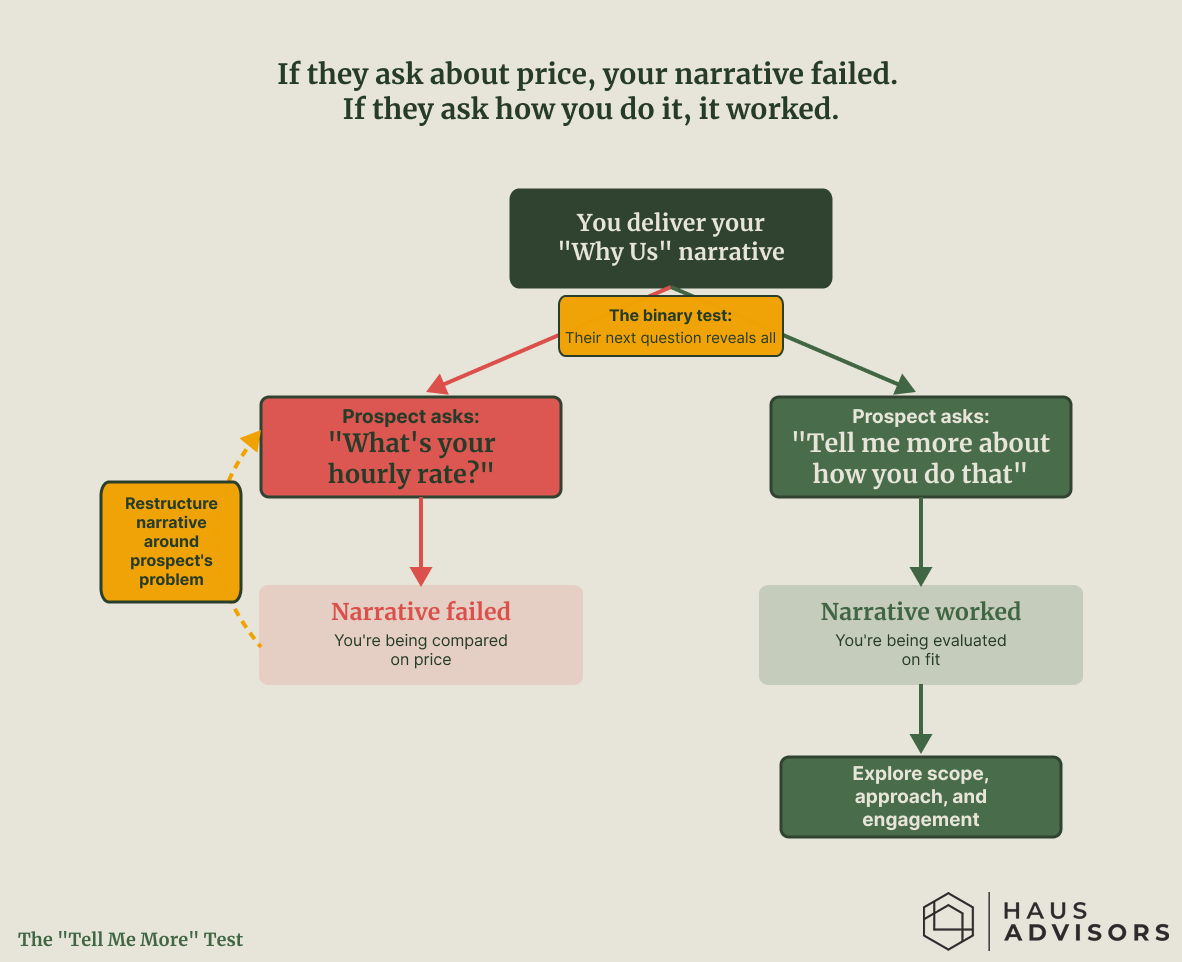
Your prospect's first response after your pitch tells you which question you answered. If it's about price, you answered the wrong one.
The Honest Objection
Here's the strongest argument against narrowing your narrative to a specific problem and buyer: you'll alienate prospects who have different problems. If your pitch is about SaaS onboarding conversion, the fintech CTO with an API scaling challenge tunes out. You're trading broad appeal for narrow resonance, and broad appeal keeps more doors open.
That's the math that keeps most agencies generic. And it's not entirely wrong. A narrow narrative does close some doors.
Where That Logic Hits a Wall
But here's the boundary: a broad narrative doesn't keep doors open. It keeps them ajar. The prospect hears "we build custom software" and doesn't slam the door. They also don't walk through it. They add you to a comparison spreadsheet alongside four other agencies who said the same thing, and the cheapest option wins.
A narrow narrative closes some doors firmly and opens the right doors completely. The SaaS VP who hears "we've fixed this exact problem for six companies at your stage" doesn't put you on a spreadsheet. She asks for a call. One enthusiastic "yes" from a perfect-fit buyer is worth more than ten lukewarm "maybes" from prospects who can't distinguish you from cheaper alternatives.
The agencies I've watched break through the pricing ceiling didn't do it by broadening their message. They did it by narrowing it until the right prospects felt like the agency was built specifically for them. That feeling is what justifies premium pricing. And it's impossible to create with a narrative that tries to resonate with everyone.
The Next Step
You don't need to rebuild your entire sales pitch this week. You need to test whether your current narrative is answering the right question.
Start here: think about the last three prospects who asked "why should we choose you?" or some version of it. Recall what you said. Then ask yourself honestly: did your answer describe what makes you different, or did it demonstrate that you understand their specific problem better than anyone else in the room?
If it was the first, you have the building blocks for a strong narrative. They just need to be restructured around the prospect's problem rather than your capabilities. Pull up your best five client engagements, identify the business problem you solved, quantify the impact, and rebuild the answer around comprehension rather than comparison.
The shift isn't dramatic. It's a reorientation. Same expertise, same track record, same capabilities. Different question being answered.
The principle is simple:
There are agencies that answer "why are you different?" and there are agencies that answer "do you understand my problem?"
The first answer invites comparison. The second builds trust.
Most founders reading this already know the real problem. It isn't the narrative. A comprehension narrative built from your best wins is your judgment written down, and right now that judgment, with the reputation and the relationships that make your agency worth hiring, still lives in your head. So the business only grows when you're in the room.
That's the work we do at Haus Advisors. The Relevance Engineering Program is six months of implementation, not a strategy document. We pull what makes your agency relevant out of your head, build it into positioning, offers, and growth plays your team can run, and hand ownership to them. If you want an agency that grows without needing you in every deal, book a call to see if it's a fit.
Keep reading
Browse by topic
- Positioning & Strategy
- Lead Gen & Marketing
- Sales & Biz Dev
- Pricing & Productization
- Research & Data
- Operations & Delivery
- Client Retention & Expansion
- Leadership & Culture
For founders whose agency has outgrown referrals.
One idea a week that makes a hard growth problem obvious, usually with a chart that shows you the mechanism behind it.
Built from conversations with seventy-plus agency founders on the Behind the Agency podcast.