The Pricing Problem That Has Nothing to Do With Your Rates
A founder I advise called me last fall with a question that, on the surface, seemed straightforward: "We're losing deals to cheaper agencies. Should we lower our rates or switch to value-based pricing?"
I asked him to walk me through the last three deals he'd lost. Same story each time: prospect got multiple quotes, couldn't distinguish between his agency and two others, chose the cheapest option. His team was better. His process was more thorough. His results were more reliable. None of that mattered, because by the time the prospect was comparing hourly rates on a spreadsheet, the conversation was already over.
His pricing wasn't the problem. His pricing was the symptom. The problem was that nothing in his positioning, sales process, or market presence gave the prospect a reason to evaluate him on anything other than cost.
The Pattern Has a Name
I call it The Pricing-Positioning Gap, the disconnect between what an agency charges and the market's ability to understand why that price is justified. It's the reason "should we switch to value-based pricing?" is almost always the wrong first question.
Here's how it works: an agency develops real expertise over years of delivery. Their work is genuinely better than commodity alternatives. They know it. Their existing clients know it. But the market (the prospects encountering them for the first time) can't see it. There's no positioning that explains the difference, no content that demonstrates the thinking, no productized offering that makes the value tangible. So the prospect defaults to the only comparison metric available: the hourly rate.
The agency responds by researching pricing models. They read guides about value-based pricing, retainer structures, milestone billing. They find a model that sounds right and implement it. Margins don't improve. Close rates don't improve. The problem persists, because changing the pricing model without changing the positioning is like changing the price tag on a product that's still sitting on the wrong shelf.
The pricing model matters. But it's the second conversation, not the first.
Why You're Having the Wrong Conversation First
Because pricing feels like the most direct lever. When you're losing deals on cost, the instinct is to fix cost, either by lowering it or by restructuring it so the number looks different. That instinct is rational. It's also a trap.
In the early years of an agency, simple hourly billing works fine. Your clients come through referrals, they already trust you, and the pricing conversation is a formality. The rate is a number on an invoice, not a competitive differentiator. You don't need sophisticated pricing because the relationship carries the weight that positioning would normally carry.
But as the agency grows and starts encountering prospects who don't know you (who found you through search, or a conference, or a cold outreach) the relationship scaffolding disappears. Now the price has to stand on its own. And hourly rates, standing on their own, always invite comparison. That's when the losses start.
The founders I work with usually arrive at the pricing conversation after two or three years of this pattern. They've tried raising rates and lost more deals. They've tried lowering rates and attracted worse clients. They've read about value-based pricing and can't figure out how to implement it without losing the deals they're currently winning. Every path feels blocked, because the underlying problem, positioning clarity, hasn't been addressed.
What the Pricing-Positioning Gap Actually Costs You
A race to the bottom you can't win. When prospects can't distinguish between you and cheaper alternatives, every negotiation compresses your margins. You can optimize your pricing model all you want, but if the market sees you as interchangeable, you'll always be one spreadsheet column away from losing on cost. Offshore teams and AI-augmented competitors will always be cheaper. You can't win the price game. You can only exit it.
The AI efficiency penalty. This is the part that's new, and it's urgent. As tools like Copilot and Cursor reduce the time required to write code, agencies billing by the hour face a structural crisis. If AI allows your team to finish a project in 50 hours instead of 100, an hourly model means you just lost half your revenue for being more efficient. The better your team gets at using AI, the less you earn. That's not a pricing problem, it's a business model that punishes innovation. And it can only be solved by decoupling revenue from time, which requires positioning strong enough to justify a model that isn't anchored to hours.
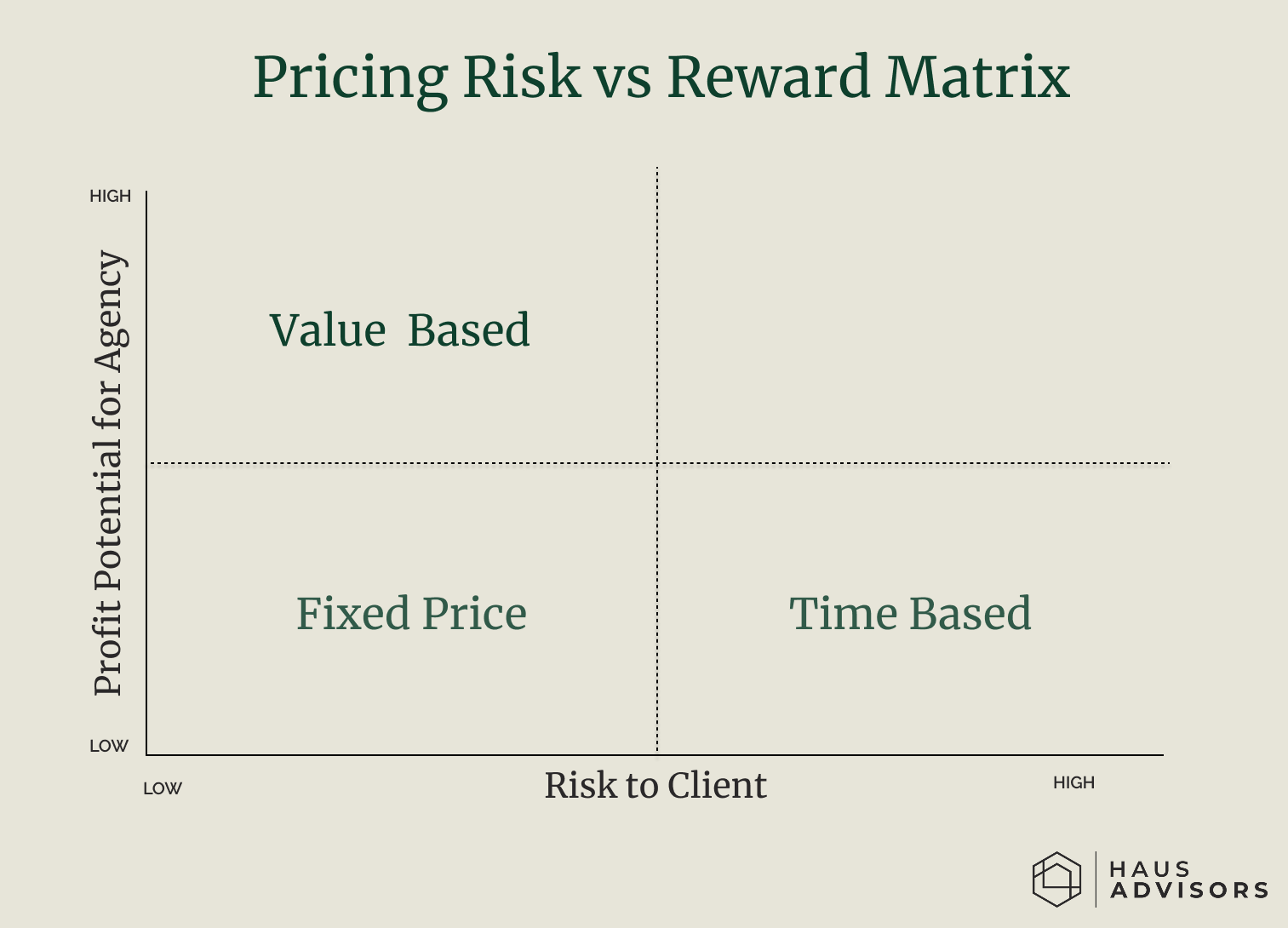
Conversations with the wrong buyer. Hourly rates pull you into negotiations with procurement managers and cost-focused gatekeepers—people whose job is to minimize spend. Value-based pricing earns you a conversation with the CEO or founder, who's focused on ROI. When you anchor your price to a $500K revenue upside, a $50K fee sounds like an investment. In an hourly conversation, that same $50K sounds like "500 expensive hours." But you can't credibly anchor to outcomes if your positioning doesn't establish you as someone who delivers them.
A pricing model you can't evolve. Agencies that jump to value-based pricing without the positioning to support it often retreat back to hourly billing within a year. The value conversation requires the prospect to believe you understand their business well enough to tie fees to outcomes. Without market credibility, published expertise, and a defined specialization, that belief doesn't exist—and the value-based proposal feels presumptuous rather than compelling.
The Seven Models, in Context
Before I go further, it's worth mapping the landscape. There are seven pricing models that development agencies actually use, and understanding where each one sits helps clarify why the positioning question has to come first.
Hourly billing. The default starting point. Predictable, easy to understand, easy for clients to compare. Also the model most vulnerable to commoditization and the AI efficiency penalty. It creates a direct conflict of interest: the client wants the work done fast, the model rewards working slow. It caps your revenue at available hours multiplied by rate—a ceiling that tightens as AI makes teams more efficient.
Fixed project pricing. You quote a defined outcome for a set price. This lets you capture more value when you work efficiently, and gives clients budget certainty. The risk is scope creep—without sharp scoping skills and clear change management processes, fixed-price projects can erode margins faster than hourly ones. Works best when you have deep pattern recognition from delivering similar projects repeatedly.
Value-based pricing. Fees tied to business outcomes rather than time spent. A project that increases client revenue by $500K annually justifies a fee structure that has nothing to do with hours. This is the model with the highest margin ceiling, but it requires the strongest positioning foundation—the client has to believe you understand their business and can deliver measurable impact. Without that credibility, value-based proposals don't land.
Monthly retainers. Predictable recurring revenue in exchange for ongoing access and defined service levels. Builds deep client relationships and stabilizes cash flow. The danger is vague scope—without clear boundaries, retainers become unlimited work arrangements that drain capacity. Works best for ongoing strategic support rather than one-off project delivery.
Milestone-based pricing. Payments tied to completed deliverables rather than time periods. Maintains cash flow through long projects while giving clients visibility into progress. Effective for complex builds where requirements evolve but core outcomes stay consistent.
Hybrid approaches. Hourly for discovery, fixed for defined builds, retainer for ongoing support. The most sophisticated agencies use multiple models within a single client relationship, matched to the type of work and risk profile. Requires clear communication about when each model applies.
Performance-based pricing. Compensation linked directly to measurable results—conversions, revenue growth, cost savings. Highest risk, highest reward. Only viable for agencies with proven track records in specific verticals where results can be clearly measured and attributed.
Each of these models has a place. None of them solves the positioning problem. An agency with clear positioning and strong market credibility can make almost any of these models work. An agency without those things will struggle with all of them—because the prospect has no basis for evaluating the price against anything other than a competitor's lower number.
Price vs. Pricing
This is the part most people miss.
Agencies conflate their price: the number on the proposal, with their pricing: the strategic framework that determines how value is captured, communicated, and defended. These are different things, and confusing them is what keeps the cycle going.
Your price is a number. Your pricing is a system. And that system has to be built on top of positioning, not alongside it.
When positioning is clear—when a prospect understands who you serve, what specific problem you solve, and why your approach produces better outcomes—the pricing model becomes a delivery mechanism for a value proposition that already exists. The conversation is about fit, not cost. About outcomes, not hours. The number on the proposal is justified by everything the prospect already knows about you before they see it.
When positioning is unclear, the pricing model has to do the work that positioning should have done. And no pricing model is strong enough to carry that weight. You end up switching between models, testing different structures, running pricing experiments—all while the real issue remains untouched.
The agencies I work with that have successfully moved to premium pricing didn't start with a pricing change. They started with a positioning change that made premium pricing possible. The sequence matters more than the model.
The Transition Path
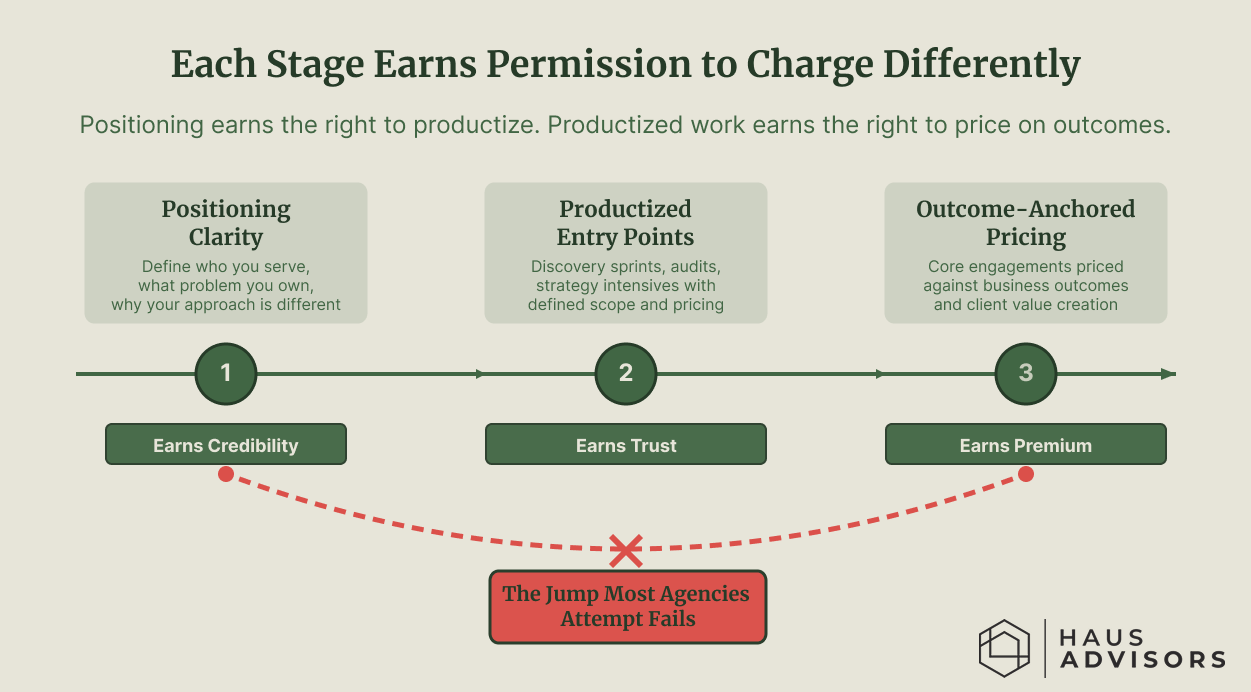
If you're currently billing hourly and want to move toward value-based or hybrid pricing, the path has three stages, and the first one has nothing to do with pricing.
Stage one: positioning clarity. Define who you serve, what problem you own, and why your approach is different. This is the foundation that makes every downstream pricing decision coherent. Without it, you're choosing pricing models based on what sounds good in theory rather than what your market position can support.
Stage two: productized entry points. Create defined offerings (discovery sprints, audits, strategy intensives) with clear scope, pricing, and outcomes. These aren't your full engagement model. They're the entry point that lets a prospect experience your expertise at low risk before committing to a larger engagement. Productized entry points also give you pricing data: you learn what the market will pay for defined outcomes, which informs your larger pricing architecture.
Stage three: outcome-anchored pricing for core engagements. Once you have positioning that establishes credibility and productized offerings that demonstrate competence, you can credibly price larger engagements against business outcomes rather than time. The prospect has already seen your thinking, experienced your process, and developed trust in your ability to deliver. At that point, the value-based conversation isn't presumptuous—it's earned.
Most agencies try to jump from stage zero (generic hourly billing with no positioning) to stage three (value-based pricing). That jump doesn't work. The stages exist for a reason, and each one builds the credibility that makes the next one possible.
The Honest Objection
Here's the strongest argument against what I'm proposing: positioning work takes time, and your pricing problem is costing you money right now. Every month you spend on positioning clarity is another month of deals lost to cheaper competitors and margins compressed by a model you know is wrong.
That's real. And I won't pretend that a founder watching a $150K deal go to a cheaper competitor should feel patient about a three-month positioning sprint.
Where That Logic Hits a Wall
But here's the boundary: switching your pricing model without changing your positioning doesn't stop the losses. It changes their shape.
You move to value-based pricing without the positioning to support it, and you lose deals because prospects don't believe you can deliver the outcomes you're pricing against. You move to fixed pricing without the scoping discipline that comes from specialization, and you lose margin to scope creep. You raise your hourly rate without market credibility, and you simply lose more deals, faster.
The agencies that successfully charge premium rates didn't find a clever pricing model. They built a market position that made premium pricing feel obvious to the buyer. The pricing model was the last thing they changed, not the first.
The Next Step
You don't need to overhaul your pricing this quarter. You need to diagnose whether your pricing challenges are actually pricing challenges or positioning challenges wearing a pricing disguise.
Start here: think about the last deal you lost on price. Replay the conversation. At what point did the prospect start comparing you to cheaper alternatives? Was it before or after they understood what makes your approach different?
If they never understood what makes your approach different, if the conversation was always about rates, scope, and timeline, you don't have a pricing problem. You have a positioning problem that surfaces during pricing conversations.
That distinction changes everything about what you do next.
The principle is simple:
There are agencies that try to price their way out of a positioning gap, and there are agencies that position their way into premium pricing.
The first group cycles through models. The second group builds something the models sit on top of.
Most founders reading this already know the real problem. It isn't the pricing model. It's that the reputation, the relationships, and the judgment that make your agency worth hiring still live in your head. So the business only grows when you're in the room, and so does the pricing power.
That's the work we do at Haus Advisors. The Relevance Engineering Program is six months of implementation, not a strategy document. We pull what makes your agency relevant out of your head, build it into positioning, offers, and growth plays your team can run, and hand ownership to them. If you want an agency that grows without needing you in every deal, book a call to see if it's a fit.
Keep reading
Browse by topic
- Positioning & Strategy
- Lead Gen & Marketing
- Sales & Biz Dev
- Pricing & Productization
- Research & Data
- Operations & Delivery
- Client Retention & Expansion
- Leadership & Culture
For founders whose agency has outgrown referrals.
One idea a week that makes a hard growth problem obvious, usually with a chart that shows you the mechanism behind it.
Built from conversations with seventy-plus agency founders on the Behind the Agency podcast.