Your Homepage Doesn't Have a Design Problem. It Has a Positioning Debt Problem.
A founder told me he was about to spend $25K on a homepage redesign. He'd been browsing Awwwards, collecting screenshots of agencies with smooth animations and bold typography. His current site felt dated. He was losing bids to agencies he considered technically inferior, and he'd concluded the problem was how his agency looked online.
I asked him to show me the current homepage. It was fine. Clean design, professional imagery, decent typography. Then I read the headline: "We build world-class digital experiences for forward-thinking brands."
I asked: "If a fintech CTO lands on this page, do they know within five seconds that you've built compliant transaction systems for six other fintech companies?" He paused. "No. But our portfolio page has those case studies."
Nobody clicks to the portfolio page. The homepage has five seconds to answer three questions: What do you do? Who do you do it for? Why should I trust you over a cheaper alternative? If those answers aren't in the hero section, the visitor is gone. No amount of animation, typography, or visual polish changes that.
He didn't need a redesign. He needed a refactor. The UI was fine. The positioning underneath it was empty.
The Pattern Has a Name
I call it Positioning Debt: the accumulated gap between what your agency actually does well and what your homepage communicates to visitors. Like technical debt, positioning debt accrues silently. The agency ships excellent work, builds impressive case studies, and develops deep expertise, but none of it is reflected in the first thing a prospect sees. The homepage says "full-service development for growing companies" while the actual work is highly specific and demonstrably excellent.
Positioning debt produces a specific, measurable consequence: the homepage attracts generalist traffic (price shoppers, RFP mills, anyone with a project) instead of qualified traffic (buyers with the specific problem your agency specializes in solving). The conversion rate is low not because the design is poor, but because the visitor can't tell whether your agency is relevant to their situation.
The redesign instinct makes this worse, not better. A $25K redesign that puts a beautiful new interface on the same vague positioning is the most expensive way to not solve the problem. The traffic pattern doesn't change because the signal doesn't change. You've reskinned the UI without refactoring the positioning underneath it.
The 10-Second Test
Before evaluating archetypes or examples, test your own homepage against this threshold.
A qualified prospect lands on your site from a Google search, a partner referral, or a cold outreach link. They have five to ten seconds before they decide whether to keep reading or close the tab. In those seconds, your homepage needs to answer three questions:
Do they know exactly what you do? Not "digital experiences" or "technology solutions." The specific capability that differentiates you from ten thousand other dev shops.
Do they know who you are for? The industry, the company stage, the buyer type. Specific enough that the right prospect thinks "this is for me" and the wrong prospect thinks "this isn't for me." Both responses are correct.
Do they have a reason to choose you over a cheaper alternative? A credibility signal that justifies premium pricing: specific outcomes delivered, recognizable logos in their industry, a methodological claim that demonstrates depth.
If the answer to any of these is no, the homepage is running on positioning debt. The redesign won't fix it. Only the positioning refactor will.
Here's the difference in practice:
The Commodity Homepage: "We build world-class digital experiences for forward-thinking brands." Subhead: "Full-service development, design, and strategy." Visual: stock photo of people collaborating or a generic MacBook mockup. The visitor's response: "Can you send me a rate card?"
The Premium Homepage: "We build high-velocity fintech infrastructure for Series B startups." Subhead: "Scale your transaction volume without breaking your stack. SOC2 compliant." Visual: a sanitized architecture diagram or a dashboard showing throughput metrics. The visitor's response: "When can we start scoping?"
Same agency. Same capabilities. Different positioning signal. Different quality of conversation that follows.
| The Commodity Agency (Legacy Code) |
The Premium Agency (Refactored) |
|---|---|
|
Headline:
"We build world-class digital experiences for forward-thinking brands."
|
Headline:
"We build high-velocity fintech infrastructure for Series B startups."
|
|
Subhead:
"Full-service development, design, and strategy."
|
Subhead:
"Scale your transaction volume without breaking your stack. SOC2 compliant."
|
|
Visual:
Stock photo of people high-fiving or generic MacBook mockup.
|
Visual:
A sanitized architecture diagram or a dashboard showing throughput.
|
|
The Result:
"Can you send a rate card?"
|
The Result:
"When can we start scoping?"
|
Four Homepage Archetypes That Convert
Most founders look at "unicorn" studios like MetaLab or Work & Co for homepage inspiration. But those agencies rely on massive brand awareness and inbound reputation that took decades to build. You can't replicate their approach if you're trying to win cold traffic from prospects who've never heard of you.
You need structural positioning, not aspirational aesthetics. Here are four archetypes that work for agencies building pipeline from scratch, with real examples executing each one.
Archetype 1: The Vertical Specialist
The safest way to de-risk a six-figure project for a buyer is to prove you already know their regulatory environment, operational constraints, and industry-specific challenges. You aren't learning their industry on their budget.
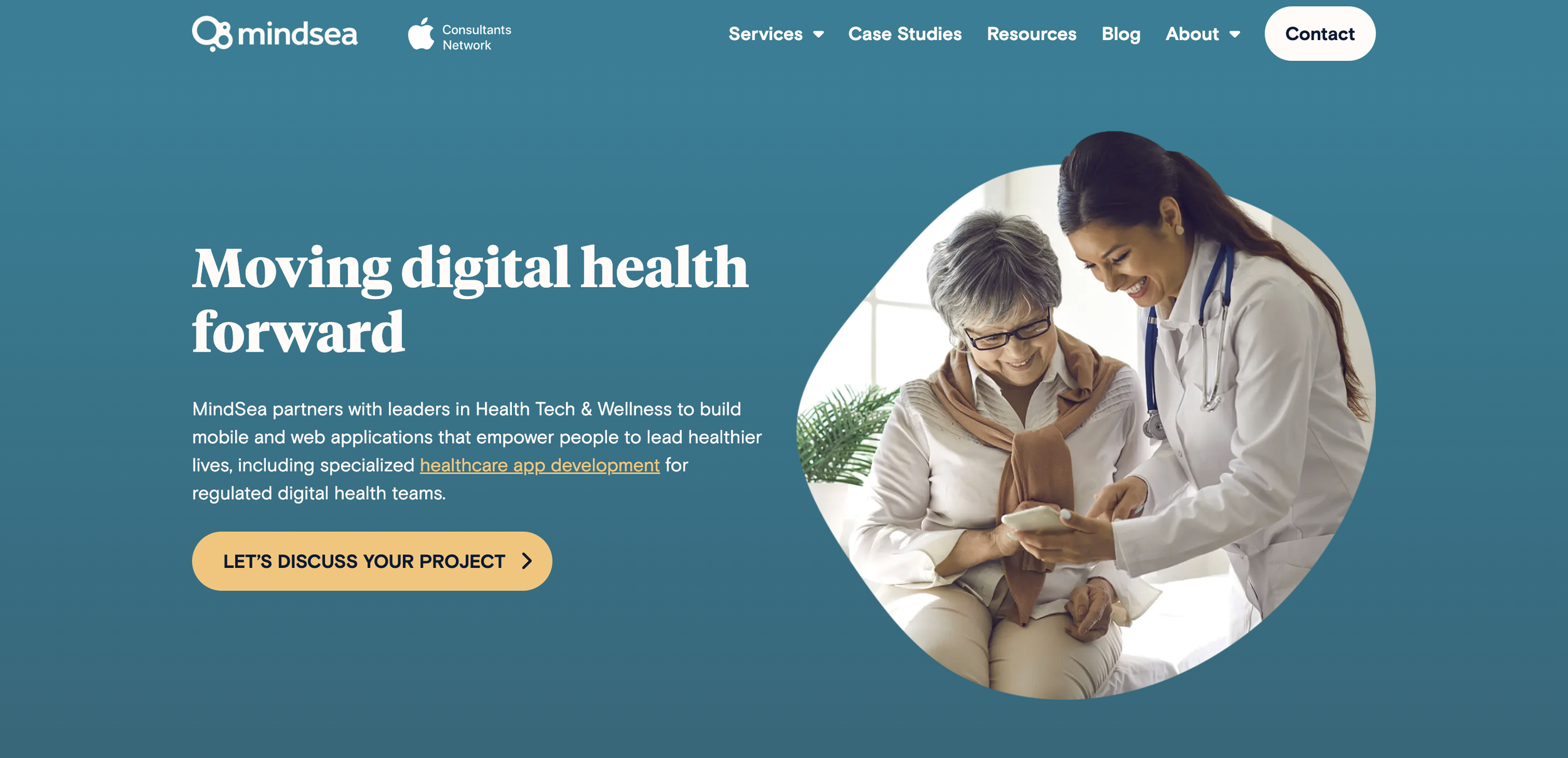
MindSea (Digital Health). Their homepage doesn't say "App Development." It says "Healthcare App Development for Regulated Teams." A CTO at a healthcare company who needs a HIPAA-compliant application isn't going to hire a generalist shop. MindSea eliminates the competition by demonstrating fluency in medical compliance before the prospect ever gets on a call.
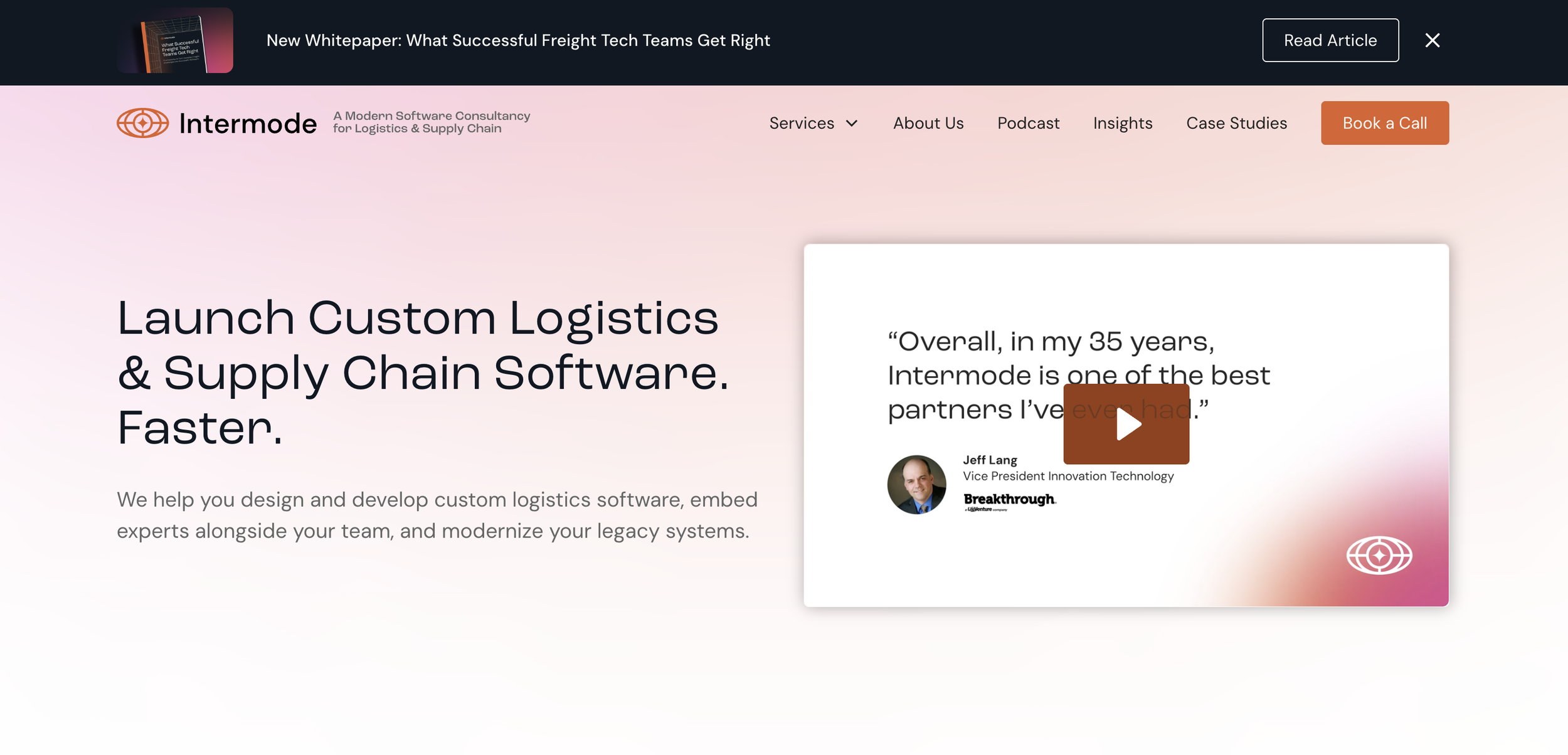
Intermode (Logistics). They lead with "Launch Custom Logistics & Supply Chain Software" and show interfaces specifically designed for freight tracking and carrier procurement. An operations director at a logistics company lands on this page and knows immediately: this agency has built the exact kind of system I need.
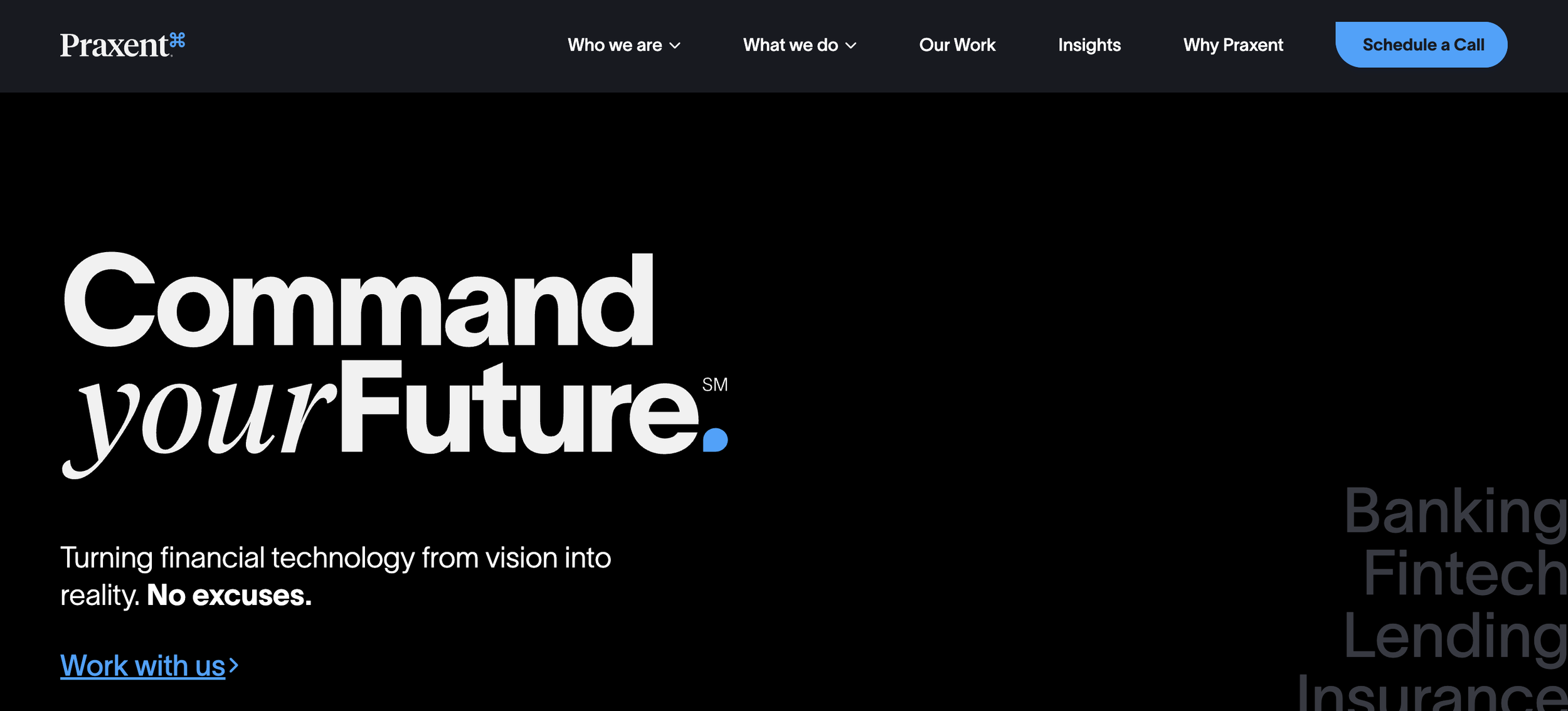
Praxent (Financial Services). They own the fintech integration space with language that speaks directly to wealth management and digital lending. The positioning simultaneously disqualifies buyers outside their vertical and looks like the only safe choice for those inside it.
The pattern across all three: the homepage communicates industry fluency, not just technical capability. The prospect sees not just "they can build this" but "they've built this before, in my exact context, with my exact constraints."
Archetype 2: The Event-Driven Specialist
Instead of specializing by industry, you specialize by a high-stakes trigger event where speed and reliability override price sensitivity entirely.
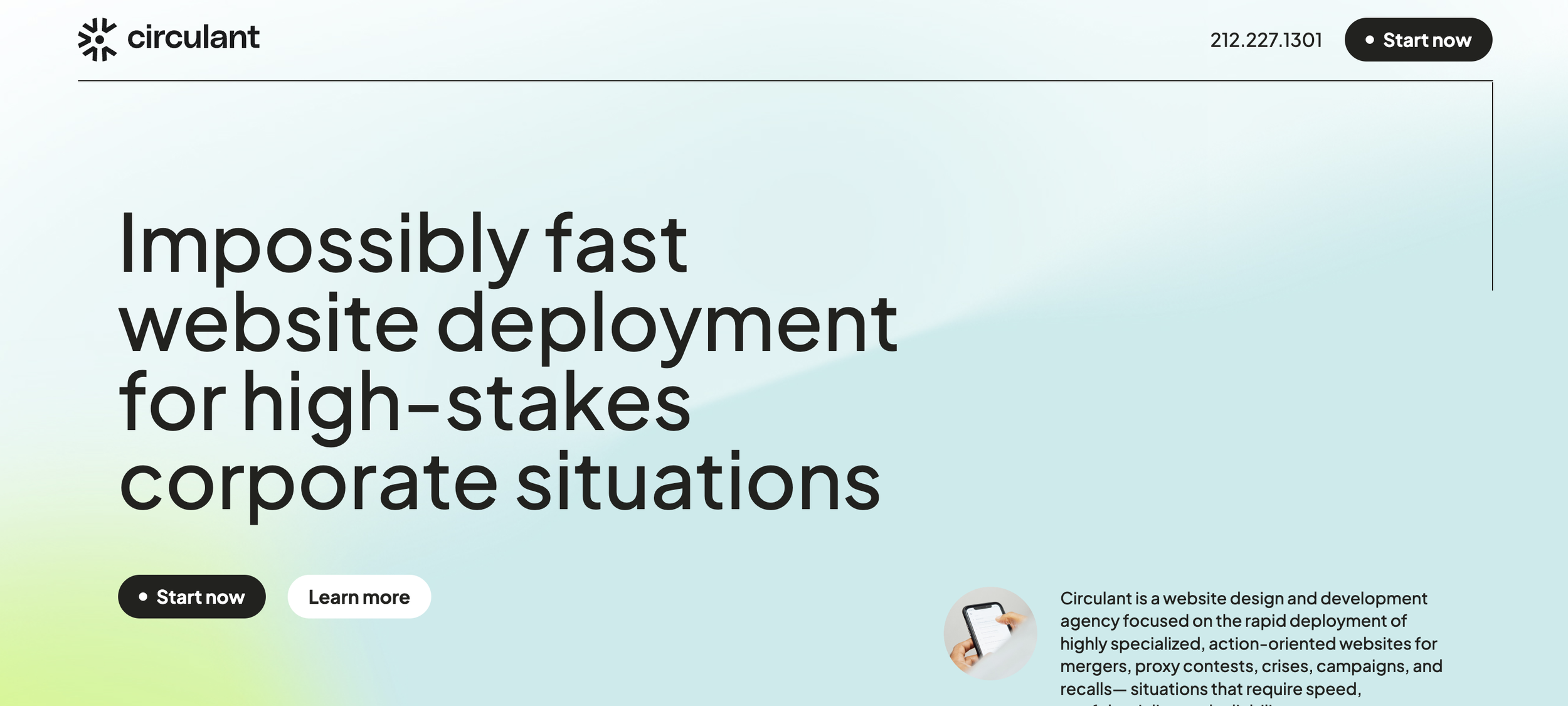
Circulant (High-Stakes Corporate Situations). This is one of the most precise positioning statements on the web: "Impossibly fast website deployment for high-stakes corporate situations (Mergers, Proxy Contests, Recalls, Crises)." They disqualify 99% of web traffic to absolutely dominate the 1% who need a site launched in 72 hours for a $10B corporate merger. When the stakes are that high, the buyer isn't shopping for a discount. They're looking for certainty. Circulant's homepage provides that certainty in a single sentence.
The event-driven archetype works because it targets a moment of acute need rather than a general capability gap. The buyer isn't browsing. They're urgent. And urgency eliminates price sensitivity.
Archetype 3: The Legacy Refactor Specialist
Targeting established businesses whose current systems are constraining their operations. The buyer isn't looking to build something new. They're looking to modernize something old that's costing them money every day it remains unchanged.
UpTop (UX Modernization). They own a highly specific problem: "UX Modernization for Technology-Enabled Services." They aren't selling UI design or pretty websites. They're selling the removal of operational bottlenecks caused by 15-year-old legacy interfaces. The positioning speaks directly to the operations leader who's losing margin because employees are fighting with software that should have been replaced years ago.
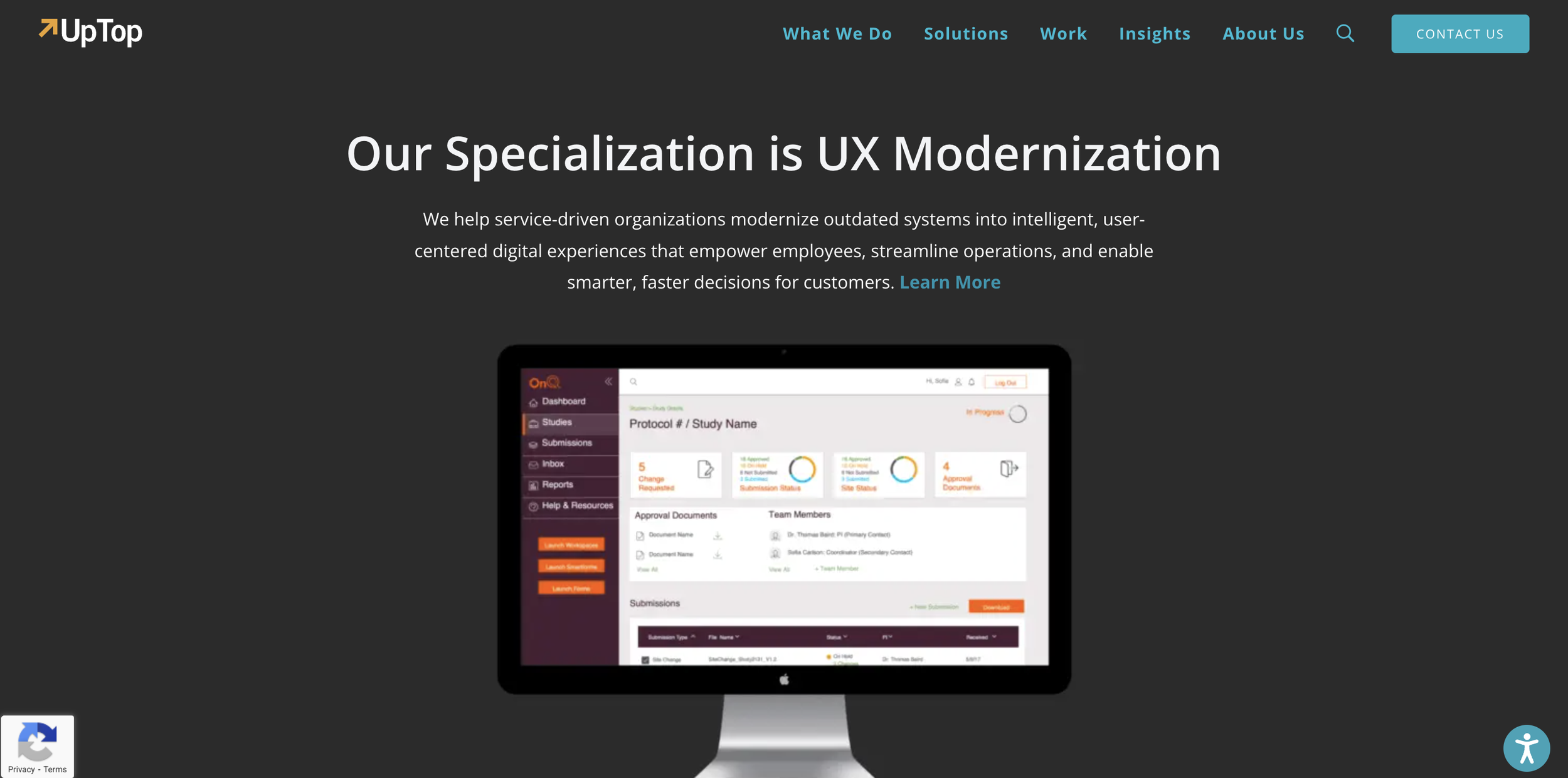
The legacy refactor archetype works because the business case is quantifiable. The cost of inaction is visible in operational inefficiency, employee frustration, and competitive disadvantage. The homepage that names this cost specifically creates urgency that generic "we build software" positioning never achieves.
Archetype 4: The Risk-Reversal Model
Solving the buyer's deepest fear about agency engagements: the unpredictable cost, the scope creep, the feeling of writing a check into a black box.
Pilot West Studios (Software as a Subscription). They rebuild outdated business software for non-technical CEOs, but their positioning superpower is the engagement structure itself: "Custom Software Development, As A Subscription. Month-to-month. No contracts. 30-day money-back guarantee." They recognize that their target buyer has likely been burned by agencies that over-scoped and under-delivered. By restructuring the pricing model to eliminate the buyer's risk, they make saying no harder than saying yes.
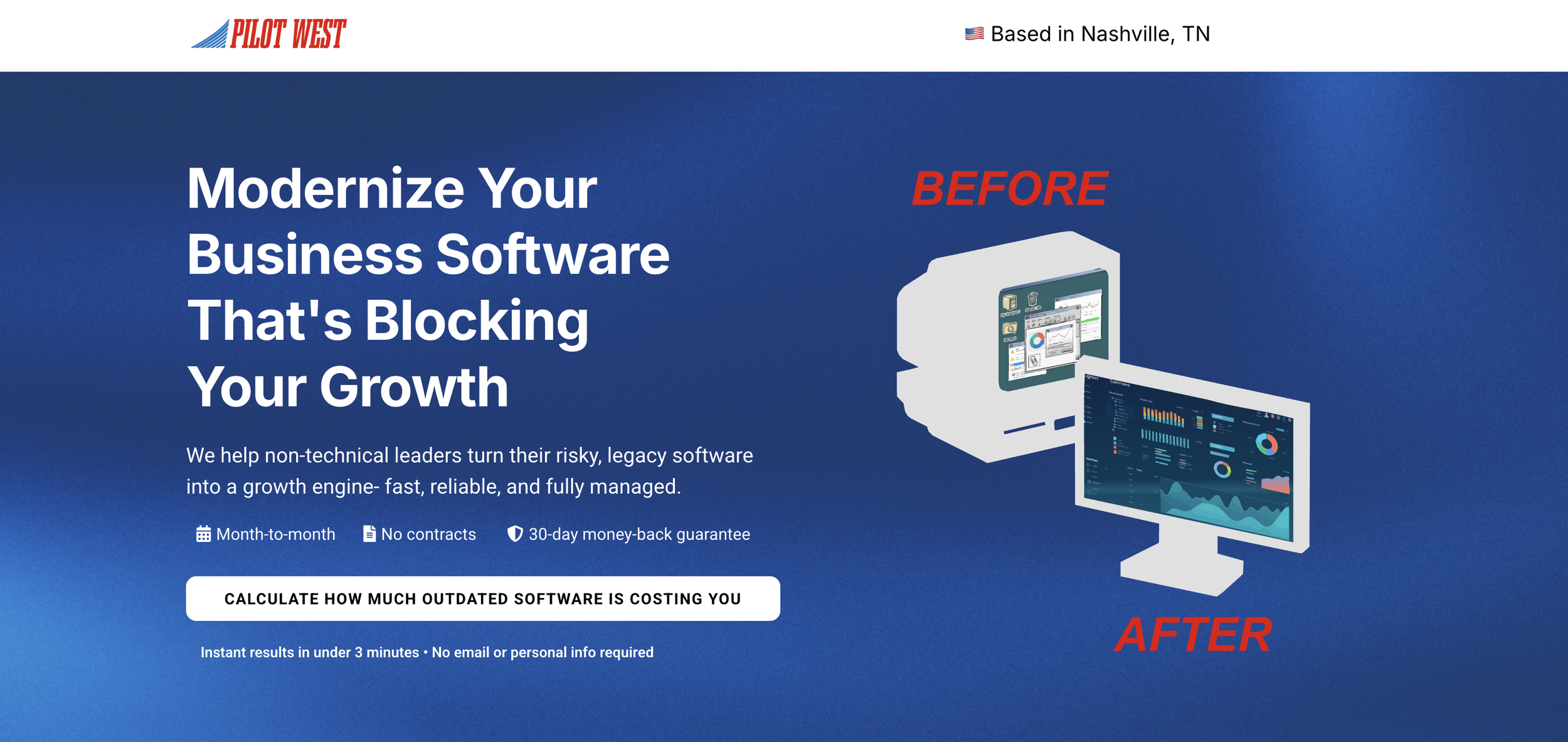
The risk-reversal archetype works because it addresses the objection before it's raised. The buyer who's been burned by agencies doesn't need to hear about your capability. They need to know that if the engagement doesn't work, they can walk away without a loss. That structural guarantee does more trust-building than any case study.
The Anatomy of a Hero Section That Converts
Based on audits of 50+ high-performing agency homepages, here's the information hierarchy that works:
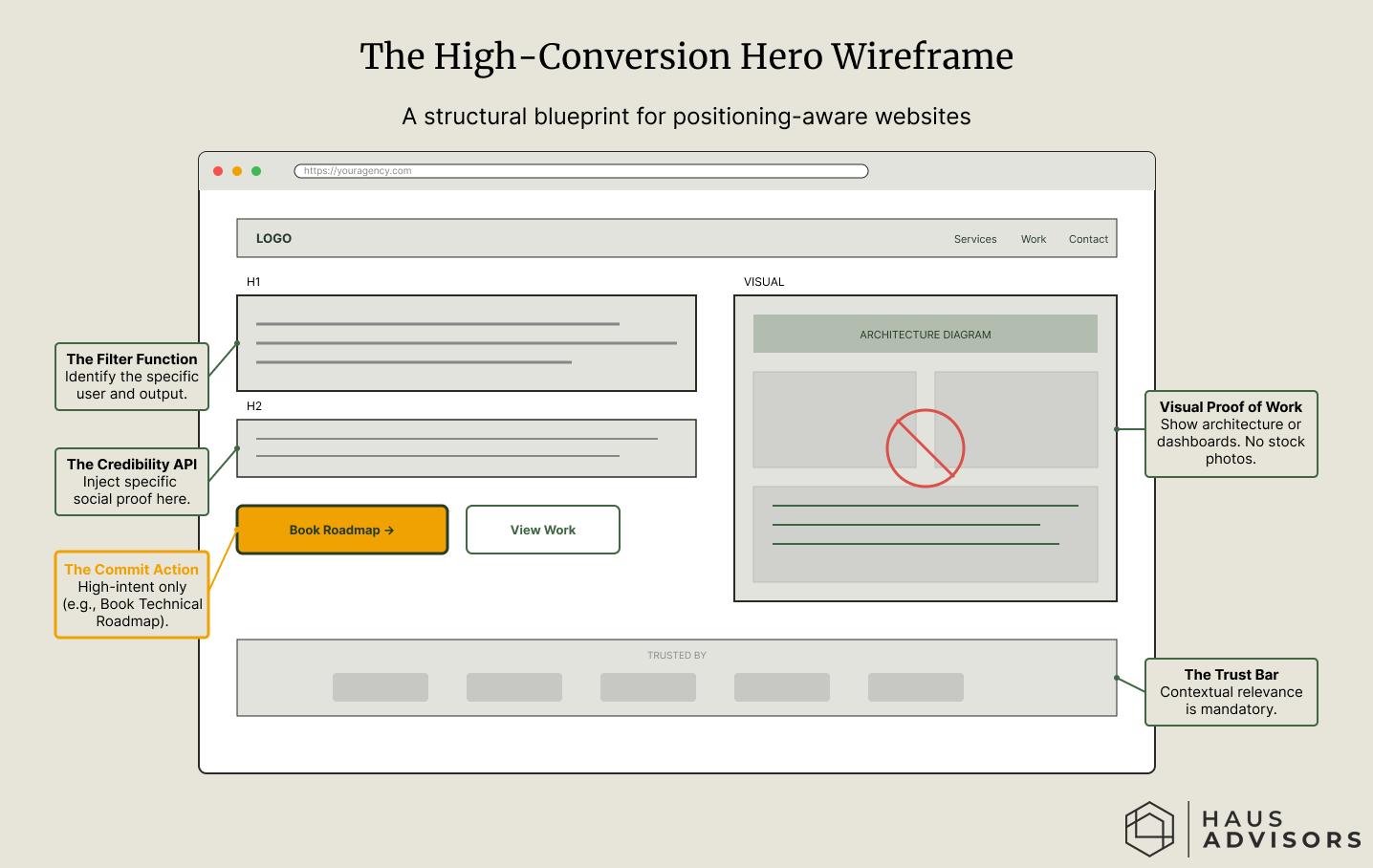
The Positioning Headline (H1). [Specific Service] for [Specific Buyer] who needs [Specific Outcome]. If your headline could apply to any dev shop, it's too generic. Test: would your mother understand who this agency is for? If yes, it's probably too vague for a technical buyer.
The Credibility Subhead (H2). Proof that you're safe. Not a second value proposition. Evidence. "We handle the infrastructure for 3 of the top 10 crypto exchanges." Or "SOC2 compliant. 99.99% uptime across 40+ deployments." The subhead answers the question the headline raised: "Can they actually do this?"
The Trust Bar. Relevant logos only. If you want enterprise fintech clients, show fintech logos. If you want healthcare clients, show healthcare logos. Do not put a local bakery logo next to a bank logo. The trust bar is an industry signal. Mismatched logos confuse the prospect about who you actually serve.
The Route-to-Value CTA. Not "Contact Us" (too passive, no value implied). Offer a specific first step that provides value: "Book a Technical Roadmap Session," "Get a Free Architecture Assessment," "Calculate Your Legacy Debt." The CTA should feel like the beginning of a diagnostic relationship, not a sales pitch.
The Honest Objection
Here's the strongest argument against narrow homepage positioning: you'll lose traffic. A homepage that says "fintech infrastructure for Series B startups" will get fewer visitors than one that says "custom software for growing companies." You're deliberately shrinking your audience.
That's true. Traffic will drop.
Where That Logic Hits a Wall
But the traffic you lose is the traffic that wasn't converting anyway. The "full-service for everyone" homepage gets more visitors and fewer clients because the visitors can't determine whether the agency is relevant to their specific situation. The narrow homepage gets fewer visitors and more clients because every visitor who arrives already knows they're in the right place.
The agencies I've watched make this transition consistently report the same pattern: traffic drops by 30% to 50%, and qualified inbound conversations increase by 2x to 3x. The homepage is doing less volume and more work. The conversations that start are better qualified, less price-sensitive, and faster to close because the prospect arrived with context instead of confusion.
A homepage that converts 5% of 1,000 visitors produces more pipeline than a homepage that converts 0.5% of 5,000 visitors. The math favors specificity every time.
The Next Step
You don't need to redesign your homepage. You need to run the 10-Second Test.
Open your homepage in a new browser tab. Set a timer for ten seconds. Read only what's visible without scrolling. Then answer:
Does a qualified prospect know what you do? Not "digital experiences." The specific capability.
Does a qualified prospect know who you are for? Not "growing companies." The specific buyer.
Is there a credibility signal that justifies your pricing over a cheaper alternative?
If any answer is no, that's your positioning debt. The debt isn't paid with a redesign. It's paid with a positioning refactor: clarifying who you serve, what problem you own, and why you're the safe choice, then expressing that clarity in the first five seconds of your homepage.
The examples above aren't aspirational designs. They're positioning decisions expressed as homepages. The design is secondary. The positioning is the system that makes the homepage work.
The principle is simple:
There are agencies that redesign their homepage to look better, and there are agencies that refactor their positioning to convert better.
The first group spends $25K on new paint. The second group fixes the architecture first and builds a homepage that does the selling before the founder ever gets on the call.
Most founders reading this already know the real problem. It isn't the homepage. It's that the reputation, the relationships, and the judgment that make your agency worth hiring still live in your head. So the business only grows when you're in the room. A homepage that says who you're for is the first place the market credits the company instead of the founder, and that only works once the positioning has left your head.
That's the work we do at Haus Advisors. The New-Business Engine is six months of implementation, not a strategy document. We pull what makes your agency relevant out of your head, build it into positioning, offers, and growth plays your team can run, and hand ownership to them. If you want an agency that grows without needing you in every deal, book a call to see if it's a fit.
Keep reading
Browse by topic
- Positioning & Strategy
- Lead Gen & Marketing
- Sales & Biz Dev
- Pricing & Productization
- Research & Data
- Operations & Delivery
- Client Retention & Expansion
- Leadership & Culture
For founders whose agency has outgrown referrals.
One idea a week that makes a hard growth problem obvious, usually with a chart that shows you the mechanism behind it.
Built from conversations with seventy-plus agency founders on the Behind the Agency podcast.