Every AI Tool Your Team Adopts Makes Your Agency Less Profitable. Unless You Change What You're Selling.
A founder I advise showed me his team's productivity numbers last quarter. They were stunning. A module that used to take twenty developer-hours was getting shipped in four. A feature that required a week of scoping, building, and testing was landing in two days. His senior engineers were producing at roughly five times their pre-AI velocity.
Then he showed me his revenue numbers. They were down 30%.
The math was simple and brutal. His agency billed hourly. When his team built the same module in four hours instead of twenty, the invoice went from $3,500 to $700. Same deliverable. Same client satisfaction. Same quality. Eighty percent less revenue.
He'd adopted AI tooling faster than most of his competitors. His team was among the most productive in their market. And every productivity gain was directly reducing his top line, because the billing model converted efficiency into a pay cut.
He'd used the most advanced technology in human history to make his agency poorer.
The Pattern Has a Name
I call it The Efficiency Penalty: the paradox in which AI-driven productivity gains directly reduce revenue for agencies that bill on time-based models. It's the defining economic threat to development agencies in the current era, and it's invisible to founders who are focused on the productivity benefits without tracing the financial implications downstream.
Here's the mechanism. Hourly billing works when time is a reasonable proxy for value. If a module takes twenty hours, the client pays for twenty hours, and both parties accept the exchange as fair. AI breaks this proxy. The module still delivers the same value to the client, but it takes a fraction of the time. Under hourly billing, the agency captures a fraction of the revenue. The value delivered didn't change. The time invested did. And since the billing model is pegged to time, not value, the agency's revenue collapses proportionally with the efficiency gain.
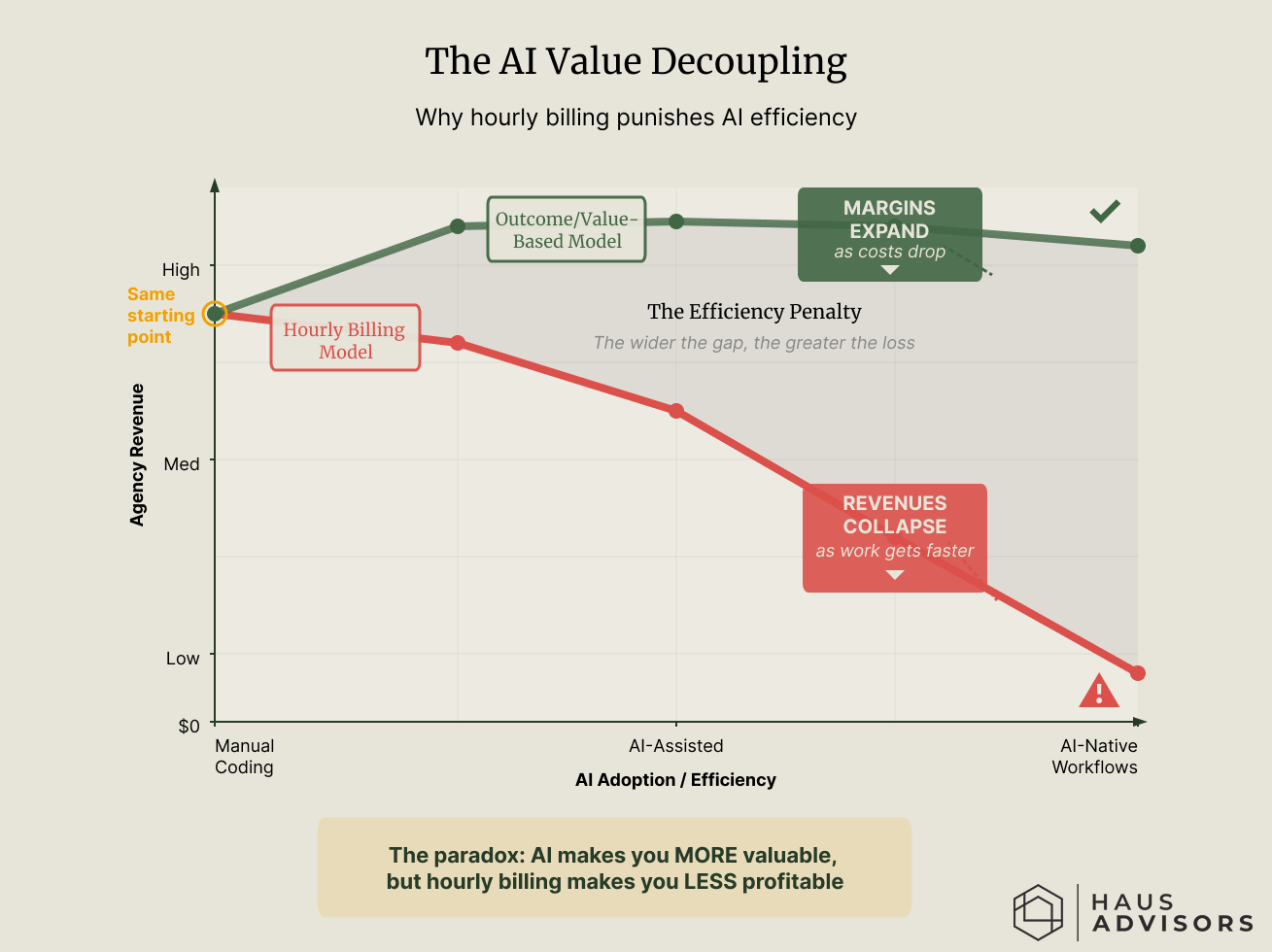
The diverging curves: Under hourly billing, every productivity gain from AI directly reduces revenue. Under outcome-based pricing, the same productivity gain becomes pure margin. The gap between these curves widens as AI tooling improves. Agencies on the red line are racing toward zero revenue per project. Agencies on the green line are building leverage.
The Efficiency Penalty is not theoretical. It's happening now, in real agencies, with real revenue impact. And it will accelerate as AI tooling improves, because the efficiency gains will compound while hourly rates remain constrained by market expectations.
The founders who recognize this early have a window to restructure their pricing model before the market forces them to. The founders who don't will find their clients reading the same headlines about AI productivity and arriving at the obvious conclusion: "If AI makes this work faster, why am I still paying the same hourly rate?"
Why Generalist Agencies Are Most Exposed
Because AI is the ultimate generalist.
GPT-based tools can scaffold React components, write Python scripts, generate API integrations, produce database schemas, and debug common errors. They do it at near-zero marginal cost, twenty-four hours a day, with no project minimums and no invoicing. For the category of work that generalist agencies have traditionally sold ("we build custom software"), the competitive pressure from AI tooling is direct and intensifying.
This doesn't mean AI replaces agencies. It means AI replaces the category of value that generalist agencies sell: commodity code execution. If your positioning is "we write code for anyone who needs code written," you are now competing with a tool that does the same thing for $20 per month. You cannot win that competition on price. And if your positioning doesn't articulate any value beyond code execution, you have no other dimension to compete on.
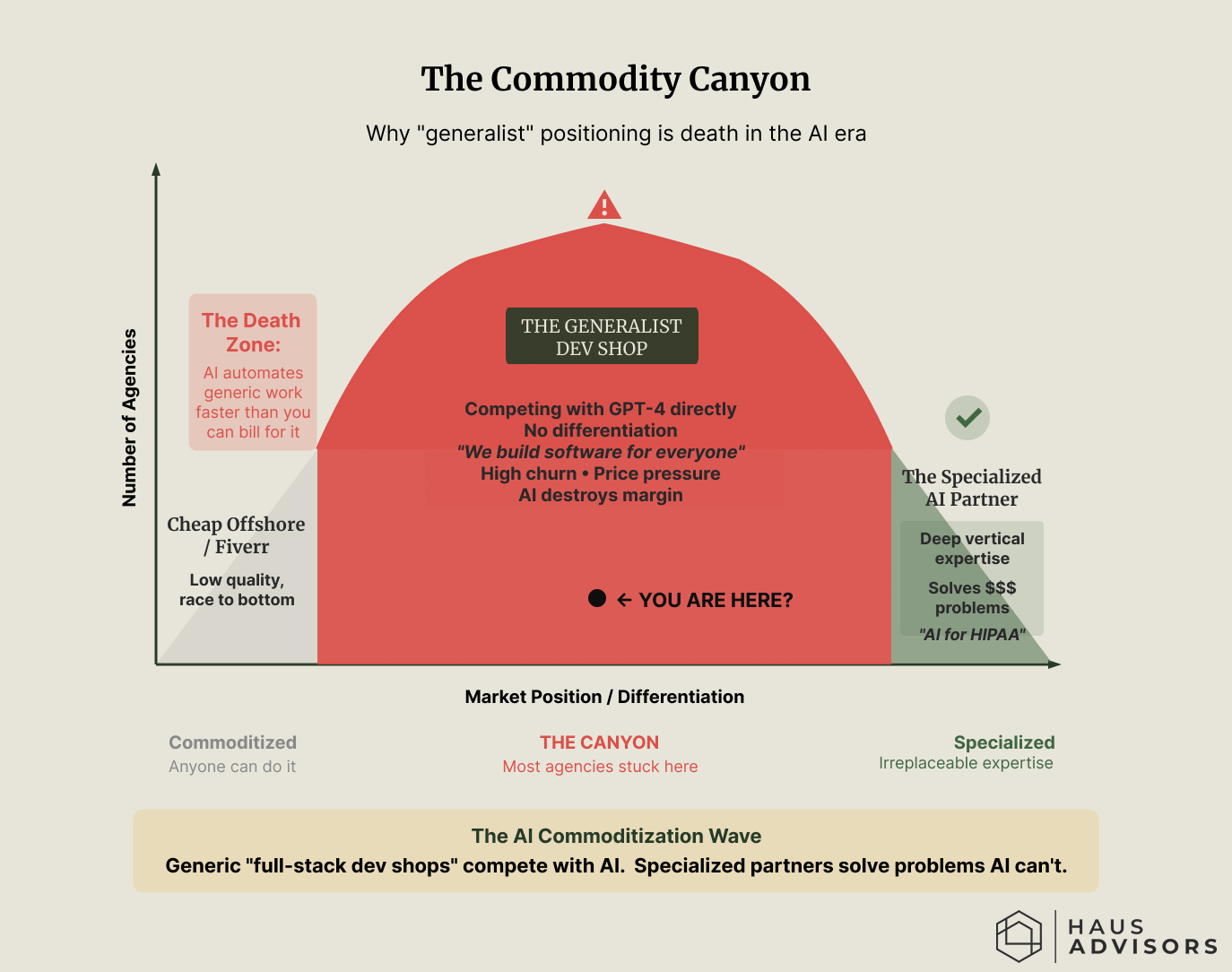
The market redistribution: AI is flattening the middle of the agency market. Generalist code execution is being commoditized. The margin is migrating to the tails: fully automated (left) or deeply specialized (right). Agencies stuck in the middle face compression from both directions. The only path to preserved margin is the specialist tail, where you're selling expertise AI can't replicate.
The agencies that survive this transition will be the ones selling something AI fundamentally cannot: diagnosis of complex business problems, strategic judgment about what should be built and why, accumulated expertise from solving the same category of problem across dozens of similar companies, and accountability for business outcomes rather than code deliverables.
AI can write the Python. AI cannot guarantee the compliance strategy for a fintech audit. AI can scaffold an onboarding flow. AI cannot diagnose why your trial-to-paid conversion is underperforming based on patterns it's seen across fifteen similar SaaS companies. The margin lives in the context, the judgment, and the accountability. It does not live in the code.
What the Efficiency Penalty Actually Costs You
Revenue decline disguised as productivity success. This is the most disorienting cost. Your team's metrics look better than ever: faster delivery, higher output per developer, shorter project timelines. But if you're billing hourly, every improvement in those metrics reduces your invoice. You're celebrating the productivity data while the financial data deteriorates underneath it.
Client expectations that ratchet downward. Once a client sees that a feature can be delivered in four hours instead of twenty, they recalibrate their expectations permanently. They don't go back to accepting twenty-hour estimates. The new baseline becomes the AI-augmented timeline, and every future quote is evaluated against that expectation. Your rates don't just drop on the current project. They drop on every future project with that client.
A pricing conversation you can't win. When prospects know that AI has compressed the time required for development work, arguing for premium hourly rates becomes untenable. "Why should I pay $175 per hour when the work takes a fifth of the time it used to?" is a question with no good answer under hourly billing. The only escape is to stop anchoring the conversation to time altogether.
Talent economics that invert. Your most valuable team members, the senior engineers who leverage AI tools most effectively, become your least profitable under hourly billing. The person who can ship a module in four hours generates less revenue than the person who takes twenty. The incentive structure rewards slowness and penalizes expertise. This is obviously unsustainable, but it's the direct consequence of a billing model that equates time with value.
Hourly Billing vs. Outcome Pricing
This is the part most people miss.
Hourly billing sells inputs: time, effort, bodies. The client pays for how long the work takes, and the agency's revenue is a function of hours multiplied by rate. In this model, efficiency is a cost to the agency. Every minute saved is revenue lost.
Outcome pricing sells outputs: deliverables, results, solved problems. The client pays for what they receive, and the agency's revenue is a function of the value delivered. In this model, efficiency is an asset. Every minute saved is margin gained. The faster you deliver the same outcome, the more profitable the engagement becomes.
The Efficiency Penalty only exists under hourly billing. Under outcome pricing, AI-driven productivity becomes leverage: you deliver the same value in less time, with fewer resources, and the fee stays constant because it's anchored to the outcome, not the clock.
The shift from hourly to outcome pricing is not a pricing change. It's a positioning change. You can't charge for outcomes if you haven't defined what outcomes you produce. "We build custom software" doesn't have a measurable outcome. "We fix the onboarding conversion problem that's costing you $40K per month in churned trials" has a quantifiable outcome that can be priced against the value it delivers.
This is where the Efficiency Penalty connects to Relevance Engineering. The agencies that can make the pricing transition are the ones that have already done the positioning work: defined who they serve, what problem they own, and what measurable outcome their work produces. Without that positioning, outcome pricing is impossible because there's no outcome to price. And a defined outcome is something your team can sell without you in the room.
The Transition Path
You can't jump from hourly billing to outcome pricing overnight. The transition requires building the infrastructure that makes fixed-fee, outcome-anchored pricing credible and sustainable.
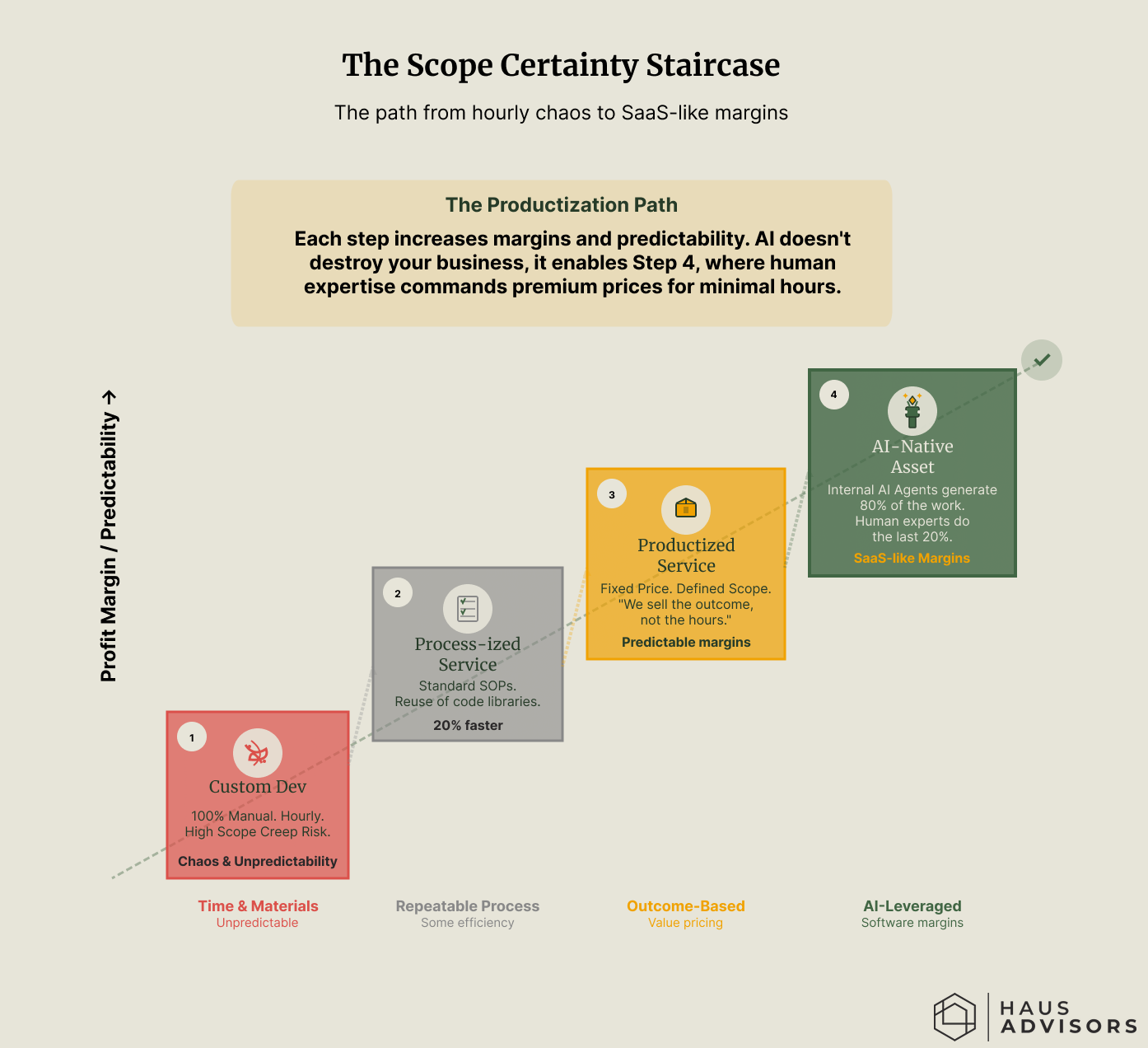
The pricing evolution: Each step up the staircase reduces your exposure to the Efficiency Penalty. Hourly billing is fully exposed: every efficiency gain reduces revenue. Project-based pricing is partially insulated: the fee is fixed for the scope, so faster delivery means better margins. Productized services are mostly insulated: the offering is standard, the delivery is refined, and the price reflects accumulated expertise. Outcome-based pricing is fully insulated: the fee is anchored to business value, and AI-driven efficiency becomes pure margin expansion.
Step one: productize your most repeated engagement. Take the project type you've delivered most frequently and package it into a defined offering with scope, deliverables, timeline, and a fixed fee. This doesn't require outcome pricing yet. It just decouples your revenue from your hours for that one offering. When AI makes delivery faster, your fee stays constant and your margin improves.
Step two: anchor pricing to client value, not your cost. For the productized offering, stop calculating the price based on estimated hours. Start calculating it based on the value of the outcome to the client. A Technical Architecture Audit that saves a company $200K in avoided bad decisions is worth $15K to $25K regardless of whether your team spends 20 hours or 40 hours producing it.
Step three: use AI to compress delivery, not reduce price. Once pricing is anchored to outcomes, every AI tool your team adopts becomes a margin expansion tool rather than a revenue reduction tool. Copilot cuts delivery time in half? Great. The fee stays the same. Your cost of delivery drops. Margin doubles. This is the green curve on the Efficiency Penalty chart: the same AI adoption that bankrupts hourly agencies makes outcome-priced agencies more profitable.
Step four: position for the work AI can't do. The long-term play is to ensure your agency's positioning is anchored to value that AI cannot replicate: diagnosis, strategic judgment, domain expertise, accountability for business outcomes. AI can write the code. It cannot identify which code needs to be written, or why, or what business outcome the code should produce. That layer of judgment is where the margin lives permanently, regardless of how good the tooling gets.
The Honest Objection
Here's the strongest argument against outcome pricing: scope risk. When you bill hourly, scope creep is the client's problem. When you charge a fixed fee, scope creep is yours. A project that balloons beyond the estimated hours eats your margin and can turn profitable work into a loss. For agencies that already struggle with scope management, fixed-fee pricing feels like adding risk to a process that's already fragile.
That's a legitimate concern. Poor scope management under fixed-fee pricing is genuinely dangerous.
Where That Logic Hits a Wall
But here's the boundary: the Efficiency Penalty is also dangerous, and it's guaranteed. Scope creep on a fixed-fee engagement is a risk you can manage through better scoping, defined deliverables, and change-order processes. Revenue decline from AI-driven efficiency under hourly billing is a certainty you cannot manage at all. You can mitigate scope risk. You cannot mitigate the fundamental repricing of development labor that AI is producing.
The agencies I've watched navigate this transition successfully didn't eliminate scope risk. They traded an unmanageable certainty (the Efficiency Penalty) for a manageable risk (scope on fixed-fee engagements). And they managed it through the same mechanism that makes the transition possible in the first place: productized offerings with clearly defined scope, deliverables, and boundaries. When the offering is defined, scope creep has a structural barrier. The conversation isn't "what else do you need?" It's "here's what this offering includes, and here's what falls outside it."
The Next Step
You don't need to rebuild your pricing model this quarter. You need to test whether the Efficiency Penalty is already active in your revenue.
Start here: look at your average revenue per project over the past two years. Compare the first twelve months to the second twelve months. If your team has adopted AI tooling during that period and your average revenue per project has declined (even if total revenue is flat because you've taken more projects), the Efficiency Penalty is active. You're running faster to stay in place.
Then ask: what percentage of your revenue comes from hourly billing versus fixed-fee engagements? If it's primarily hourly, every improvement in your team's AI-augmented productivity is working against your revenue. The margin is migrating away from time-based billing permanently. The question isn't whether to make the transition. It's whether you make it now, while you have the margin to invest in the shift, or later, when the market has already repriced your labor and the margin is gone.
The principle is simple:
There are agencies that use AI to work faster, and there are agencies that use AI to work differently.
The first group races toward cheaper. The second group races toward more valuable.
Most founders reading this already know the real problem. It isn't your billing model. It's that the reputation, the relationships, and the judgment that make your agency worth hiring still live in your head. So the business only grows when you're in the room.
That's the work we do at Haus Advisors. The New-Business Engine is six months of implementation, not a strategy document. We pull what makes your agency relevant out of your head, build it into positioning, offers, and growth plays your team can run, and hand ownership to them. If you want an agency that grows without needing you in every deal, book a call to see if it's a fit.
Keep reading
Browse by topic
- Positioning & Strategy
- Lead Gen & Marketing
- Sales & Biz Dev
- Pricing & Productization
- Research & Data
- Operations & Delivery
- Client Retention & Expansion
- Leadership & Culture
For founders whose agency has outgrown referrals.
One idea a week that makes a hard growth problem obvious, usually with a chart that shows you the mechanism behind it.
Built from conversations with seventy-plus agency founders on the Behind the Agency podcast.