Marketing Agency Hourly Rates & Retainers: 2026 Benchmarks
Ask what the average marketing agency hourly rate is and you'll get two confident, credible, completely different answers. An analysis of 6,808 U.S. agency listings puts the national average at $82.66 per hour. A self-reported industry survey puts it at $137.94. Both are real numbers from real datasets, and the 67% gap between them is the most useful fact in agency pricing: rates aren't a market price. They're a positioning artifact.
“Rates aren’t a market price. They’re a positioning artifact.”
This page compiles the most-cited agency pricing statistics for 2026, sourced from the primary surveys that actually collected the data: hourly rates by agency type, retainer ranges by service, project minimums, pricing model mix, and how rates have moved since 2024. It's the pricing companion to our broader marketing agency industry statistics.
Key Marketing Agency Pricing Statistics
The essential pricing benchmarks in one place, sourced from primary surveys and directory analyses.
$82.66
The average hourly rate across 6,808 U.S. digital marketing agencies' listed prices.
DesignRush via MarketingSherpa, 2024
$125–$200/hr
The typical digital agency billing range. 29% of agencies charge $175–199.
Promethean Research, 2026
$3,209/mo
The average SEO agency retainer. The most common retainer band is $501–$1,000.
Ahrefs, 439 providers
80%
Share of agency retainers that fall between $1,000 and $10,000 per month.
SparkToro, 2025
The average hourly rate across 6,808 U.S. digital marketing agencies is $82.66 (median $84.40), based on listed directory rates. (Source: DesignRush data, reported by MarketingSherpa, 2024)
The average self-reported hourly rate for digital marketing agencies is $137.94, and 49.88% of agencies don't bill by the hour at all. (Source: Credo Digital Marketing Industry Pricing Survey, 2019)
The typical digital agency bills between $125 and $200 per hour, and 29% of agencies in the most recent survey charged $175–199/hr. (Source: Promethean Research, Digital Agency Industry Report, 2026)
SEO services cost $2,917 per month on average across all provider types, with agencies averaging $3,209/month and freelancers $1,349/month. (Source: Ahrefs, 439 SEO providers polled, 2023)
85% of agencies work with clients primarily on retainer, and 49% report average retainers of $1,000–$5,000 per month. (Source: SparkToro State of Digital Agencies Survey, 2025, N=376)
The share of agencies raising rates fell from 28% in 2025 to 20% in 2026, down from the 2021–22 peak, as AI-driven client pressure makes hourly increases harder to defend. (Source: Promethean Research, Digital Agency Industry Report, 2026)
Value-based pricing adoption fell from 31% of agencies in 2024 to 18% in 2025, and agencies using only value-based pricing grew more slowly than those using any other model. (Source: Promethean Research, 2026)
Specialists and generalists charge hourly rates in the same band, but specialists earn 37% average project margins versus 27% for generalists. The specialization premium shows up in margin, not rate card. (Source: Promethean Research, 2026)
Takeaway: The pattern across all eight numbers: there is no "market rate" for agency work. The same hour of marketing labor sells for $25 on Upwork, $83 at the average listed agency, $138 at the average surveyed agency, and $250 at a specialist consultancy. That's a 10x spread, and experience, positioning, and pricing model explain it far better than cost or quality do. If you're benchmarking your agency against "the average," the first question is which average you've decided to belong to.
The Average Marketing Agency Hourly Rate (and Why Sources Disagree)
The honest answer to "what does a marketing agency charge per hour" is a range, not a number. And the range depends on who's counting. One scope note first: every figure on this page is what agencies charge clients, not what agency employees earn. If you're looking for salary data, you're on the wrong page.
“Almost a third (29%) of the agencies in our latest survey charged between $175-199/hr.”
| Agency type | Typical hourly rate | Source |
|---|---|---|
| Digital marketing agency (U.S. listed average) | $82.66 avg / $84.40 median | DesignRush via MarketingSherpa, 2024 |
| Digital marketing agency (self-reported survey) | $137.94 avg | Credo, 2019 |
| Digital agency (benchmark range) | $125–$200; 29% at $175–199 | Promethean Research, 2026 |
| SEO agency | $98.90 avg; most common band $75–$100 | Ahrefs, 2023 |
| PPC agency | $50–$150 (84.74% of PPC agencies) | Credo, 2019 |
| Design/creative agency (established, 10+ people) | $100–$300 | ManyPixels, 2026 |
| Web designer (solo/studio) | $92.75 median / $100 avg | Web Designer Academy, 2025 |
| Dev/software agency (U.S.) | $50–$99 listed; senior talent $125–$250+ | Clutch, 2026; Keyhole Software, 2026 |
| Dev/software agency (offshore) | $25–$49 | Clutch, 2026 |
The U.S. national average hourly rate for digital marketing agencies is $82.66, ranging from $14.55 (Alaska) to $132.04 (Delaware) by state. Large states cluster near the average: California $80.08, Florida $83.28, Texas $86.06. (Source: DesignRush data via MarketingSherpa, 2024)
Self-reported survey averages run much higher: $138/hr worldwide, with consultants at $143 and agencies at $137.94. Directory-listed rates skew toward entry pricing; surveys capture what established firms actually invoice. (Source: Credo Digital Marketing Industry Pricing Survey, 2019)
The average hourly rate for SEO work specifically is $111, with 90% of providers charging $150/hr or less and only 4.1% commanding $201+. (Source: Ahrefs, 2023)
60% of SEO agencies set hourly rates below $100, but 40% of US/Canada agencies charge over $125/hr, versus only 6% of European agencies. (Source: SE Ranking, 260 agencies, 2024)
U.S. software development agencies list $50–$99/hr on average, while offshore agencies in India, Ukraine, and the Philippines list $25–$49/hr. It's the widest and most visible geographic arbitrage in agency pricing. (Source: Clutch Software Development Pricing Guide, 2026)
Half of agencies (49.88%) don't bill hourly at all. Every "average hourly rate" statistic describes only the half of the market still selling time. (Source: Credo, 2019)
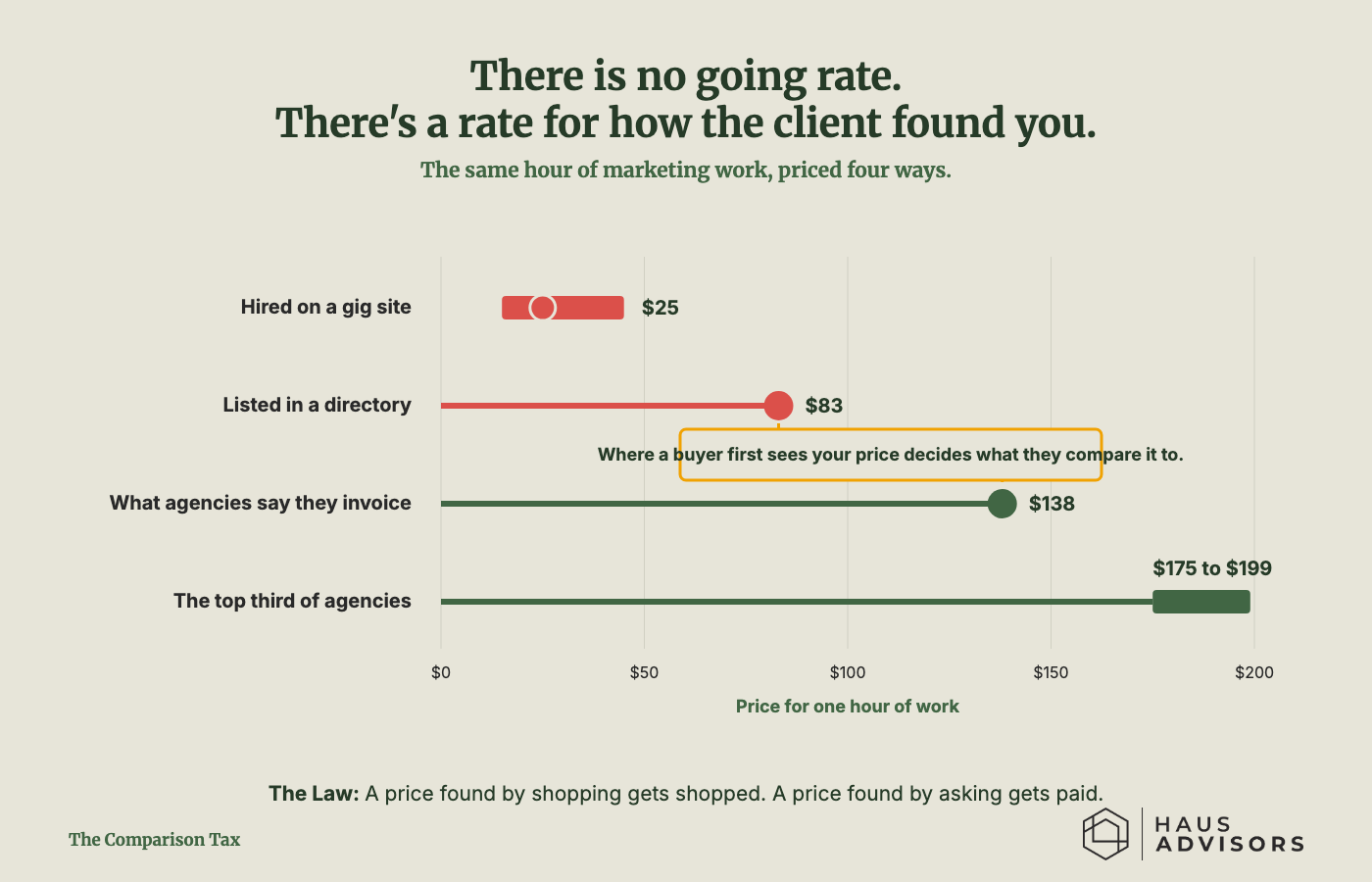
The same hour of marketing work, priced by how the buyer found it. Sources: Upwork (2026); DesignRush via MarketingSherpa, 6,808 agencies (2024); Credo pricing survey (2019); Promethean Research (2026). Sources span years and methods; the spread is the finding, not a trend.
Takeaway: If your blended rate is between $125 and $175, you're not premium. You're normal, that's the fat middle of the Promethean distribution. The interesting numbers are at the edges. The directory average of $83 is what buyers see when they comparison-shop; the $175–199 band is where a third of surveyed agencies actually live. The distance between those two numbers is what positioning buys. An agency that competes on a listed rate is choosing to be priced against Alaska. An agency that sells a specific outcome to a specific buyer gets benchmarked against nobody.
Monthly Retainer Benchmarks by Service
Retainers are the dominant agency revenue model: 85% of agencies work primarily on retainer, and only 1.21% don't offer them at all. Here's what they cost by service line. (For how these models actually get structured, see our breakdown of agency pricing models.)
“86% of agencies reported that their average monthly retainer is up to $10k.”
| Service | Typical monthly retainer | Survey average | Source |
|---|---|---|---|
| SEO | $501–$1,000 most common; 64% of agencies under $1,000 | $3,209/mo (agency avg) | Ahrefs, 2023; SE Ranking, 2024 |
| Local SEO | — | $1,557/mo | Ahrefs, 2023 |
| PPC management | $1,500–$15,000/mo, or 10–20% of ad spend | — | WebFX, 2026; WordStream |
| Digital PR | Half of retainers under $5,000/mo | $5,458/mo all; $6,357/mo agencies | BuzzStream, 2025 |
| Traditional PR | $7,500–$30,000/mo | — | Avaans Media, 2026 |
| Social media management | $750–$7,000/mo | — | WebFX, 2026 |
| Content marketing | $1,000–$9,500+/mo | — | DesignRush, 2026 |
| Email marketing | $1,000–$2,500+/mo | — | DesignRush, 2026 |
| Design (ongoing) | $3,000–$15,000+/mo | — | ManyPixels, 2026 |
The average SEO agency retainer is $3,209/month, but the single most common retainer band is $501–$1,000 (20.4% of providers). The average is pulled up by a long tail of large contracts; the median engagement is far smaller. (Source: Ahrefs, 2023)
64% of SEO agencies price retainers below $1,000/month, and 30% below $500, while the average U.S. small business spends $497.16/month on SEO. Most of the market is selling at a price point where results are structurally hard to deliver. (Source: SE Ranking, 2024; Backlinko, 2019)
Clients spending $500+/month on SEO were 53.3% more likely to be "extremely satisfied" than those spending less. That's the clearest buyer-side evidence that underpriced retainers underdeliver. (Source: Backlinko, N=1,200 business owners, 2019)
The standard PPC management fee is 10–20% of ad spend, with 84.74% of PPC agencies charging $50–$150/hr when they bill hourly. (Source: WordStream; Credo, 2019)
Digital PR retainers average $5,458/month, with agencies averaging $6,357/month and $663 per link earned. (Source: BuzzStream Digital PR Cost Survey, 2025)
Serving a national or worldwide market more than doubles retainer size: $3,474/month average versus $1,557 for local-market providers. That's a 123% premium for the same discipline aimed at a bigger problem. (Source: Ahrefs, 2023)
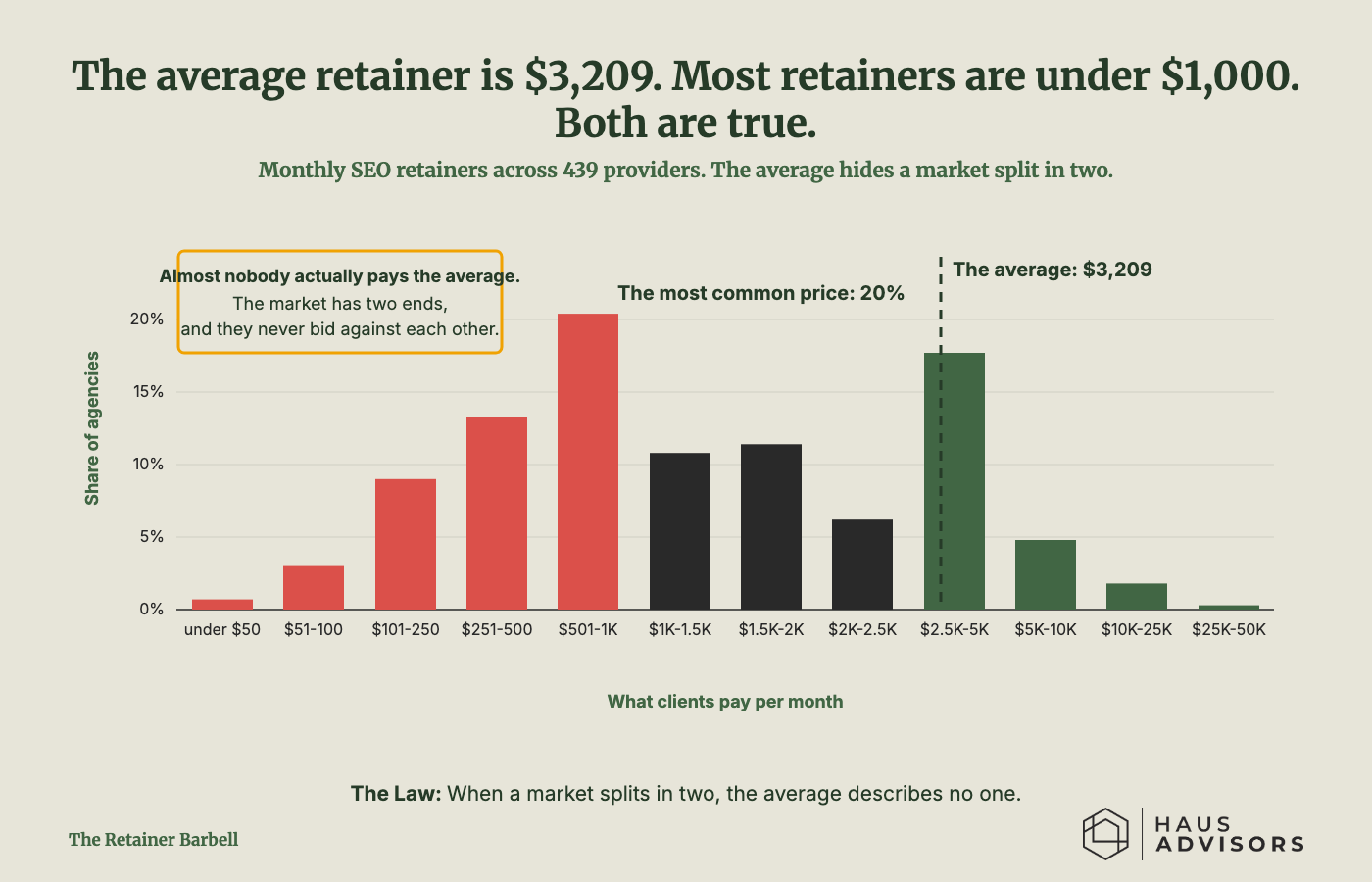
Distribution of monthly SEO retainers across 439 providers. The most common band is $501 to $1,000 while the average is $3,209. Sources: Ahrefs (2023); SE Ranking (2024). Clients spending $500+/month were 53.3% more likely to be “extremely satisfied” (Backlinko, N=1,200).
Takeaway: Agency retainer pricing is a barbell, not a bell curve. The mode is under $1,000; the mean is over $3,000; and the satisfied clients cluster at the top. If your average retainer is in the $1,000–$5,000 band, you're with the 49% plurality: average, not underpriced. But notice what the barbell implies. There is almost no competition between the two ends. The agencies charging $6,000+ aren't winning deals against the agencies charging $800; they're selling a different product to a different buyer. Moving up the barbell is a repositioning problem, not a negotiation problem.
Rates by Provider Type and Agency Size
The rate ladder from freelancer to consultancy is consistent across surveys, and it inverts what most buyers assume about seniority and headcount.
“Consultancies: $171.18/hour, on average. Agencies: $98.90/hour, on average. Freelancers: $71.59/hour, on average.”
| Provider type / size | Hourly rate | Monthly retainer | Source |
|---|---|---|---|
| Marketplace freelancer (Upwork) | $15–$45; median $25 | — | Upwork, 2026 |
| Freelancer (established) | $71.59 avg | $1,349/mo avg | Ahrefs, 2023 |
| Agency | $98.90 avg | $3,209/mo avg | Ahrefs, 2023 |
| Solo consultant | $171.18 avg | $3,250/mo avg | Ahrefs, 2023 |
| Typical digital agency (all sizes) | $125–$200 | — | Promethean Research, 2026 |
| New provider (≤2 yrs in business) | $73.05 avg | $1,541/mo avg | Ahrefs, 2023 |
| Established provider (10+ yrs) | $118.35 avg | $3,648/mo avg (5–10 yrs) | Ahrefs, 2023 |
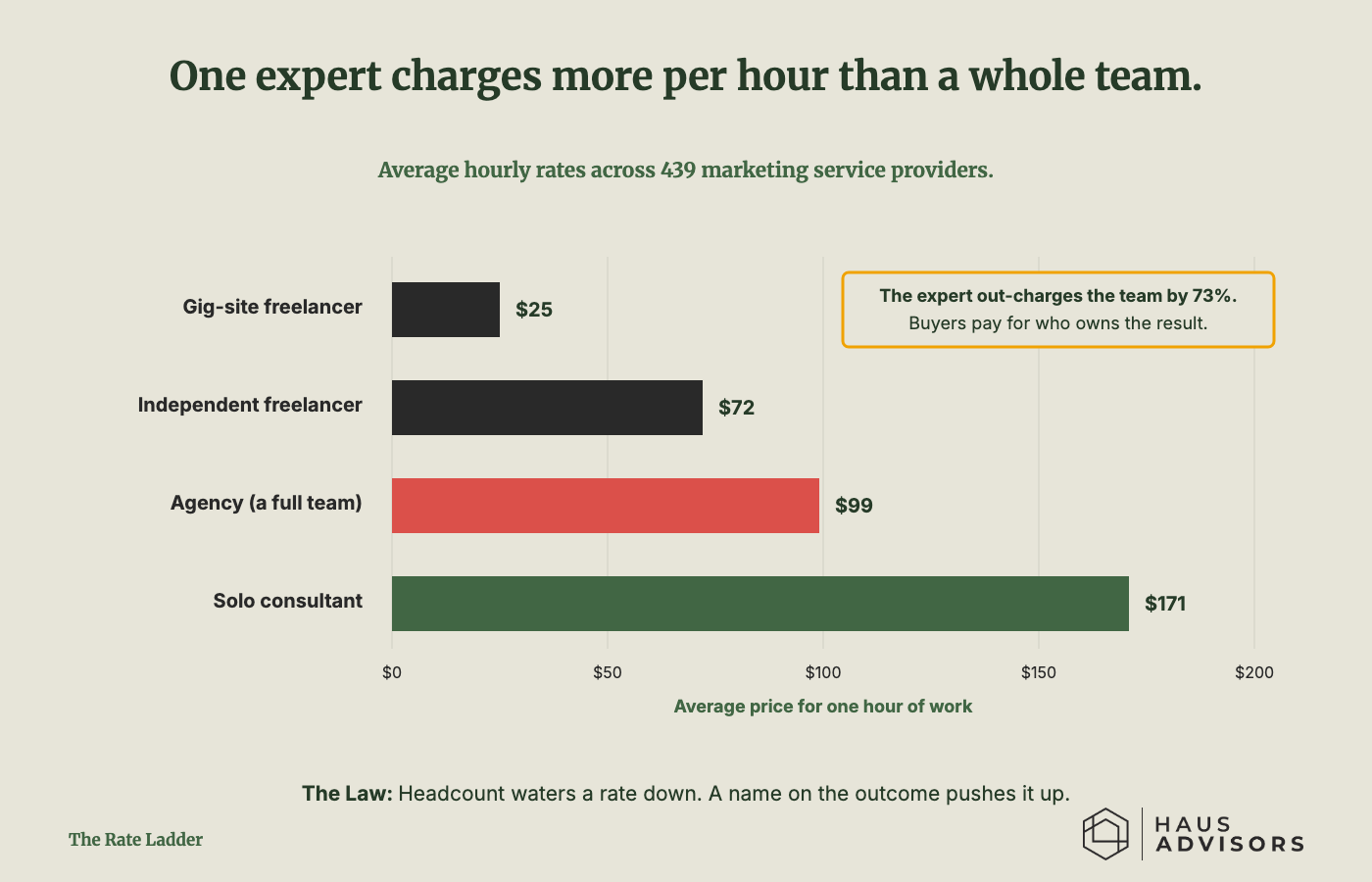
Average hourly rates by provider type. Sources: Ahrefs, 439 providers (2023); Upwork (2026).
Agencies charge 138% more than freelancers on monthly retainers ($3,209 versus $1,349) and more than 4x more per project ($9,508 average versus $2,349). (Source: Ahrefs, 2023)
Solo consultants out-charge agencies per hour: $171.18 versus $98.90. The highest hourly rates in the industry belong to individuals selling judgment, not teams selling capacity. (Source: Ahrefs, 2023)
The marketplace floor: Upwork digital marketers command a median of $25/hr, with typical rates of $15–$45. That's roughly one-quarter of the average agency rate for adjacent work. (Source: Upwork, 2026)
Experience compounds: providers with 10+ years in business average $118.35/hr versus $73.05 for those with two years or less, a 62% premium. On retainers, the 5–10 year cohort averages $3,648/month, more than double the newcomer average. (Source: Ahrefs, 2023)
Solo web designers show the same curve inside a single discipline: average rates climb from $76/hr to $131/hr as annual revenue grows. The market rewards proof, not effort. (Source: Web Designer Academy, State of Web Designer Pricing, 2025)
“The highest hourly rates in the industry belong to individuals selling judgment, not teams selling capacity.”
Takeaway: Buyers assume the rate ladder is freelancer, then consultant, then agency, with headcount justifying price. The data says otherwise: the consultant out-charges the agency by 73% per hour. What the market pays for at the top of the ladder is accountable expertise, one person whose name is on the outcome, not team size. If your agency's blended rate is below what a good solo consultant charges, your clients aren't paying for your team; your team is subsidizing your rate.
Benchmark yourself
Where does your pricing actually sit?
Project Minimums and One-Off Pricing
Retainers get the attention, but nearly half of providers also sell projects. The minimums reveal how agencies actually filter clients.
“A minimum is a positioning statement disguised as an operations policy.”
Half of agencies set their retainer minimum at $2,000/month or less, and only 13.5% require more than $5,000/month. 8% have no minimum at all. (Source: Credo, 2019)
36% of agencies will take a single project under $2,000; only 21% hold a project minimum above $5,000. (Source: Credo, 2019)
The most common per-project fee in SEO is $2,501–$5,000 (21.2% of providers), and 48.9% of providers offer project pricing alongside other models. (Source: Ahrefs, 2023)
54% of agencies charge between $1,000 and $10,000 for one-off projects. (Source: SparkToro, 2025)
Typical custom software projects reviewed on Clutch cost $10,000–$49,999, an order of magnitude above marketing project norms, which is why dev shops anchor differently. (Source: Clutch, 2026)
Takeaway: A minimum is a positioning statement disguised as an operations policy. The 13.5% of agencies holding a $5,000+ retainer floor aren't pricing out clients. They're pre-qualifying for the engagements where results are achievable, the same engagements where Backlinko found satisfaction concentrates. If you take $1,500 projects to fill revenue gaps, understand what the data says you're buying: the segment of the market with the least budget, the lowest satisfaction rates, and the highest churn.
Pricing Models: How Agencies Actually Charge
The model mix matters more than the rate. And the industry's supposed migration to value-based pricing has quietly reversed. (We've written about why in value-based pricing for agencies.)
“Agencies that switched to VBP in recent years are not achieving the results they thought they would, and now they’re switching away from it.”
78.2% of SEO providers charge via monthly retainer, 48.9% per-project, and 34.8% hourly. Most use more than one model. (Source: Ahrefs, 2023)
Only 8% or fewer of digital agencies rely on any single pricing model exclusively. The most common approach is a mix of time & materials, fixed bid, and retainer. (Source: Promethean Research, 2026)
Value-based pricing adoption nearly halved in one year, from 31% of agencies in 2024 to 18% in 2025, and VBP-only agencies underperformed every alternative on growth. (Source: Promethean Research, 2026)
The 22% of agencies that raised rates grew faster than the 73% who held steady. Raising rates beat switching pricing models as a margin lever. (Source: Promethean Research, 2026)
Only 1.21% of agencies don't offer retainers, and only 1.65% refuse one-off projects. That near-universal flexibility tells buyers pricing is negotiable by structure, not just by amount. (Source: Credo, 2019)
Takeaway: The value-based pricing story most agencies were sold (quantify client value, capture a share of it, escape the hour) is not what the adoption data shows. VBP is retreating, not winning, because it demands proof and sales sophistication most agencies haven't built. The unglamorous finding is the useful one: simply raising rates outperformed model innovation. Before you re-architect your pricing, check whether you've exhausted the simpler move of charging more for what you already do.
How Rates Changed From 2024 to 2026: The AI Squeeze
The clearest recent shift in agency pricing isn't the rates themselves. It's the shrinking share of agencies willing to raise them. (This is the AI Efficiency Penalty in action.)
“If the same output requires fewer hours, those using T&M are at risk as clients increasingly believe execution is easier. We are slowly seeing this show up in the data as agencies are raising hourly rates more slowly, hiring has been stagnant for years, and margins are slowly compressing.”
The share of agencies raising rates was cut in half from 2023 to 2024, landing at 22%; rebounded to 28% in 2025; then fell back to 20% in 2026. The 2021–22 rate-raising era is over. (Source: Promethean Research, 2026)
The average agency net margin fell to 13% in 2025, below the ~15% long-run average since 2015, with part of the compression attributed to clients expecting cheaper services because of AI (the full agency profit margin benchmarks by size and type are on their own page). (Source: Promethean Research, 2026)
Time-and-materials agencies bear the AI risk directly. When AI cuts production hours and pricing stays hourly, revenue falls even as efficiency rises. Promethean identifies this as the reason AI feels more disruptive to agencies than the internet, social, or martech waves: those expanded sellable work, while AI compresses it. (Source: Promethean Research, 2026)
53% of agency leaders saw AI as a significant threat to their business in 2025, up from 44% the year before. (Source: SparkToro State of Digital Agencies Survey, 2025)
Takeaway: If you held rates flat this year, you're with the 80% majority, and that's the problem. The 20% still raising rates aren't ignoring AI. They're the agencies whose pricing was never anchored to hours in the first place. When your invoice line reads "40 hours of work," AI efficiency is a discount your client expects. When it reads "a solved problem," AI efficiency is margin you keep. The squeeze is real, but it's landing almost entirely on agencies that bill time.
Find the real constraint
Is your rate the problem, or is it what your rate is anchored to?
If AI pressure has you defending hours, the fix isn't a better rate card. The free Bottleneck Score is 18 questions across the six things that decide whether an agency can raise its number: who it's for, what it sells, why buyers believe it, where demand comes from, who besides you can close, and whether the business owns any of that. You get one score and the one place to start.
Take the free Bottleneck Score →Already know where you're stuck? See how the Program moves it out of your head and into the business.
The Specialization Premium: Where Pricing Power Actually Comes From
The most counterintuitive finding in the 2026 pricing data: specialists don't out-charge generalists by the hour. They out-earn them anyway.
Specialists earned 37% average project margins versus 27% for generalists in 2025, on hourly rates in the same band. (Source: Promethean Research, 2026)
Specialist and generalist hourly rates fall in the same band (the specialist median sits one band higher). The premium doesn't show up on the rate card. (Source: Promethean Research, 2026)
Specialists earn 37% average project margins versus 27% for generalists, a 10-point spread on identical rate cards, because repetition makes delivery cheaper, scoping tighter, and rework rarer. (Source: Promethean Research, 2026)
Experience is the strongest rate predictor in the data: 10+ year providers charge 62% more per hour and 5–10 year providers bill 2.4x the monthly retainer of newcomers. Specialization is how an agency accumulates 10 years of experience in 3: solving the same problem 50 times instead of 50 problems once. (Source: Ahrefs, 2023)
Market scope doubles retainers: worldwide-serving providers average $3,474/month versus $1,557 for local providers. Narrow service, wide market is the highest-priced quadrant. (Source: Ahrefs, 2023)
Serving a bigger client, not building a bigger team, moves the number: consultancies out-charge agencies $171 to $99 per hour. Pricing power tracks positioning and proof, not headcount. (Source: Ahrefs, 2023)
Takeaway: If you've been waiting for specialization to justify a higher hourly rate, you've been watching the wrong number. The data says specialists charge roughly what generalists charge and keep 10 more points of every project. (Where those points sit against the rest of the industry is in our agency profit margins benchmarks.) That's the actual mechanism of pricing power: not a premium rate the client must swallow, but a delivery cost the client never sees. Which means the agencies that win the AI era won't be the ones that defend their rate card. They'll be the ones whose focus makes every efficiency gain, AI included, land on their side of the invoice.
Frequently Asked Questions
What is the average marketing agency hourly rate?
It depends on the measurement method. Directory-listed rates across 6,808 U.S. digital marketing agencies average $82.66/hour (DesignRush data, 2024), while self-reported survey averages run $137.94/hour (Credo, 2019). Promethean Research's 2026 benchmark puts the typical digital agency at $125–$200/hour, with 29% of surveyed agencies charging $175–199. A reasonable planning range for an established U.S. agency is $100–$200/hour.
How much does a marketing agency retainer cost per month?
Most agency retainers fall between $1,000 and $10,000 per month. 49% of agencies report average retainers of $1,000–$5,000 and 31% report $5,000–$10,000 (SparkToro, 2025). By service: SEO averages $3,209/month at agencies (Ahrefs), digital PR averages $6,357/month at agencies (BuzzStream, 2025), PPC management typically runs $1,500–$15,000/month or 10–20% of ad spend, and traditional PR runs $7,500–$30,000/month.
Do marketing agencies charge more than freelancers?
Yes, substantially. SEO agencies charge 138% more than freelancers on monthly retainers ($3,209 vs. $1,349) and more than 4x more per project (Ahrefs, 2023). Solo consultants out-charge both per hour: $171 versus $99 for agencies and $72 for freelancers.
What is the most common agency pricing model?
Retainers dominate: 85% of agencies work primarily on retainer (SparkToro, 2025) and 78.2% of SEO providers charge monthly retainers (Ahrefs). Most agencies mix models. Only 8% or fewer rely on a single pricing model exclusively (Promethean Research, 2026), and value-based pricing is retreating, down from 31% adoption in 2024 to 18% in 2025.
Are marketing agency rates going up or down?
Mostly flat. Only 20% of agencies raised rates in 2026, down from 28% in 2025 and roughly half the 2021–22 peak (Promethean Research). Average net margins fell to 13% in 2025, partly due to client expectations that AI should make services cheaper. Rates aren't falling, but the decade of easy annual increases has ended, especially for agencies billing by the hour.
Sources & Methodology
Every statistic on this page is traceable to the organization that originally collected it. Where sources conflict (e.g., the $82.66 directory average vs. the $137.94 survey average), both are shown with their methods noted. Vendor pricing guides are used only for typical service ranges, never presented as survey averages.
Ahrefs, SEO Pricing Survey, 439 SEO providers polled (2023, updated 2024): https://ahrefs.com/blog/seo-pricing/
Promethean Research, Digital Agency Industry Report (2026): https://prometheanresearch.com/digital-agency-industry-report/
Promethean Research, "Value-Based Pricing Was Supposed to Save Us" (2026): https://prometheanresearch.com/value-based-pricing-was-supposed-to-save-us/
Promethean Research, Digital Agency Benchmarking Tool: https://prometheanresearch.com/digital-agency-benchmarking-tool/
SparkToro, State of Digital Agencies Survey, N=376 agency owners (2025): https://sparktoro.com/blog/where-agency-revenue-is-heading-fewer-big-retainers-more-mid-market-retainers-and-longer-engagements/
Credo, Digital Marketing Industry Pricing Survey (2019): https://getcredo.com/guide/digital-marketing-industry-pricing-survey/
SE Ranking, SEO Pricing Survey, 260 agencies (2024): https://seranking.com/blog/seo-pricing/
Backlinko, The SEO Services Report, N=1,200 business owners (2019): https://backlinko.com/seo-services-statistics
BuzzStream, Digital PR Cost Survey (2025): https://www.buzzstream.com/blog/digital-pr-costs/
DesignRush agency data, reported by MarketingSherpa (2024): https://marketingsherpa.com/article/chart/digital-marketing-pricing
Clutch, Software Development Pricing Guide (2026): https://clutch.co/developers/pricing
Upwork, Digital Marketer Hourly Rates (2026): https://www.upwork.com/hire/digital-marketers/cost/
Web Designer Academy, State of Web Designer Pricing (2025): https://webdesigneracademy.com/state-of-web-designer-pricing-2025/
WebFX, Digital Marketing Pricing (2026): https://www.webfx.com/digital-marketing/pricing/
WordStream by LocaliQ, PPC Management Pricing: https://www.wordstream.com/blog/ws/2015/07/15/ppc-agency-pricing
DesignRush, Digital Marketing Agency Pricing Guide (2026): https://www.designrush.com/agency/digital-marketing/pricing
ManyPixels, Design Agency Pricing (2026): https://www.manypixels.co/blog/get-a-designer/design-agency-pricing
Avaans Media, How Much Does a PR Agency Cost (2026): https://avaansmedia.com/how-much-does-a-pr-agency-cost/
Keyhole Software, Custom Software Development Cost (2026): https://keyholesoftware.com/cost-custom-software-development/
About the author
David Hoos
Founder, Haus Advisors
David Hoos works with marketing agency founders who have built real businesses but haven't yet built the systems that let those businesses run without them. Haus Advisors advises independent agencies on positioning, pricing, and pipeline: the three levers that determine whether an agency is a job or an asset.
Keep reading
Browse by topic
- Positioning & Strategy
- Lead Gen & Marketing
- Sales & Biz Dev
- Pricing & Productization
- Research & Data
- Operations & Delivery
- Client Retention & Expansion
- Leadership & Culture
For founders whose agency has outgrown referrals.
One idea a week that makes a hard growth problem obvious, usually with a chart that shows you the mechanism behind it.
Built from conversations with seventy-plus agency founders on the Behind the Agency podcast.