Monthly Retainer Proposal Template: What to Include, How to Price It, and Sample Scope Language
A performance marketing founder I worked with had a closing problem she couldn't explain. Her discovery calls were strong. Her case studies were solid. Her pricing was competitive. But every monthly retainer proposal template she sent kept stalling. Prospects would go quiet after receiving the document, resurface two weeks later asking if they could "just do a project first," and either disappear or sign something smaller than what she'd proposed.
When I asked to see the proposal, I understood immediately. It was twelve pages. It had a termination clause on page four. The pricing table was the last thing before the signature block.
She had written a contract. Not a proposal.
Most retainer proposal templates read like contracts. They’re stuffed with rigid legalese, rigid hourly limits, and a pricing table slapped onto the final page. If you run a software dev shop, a performance marketing agency, or a data consultancy, you already know how this ends: the client pushes back on the monthly fee, asks to buy piecemeal project milestones instead, or simply ghosts you.
A retainer proposal has exactly one job: make the client feel absolute confidence that saying yes is their highest-ROI decision. That means building a case for outcomes, not hours. Setting scope that feels protective, not restrictive. And framing your price before you reveal the number. Here's the exact monthly retainer proposal template structure that closes retainer deals, along with the pricing frameworks most templates skip entirely.
Why Most Retainer Proposals Stall (And It's Not the Price)
The price is almost never why a retainer proposal stalls. I've seen $25K/month retainer proposals close in a week and $4K/month proposals die in silence for three weeks before the prospect hires someone cheaper.
What kills retainer proposals is scope ambiguity. The client can't visualize what they're buying month over month, so they hesitate. They ask for a project instead, not because they don't want the ongoing relationship, but because a project has a defined finish line they can mentally model.
The other thing that kills retainer proposals is the proposal-as-contract mistake. Loading a sales document with termination clauses, IP ownership language, and liability limits creates friction where you need trust. A prospect reading legal language in a proposal isn't thinking about the value of the engagement. They're thinking about what happens when it goes wrong.
There's also a selling motion problem most agency founders don't name. A retainer is fundamentally different from a project. A project asks the client to say yes to a defined deliverable. A retainer asks the client to say yes to an ongoing relationship. That second ask requires a stronger value case up front, not just a price and a list of what you'll do each month.
The single most common failure point I see: no explicit statement of what problem the retainer solves for the client's business. Why is ongoing support worth more than calling when they need something? That question should be answered before the client even gets to the scope section.
The Difference Between a Retainer Proposal and a Retainer Agreement
Every page I saw in the search results for "monthly retainer proposal template" conflates these two documents. They're not the same thing, and mixing them produces a document that's too legalistic to persuade and too vague to enforce.
A proposal is a sales document. Its job is to persuade. It should be clear, outcome-focused, and easy to say yes to.
A retainer agreement is a legal document. Its job is to protect both parties after the yes. It should be specific, enforceable, and signed after the proposal closes.
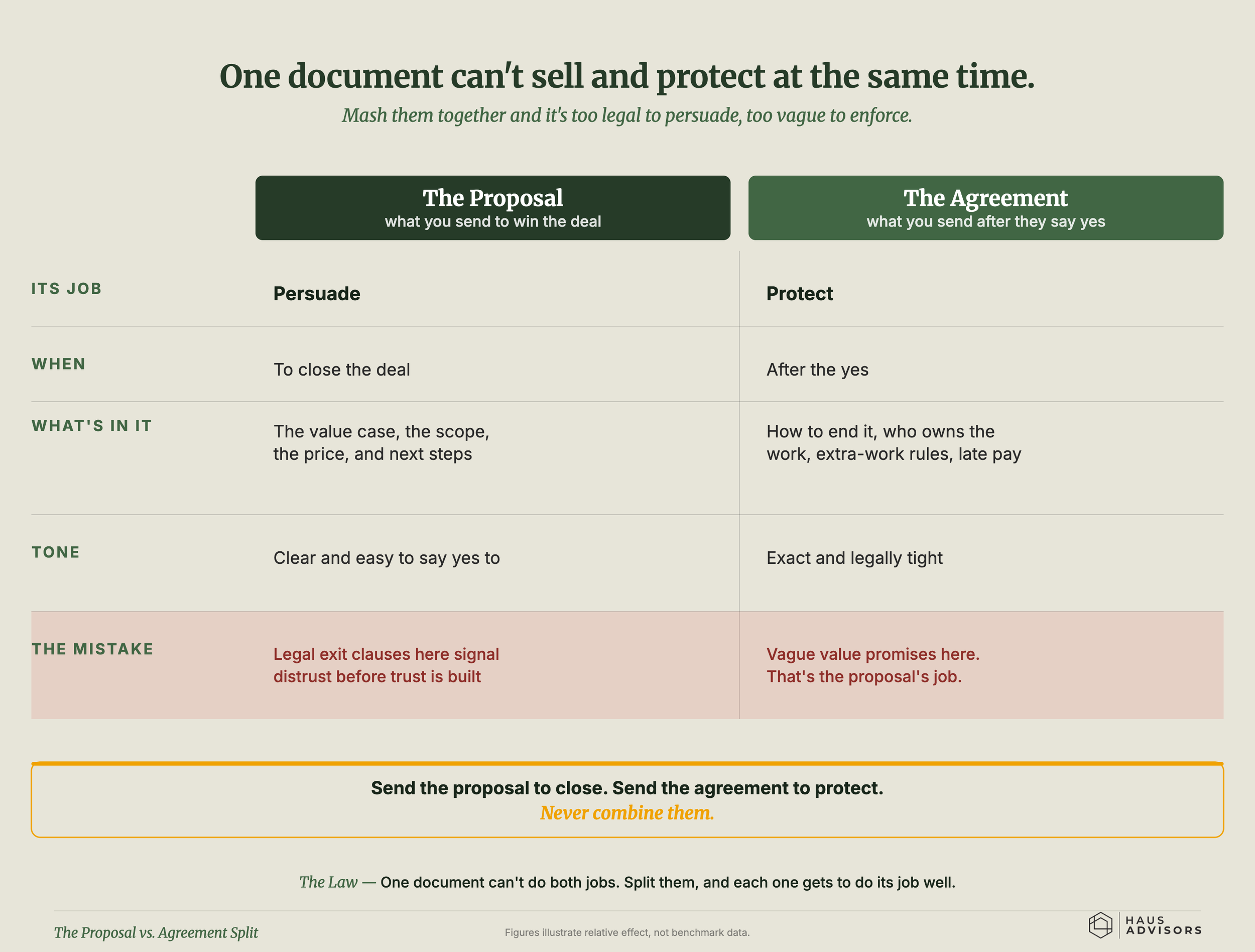
One document persuades. The other protects. Sending both jobs in one document produces something that's too legal to close and too vague to enforce. Split them, and only send the proposal until you have a yes.
What goes in the proposal: the value case, the scope summary, the pricing, and the engagement structure. What goes in the agreement: termination terms, IP ownership, overage process, governing law, and payment consequences.
The practical rule: send the proposal to close. Send the agreement to protect. Never put a termination clause in a proposal.
Here's what happens when founders skip this distinction. The proposal goes out twelve pages long, the client's lawyer reads it, and suddenly you're in a negotiation about liability clauses instead of a conversation about outcomes. I've seen retainer deals stall for three weeks not because the client didn't want the engagement, but because someone handed the proposal to legal and the legal team did exactly what legal teams do. Keep the sales document clean. It signals that you know the difference between persuasion and protection.
How to Write the Value Case Before You Define Scope
Every retainer proposal template I've seen starts with scope. This is backwards.
Scope tells the client what you'll do. The value case tells the client why it matters. If they don't understand why ongoing support changes something specific in their business, the scope is just a list of activities they're being asked to pay for monthly.
The value case is two sentences maximum. Start by naming the client's current situation and the cost of it, not necessarily in dollars, but in friction, missed opportunity, or speed lost. Then state what changes if they have ongoing support.
For a performance marketing agency: "Right now, your team is making paid media decisions without a dedicated strategic layer. That means reactive optimization instead of compounding strategy. This retainer is structured to close that gap."
For a dev agency: "Without a standing engineering partner, your product roadmap is subject to vendor availability and context loss at every engagement. This retainer provides consistent technical context across your full development lifecycle."
For a data consultancy: "Your team has the data but not the bandwidth to surface what it's telling you before the decision window closes. This retainer puts a dedicated analyst in the room for every major decision cycle."
Two sentences. Written specifically for this client. It appears before the scope section, not after.
Anatomy of an Agency Retainer Proposal (Section by Section)
A strong agency retainer proposal has seven parts, and the order matters as much as the content. Here is the structure, top to bottom.
COVER / HEADER
Client name. Date. Your agency name. Title the document something outcome-oriented, not "Proposal" and not "Monthly Retainer Agreement." Use: "Ongoing Performance Partnership" or "Strategic Development Support Plan" or "Standing Analytics Support."
THE SITUATION(one paragraph)
Reflect back what the client is dealing with. Show you listened. This creates the context that makes everything that follows feel earned rather than generic.
Sample language (performance marketing agency): "Your current paid media spend is generating leads, but the team is optimizing reactively, adjusting bids and creative based on last week's data rather than forward-looking signals. The result is consistent spend with inconsistent returns, and no strategic layer to catch the pattern before it becomes a quarter."
WHAT THIS ENGAGEMENT DELIVERS(three to five bullets)
Not a deliverables list. An outcome summary. What will be different in their business in 90 days?
Sample language:
Paid search and paid social campaigns optimized on a weekly cadence, with a dedicated strategy review each month
A clear attribution model so you know which channels are generating revenue, not just traffic
A standing point of contact who knows your account history and doesn't need to re-learn your business every engagement
SCOPE OF WORK
What's explicitly included. What's explicitly not included. How overages are handled. More on scope language in the next section, this is where most proposals go vague and most retainer relationships go sideways.
ENGAGEMENT STRUCTURE
How often you meet. How they reach you. What the reporting cadence looks like. This makes the retainer feel concrete. Clients who can picture the relationship are more likely to sign into it.
Sample language: "Monthly 60-minute strategy review. Weekly Slack updates on campaign performance and any material changes. All requests routed through a shared project management board with a 48-hour acknowledgment SLA."
INVESTMENT
The monthly fee. Payment timing (in advance, on the 1st). What triggers a scope reassessment (annual review, material change in spend level, expansion into new channels).
Present the price here, not at the end of the document. Price should come after value case and scope, but before next steps. The sequence is: situation → what changes → what's included → what it costs → what to do next. Never let price be the last thing the client reads.
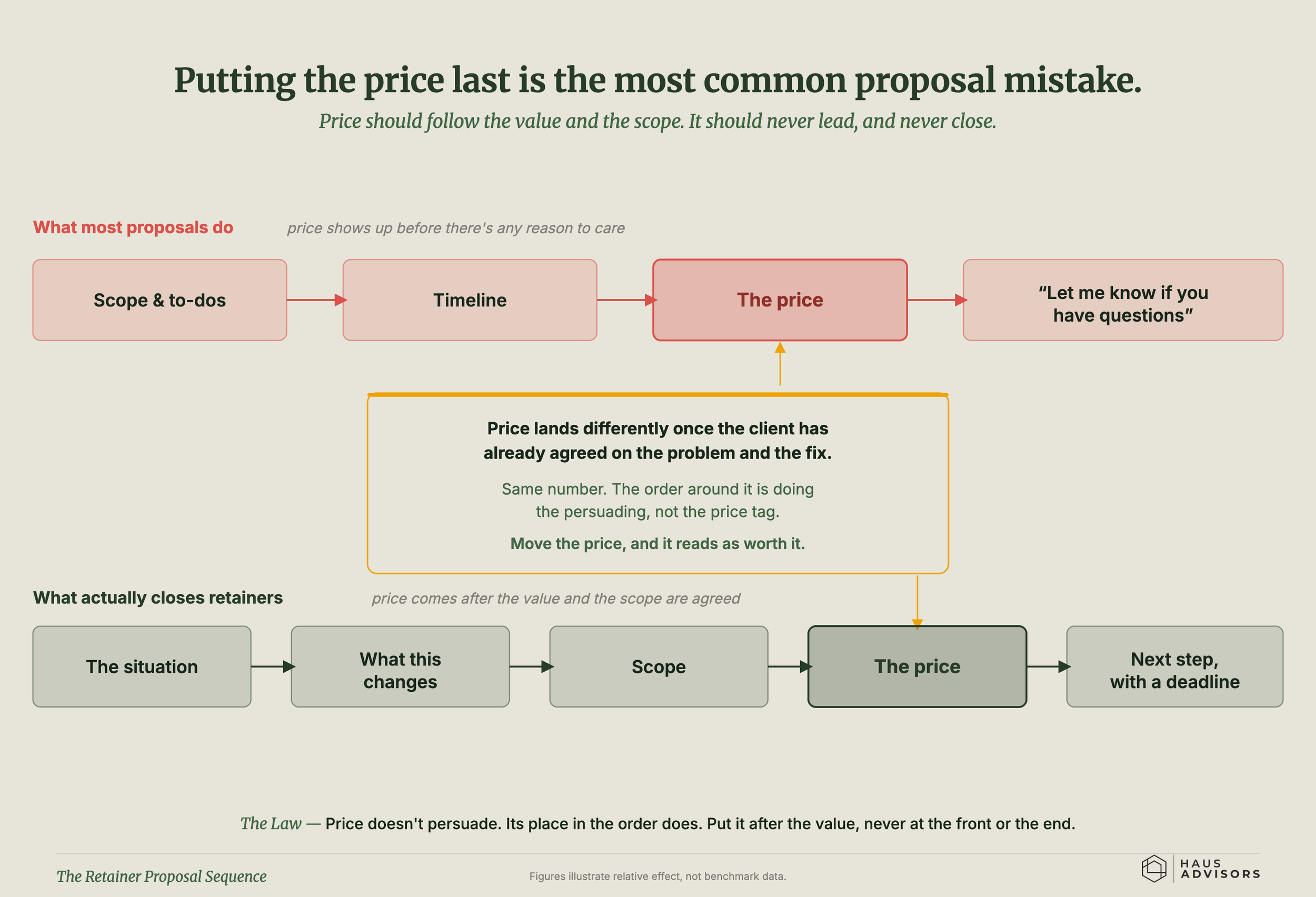
Most retainer proposals put price last because it feels safer. It isn't. Price lands differently when the client has already agreed on the problem and the outcome. Sequence is doing the persuasion work, not the pricing.
NEXT STEPS
One clear action. A deadline helps. Never end with "let me know if you have questions."
Sample language: "To move forward, sign and return this proposal by [date] and we'll schedule the kickoff call within the week. Questions before then? Reply to this email and I'll respond same day."
(The full template above is designed to be copy-pasted into Google Docs or Word and adapted for each client. The sections in italics are sample language: replace the specifics with your client's situation, your agency's scope, and your pricing before sending.)
Scope Language That Protects Both Sides
Scope is the hardest part of a retainer proposal for most agency founders. Generic templates punt on it entirely. They say "ongoing support as needed" and leave both parties to figure out what that means when month three gets complicated.
Specific scope language protects the client by telling them exactly what they're getting. It protects you by defining what triggers a scope conversation before work begins.
What to avoid (dev agency scope): "Ongoing software development support as needed, including architectural guidance, code reviews, and implementation work." This invites scope creep from day one. "As needed" is an open invitation.
What works (dev agency scope): "Up to 40 hours of senior engineering time per month, allocated across architectural advisory, code review, and implementation sprints. Requests above 40 hours or outside the defined technology stack trigger a scope conversation before work begins. Unused hours do not roll over."
What to avoid (performance marketing scope): "Monthly campaign management and optimization across paid channels." Every word in this sentence is ambiguous.
What works (performance marketing scope): "Standing optimization of paid search and paid social campaigns across [specified accounts], including weekly bid adjustments, monthly creative rotation, and a 30-minute strategy review each month. Creative production and new campaign builds are outside this scope unless added via a project addendum. Spend levels above [threshold] trigger a scope review."
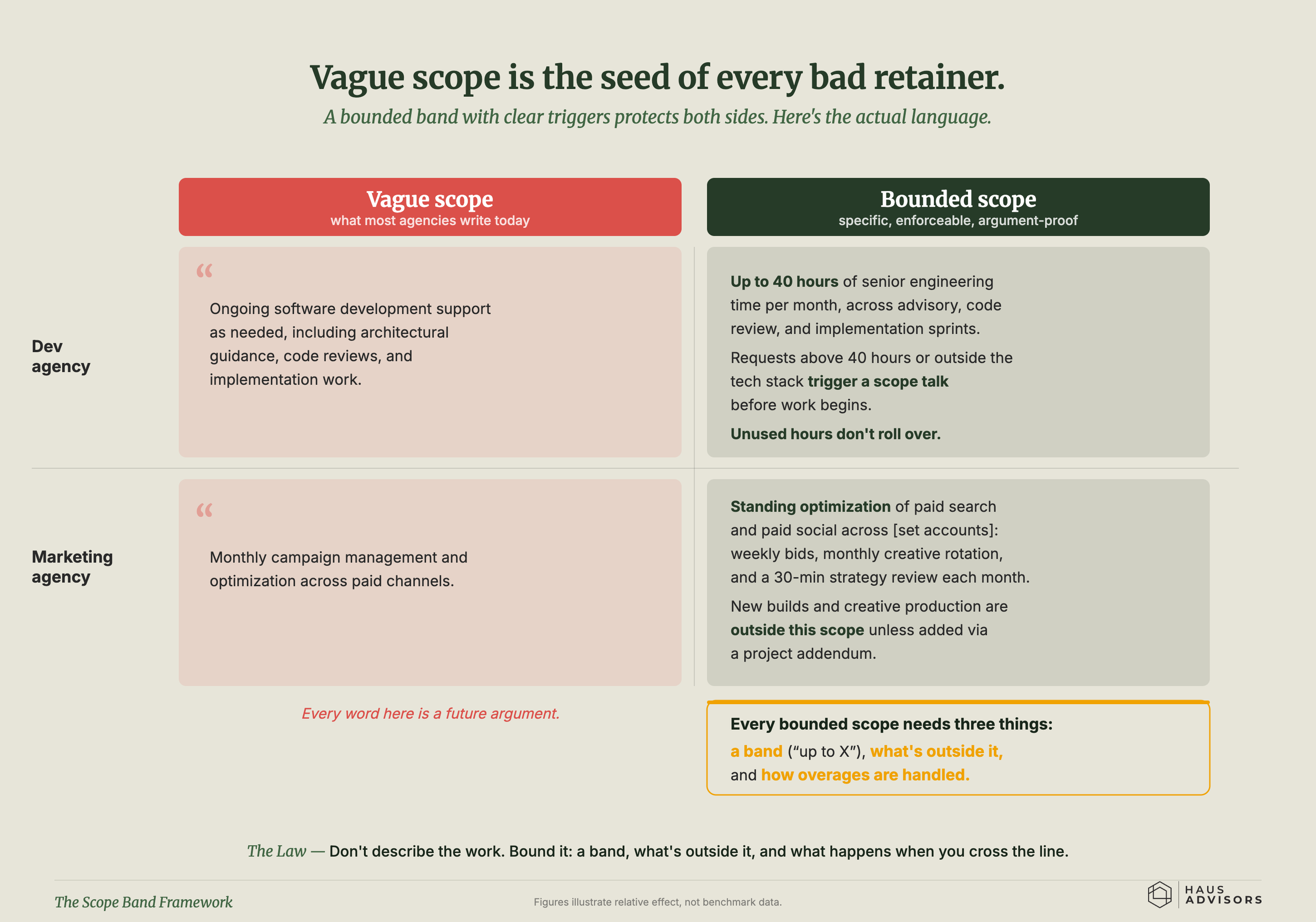
"As needed" is not scope. It's an invitation to a future argument. Every retainer scope needs three things: a band, what's outside it, and how overages are handled. Here's what that looks like for a dev agency and a performance marketing shop.
Three principles for scope language that doesn't collapse at month three: define the activities and outcomes in a band ("up to X hours"), explicitly name what is outside scope, and explain how overages are handled before the retainer starts, not when they happen.
How to Price Your Retainer (And Present It in the Proposal)
Most retainer proposal templates show you where to put the price. None explain how to arrive at it.
Don't start with hours. Start with what the outcome is worth to the client. A performance marketing retainer that reduces CAC by 15% on a $500K annual spend is worth $75K in recovered budget. A dev retainer that eliminates context loss across engagements is worth the cost of re-onboarding a new vendor every three months, which is typically 20-40 hours of engineering time per transition.
Three pricing anchors that work for agency retainers:
Outcome-based: Price as a percentage of the value you're creating or protecting. 10-20% of quantified value is a credible range. This requires a specific kind of discovery conversation, one where you actually nail down the cost of the problem, not just the symptoms. Most agency founders don't run that conversation, which is why this pricing model is underused.
Capacity-based: Price based on access to a team at a fixed monthly fee. The client isn't buying hours, they're buying standing availability. This works when the value of the relationship is the consistency, not any specific deliverable.
Time-based: Time-based pricing is the most common and the least defensible, it keeps the client focused on utilization rather than outcomes. Use it only when the other two aren't available yet.
The Tiered Options Frame: offer two or three retainer configurations. A focused tier, a full-service tier, and optionally a lightweight advisory tier. The choice frame reduces sticker shock and increases close rate. The middle option closes most often.
One more rule: never let price be the last thing on the page. Follow it immediately with what happens next.
If your price keeps getting pushed back, the problem is usually the pricing model, not the proposal.
Common Mistakes to Avoid
Using the same proposal template for retainers and projects. This one costs the most deals. A project proposal closes a defined deliverable. A retainer proposal sells an ongoing relationship. The structure, tone, and value case are fundamentally different, and clients can feel when you've handed them a document that wasn't written for this situation.
Including a termination clause in the proposal. Save it for the agreement. A termination clause in a sales document signals that you're already thinking about how the relationship ends before it starts. The client will notice, even if they don't say so.
Leaving the renewal process undefined. A proposal that doesn't say what happens at month six creates awkward renegotiations that erode the relationship. It's one line: "This engagement renews month-to-month unless either party requests a scope review 30 days in advance." Add it.
Writing scope in terms of your process rather than the client's outcome. "We will conduct weekly optimization" tells the client what you do. "Your campaigns will have a dedicated optimization cycle that catches underperformers before the next billing period" tells them what changes. The second version is easier to say yes to.
Attaching the invoice or payment link before the proposal is signed. The client should say yes first, then receive payment instructions. Sending both together makes it feel transactional, like you're trying to close before they've decided.
How Haus Advisors Approaches Retainer Pricing and Proposal Structure
A proposal that keeps stalling is a symptom of something upstream: undefined service architecture, unclear scope, or pricing that isn't grounded in a value baseline. The proposal is the last step. When it breaks, the problem is usually earlier in the process.
Most founders reading this already know the real problem. It isn't the proposal template. It's that the reputation, the relationships, and the judgment that make your agency worth hiring still live in your head. So the business only grows when you're in the room, and every proposal that matters still crosses your desk before it goes out.
That's the work we do at Haus Advisors. The New-Business Engine is six months of implementation, not a strategy document. We pull what makes your agency relevant out of your head, build it into positioning, offers, and growth plays your team can run, and hand ownership to them. If you want an agency that grows without needing you in every deal, book a call to see if it's a fit.
Common Questions About Agency Retainer Proposals
What should a retainer proposal include?
A retainer proposal should include the value case, the scope, the price, and the terms, in that order. Lead with the outcome the client is buying, then define what is and is not covered, then present the monthly price, and close with start date and renewal terms. The version that stalls almost always opens with scope and price instead of value.
How is a retainer proposal different from a retainer agreement?
A proposal is the document that gets the client to yes. An agreement is the contract that governs the work after they say yes. The proposal sells the relationship. The agreement protects it. Sending a contract when the client expected a proposal is the fastest way to lose the deal.
How long should a monthly retainer proposal be?
A retainer proposal should be short enough to read in one sitting, usually two to four pages. Twelve-page proposals stall because they read like contracts. Put the value case and price up front, move legal terms to the agreement, and let the proposal do one job: earn the yes.
How do you price a monthly retainer?
Price a retainer on the value of the outcome, not the hours you expect to spend. Set a defensible baseline tied to what the engagement is worth to the client, present it as a clear monthly figure, and offer one or two tiers so the client chooses how much, not whether. If you cannot articulate the value case, the pricing problem is upstream of the proposal.
Next Steps
If you're writing a retainer proposal right now, the template structure above gives you everything you need to put together a stronger document than most of what's out there. Copy the section headers into a Google Doc, replace the sample language with your client's specifics, and send it before the end of the week.
If your proposals are landing but retainers keep churning, or you're struggling to articulate what to include and what to charge, that's a pricing or positioning problem upstream of the template. The document is fine. The architecture behind it isn't.
That's what the first phase of the New-Business Engine is built to find. We pull the offer design, the pricing logic, and the discovery questions out of your head, so the team can send a proposal you didn't have to rewrite.
Keep reading
Browse by topic
- Positioning & Strategy
- Lead Gen & Marketing
- Sales & Biz Dev
- Pricing & Productization
- Research & Data
- Operations & Delivery
- Client Retention & Expansion
- Leadership & Culture
For founders whose agency has outgrown referrals.
One idea a week that makes a hard growth problem obvious, usually with a chart that shows you the mechanism behind it.
Built from conversations with seventy-plus agency founders on the Behind the Agency podcast.