From Hourly to Productized: The 6 Agency Pricing Models (and Why Value-Based Pricing Keeps Failing You)
I talked to a performance marketing agency founder last spring who had done everything right. Fourteen people. $1.8M in revenue. She'd read the articles, listened to the podcasts, made the switch from hourly to retainers two years earlier. Her cash flow got more predictable. Her team felt more stable.
But her margins hadn't moved. Still hovering around 14%, down from 16% when the agency was smaller.
When I asked what she thought the problem was, she didn't hesitate. "I just haven't made the move to value-based pricing yet."
She had already tried it twice. Both times, the prospect had nodded along through the value conversation, asked what the investment would be, and then gone quiet. One came back a week later with a counteroffer built around hourly rates. The other hired a cheaper shop.
She wasn't doing the value conversation wrong. She was doing it without the foundation that makes it work.
Most articles about agency pricing models are written by the software companies that profit when you track every minute, so they hand you a neutral list and tell you "it depends." This is not that.
“The model was never the problem. Your positioning is.”
Whether you're a software dev shop tired of trading engineering hours for dollars or a performance marketing agency trapped in low-margin retainers, changing your billing mechanism rarely fixes a flatlining margin. The model was never the problem. Your positioning is.
But we'll get to that. First, the map.
The Six Pricing Models: What Each One Does to Your Margins
There are six ways agencies charge, and each one makes a quiet promise to your revenue, your margins, and the way clients think about what you're worth. Most agencies pick one by default and build around it. The ones with pricing power pick deliberately.
| Model | Best for | Key risk | Positioning required |
|---|---|---|---|
| Hourly | Undefined scopes, early-stage agencies, ad-hoc work | Punishes speed and expertise — the better you get, the less you bill | None |
| Fixed Project | Bounded scopes with a clear deliverable and finish line | Feast-famine cycle — revenue resets to zero after every project closes | Basic |
| Retainer | Ongoing relationships with a standing need or capability | Hourly in disguise — hour-based retainers invite audits and renegotiations | Basic |
| Productized | Agencies with a repeatable process for a specific problem | Can't productize what you haven't positioned — generalists can't build this | Sharp |
| Value-Based | High-stakes engagements where the cost of inaction is felt | Collapses without differentiation — becomes a negotiation with extra steps | Expert |
| Performance | Agencies confident enough in outcomes to put fees at risk | Attribution disputes — who gets credit when the result happens? | Expert |
Hourly / Time-and-Materials
This is where almost every agency starts. It's intuitive, it's easy to explain, and it feels fair to both sides.
It's also the model that punishes the thing you most want to get good at: speed.
The structural flaw is simple. The better your team gets at delivering results, the less they bill. A senior developer who solves a problem in four hours bills less than a junior one who takes twelve. You're not building a business that rewards expertise. You're building one that rewards effort. Those are different things.
Hourly still makes sense for genuinely undefined scopes, short ad-hoc work, and agencies early enough that they don't yet know their real delivery costs. But if hourly is your primary model after year three, the market is paying for your labor. Not your expertise.
Fixed Project / Flat Fee
Fixed pricing is the first real step toward treating your work as a product rather than a service. The client knows what they're getting. You know what you're building. The financial upside is yours if you deliver efficiently.
The problem is what happens at the end.
Every project-based agency lives with the feast-famine cycle. The project closes, the delivery runs, the invoice goes out. Then the pipeline resets to zero. Revenue is lumpy not because business is slow, but because the model requires a constant stream of closings just to stay flat. Add scope creep to that, and fixed-price work can quietly destroy the margins it was supposed to protect.
A data analytics agency I worked with felt this acutely. Clean engagements, strong margins on paper, but the team spent the back half of every project already pitching the next one. Every quarter was a sprint from zero.
Fixed pricing works when the scope is genuinely bounded and the deliverable has a clear finish line. It stops working when your client relationships are better than your contract discipline.
One more thing about fixed project pricing that doesn't get said enough: a lot of agencies rush to retainers before they have the positioning to hold them. If a client can't articulate why they'd pay you a standing monthly fee versus calling when they need something, that's not a retainer problem. That's a positioning problem. And a fixed-project model, properly scoped, is more honest for where you actually are.
Retainer
Retainers are the closest thing the agency world has to predictable revenue, which is why they've become the dominant model. A 2026 survey from InfluenceFlow found that 78% of digital agencies now use retainers as their primary pricing structure, up from 64% in 2023. That shift happened for a reason.
But there's a version of the retainer that's a trap.
If your retainer is priced as "a set number of hours each month," you haven't escaped the hourly model. You've wrapped it in a subscription. And clients know it. The moment they feel like they're not using their hours, they start auditing the bucket. That conversation always ends with a renegotiation or a cancellation.
The retainer that works is priced against an outcome or a standing capability, not a timesheet. "You have access to our team to maintain and improve your paid search performance" is a different value conversation than "you have 40 hours of our time per month." Same work. Completely different contract dynamics.
Value-Based
Every guide to agency pricing models calls value-based pricing the gold standard. Most of them don't explain why it keeps failing in practice.
We'll cover that in the next section.
The short version: value-based pricing works when the buyer already perceives you as differentiated. When you're one of several capable options, it doesn't work. Not because the tactic is flawed, but because the prerequisite is missing.
Where value-based pricing genuinely shines: high-stakes engagements where the client can already feel the cost of inaction, and where your track record makes the outcome feel credible. That combination is rarer than the podcasts suggest.
Productized / Subscription
Productized services are the model most agencies wish they had and few know how to build. Fixed scope, fixed price, sold like a product — the buying decision is simple and the delivery is systematized, which means you can grow revenue by adding clients rather than adding headcount. That's a different business than a services firm. The economics work differently.
The quiet advantage nobody talks about: because a productized offer is scoped in advance, the margin on repeat clients compounds. You're not re-estimating every engagement. You're running a known process.
But the prerequisite is the part that always gets skipped. You can only productize what you've already positioned. A product needs a specific buyer and a specific job. A narrowly defined problem that a specific type of client has, delivered in a way that can be repeated with consistent quality. Generalist agencies can't productize because they haven't committed to a lane. Positioning comes first.
Performance / Hybrid
Performance pricing is the bet-on-yourself model. A base fee plus upside tied to a measurable result. If you grow their revenue, you share in the growth.
The challenge is attribution. Who gets credit when the result happens? Was it the creative, the media buy, the landing page, the sales team? Every performance deal eventually runs into this question, and the answer is always contested. For data and analytics agencies, it runs even deeper: the insight your model generated may have driven the decision, but proving that causal chain to a client's satisfaction is its own project.
Performance models work for agencies with enough confidence in their outcomes to put a piece of the fee at risk, and enough contract clarity to define the trigger before the work starts. Make the trigger binary. "If ROAS exceeds 4x in months 3 through 6, the fee increases by $X." Vague performance metrics become arguments.
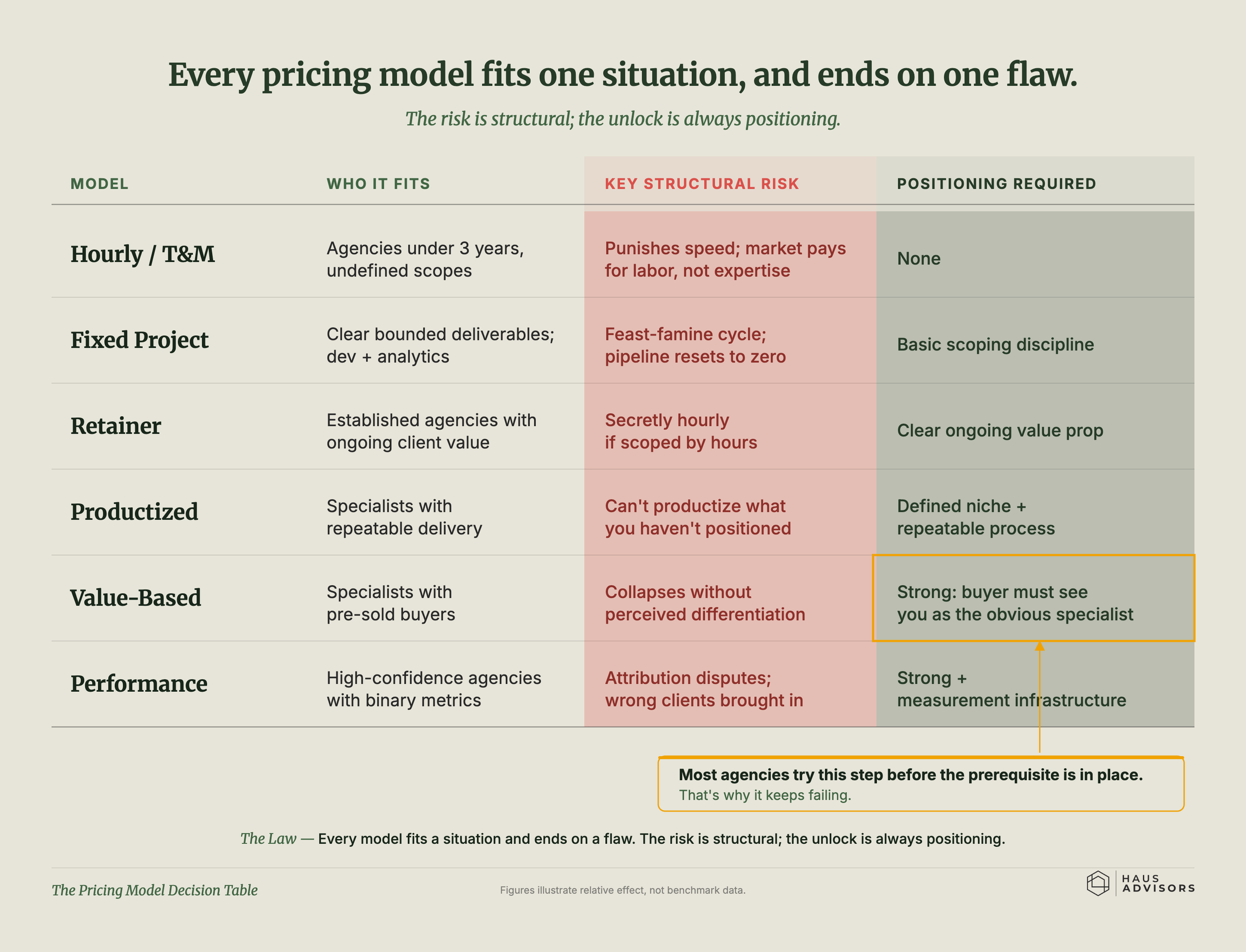
Every model has a situation it fits and a flaw that ends it. The pattern: the higher-margin models don't require better sales skills. They require stronger positioning.
Why Value-Based Pricing Fails (And What Has to Come First)
Here's what the standard advice gets wrong.
Every article on value-based pricing tells you to "have the value conversation." Ask the prospect what the outcome is worth to them. Anchor to ROI. Price based on the impact, not the hours. It's the right framework.
And it falls apart in practice for most agencies.
The reason isn't a lack of execution. It's a missing prerequisite.
Value-based pricing is not a pricing skill. It's a positioning outcome. You can only charge based on the value the buyer already perceives. And the buyer can only perceive that value if your positioning has made you the obvious specialist for their specific problem.
“Value-based pricing is not a pricing skill. It’s a positioning outcome.”
Think about what happens in a sales call when you're one of five agencies the prospect is talking to. They're asking about scope. They're comparing deliverables. They're deciding who to trust with a project they could also give to three of your competitors. That's not a value-based pricing conversation. That's a commodity conversation with a value-based wrapper.
Now think about what happens when a founder calls you because his CTO recommended your firm specifically. Because you're known for building data infrastructure for Series B SaaS companies going through hypergrowth, and that's exactly his situation. That conversation doesn't start with scope. It starts with "can you help us, and when can you start?"
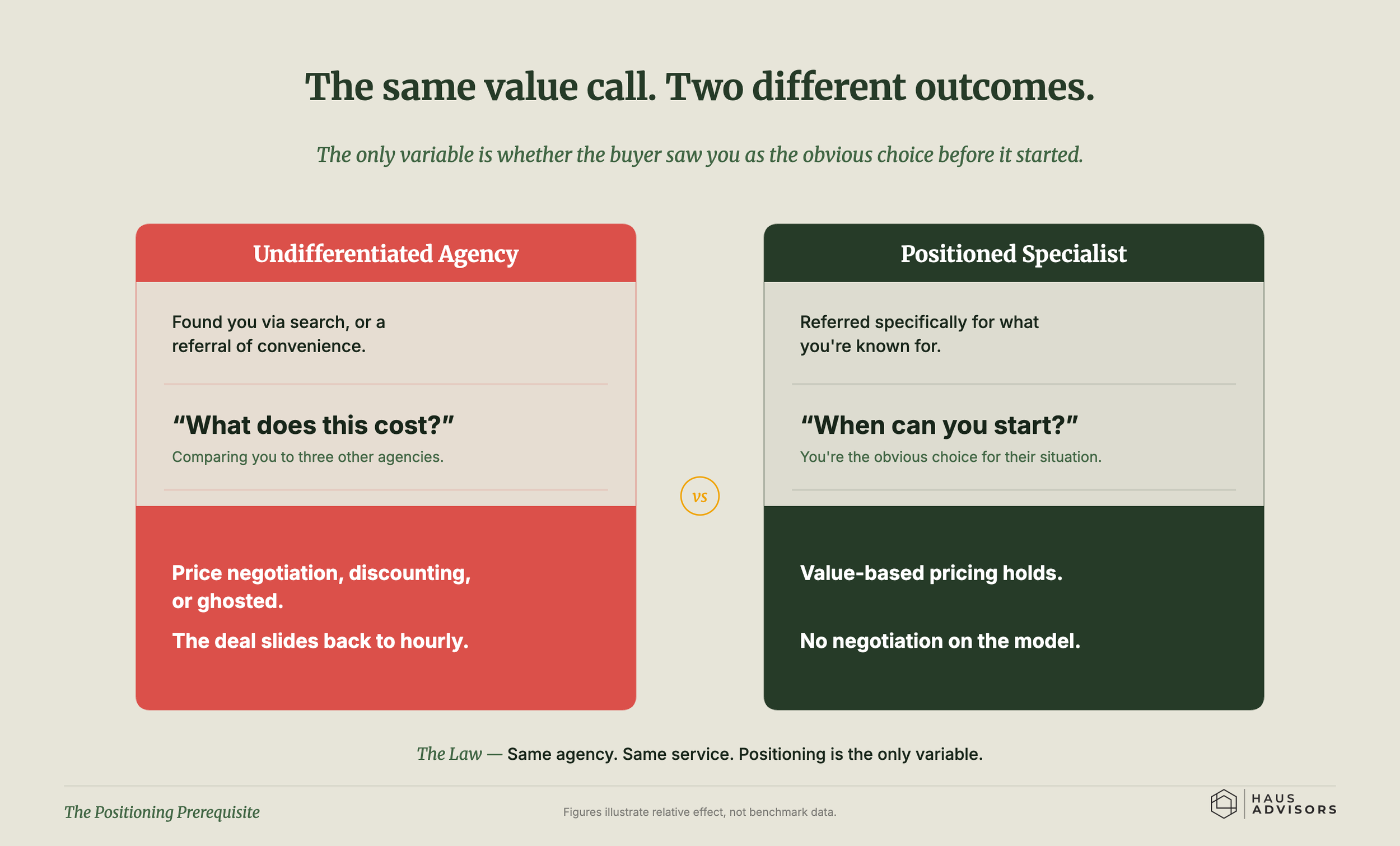
The value conversation doesn't fail because you ran it wrong. It fails because the buyer arrived without the perception that makes it work. That perception is built before the call, not during it.
Same service. Completely different commercial dynamic. The pricing is different because the positioning is different.
“Craft earns you repeat business and referrals. It doesn’t earn you pricing power.”
The Delivery Trap makes this worse. Most agency founders I talk to believe that if they just do better work, the market will pay more for it. It doesn't work that way. Craft earns you repeat business and referrals. It doesn't earn you pricing power. Pricing power comes from differentiation: from being the obvious choice for a specific type of problem, not from being excellent at a broad range of work.
If value-based pricing keeps collapsing in your sales calls, stop looking at the pricing model. Start looking at what you're positioned to be.
How to Know Which Pricing Model Your Agency Has Earned
The right question isn't "which pricing model is best." It's "which model fits where I am, and which model does my positioning allow me to move toward next?"
That reframe matters. Because the gating variable at every transition isn't revenue. It's positioning clarity.
Every agency I've worked with started on hourly. Most escape toward fixed project pricing as they learn their delivery costs and develop the contract discipline to scope cleanly. Established agencies add retainers and productized offers as their service lines sharpen. Specialists with clear, demonstrable outcomes earn the right to value-based and performance pricing because their buyers arrive pre-sold on the impact.
The transitions aren't automatic. An agency with sharp positioning can move to productized offers at $1M in revenue. An undifferentiated agency still struggles to hold a retainer at $5M, because every renewal is a negotiation.
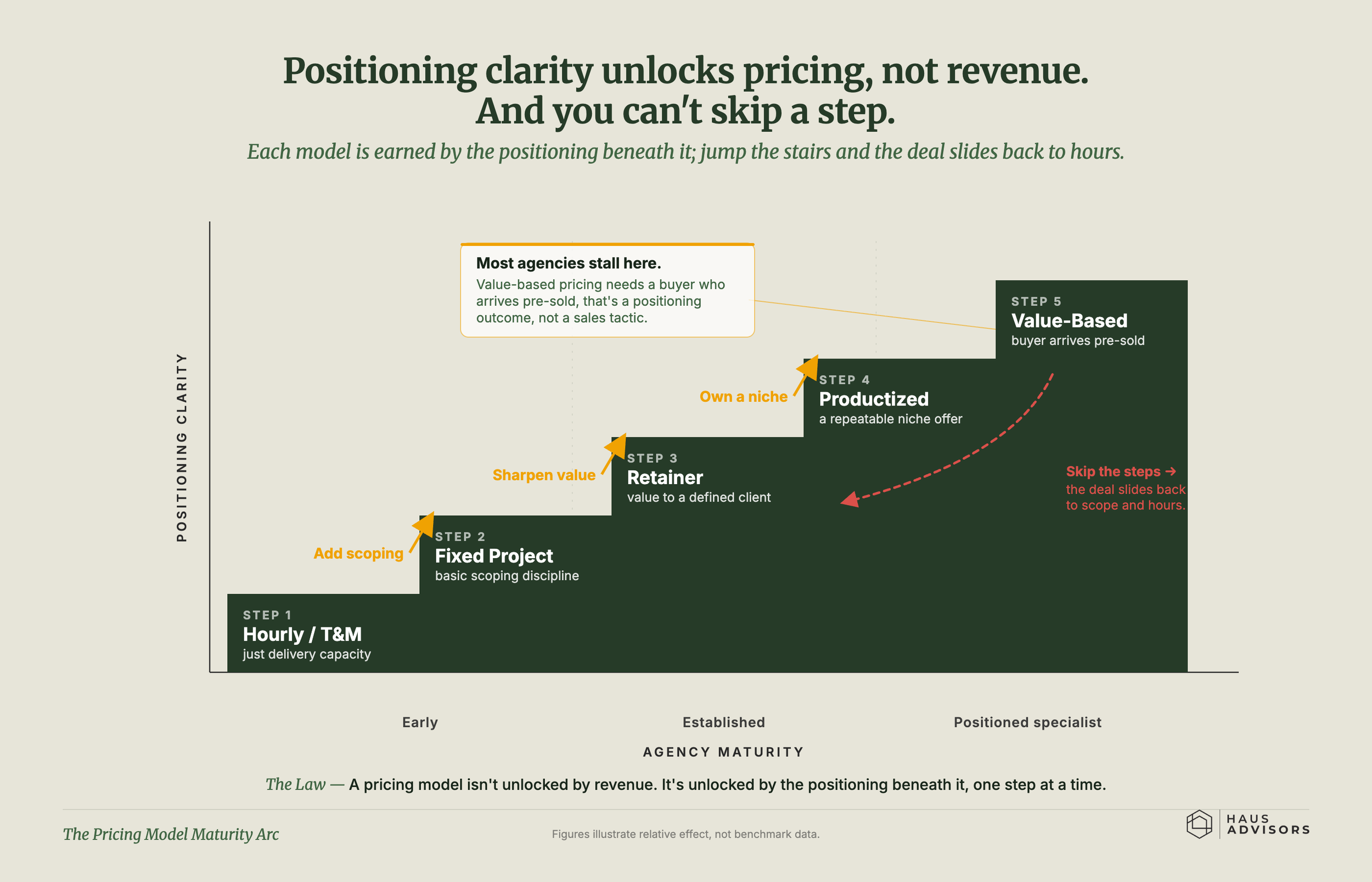
Most agencies try to jump to value-based pricing before they've earned the positioning that makes it work. The model isn't the problem. The step they skipped is.
Here's the self-check that cuts through the noise: can you name, in one sentence, the one type of buyer you're best for and the one problem you solve better than anyone else? Not "B2B companies" and not "digital marketing." A sentence that a former client could repeat back to a colleague over lunch, and the colleague would immediately know whether it applied to them.
If you can't pass that test, you don't have a pricing problem. You have a positioning ceiling. And no model switch will raise it.
Five Pricing Mistakes That No Model Switch Will Fix
I see these in almost every pricing conversation I have with founders. If you recognize yourself in more than two, the pricing model isn't the thing to fix.
Switching from hourly to retainers, or retainers to value-based, without fixing the positioning that determines whether any model can hold. The change feels like progress. It usually isn't.
It looks like a retainer on the invoice. But it's scoped by hours, tracked by hours, and the client knows it. When utilization drops, the renegotiation starts. This is a scope problem, not a pricing problem.
The value conversation is there. The ROI framing is there. But the client doesn't see you as the obvious choice for their specific problem. Without that, the value conversation is just a negotiation with extra steps.
Well-positioned agencies raise rates and keep their best clients — constantly. The clients who leave over a rate increase were rarely the ones worth keeping. They were buying on price, not on fit.
One client on hourly because the scope was undefined. One on a custom hybrid because they pushed back. One productized offer that got customized into something unrecognizable. Six months later you have six clients on six arrangements and no coherent pricing signal going to market. Clients feel that incoherence before you can see it.
How We Help Agencies Break Through the Pricing Ceiling
This is the pattern I keep seeing with agency founders who finally break through on pricing: they didn't find a better model. They fixed the thing upstream.
The New-Business Engine is where most of this starts. The first phase is where we pull the positioning and the judgment out of your head and name the single constraint holding the agency back. Sometimes that's positioning, sometimes productization, sometimes pipeline. For founders who've tried every pricing model and still feel stuck, that first phase almost always surfaces a positioning gap that no billing structure could have fixed.
From there, the rest of the Program is where the actual work happens: six months of implementation, not a strategy document. Positioning comes first because it has to. You can't build a productized offer without a clear buyer, and you can't hold value-based pricing without clear differentiation. And the productized offer matters for another reason. It's what lets someone other than you scope the work and sell it.
Then pricing architecture: rebuilding the offer structure so the model matches what the agency can actually deliver and defend. Then pipeline, so the leads coming in are already shopping on fit rather than price.
The agencies that come out of the Program aren't necessarily charging more across the board. They're charging more to the right clients, and losing fewer deals to the wrong ones. That's what actually moves the margin.
One more concept worth naming here: the Stress Tax. It's the hidden cost of running an agency with a pricing model that creates feast-famine cycles. The decision fatigue, the conservative hiring, the clients you take because you're worried about what Q3 looks like. Fixing the pricing model by fixing the positioning underneath it doesn't just improve the P&L. It changes how the whole agency feels to run.
The One Test That Tells You Whether Pricing Is Actually Your Problem
Start with the positioning test.
Can you name, in one clear sentence, the one buyer and the one problem you're best positioned to solve? Not "we work with growth-stage companies on their digital presence." Something specific enough that a former client could describe you to a prospect and the prospect would immediately know whether it applied to them.
If you can't pass that test, the highest-leverage move isn't changing the pricing model. It's getting the positioning sharp enough that the right model becomes obvious.
If you can pass it — if you have a clear niche, a specific problem, and clients who seek you out because of what you're known for — then the next question is whether your pricing captures the value you're actually creating. Most agencies in that position are underpriced relative to the positioning they've built.
That gap is what the first phase of the New-Business Engine is built to surface: one constraint named, and a specific recommendation for what to fix first. If you want your agency to grow without needing you in every deal, that's what the Program is built for. Book a call to see if it's a fit.
The model doesn't lead. The positioning does.
Keep reading
Browse by topic
- Positioning & Strategy
- Lead Gen & Marketing
- Sales & Biz Dev
- Pricing & Productization
- Research & Data
- Operations & Delivery
- Client Retention & Expansion
- Leadership & Culture
For founders whose agency has outgrown referrals.
One idea a week that makes a hard growth problem obvious, usually with a chart that shows you the mechanism behind it.
Built from conversations with seventy-plus agency founders on the Behind the Agency podcast.