How to Choose a Positioning Consultant for Your Dev Shop: Red Flags, Criteria, and Questions to Ask
Picture a founder on a Tuesday morning, looking at his pipeline spreadsheet. Three deals in late-stage. Two went dark last week. The one he was counting on just picked a competitor who quoted 40 percent less.
He knows he has a positioning problem. He's known for a year.
The trouble starts when he goes looking for help. Most positioning consultants have never worked with agencies. They've worked with SaaS companies. They've worked with enterprise software. They understand B2B positioning in the abstract. They don't understand the specific reality of running a services business where the product is judgment and the sales cycle depends on demonstrating you've seen this exact problem before.
So he ends up with generic advice. A strategy deck. Nothing changes.
This guide is for dev agency founders trying to avoid that outcome. Below are the red flags that tell you a consultant is wrong for your business, the criteria that actually predict success, and the questions most agencies forget to ask before they sign.
Why Choosing the Right Positioning Consultant Matters More Than You Think
The positioning decision determines every downstream marketing investment. Your content strategy. Your outbound messaging. Your partnership targets. Your service packaging. All of it inherits from positioning. A consultant who gets this wrong doesn't just waste their fee. They waste 12 to 18 months of your team's execution effort.
Most dev agencies waste $50K to $150K on marketing tactics that fail because the underlying positioning is broken. SEO. LinkedIn ads. Content production. None of it works. You can't fix a generalist message with better distribution.
“You can’t fix a generalist message with better distribution.”
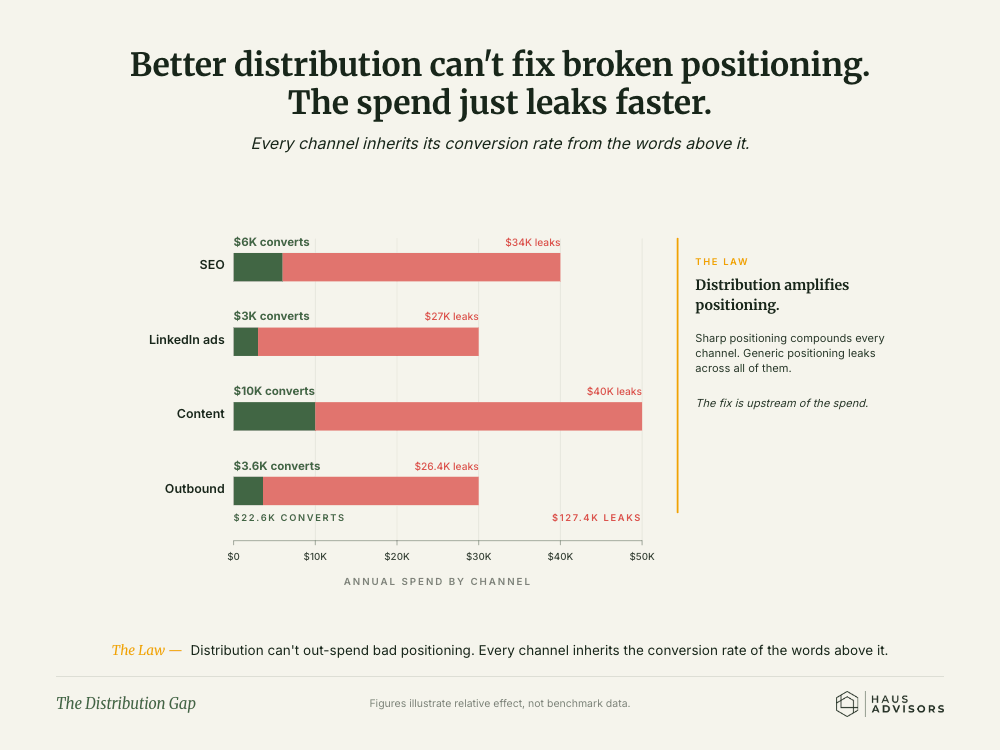
The wrong consultant delivers a strategy deck that sits on a shelf because it doesn't account for how agencies actually operate. You end up with advice built for product companies that doesn't translate to services businesses.
Technical founders who hire generalist positioning consultants often get pushed toward sales tactics that feel manipulative. The advice doesn't fit how engineers think. Internal resistance kills adoption even when the strategy is theoretically sound.
The opportunity cost is invisible but massive. Every month you stay positioned as a "full-service dev shop" is a month your best-fit clients don't know you exist. Your competitors with sharper positioning are capturing deals you should have won.
Product, Category, Market: Which Type of Positioning Consultant Do You Actually Need?
Search "positioning consultant" and you get a dozen variations. Product positioning consultant. Category positioning consultant. Market positioning consultant. Enterprise positioning consultant. Brand positioning consultant. They sound like distinct specialties. Most of the time they're just the language of whichever industry the consultant came from.
Here is what those labels actually mean, and why the distinction matters more for an agency than for almost anyone else.
A product positioning consultant works on where a product sits in its market. Features, competitors, the wedge that makes buyers choose it over the alternative. This is SaaS-native work. The product is fixed, and the job is to frame it.
A category positioning consultant works on creating or owning a category. Define a new space, name it, become the default answer inside it. Powerful for a venture-backed software company with the budget to educate a whole market. Rarely the right first move for a services business.
A market positioning consultant or enterprise positioning consultant usually means large-account, multi-stakeholder work. Long buying committees. Analyst relations. Procurement. That is a different sport from a founder-led agency selling six-figure engagements.
Notice the pattern. Almost every one of these specialties assumes you are selling a product. Your agency isn't. Your product is judgment, and judgment can't be positioned with a feature grid.
“Your product is judgment, and judgment can’t be positioned with a feature grid.”
That is the trap. A dev agency that hires a product or category positioning consultant gets product-shaped advice. Feature differentiation. Category creation. A messaging house built for something you don't sell. The output looks professional and changes nothing, because it was never built for a business where the buyer is hiring a team, not licensing software.
What an agency actually needs is a consultant who positions services businesses. Someone who understands that you compete on expertise and trust, that your sales cycle depends on showing a prospect you have solved their exact problem before, and that "positioning" for you means becoming the obvious choice for one type of buyer. If that is the gap you are trying to close, the real question isn't which flavor of product consultant to hire. It is whether the consultant has ever done agency work at all.
| Type of consultant | What it actually works on | Right for a dev shop? |
|---|---|---|
| Product positioning | Where a fixed product sits against competitors: features, the wedge that makes buyers pick it. Assumes you sell a product. | Wrong fit |
| Category positioning | Creating or owning a new market category. Needs a big budget to educate a market. Built for venture-backed software. | Wrong fit |
| Market / enterprise positioning | Large-account, multi-stakeholder work: buying committees, analyst relations, procurement. A different sport from founder-led sales. | Wrong fit |
| Brand positioning | How you look and sound. Useful, but it's a design layer on top of positioning, not the positioning decision itself. | Partial |
| Agency / services specialist | Becoming the obvious choice for one type of buyer. Competes on expertise and trust, where your product is judgment. | What you need |
If you are still one step earlier — deciding whether you need a consultant or a full brand agency in the first place — that is a different question with a different answer, and we walk through it in .
Which brings us to the red flags.
Red Flags That Signal You're About to Hire the Wrong Consultant
Red flag 1: They give you a fixed price and timeline from a brief conversation
This signals they're pricing to win the proposal, not to deliver the outcome. Genuine positioning work requires discovery to understand scope and complexity. If they can quote you without understanding your current positioning challenges, your past wins, or your team dynamics, they're selling a productized process. They aren't diagnosing your situation.
Red flag 2: Their portfolio is all product companies or large enterprises
Positioning a SaaS product with defined features is fundamentally different from positioning a services business where the product is expertise and judgment. Consultants who haven't done agency work default to product-shaped advice. It doesn't account for how buyers evaluate and hire agencies.
Red flag 3: They talk about brand strategy but not about go-to-market
Positioning without distribution is just aesthetics. You need a consultant who understands how positioning decisions flow through to content, partnerships, and sales conversations. If they can't connect the positioning work to your pipeline, you're hiring a brand designer. Not a growth consultant.
Red flag 4: They can't articulate a clear methodology
If their process is "collaborative exploration" or "we tailor it to each client," they're figuring it out as they go. You're paying for their learning curve, not their proven expertise. Look for named frameworks and systematic processes that have been repeated successfully across similar engagements.
Red flag 5: They position themselves as generalists
Just as they'd tell you to specialize, hold them to the same standard. Deep expertise in one domain produces better outcomes than shallow expertise across many. A consultant who works with agencies, SaaS companies, and Fortune 500 enterprises isn't specialized enough to understand your specific challenges.
Red flag 6: They don't ask about your best past clients
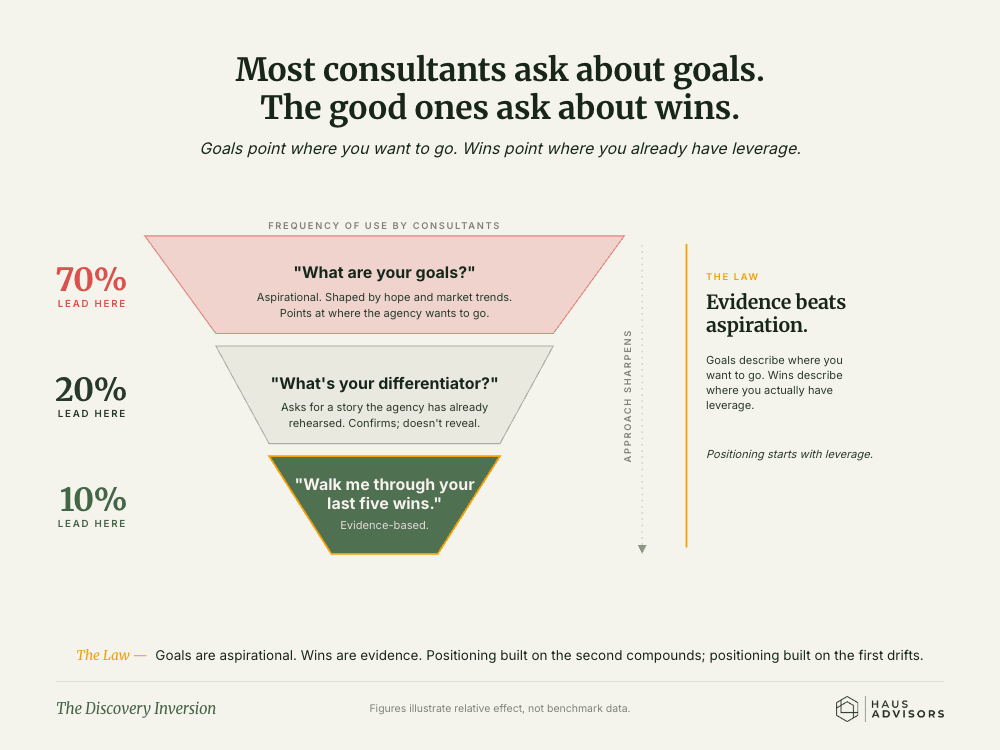
This is the most important input to a positioning decision. Consultants who skip it are working from theory rather than your specific strengths. The first question should be about your most successful projects and your happiest clients. Not your aspirations. Not your market opportunities. Your demonstrated wins.
Red flag 7: Their engagement model has no early exit
If you're being asked to commit $30K or more upfront with no trial period or guarantee, the consultant is optimizing for their risk. Not yours. The best consultants offer low-risk ways to test fit before larger commitments.
The 7 Criteria That Actually Predict Positioning Consultant Success
Criterion 1: Agency specialization
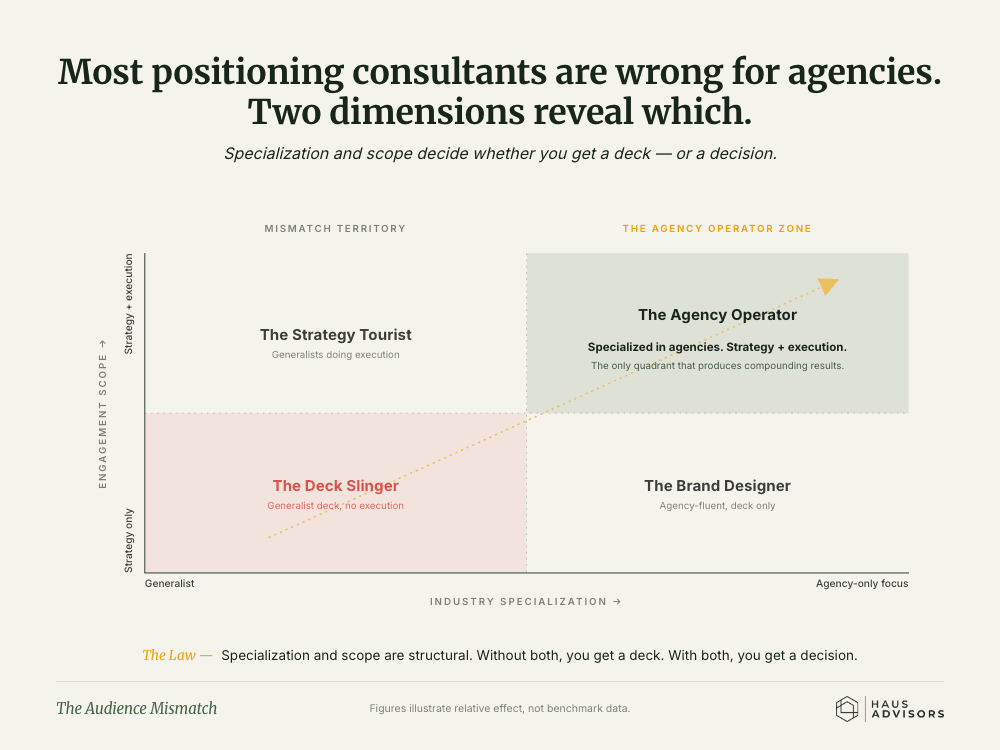
The consultant should work primarily with agencies or services businesses. Not product companies. The positioning challenges are structurally different. Agencies can't differentiate on features alone. They compete on expertise and trust. Their sales cycles depend on demonstrating domain knowledge before prospects will engage.
Look for consultants who understand the "we do everything for everyone" trap that most dev agencies fall into. Look for specific experience helping agencies say no to poor-fit opportunities.
Criterion 2: Documented methodology
Look for a named framework. Not "we'll figure it out together." Positioning decisions are high-stakes. You need confidence that the consultant has repeated this successfully before, not that they're experimenting with your budget.
Ask them to walk you through their framework step by step. Good consultants can explain their process in detail because they've used it repeatedly. Weak consultants speak in generalities because each engagement is improvised.
Criterion 3: Execution capability beyond strategy
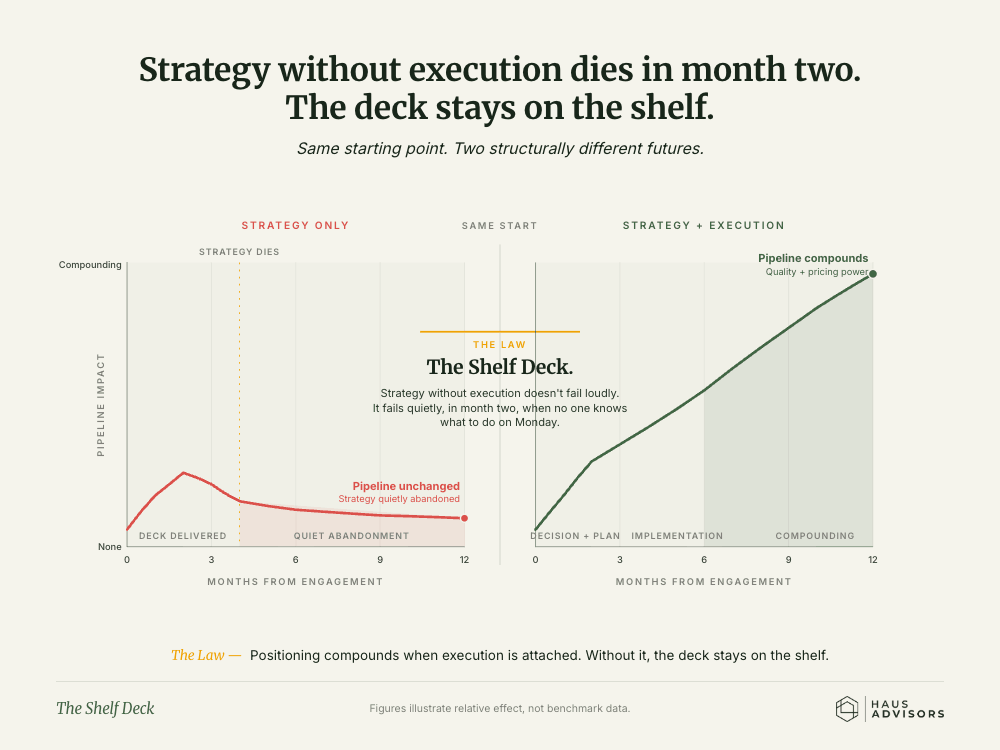
Verify whether the consultant helps you implement the positioning through content, messaging, outbound, and partnerships. Or whether they stop after delivering a strategy document. Most agencies lack the internal capacity to translate positioning strategy into operational reality.
The best positioning consultants provide messaging frameworks, content plans, and tactical work, not just strategic recommendations. They understand that positioning only matters if it changes how you show up in the market.
Criterion 4: Understanding of technical founder psychology
The consultant should frame positioning as a systems problem. Inputs, logic, outputs. Not a personality or charisma challenge.
Technical founders have a deep and justified aversion to push-based sales because it feels manipulative. The right consultant understands this and builds positioning around relevance and expertise. Not persuasion and hustle.
Criterion 5: Robust discovery process
Evaluate what questions the consultant asks before proposing a solution. Do they dig into your past wins, your best clients, your delivery model, and your team's strengths? Or do they jump straight to "here's what you should do"?
The best consultants spend significant time understanding your current positioning, analyzing your most successful client relationships, and identifying patterns in your wins before making any recommendations. Discovery should feel thorough. Not rushed.
Criterion 6: Transparency about who does the work
Confirm that the person pitching is the person who will actually do the positioning work. Or at minimum, that you can meet and vet the team members who will be involved.
The bait-and-switch is the most common complaint across all consulting categories. Senior consultant pitches. Junior consultant delivers. If they're evasive about team composition or say "we'll assign the right resources," that's a red flag.
Criterion 7: Post-engagement self-sufficiency
Understand what happens when the engagement ends. Will your team be able to maintain and evolve the positioning independently? Or will you be dependent on the consultant for ongoing decisions?
The best consultants design engagements to transfer knowledge and capability. Not to create dependency. You should be more self-sufficient after working with them. Not more reliant on external help.
Most agencies think the problem is lead gen. It usually isn't. The Bottleneck maps your business across the five pillars and names the one constraint holding your pipeline back — so you hire against the real problem, not a guess.
Start with The Bottleneck →Questions to Ask During Consultant Evaluations (That Most Agencies Forget)
"Can you walk me through a recent positioning engagement with an agency or services business?"
This forces specificity and reveals whether they have relevant experience or are improvising. Listen for details about the agency's starting position, the positioning decision made, and the outcomes achieved. Vague answers or product company examples are red flags.
"What's your discovery process, and what do you need from us before you can recommend a positioning direction?"
Good consultants describe a structured intake. Client interviews. Past project analysis. Competitive landscape review. Bad ones say they can start immediately with minimal input. The more questions they ask upfront, the better their recommendations will be.
"Who specifically will be doing the work, and can I meet them before we sign?"
This exposes the bait-and-switch risk. If they're evasive or say "we'll assign the right team" without names, that's a red flag. You should know exactly who you're working with before you commit.
"How do you handle it when the work uncovers a direction that requires us to say no to certain types of clients?"
This tests whether they understand that real positioning requires exclusion. Not just "finding your unique angle." They should be prepared to have difficult conversations about trade-offs and help you navigate the short-term revenue risk of saying no to poor-fit opportunities.
"What does the deliverable look like, and what are we expected to do with it after the engagement ends?"
This reveals whether you're getting a strategy document or an implementation plan. Look for consultants who provide tactical, actionable deliverables you can implement immediately.
"Can you share an example where the work didn't go as planned, and how you handled it?"
Consultants who can't articulate failures are either lying or lack enough experience to have encountered real resistance. How they describe problem-solving tells you how they'll handle obstacles in your engagement.
"What metrics do you use to determine whether a positioning engagement was successful?"
If they talk about "client satisfaction" or "strategic clarity" rather than measurable business outcomes like pipeline quality, sales cycle length, or conversion rates, they're optimizing for deliverables. Not results.
1. When you asked about price, what happened?
2. Their client portfolio is mostly…
3. Ask them to explain their methodology and you get…
4. After the strategy is delivered, do they help you execute?
5. The first thing they wanted to talk about was…
Common Mistakes Agencies Make When Choosing Positioning Consultants
Mistake 1: Choosing based on proposal quality rather than question quality
Polished proposals with detailed timelines often indicate the consultant is selling a productized process. Not diagnosing your specific situation. The best positioning consultants ask uncomfortable questions before proposing solutions. Their proposals reflect the uniqueness of your context. Not a template they use for everyone.
Mistake 2: Hiring a consultant whose portfolio is all product companies
The positioning strategies that work for B2B SaaS, like feature differentiation and category creation, don't translate to services businesses. Consultants without agency experience will default to product-shaped advice that doesn't account for how buyers evaluate and hire agencies.
Mistake 3: Optimizing for the lowest price
Positioning is not a commodity purchase. The same deliverable cannot be produced by any vendor. The difference between a $5K consultant and a $50K consultant isn't just price. It's whether they have deep expertise in your specific business model and whether they can help you execute. Not just strategize.
Mistake 4: Expecting the consultant to figure it out without your involvement
Positioning decisions require deep understanding of your past wins, your team's strengths, your market's gaps, and your leadership's risk tolerance. Consultants who promise to deliver positioning without significant client input are making it up. Not discovering it.
Mistake 5: Hiring based on credibility markers rather than relevant experience
A consultant might be brilliant at positioning Fortune 500 companies but have zero understanding of how dev agencies operate at $2M to $10M in revenue. Credibility is table stakes. Specificity is what matters. Book authors and conference speakers aren't automatically good at agency positioning.
“Credibility is table stakes. Specificity is what matters.”
Mistake 6: Not verifying who does the actual work
The person who presents the proposal and the person who does the positioning work are often different people, especially at larger consulting firms. If you don't explicitly ask "will you personally be doing this work?" you risk getting a junior consultant executing a senior consultant's methodology.
Mistake 7: Skipping the reference check
Most agencies don't call references. Or if they do, they ask generic questions like "would you work with them again?" Instead, ask "did the positioning work lead to measurable pipeline changes?" and "how did they handle resistance from your team?" and "what would you do differently if you started over?"
Choosing a Positioning Consultant: Common Questions
What is the difference between a product positioning consultant and a category positioning consultant?
Do I need a positioning consultant or a brand agency?
How much does a positioning consultant cost?
How long does a positioning engagement take?
What should a positioning consultant ask about before they start?
Haus Advisors: Positioning Consulting Built Specifically for Dev Agencies
A few months ago I got on a call with a founder running a $4M dev shop. Strong client roster. Senior team. Twelve years in business. He told me his pipeline felt like gambling.
He'd hired a positioning consultant the year before. Got a strategy deck. Nothing changed.
That's the pattern we see. Agencies don't have a strategy problem. They have positioning that was never built for the way agencies actually grow.
“Agencies don’t have a strategy problem. They have positioning that was never built for the way agencies actually grow.”
Built for agencies, not product companies
Haus Advisors works with technical agencies beyond $1M. Not SaaS. Not Fortune 500. Agencies. The structural rules are different. You can't differentiate on features. Your product is judgment. Your sales cycle depends on showing the prospect you've seen their exact problem before, not pitching a process.
This is why generalist positioning consultants miss. They give you advice that works for a category creation play in B2B SaaS. You're not creating a category. You're trying to be the obvious choice for one type of buyer with one specific problem.
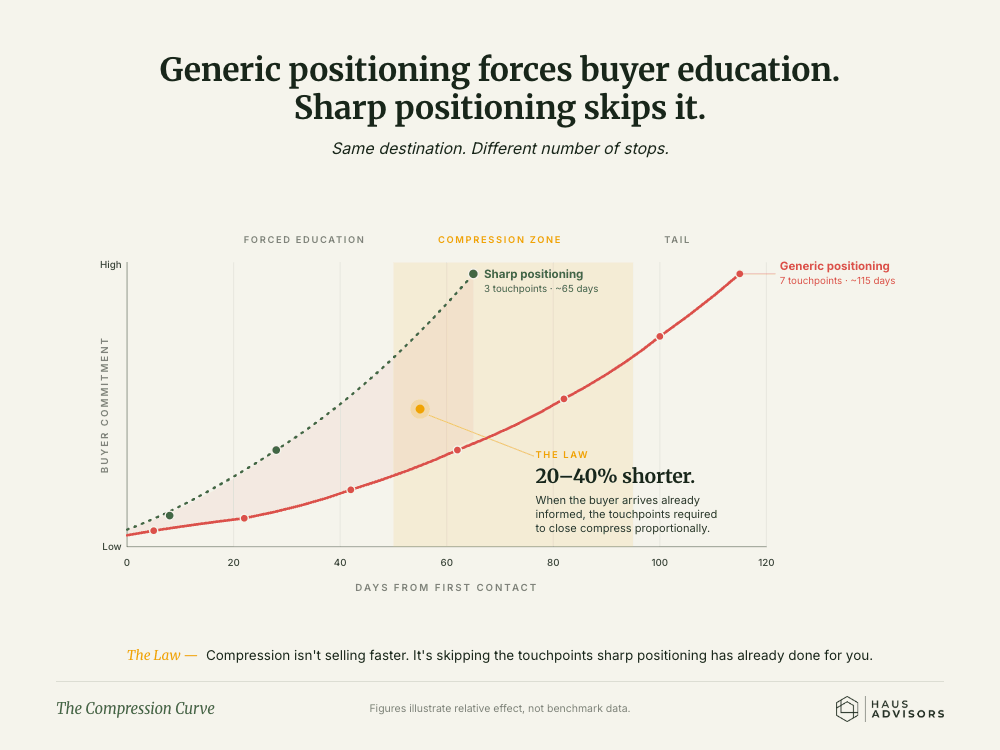
When that lands, the math changes. Sales cycles compress 20 to 40 percent because prospects show up already understanding why you. Win rates move from 20-30 percent to 40-60 percent because you're only in conversations where you're the right answer. Pricing power goes up 20-50 percent because you're competing on expertise, not hours.
The Relevance Engineering methodology
Sharp positioning is one of five components. The others are productization, publishing, partnerships, and persistence. They work as a system. Positioning without distribution is aesthetics. Distribution without positioning is noise. Both without persistence is a project that dies in month four.
This is the framework underneath everything we do. It's not improvised per client. It's been built across more than thirty named diagnostic patterns we see repeatedly in agency pipelines.
Start with The Bottleneck
Most agencies don't actually know what's broken. They think it's lead gen. It's usually not.
The Bottleneck is an $6K diagnostic. Three weeks. We map your business across the five pillars, run the diagnostic against your past wins and current pipeline, and tell you the one constraint holding the whole system back. You walk out with a prioritized plan and a clear answer to the question, "what do we fix first."
If you're not confident after the first session that this is going to be useful, you get a full refund. The diagnostic stands on its own. You don't have to continue with us to get value from it.
From there, agencies that want execution help move into The Breakthrough at around $6K a month. Agencies that just need a senior thought partner step into The Next Move at $3K a month. Same person across all three. No bait and switch. No junior consultant inheriting the engagement once the proposal is signed.
Built for technical founders
Most positioning advice gets framed as a sales problem. Be more confident. Tell better stories. Push harder on the call.
That's not how technical founders win. Technical founders win by reverse-engineering the system. Inputs, logic, outputs. The reason most positioning work feels off to engineers is because it's being sold as a personality upgrade. It isn't. It's an engineering problem about which inputs the market is using to evaluate you, and what you need to change to be the obvious choice.
That's the conversation we have with clients. Not "be more outgoing." More like, "your prospects are evaluating you on three signals you don't control yet. Here's how we change that."
Where to start
If you've read this far, you're past the question of whether you need positioning help. The real question is whether you trust the person doing the work.
The Bottleneck is the lowest-risk way to find out. Four weeks. Starting at $6K. Money back if the first session doesn't land.