Should Your Agency Niche Down? The Real Barrier Isn't Logic
Most founders already believe in niching down. They still can't commit. Here's the psychology behind the leap, and how to actually take it.
A founder emailed me recently with a confession most agency owners would recognize. He understood the theory of good positioning. He believed in it completely. He could recite the benefits: premium pricing, faster closes, sharper referrals. And he still could not bring himself to commit to a narrower position. In his words, the logic was not the issue. The problem was the human part -- taking what felt like a leap of faith.
He is right about where the difficulty lives. If deciding to niche down were a logic problem, every founder who read the arguments would have done it years ago. They have read the arguments. They agree with the arguments. They are still generalists. That tells you the gap is not in the reasoning. It is in the commitment. This post is about that gap, why it stays open, and how to close it -- not by adding more logic, but by understanding the psychology the logic keeps failing to move.
The Commitment Gap: Why Belief Doesn't Become Action
The Commitment Gap is the distance between believing in a narrow position and actually committing to one. It is not a knowledge problem. The founder already knows. It is not a persuasion problem. The founder is already persuaded. It is the space where a settled decision fails to become an action, and it stays open because the forces holding it open are emotional, not rational.
Psychologists have a useful picture for this. The mind works like a rider on an elephant. The rider is your conscious, logical self. The elephant is everything underneath: instinct, fear, the pull of what feels safe. The rider can study the map and choose the road. But if the elephant does not want to move, the rider cannot force it. You do not steer six tons of animal with an argument.
When a founder reads the case for niching and nods along, that is the rider agreeing. The rider has already voted yes. The elephant has not moved. And every article that piles on more reasons to niche is talking to the rider who was never the holdout. The commitment gap stays open because nobody is addressing the elephant.
“You do not steer six tons of animal with an argument.”
The Three Forces That Keep You From Committing
Three forces keep the elephant planted. None of them are about whether niching works.
Force 01 · Loss Aversion
The loss shouts, the gain whispers
The pain of a loss lands about twice as hard as the pleasure of an equal gain. The check you turn down is vivid and immediate. The better clients you would win are delayed and probabilistic. The scale is rigged before you start thinking.
Force 02 · The Endowment Effect
Closing a door you never use still feels like a loss
Every service line and industry you could serve is a door that is currently open. Narrowing means closing most of them on purpose. The brain treats options it owns as possessions, even the ones it was never going to walk through.
Force 03 · Identity Risk
"We can do anything" is a self-image, not just a position
For a lot of founders, being able to do anything for anyone is who they are, not just how they sell. Committing to a narrow position means saying in public who you are not. The brain protects identity even harder than it protects money, which is why this is the force nobody says out loud.
The first is loss aversion. Human beings feel the pain of a loss about twice as intensely as the pleasure of an equivalent gain. Lose two hundred dollars and it stings roughly as much as finding four hundred feels good. Now map that onto positioning. When you commit to a narrow position, the loss is vivid and immediate: the prospect who does not fit, the check you have to turn down, the whole category of work you are walking away from. You can see it. You can name the company.
The gain is the opposite. Better-fit clients, higher close rates, and cleaner referrals are real, but they are delayed and probabilistic. You cannot point to them yet. So the brain runs a rigged comparison. A concrete, visible loss on one side. A fuzzy, future gain on the other. The felt weight is not even close, even when the math clearly favors the gain.
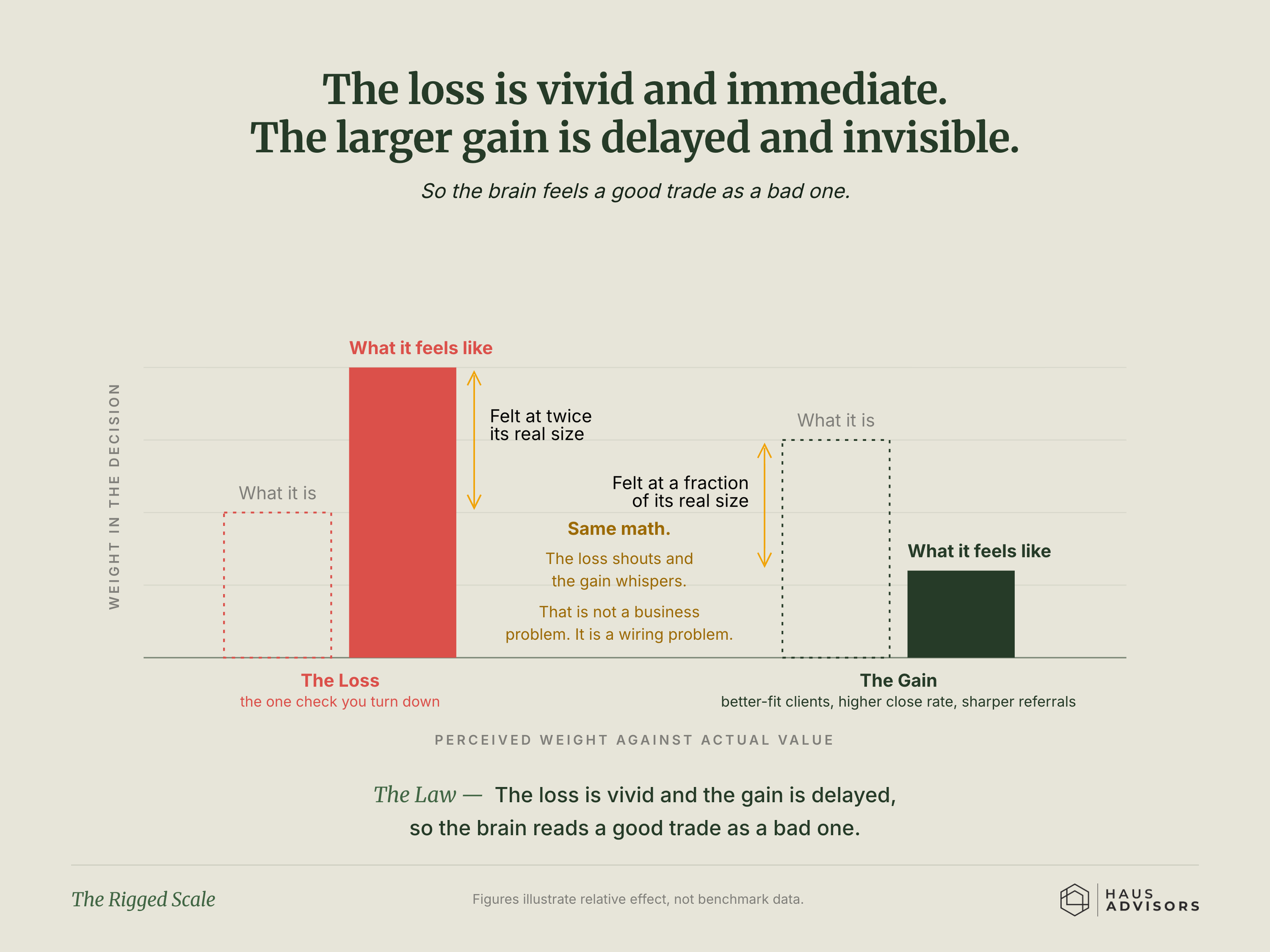
Same decision, weighed two ways. The real gain from niching is bigger than the real loss. But the loss is immediate and you can name it, so it feels twice as heavy, while the gain is delayed and abstract, so it barely registers. The founder isn't being irrational. The scale is rigged before the thinking starts.
The second force is the endowment effect. We value things more once we feel we own them, and an agency that can do anything for anyone already owns an enormous option set. Every service line, every industry, every kind of project is a door that is currently open. Narrowing means closing most of those doors on purpose.
The rational read is that you never had the capacity to walk through all of them anyway, and open doors you never use are not assets. But the elephant does not see unused options as worthless. It sees them as possessions. Closing them registers as giving something up, and giving something up is exactly what the brain is wired to resist.
The third force is the one nobody says out loud. Identity risk. "We can do anything" is not just a market position. For a lot of founders it is a self-image. It says we are capable, we are flexible, we are not the kind of shop that has to turn work away.
Committing to a narrow position means saying, in public, who you are not. That is not a marketing edit. It feels like a smaller version of yourself, at least at first. And the brain protects identity even harder than it protects money.
Stack those three together and the commitment gap makes complete sense. The founder is not being irrational. He is running an accurate emotional calculation on a rigged scale: a visible loss, a set of possessions he is being asked to surrender, and a threat to how he sees himself, all traded against a gain he cannot yet see. Of course the elephant sits down. More logic will not lift it, because logic was never the thing holding it in place.
What founders actually say when they resist niching
I went back through 1,751 quotes from recorded client and discovery calls and pulled every one where a founder talked about narrowing and hesitated in the same breath. Thirteen. Small enough to read individually, which is the useful part, because the objections are not the ones the guides answer.
Four of them are the same objection in different clothes: the market will not let me. One founder described being in a position where the agency would take anything, so declaring a specialty seemed like the wrong move. Another said that whenever they told a client they were specialized, the client wanted a one-stop shop instead and did not want to assemble three specialty firms.
That objection is real and it is also a description of the problem rather than a reason to keep going. An agency that takes anything is an agency nobody can refer, because there is nothing to refer it for.
Three more are about the identity, not the economics. One founder described the discomfort of putting a narrow line above the fold on their own website, and was working hard to delete the industry dropdown they had built. Another said going more narrow in positioning was nerve-racking, in those words. A third resisted becoming known for one vertical even while agreeing the category was broad enough, because it still did not feel like them.
And one objection deserves more respect than it usually gets. Founders worry about over-narrowing, and they are right that it is possible. One put the failure mode precisely: e-commerce for shoe manufacturers who only make black shoes is too far.
The answer is not to niche less. It's to pick a slice with enough companies in it to build a business, then go deep.
But the most useful finding is the one nobody writes about. Four of the thirteen were not refusing to specialize. They had already done it and it had not held. One described sticking a toe into specializing several times over the years, and not knowing whether the problem was the wrong fit or not staying with it long enough. Another had drifted back to broad after being the craft shop that got the craft leads they wanted.
So the failure mode in the data is not the decision. It's the follow-through. Which means the question worth asking is not whether to niche, but what you will still be saying about yourself in eighteen months when a good-fit-but-off-niche deal is on the table.
The Real Risk Isn't Niching Down. It's Staying in the Middle.
Here is where the psychology quietly betrays you. Staying broad feels like the safe, low-risk option. It is not. It is the choice that carries the larger risk. The elephant just cannot see it, because that risk is invisible and slow.
Consider what the undifferentiated middle actually costs, in the same terms the loss-aversion instinct understands. Generalist agencies close new business at roughly 15 to 25 percent of qualified proposals. Positioned agencies close at 35 to 50 percent, sometimes higher when the position is tight and referrals reinforce it. That gap does not sit still. It compounds on every deal, every quarter, for as long as you stay in the middle.
A two-million-dollar agency at a 20 percent close rate is doing twice the proposal volume of the same agency at 40 percent, for the same revenue. Same team. Same effort. Half the yield. That is the tax on staying broad, and you pay it whether or not you ever notice it on the invoice.
“The thing that feels like the cliff is the guardrail. The thing that feels like the guardrail is the slow drop.”
Referral quality erodes the same way. When your position is clear, the people who refer you know exactly who to send. When it is vague, they send everyone, and you spend your time educating prospects who were never a fit before you can even evaluate them. Pricing erodes too. Specialists command a premium because they understand a specific buyer's problem better than a generalist ever could, and buyers pay for that depth. The generalist competes on price because there is nothing else to compete on.
So the real comparison is not "safe broad path" against "risky narrow leap." It is a small, visible, survivable risk -- you commit, and some of it does not fit, and you adjust -- against a large, invisible, compounding one -- you stay in the middle and bleed close rate, referral quality, and pricing power every single quarter, slowly enough that it never triggers the alarm. Loss aversion is supposed to protect you from danger. In positioning, it points you at the wrong one. The thing that feels like the cliff is the guardrail. The thing that feels like the guardrail is the slow drop.
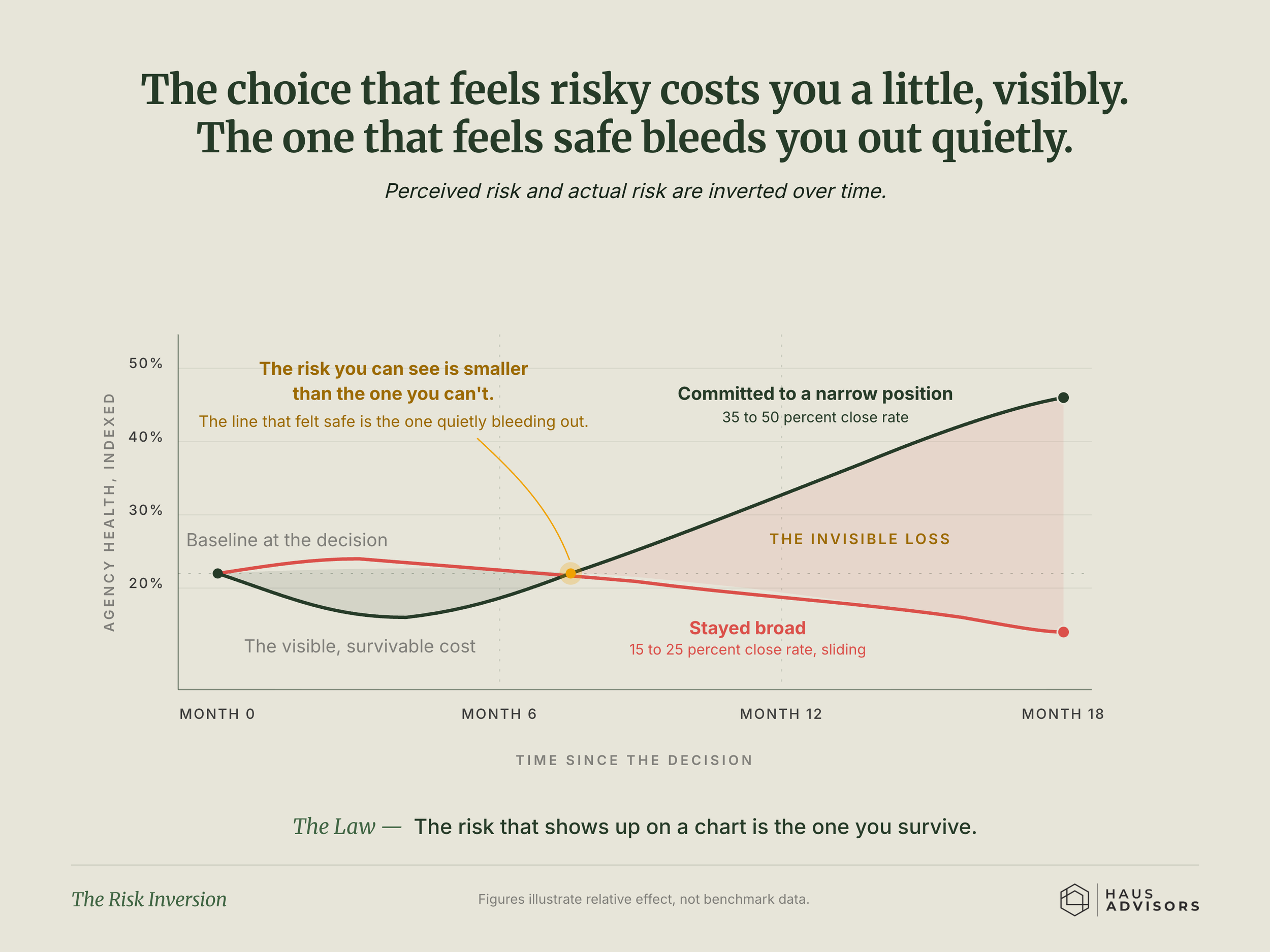
The narrow path shows a visible dip early: the checks you turn down, the bad-fit work you walk away from. The broad path shows nothing scary at all, which is exactly why it feels safe. Then the lines cross. The risk you could see turns out to be the small one, and the risk you couldn't is the one that compounds.
The Relevance Engineering Program
You don't need more logic. You need a forcing function.
You already believe in niching. The first phase of the Relevance Engineering Program is the forcing function: we anchor your position in the clients you would actually clone, then hand you the evidence and assets to commit with something firmer than nerve.
See how the Program worksHow to Actually Niche Down When the Logic Already Won
You do not close the commitment gap by becoming more convinced. You are already convinced. You close it by changing what the leap feels like to the elephant. Four reframes do most of the work.
“You have not actually positioned until you have turned down a check.”
Reframe the permanence. The reason commitment feels like a cliff is that it feels irreversible, and the brain treats irreversible decisions as threats. But a narrow position is not a marriage. It is dating. You are choosing a focus to test, not signing away every other kind of work forever. If you commit to a vertical and eighteen months of real evidence tells you it is wrong, you will have learned that faster and cheaper than eighteen months of staying blurry ever taught you anything. Positioning is one of the most reversible decisions you will make. It only feels permanent because you are staring at the version where it fails.
Reframe what commitment even means. You have not actually positioned until you have turned down a check. Everything before that first no is theory. This sounds like more pressure, but it is the opposite: it tells you the entire weight of the decision lives in one concrete, survivable act. Not a rebrand. Not a relaunch. A single moment where a bad-fit prospect shows up and you say no. You can do one hard thing once. That is the whole leap, compressed into a size the elephant can handle.
Shrink the actual drop. Most of the fear in the commitment gap is fear of losing the revenue you have. That fear is legitimate, and it also does not require the leap you think it does. You do not have to fire your existing clients or gut the pipeline to commit to a position. You narrow the message before you narrow the business, and let delivery follow as the new pipeline builds. The mechanics of doing that without a revenue gap are their own subject, and I have written the full sequence in how to niche down without losing revenue. The point here is narrower: the leap is smaller than the elephant believes, because commitment starts with what you say, not what you dismantle.
Separate real fear from real doubt. Not all hesitation is the same, and it is worth being honest about which one you have. Sometimes the niche is right and you are simply scared. That is fear-hesitation, and the reframes above are for it. But sometimes the hesitation is information: the niche is wrong, and some part of you knows it. That is healthy hesitation, and no reframe should talk you past it. The test is specificity. If you can name the two or three clients you would clone if you could -- the ones whose work you would take endlessly, who pay well and refer well -- and they share a pattern, your niche is already visible and the only thing missing is nerve. If you cannot name them, do not leap yet. Go find the pattern first. Committing to a position you have not earned the evidence for is not courage. It is a guess.
That last move does something the others cannot. It makes the invisible gain visible. The whole reason loss aversion wins is that the loss has a face and the gain does not. Name the clients you would clone, and suddenly the gain has a face too. Now the elephant is not being asked to trade a real thing for an abstraction. It is being asked to walk toward clients it can already picture.
Diagnostic · 1 minute
Which hesitation is yours?
Not all hesitation is the same. Some is fear standing between you and a niche you already know. Some is your instinct telling you the evidence is not in yet. Answer five questions to find out which one is holding you.
1. Can you name the two or three clients you would clone if you could?
2. Do those clients share a pattern you could describe in one sentence?
3. When you picture committing, what surfaces first?
4. Be honest about the hesitation. Which is closer?
5. If the position proved wrong after 18 months, that would be:
What Founders Who Commit Do Differently
The Founder Who Waits
Commits once the fear is gone
- Keeps reading, keeps agreeing, keeps intending to niche "once ready"
- Waits for a day when saying who you are not will feel safe
- Treats the fear as a signal the decision is wrong
- Stays in the undifferentiated middle, paying the invisible tax
Stays a generalist, wondering why peers pull ahead on the same tactics.
The Founder Who Commits
Commits while the fear is still there
- Does not wait to feel ready
- Picks the pattern the best clients already show
- Narrows the message first, before touching delivery
- Turns down the first bad-fit check, even though it stings
Within a year, the positioned pipeline quietly replaces the scattered one.
The difference between the two groups was never conviction. Both believed in niching. The difference was that one of them stopped waiting for the elephant to feel like moving, and moved it anyway.
“The difference between the two groups was never conviction. Both believed in niching.”
Most founders reading this already know the real problem. It isn't the logic, and it isn't nerve. It's that the reputation, the relationships, and the judgment that make your agency worth hiring still live in your head. So the business only grows when you're in the room.
That's the work we do at Haus Advisors. The Relevance Engineering Program is six months of implementation, not a strategy document. We pull what makes your agency relevant out of your head, build it into positioning, offers, and growth plays your team can run, and hand ownership to them. If you want an agency that grows without needing you in every deal, book a call to see if it's a fit.
Keep reading
Browse by topic
- Positioning & Strategy
- Lead Gen & Marketing
- Sales & Biz Dev
- Pricing & Productization
- Research & Data
- Operations & Delivery
- Client Retention & Expansion
- Leadership & Culture
For founders whose agency has outgrown referrals.
One idea a week that makes a hard growth problem obvious, usually with a chart that shows you the mechanism behind it.
Built from conversations with seventy-plus agency founders on the Behind the Agency podcast.