Vertical or Horizontal? How to Use Your Project History to Decide
A founder asked me last year whether he should position his agency vertically (by industry) or horizontally (by discipline). He'd been reading about agency positioning for months. He understood the theory. He knew he needed to specialize. But the decision between vertical and horizontal had paralyzed him for so long that he'd done nothing.
His concern was reasonable: choose the wrong axis, and you spend a year building toward a market that can't sustain you. Choose the right one, and growth compounds. The stakes felt enormous, and no amount of reading was resolving the uncertainty.
I told him the question was wrong. "Vertical or horizontal" frames the decision as a binary with two options, each carrying significant risk. The actual decision is simpler: look at where your evidence points, and specialize on the axis where your track record gives you the most credible claim.
We pulled up his last fifteen projects. Eleven of them were for SaaS companies between Series A and Series C. The industry signal was unmistakable. He hadn't noticed it because he'd been thinking about positioning as a theoretical market selection exercise when it was actually a pattern recognition exercise. The evidence was already in his project history. He just hadn't read it as a positioning signal.
His positioning decision took less than a week once we shifted from "which market should I target?" to "which market has my work already targeted?"
The Pattern Has a Name
I call it The Theoretical Positioning Trap: the tendency to approach niche selection as a forward-looking market analysis exercise ("where should I go?") rather than a backward-looking evidence assessment ("where has my work already been going?"). This produces months of deliberation over hypothetical market opportunities while the founder's actual project history contains a clear signal they haven't examined.
Here's the mechanism. The founder reads about specialization, accepts the logic, and begins evaluating market options. They research industries: is fintech big enough? Is healthcare too regulated? Is e-commerce too competitive? Each option has plausible arguments for and against. The more research they do, the less certain they become, because theoretical market analysis always produces ambiguity. Every market has pros and cons. Every niche has risks. The analysis never converges on a clear answer.
Meanwhile, their project history is sitting right there. The patterns in their past wins (which industries, which company stages, which problem types, which outcomes) contain far more reliable positioning data than any market research, because the data reflects where the agency has actually demonstrated expertise and produced results. The past wins aren't hypothetical. They're evidence.
The positioning decision becomes dramatically simpler when you start from evidence rather than theory. You're not asking "what market could we serve?" You're asking "what market have we already been serving well, and how do we make that signal louder?"
But vertical vs horizontal is only one dimension of the decision. The full agency positioning framework also includes messaging, offer design, and go-to-market focus.
The Two-Axis Framework
The "vertical vs. horizontal" framing implies a binary choice. The reality is a two-axis matrix.
Serves one industry across multiple disciplines. Clients come for the industry knowledge.
Deep in one industry AND one discipline. The strongest positioning. Hardest to build, hardest to displace.
Many industries, many capabilities. Wins on relationships and referrals. Stalls at scale.
One capability, any industry. Clients come for the discipline expertise. Works when the skill is rare.
Think of it as X and Y coordinates. The X-axis represents your discipline or capability (Python development, conversion optimization, technical architecture, data engineering). The Y-axis represents your market (fintech, healthcare SaaS, logistics, e-commerce). Your positioning is a point on this grid.
The critical insight: you must be specific on at least one axis to survive past $3M.
At the origin point (0,0), "we do code for everyone," you're invisible. You're a commodity competing on price. Every project requires reinventing operations because nothing about the previous engagement transfers to the next one. Your team can't build expertise because they're jumping between unrelated domains. Your marketing can't build momentum because your audience is too diverse to target.
Move along the Y-axis (industry focus) and you become "the dev shop for fintech." Every fintech company that needs development work considers you. Your case studies compound because each one speaks to the next prospect. Your team builds domain expertise that becomes a competitive advantage.
Move along the X-axis (discipline focus) and you become "the conversion optimization specialists." Every company that needs conversion work considers you, regardless of industry. Your methodology transfers across clients because the discipline is consistent even when the domain varies.
Both directions work. What doesn't work is staying at the origin. And the direction to move is determined by where your evidence points, not by theoretical market analysis.
Why Generalist Positioning Breaks at Scale
The origin-point problem isn't just theoretical. It creates specific, measurable operational consequences that get worse as the agency grows.
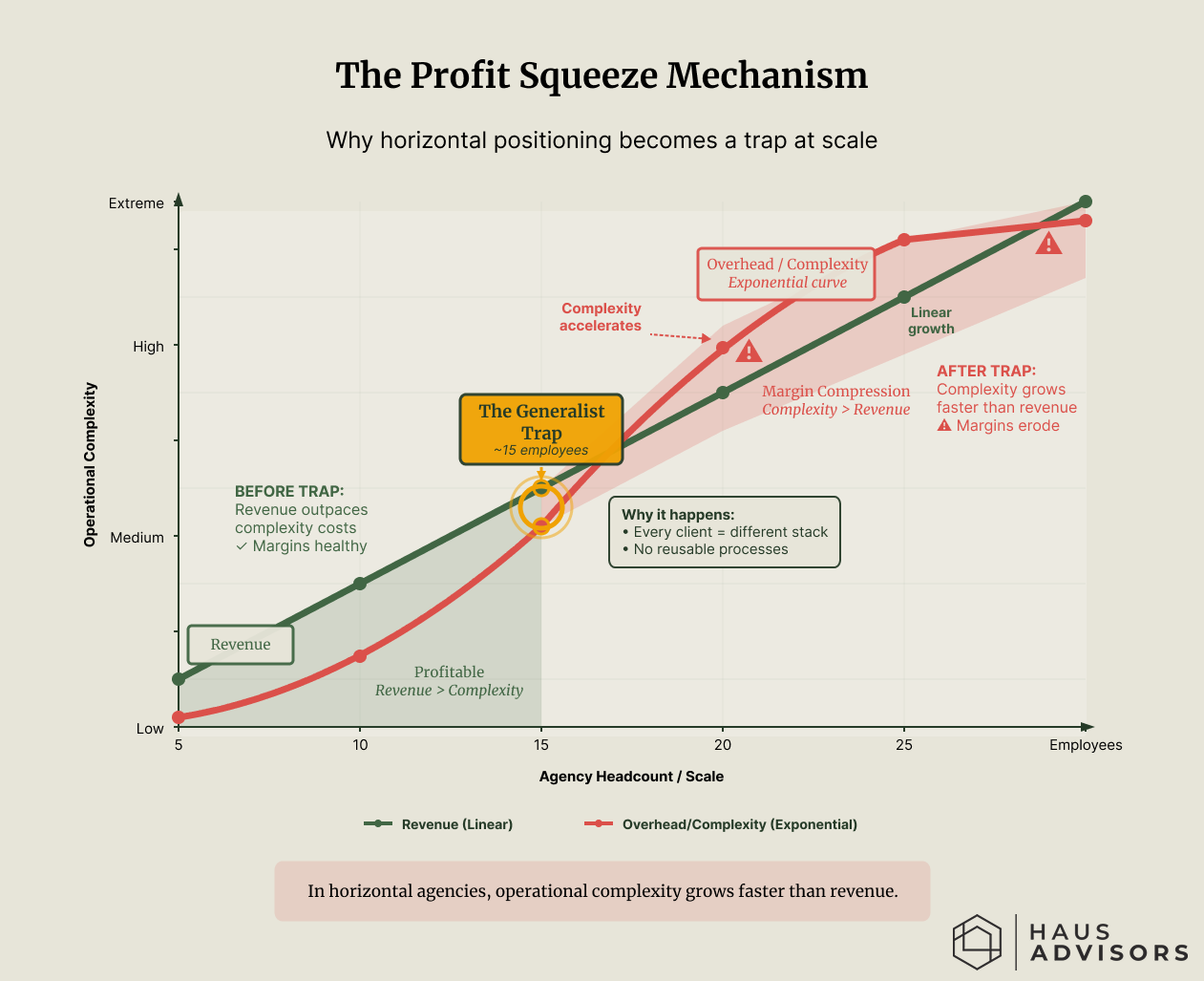
The complexity curve: In a generalist agency, revenue grows linearly with headcount. But operational complexity grows exponentially, because every new client brings different industry requirements, compliance needs, technology stacks, and domain knowledge. Eventually, the complexity curve crosses the revenue curve: you're adding people but the margin per person is declining. This is the mathematical argument for specialization. Specialists build efficiency with scale. Generalists build complexity.
“You must be specific on at least one axis to survive past $3M.”
Customer acquisition cost stays flat or increases. When your prospects don't share identifiable characteristics, you can't target efficiently. You can't buy prospect lists organized by a meaningful classification. You can't focus content on a specific audience's problems. You can't attend the right conferences because there are no conferences where your entire audience gathers. Every new client requires a fresh outreach effort, and the cost per acquisition never decreases because nothing from the previous acquisition effort compounds into the next one.
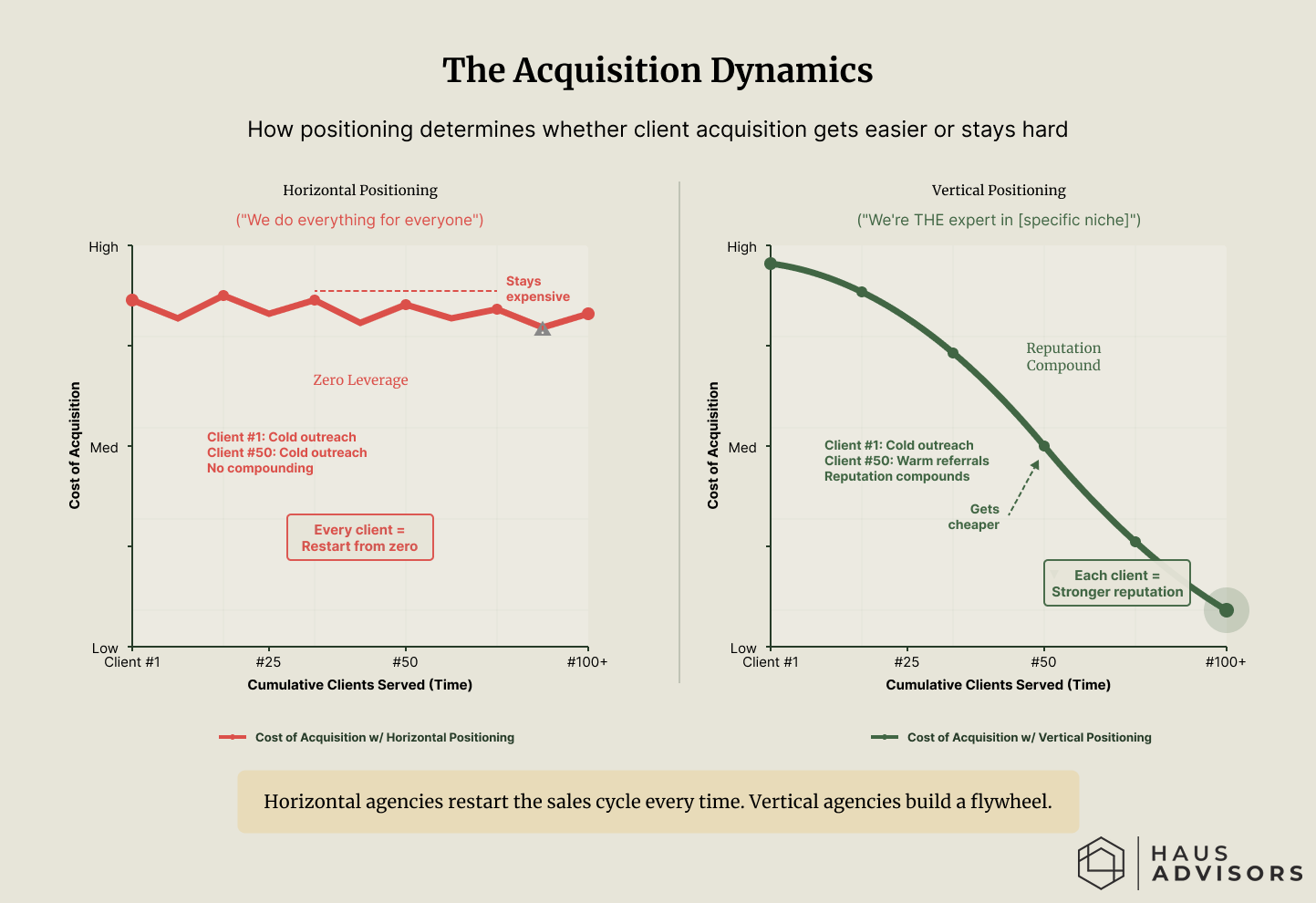
The acquisition economics: Generalist agencies restart the sales cycle from zero with every new prospect. Specialists build a reputation flywheel where every client makes the next client easier to acquire. Case studies compound. Conference visibility compounds. Referrals within the industry compound. The cost of acquiring the twentieth client in your vertical is dramatically lower than the cost of acquiring the first.
Every project is a prototype. Without a consistent client profile, your team can't build repeatable processes. Discovery is reinvented for every engagement. Delivery workflows are rebuilt from scratch. The efficiency gains that come from solving the same category of problem repeatedly never materialize. Your team is permanently in "first time" mode, which is the most expensive and error-prone mode to operate in.
Premium pricing is inaccessible. A generalist agency at $150/hour is competing against every other generalist at $150/hour. The prospect has no way to evaluate whether one generalist is worth more than another, so price becomes the tiebreaker. Specialized expertise, by contrast, creates pricing power because the specialist has solved the prospect's specific problem before, understands their industry's constraints, and can articulate risk in terms the prospect recognizes.
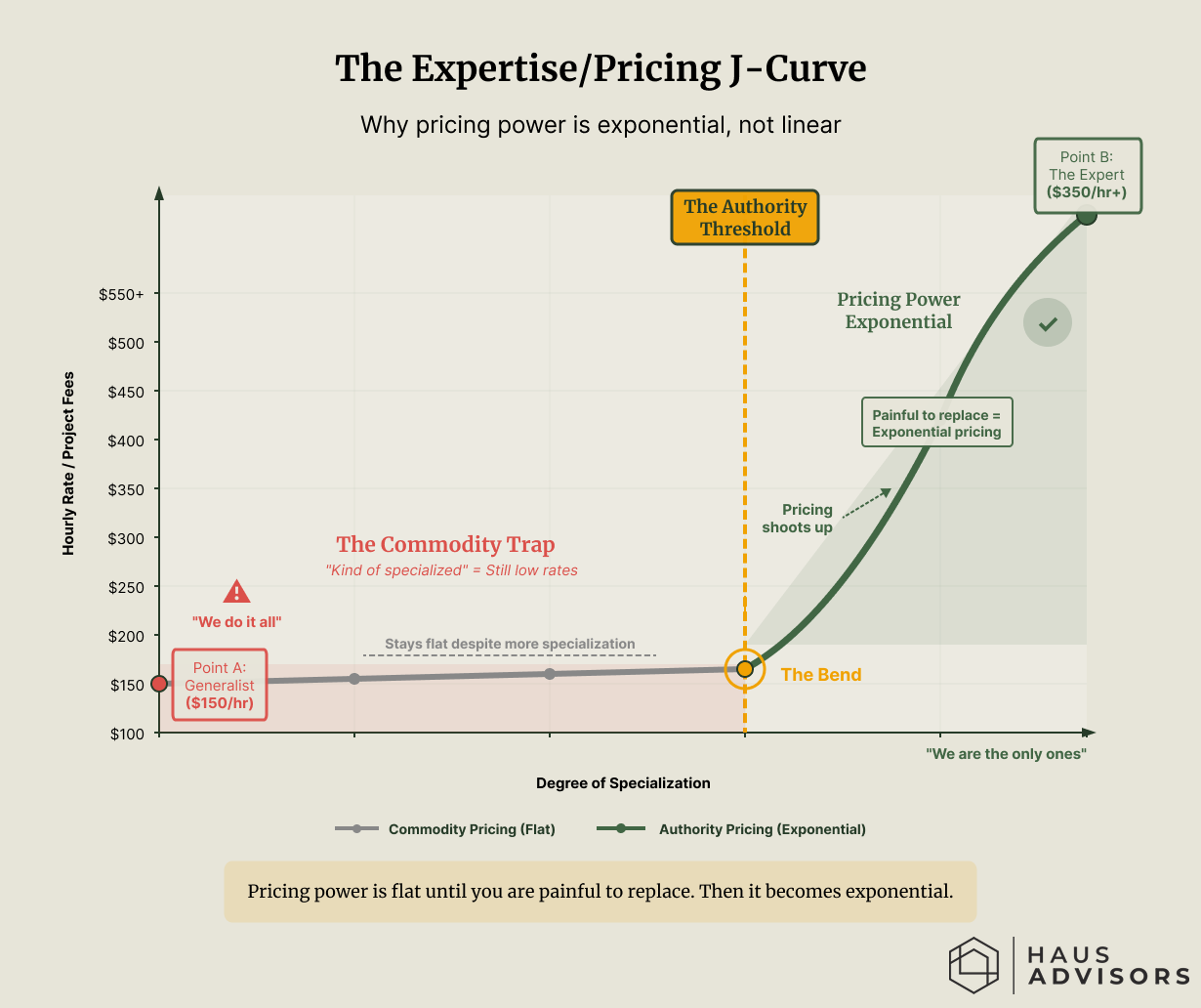
The pricing physics: Pricing power doesn't increase linearly with skill. A generalist who's slightly more skilled than another generalist gets slightly more per hour. But a specialist who has crossed the Authority Threshold, where their expertise becomes specifically painful to replace, sees pricing jump exponentially. The threshold is where a prospect says 'we need them specifically' rather than 'we need someone like them.' That specificity is what positioning creates.
Vertical Market Positioning (Specializing on the Y-Axis)
You serve a specific industry with multiple capabilities. Your agency becomes the default choice when companies in that industry need development work. The specificity is about the buyer, not the service.
Where it works best: Industries with concentrated networks (fintech, healthcare, logistics), regulatory complexity that creates domain knowledge barriers, and enough companies of sufficient size to support your revenue goals. Industries where decision-makers change jobs frequently within the same vertical are especially valuable, because you retain the relationship across multiple companies.
The compounding advantage: Every case study speaks directly to the next prospect. Industry conferences become your primary marketing channel. Your team builds domain expertise that compounds with every project: they understand the regulations, the common technical debt patterns, the integration challenges, and the business model constraints. By the tenth project, your team is faster, more accurate, and more confident than any generalist competitor encountering the industry for the first time.
The risks to manage: Market concentration means an industry downturn hits your entire client base simultaneously. You can run out of room once you've captured a big share of a small niche. Developer boredom can increase when the domain stays constant across engagements. These risks are real but manageable: geographic expansion, adjacent vertical expansion, and team rotation all mitigate them.
“The positioning decision becomes dramatically simpler when you start from evidence rather than theory.”
Horizontal Discipline Positioning (Specializing on the X-Axis)
You solve a specific type of problem across multiple industries. Your agency becomes the default choice when any company needs that particular capability. The specificity is about the service, not the buyer.
Where it works best: Disciplines with clear, measurable outcomes (conversion optimization, performance engineering, data pipeline architecture), where the methodology transfers across industries with minimal adaptation, and where the problem is painful enough that buyers actively search for specialists. Disciplines where AI is compressing commodity execution but not replacing strategic judgment are especially durable.
The compounding advantage: Your methodology deepens with every engagement. You build proprietary frameworks, benchmarks, and diagnostic tools that become competitive advantages. The discipline expertise is portable: a conversion optimization methodology developed for SaaS companies can be adapted for e-commerce with moderate effort. Your content marketing targets a specific problem rather than a specific industry, which can reach a broader audience.
The risks to manage: Marketing and targeting are harder because your audience isn't organized by a single industry classification. The content test is more demanding: you need to articulate the discipline's value to buyers from different contexts. Competition from other discipline specialists can be intense. And the "will they understand our industry?" objection from prospects requires active management through case studies that demonstrate cross-industry application.
“The specialist’s risk is cyclical and manageable. The generalist’s risk is structural and permanent.”
How to Make the Decision
The decision framework has four steps, and all of them start from evidence.
Step 1: Read your project history. Pull up the last fifteen to twenty projects. For each one, note the industry, the company stage, the core problem, the technology involved, and the outcome. Look for clusters. Do you see patterns in industry? In problem type? In company stage? In technology stack? The strongest clusters are your positioning signal.
Step 2: Identify which axis shows the stronger pattern. If eleven of fifteen projects were for SaaS companies, the Y-axis signal is strong. If twelve of fifteen involved performance optimization across different industries, the X-axis signal is strong. If both signals are present, lean toward the one where your case studies are strongest and your team's enthusiasm is highest.
Step 3: Test the market viability. For vertical positioning: can you identify and reach enough companies in this industry at this stage to support your revenue goals? Try to build a prospect list of 200+ companies that match. If you can't, the market may be too small. For horizontal positioning: can you articulate the discipline's value to buyers from different industries in a way that's specific enough to generate interest? Write a cold outreach message and assess whether it communicates clear relevance to a diverse audience.
Step 4: Validate with your existing clients. Tell your best clients your intended positioning. Ask two questions: "Does this match your experience of working with us?" and "Who in your network faces this challenge?" If the positioning resonates with people who've seen your work and produces warm introductions, the direction is validated. If clients are confused by it or can't identify referral targets, revisit the signal.
Transitioning Without Destroying Cash Flow
The biggest fear in positioning decisions is revenue loss. You have existing clients outside your new positioning. You can't fire them overnight.
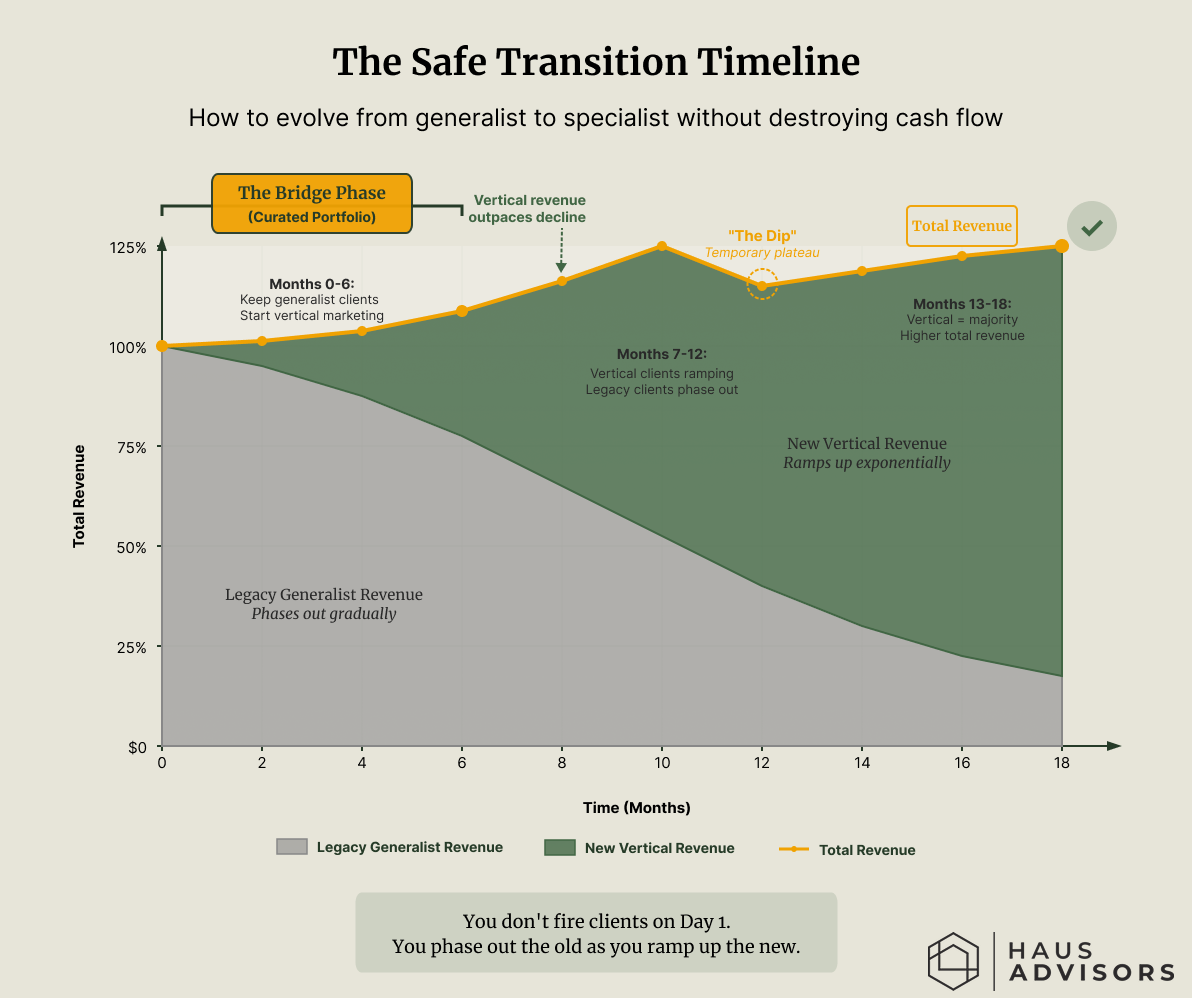
The transition economics: You don't trade revenue for positioning. You layer the new direction on top of existing cash flow. Market vertically while continuing to deliver horizontally. As the new positioning generates clients, legacy work naturally declines through attrition rather than termination. The bridge period typically takes 12 to 18 months before the new positioning produces enough revenue to fully replace legacy work.
Market vertically, deliver horizontally. Start positioning in your new direction through content, partnership conversations, and outreach. Continue serving existing clients across industries. The existing work pays the bills while the new positioning builds momentum. You're not lying to new prospects. You're choosing to highlight the 20% of your portfolio that matches your new direction while the other 80% supports cash flow in the background.
Refer legacy work rather than firing it. As new positioning gains traction, develop referral relationships with agencies that specialize in the industries you're leaving. You maintain goodwill, often receive referral fees, and sometimes receive reciprocal referrals when those agencies encounter clients in your new vertical.
Set realistic timeline expectations. Most successful positioning transitions take twelve to eighteen months to show significant results. Plan for six months of parallel positioning before meaningful traction. The agencies that abandon their positioning strategy after three to six months typically quit right before the compound effects would have started materializing.
If you want your agency to grow without needing you in every deal, that's what the New-Business Engine is built for.
Book a call to see if it's a fitThe Honest Objection
Here's the strongest argument against specializing on either axis: market concentration risk. When you specialize in fintech and fintech has a downturn, your entire client base contracts simultaneously. A generalist agency at least has diversification across industries.
That's a legitimate risk. Industry-specific recessions hit vertical agencies harder than generalists.
Where That Logic Hits a Wall
But the generalist's "diversification" comes with a permanent cost: higher customer acquisition costs, lower margins, no compounding reputation effects, and commodity pricing. The generalist trades market concentration risk for operational inefficiency risk, and the operational inefficiency risk is active every single day, not just during industry downturns.
The specialist can mitigate concentration risk through adjacent expansion (serving two related industries rather than one) and geographic diversification. The generalist cannot mitigate operational inefficiency without specializing. The specialist's risk is cyclical and manageable. The generalist's risk is structural and permanent.
And practically, the agencies I've watched through industry downturns fared differently than expected. The vertical specialists in affected industries lost some clients but maintained their positioning advantage: when the industry recovered, they were still the obvious choice. The generalists who served the same industry incidentally lost the same clients but had no positioning advantage to capture the recovery. The specialist's downturn was a temporary setback. The generalist's downturn was a permanent loss of whatever incidental foothold they'd built.
The Next Step
You don't need to commit to a positioning direction today. You need to read the evidence that's already in your project history.
Start here: pull up your last fifteen projects. Write down the industry, company stage, and core problem for each one. Look for the cluster. Is there an industry that appears in more than half? A problem type that recurs across different industries? A company stage that shows up disproportionately?
The cluster is your signal. The axis with the stronger cluster is your direction. The positioning decision, once you have the evidence, is usually obvious. The paralysis comes from trying to make the decision theoretically. The clarity comes from reading the data you already have.
“The paralysis comes from trying to make the decision theoretically. The clarity comes from reading the data you already have.”
The principle is simple:
There are agencies that choose their positioning theoretically, and there are agencies that read their positioning from their own evidence.
The first group deliberates for months. The second group decides in a week and spends the next year building on a foundation they can prove.
Most founders who've sat on this question for months already know the real problem. It isn't vertical or horizontal. It's that the reputation, the relationships, and the judgment that make your agency worth hiring still live in your head. So the business only grows when you're in the room.
That's the work we do at Haus Advisors. The New-Business Engine is six months of implementation, not a strategy document. We pull what makes your agency relevant out of your head, build it into positioning, offers, and growth plays your team can run, and hand ownership to them. If you want an agency that grows without needing you in every deal, book a call to see if it's a fit.
Keep reading
Browse by topic
- Positioning & Strategy
- Lead Gen & Marketing
- Sales & Biz Dev
- Pricing & Productization
- Research & Data
- Operations & Delivery
- Client Retention & Expansion
- Leadership & Culture
For founders whose agency has outgrown referrals.
One idea a week that makes a hard growth problem obvious, usually with a chart that shows you the mechanism behind it.
Built from conversations with seventy-plus agency founders on the Behind the Agency podcast.