Your Clients Would Refer You. They Just Don't Know What to Say.
I asked a founder last year to describe what happened during his most recent referral. His client, a CTO he'd worked with for two years, had introduced him to a VP of Engineering at a peer company. The introduction was warm. The trust was real. And the referral went nowhere.
When I asked what the CTO had actually said in the introduction, the founder paused. Then he pulled up the email. It read: "Hey, you should talk to [founder]. They're great devs. Really solid team."
That was it. No mention of the specific problem his agency solves. No mention of the industry they specialize in. No mention of the outcome they'd produced for the CTO's own company. Just "great devs" and "solid team."
The VP of Engineering had replied politely, taken a call, and then gone with a firm he'd found through a colleague who described them as "the team that fixed our onboarding conversion problem in six weeks." The competing referral was more specific. Not more trusted. More specific.
The founder's client wanted to refer him. Had gone out of his way to refer him. And the referral still failed, because the client didn't have the language to transmit the value.
The Real Reason Referrals Fail (It's Not the Relationship)
I call it The Transmission Problem: the structural failure that occurs when satisfied clients attempt to refer your agency but lack the vocabulary to articulate what makes you specifically valuable. It's the reason agencies with excellent client relationships and genuine goodwill still experience inconsistent, low-converting referrals.
Here's the mechanism. A referral is a transmission of reputation from one person to another. For the transmission to produce a qualified conversation, the referrer needs to convey three things: who you're for, what problem you solve, and why you're better suited to that problem than the alternatives. When the referrer can communicate all three, the referred prospect arrives pre-qualified and pre-convinced. The sales conversation starts at "tell me about your process," not "so what do you guys do?"
When the referrer can only communicate "they're good," the referred prospect arrives with trust but no context. They take the call out of respect for the referrer, but they have no framework for evaluating whether this agency is relevant to their specific situation. The conversation starts from zero. The agency has to build the entire case from scratch, in real time, against a prospect who isn't sure why they're on the call.
The Transmission Problem isn't a relationship problem. It's a positioning problem that manifests at the moment of referral. Your clients like you. They trust you. They want to help. But you've never given them a clear, repeatable way to describe what you do in terms that make the right prospects pay attention.
Most agencies interpret weak referrals as a sign that they need to ask for referrals more actively, or build a formal referral program, or offer incentives. None of that addresses the actual failure point. The problem isn't willingness. It's vocabulary.
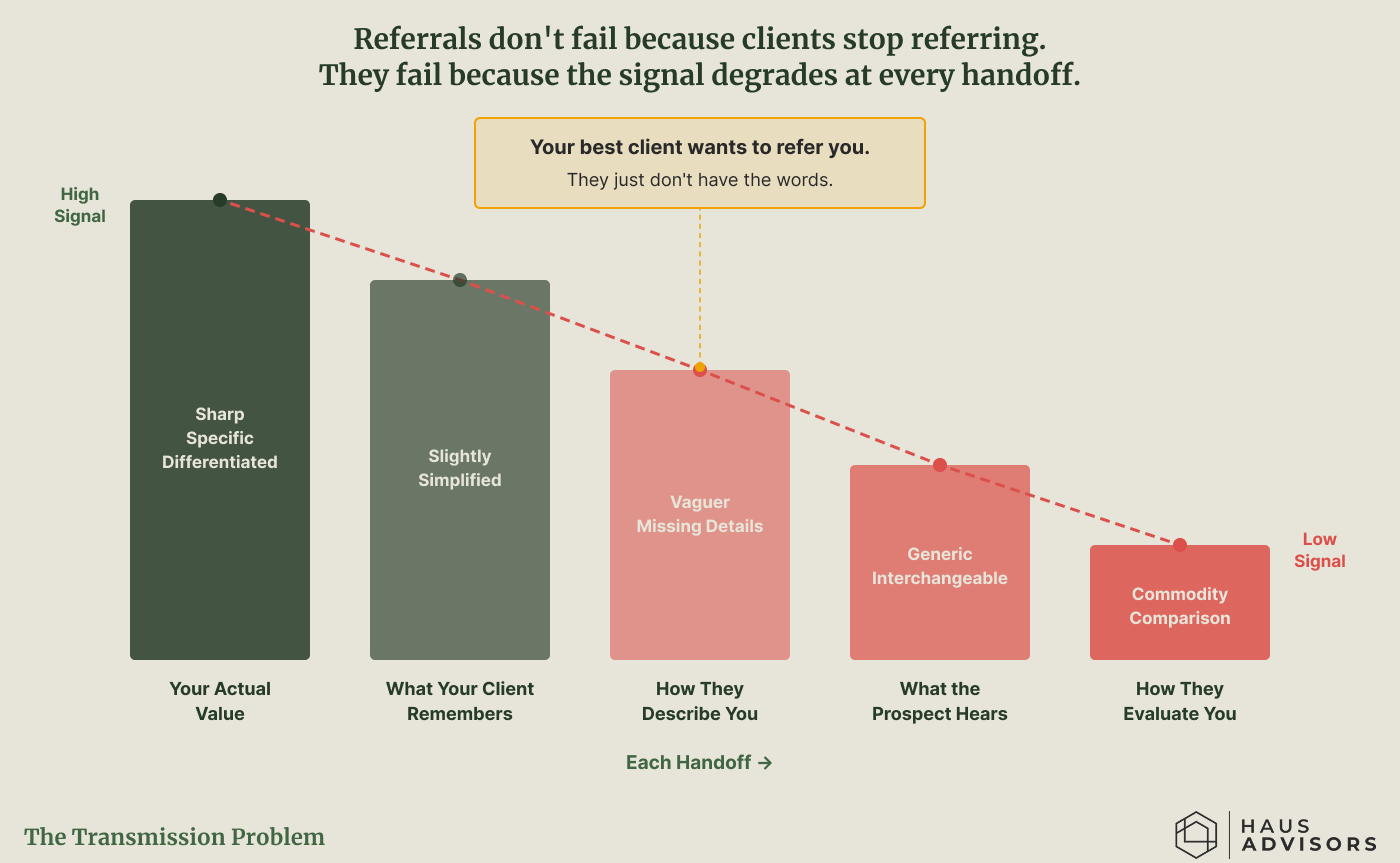
The Transmission Problem: Your client has a specific experience of your value. But at each handoff, the signal loses fidelity. By the time a prospect hears about you, they're comparing you to everyone else.
Why Clients Default to "Great Team" When They Refer You
Because you've never made it easy for them.
“The problem isn’t willingness. It’s vocabulary.”
Think about it from the referrer's perspective. They worked with your agency on a specific project. The experience was great. But when a colleague mentions they're looking for a dev shop, the referrer has to do something surprisingly difficult: compress months of working together into a single sentence that's specific enough to be useful.
If your positioning is sharp, that sentence writes itself. "They specialize in fixing conversion bottlenecks for growth-stage SaaS companies. They did it for us in six weeks." The referrer doesn't have to think. The positioning does the work.
If your positioning is generic, the referrer has to improvise. And improvisation under cognitive load defaults to the generic: "great team," "really talented," "easy to work with." These descriptions are true. They're also useless for qualifying the prospect or setting the right expectations for the conversation that follows.
“The agencies with the strongest referral conversion rates aren’t the ones with the happiest clients. They’re the ones whose positioning has reduced the cognitive load on the referrer to near zero.”
This is what I call the Cognitive Load Problem. Every referral requires the referrer to do a small act of marketing on your behalf. If that act requires them to recall specifics, synthesize your value, and frame it for their colleague's situation, most of them won't do it. Not because they don't care, but because it's too much work. They'll default to the easiest description available, and the easiest description is almost always generic.
The agencies with the strongest referral conversion rates aren't the ones with the happiest clients. They're the ones whose positioning has reduced the cognitive load on the referrer to near zero. The referrer doesn't need to remember what makes the agency special. They remember a single sentence that does the job: what problem you solve, for whom, and what outcome you produce.
The Four Ways Weak Referrals Hurt Your Business
The introduction happens. The call gets scheduled. But the prospect arrives without the framing that makes the conversation productive. The trust was transmitted. The relevance wasn't.
The inconsistency in transmission quality produces inconsistency in pipeline quality. Some referrers describe you well. Others don't. That variance is what creates the feast-or-famine cycle.
When referrals don't convert, referrers feel it. They don't stop liking you. They stop referring you — because the last few introductions didn't land and they don't want to keep spending social capital on matches that don't work.
Every call where the prospect asks "so what do you guys do?" is a call where the founder is doing work the positioning should have done before the call started.
Referrals that feel warm but convert cold. The introduction happens. The call gets scheduled. But the prospect arrives without the framing that would make the conversation productive. They're vetting you from scratch rather than evaluating fit. The close rate on these conversations is dramatically lower than it should be, given that a trusted person made the introduction. The trust was transmitted. The relevance wasn't.
Revenue Whiplash. This is the feast-or-famine pattern that most agencies experience as unpredictable cycles of too much work followed by empty pipeline. The conventional explanation is referral timing: you can't control when clients refer you. That's true, but it's only half the story. The other half is that even when clients do refer you, the referrals convert inconsistently because the transmission quality varies wildly. Some referrers happen to describe you well. Others don't. The inconsistency in transmission quality produces inconsistency in pipeline quality, which produces the whiplash.
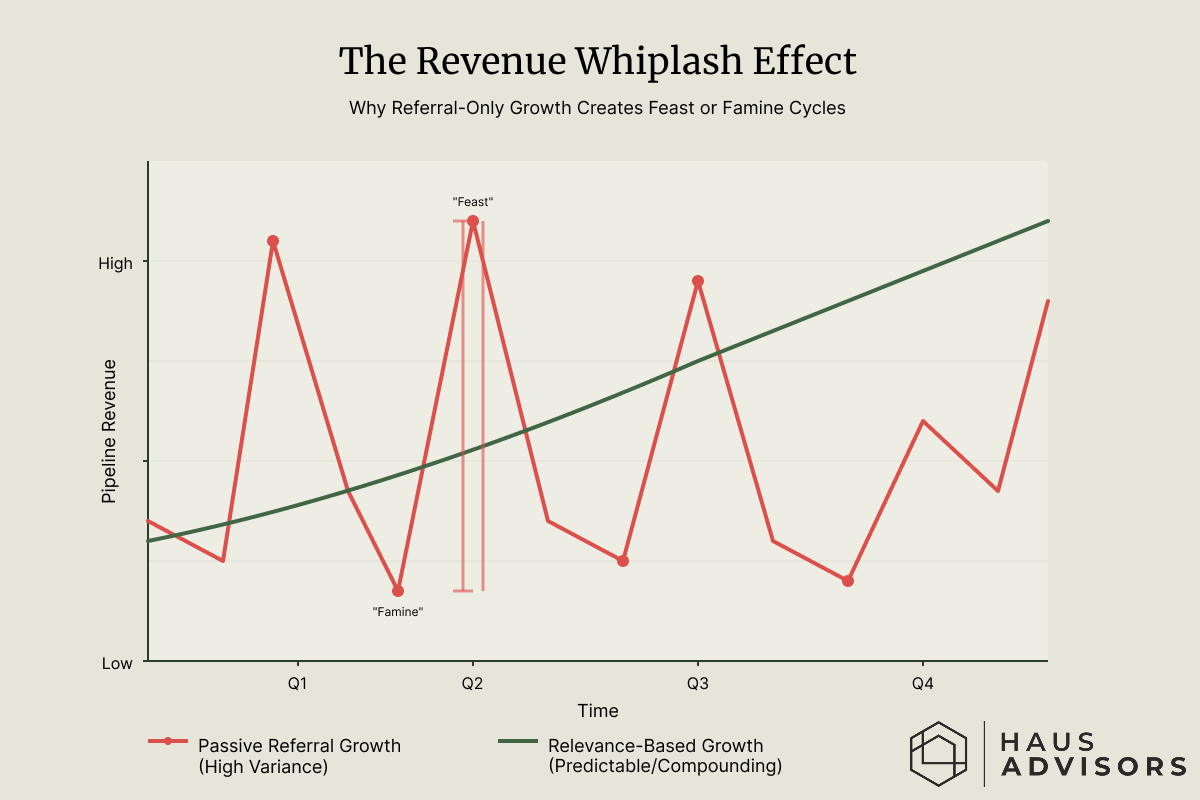
The variance problem: Revenue Whiplash isn't just a timing issue. It's a transmission quality issue. When referral introductions range from highly specific to completely generic, pipeline quality fluctuates accordingly. Predictable growth requires consistent transmission, which requires positioning sharp enough that every referrer says approximately the same thing.
Damaged trust networks. When a referral doesn't convert, both parties feel it. The referrer feels mildly embarrassed for making an introduction that didn't go anywhere. The referred prospect feels like their time was wasted. Neither outcome is catastrophic, but the accumulation of these small failures erodes the referrer's willingness to make future introductions. They don't stop liking you. They stop referring you, because the last few introductions didn't land and they don't want to keep spending social capital on matches that don't work.
Founder time spent rebuilding context that should have been pre-built. Every referral call where the prospect asks "so what do you guys do?" is a call where the founder is doing work the positioning should have done before the call started. Multiply that by dozens of calls per year, and you have a significant chunk of the founder's highest-value time spent on remedial context-building rather than consultative selling.
Stop Asking for More Referrals. Start Arming Your Referrers.
This is the part most people miss.
- Ask more frequently and at the right moment
- Make it easy to refer with templates and reminders
- Offer incentives to motivate referrers
- Build a formal referral program
- A positioning statement specific enough to be repeatable
- Visible proof that confirms what the referrer said
- Productized offerings that give referrers something concrete to name
- Referral criteria that tell referrers exactly who to send
Most referral improvement strategies focus on asking: ask more frequently, ask at the right time, make it easy to refer, provide incentives. These strategies assume the transmission mechanism works and you just need more volume through it.
The Transmission Problem reveals that the mechanism itself is broken. More volume through a broken mechanism produces more low-quality referrals, not more high-quality ones. Asking your happiest client to refer you doesn't help if they describe you as "great devs" to a prospect who needs to hear "the team that fixes API performance bottlenecks for fintech companies scaling past 10,000 daily transactions."
The alternative isn't asking more. It's arming your referrers with the language they need to transmit your value accurately.
Arming looks like:
A positioning statement sharp enough to be repeatable. Not a tagline. A sentence that your clients can remember and repeat without effort. "They help growth-stage SaaS companies fix the onboarding problems that kill trial-to-paid conversion." That's specific enough to qualify the prospect, clear enough to be memorable, and short enough that the referrer won't simplify it further.
Visible, public proof that backs up the introduction. When the referred prospect does what every referred prospect does (Googles your agency after the intro), they should find case studies, content, and a website that confirms and expands on what the referrer said. The referrer opens the door. Your published presence fills the room. This is where the Context Gap closes: not through the referral itself, but through the independent context the prospect finds after the introduction.
Productized offerings that give referrers something concrete to reference. "You should talk to them about their SaaS Conversion Diagnostic" is a more transmittable referral than "you should talk to them about your dev project." Named, scoped offerings give the referrer a handle to grab. The introduction becomes specific because the offering is specific.
Referral criteria that reduce the referrer's judgment burden. Instead of "send anyone who needs development work," give your referrers a filter: "If you know a VP of Product at a SaaS company between Series A and Series C who's frustrated with their trial-to-paid conversion rate, that's exactly who we help." The specificity feels limiting. In practice, it makes referrals more likely, not less, because the referrer can now scan their network for a specific pattern rather than vaguely wondering who "might need a dev shop."
“Won't Specific Language Limit My Referral Pool?”
Here's the strongest argument against narrowing your referral language: it limits the pool. If your referrer is armed with "they fix onboarding conversion for SaaS companies," they'll filter out every non-SaaS contact. You might miss the fintech CTO or the healthcare startup that would have been a great client.
That's a real tradeoff. Specificity does reduce the total number of introductions. And some of those missed introductions would have been good fits despite falling outside the stated focus.
Why a Smaller Pool of Better Referrals Wins Every Time
But here's the boundary: a generic referral ("great devs") that reaches ten prospects and converts zero is less valuable than a specific referral ("they fix onboarding conversion for SaaS companies") that reaches three prospects and converts two. The total pool shrinks. The conversion rate climbs dramatically. And the deals that close are higher-margin, because the prospect arrives with context that justifies premium pricing.
“You’re trading a high volume of weak transmissions for a lower volume of strong ones.”
You're not losing opportunities by narrowing the referral language. You're trading a high volume of weak transmissions for a lower volume of strong ones. And strong transmissions compound in a way that weak ones never do, because a prospect who hears a specific, compelling referral and then has a great experience becomes a specific, compelling referrer themselves. The vocabulary propagates through the network. Generic language doesn't propagate. It just repeats.
How to Test What Your Clients Actually Say About You
You don't need a referral program. You need to test what your clients actually say when they refer you.
Start here: ask three of your best clients, the ones you know have referred you before or would, to describe what your agency does. Don't coach them. Don't prompt them. Just ask: "If someone asked you what we do, what would you tell them?"
If they say something specific ("they fix X problem for Y type of company, and they did Z for us"), your transmission mechanism is working. Protect it.
If they say something generic ("they're a great dev team, really solid"), that's the Transmission Problem in action. The fix isn't to ask for more referrals. It's to give your clients a sentence worth repeating. One sentence, specific enough to qualify, clear enough to remember, short enough to transmit without simplification.
That sentence is your positioning, compressed to its most transmittable form. Everything else in your referral strategy depends on getting it right.
The principle is simple:
There are agencies whose clients want to refer them, and there are agencies whose clients know how to refer them.
Willingness without vocabulary produces warm introductions that convert cold.
At Haus Advisors, we help dev shops and technical agencies solve the Transmission Problem by building positioning sharp enough that your best clients can articulate your value without thinking about it. The Bottleneck Sprint produces the specific language, referral criteria, and published proof that arms your network to refer you with precision. If your clients love you but your referrals convert inconsistently, that's exactly the gap we close. Book a strategy call here →