Productized Services Examples for Agency Founders: What to Copy, What to Ignore, and Why Most Productize the Wrong Thing First
A dev shop founder I talked to last year had been trying to productize for eight months. He'd built a scope document, set a price, and launched what he called a "Tech Stack Assessment" offer. Two clients bought it in the first month.
Then both of them asked for customizations.
By month three, the Tech Stack Assessment had become a 40-hour custom engagement that required him to run every deliverable. He'd built a new name for his consulting work, not a product. When I asked him what he'd learned from the examples he'd studied before launching, he listed four or five well-known productized service businesses. All of them were solopreneur offerings designed for one-person shops with no existing client base and no overhead to protect.
He'd copied the model. He hadn't understood the structural conditions that made it work.
Most agency founders spend weeks digging through productized services examples: unlimited graphic design templates, podcast editing packages, basic content blocks. They come away inspired but no closer to building their own offer. The problem is that these cookie-cutter models don't apply to a 12-person software development agency or a performance marketing shop with existing staff, client retainers, and overhead at risk. This post is the strategic filter you actually need: real B2B agency examples of productized services organized by the operational bottlenecks they solve, so you can productize without breaking what's already working.
What Makes a Productized Service Actually Work (Before the Examples)
Before any example is useful, three decisions have to be made in the right order. Most agency founders get the sequence wrong. They jump to packaging before answering the foundational questions, and that's why most productization attempts revert to custom chaos within 90 days.
The three decisions, in order: what problem, for whom, at what scope.
Most agencies try to define scope first. They think: "We do great brand identity work. Let's package a brand sprint for $15K." But if they haven't named who specifically the offer is for and which specific problem it solves for that buyer, the scope document is meaningless. The sales conversation still requires a custom pitch. The delivery still requires custom judgment. The "product" is a price tag on consulting.
The specificity test is simple. "Social media management" is not a productized service. "LinkedIn content for B2B SaaS companies with sales teams that close deals over 90-day cycles" is. The second version tells the buyer immediately whether it's for them. The first version starts a conversation about whether it could be.
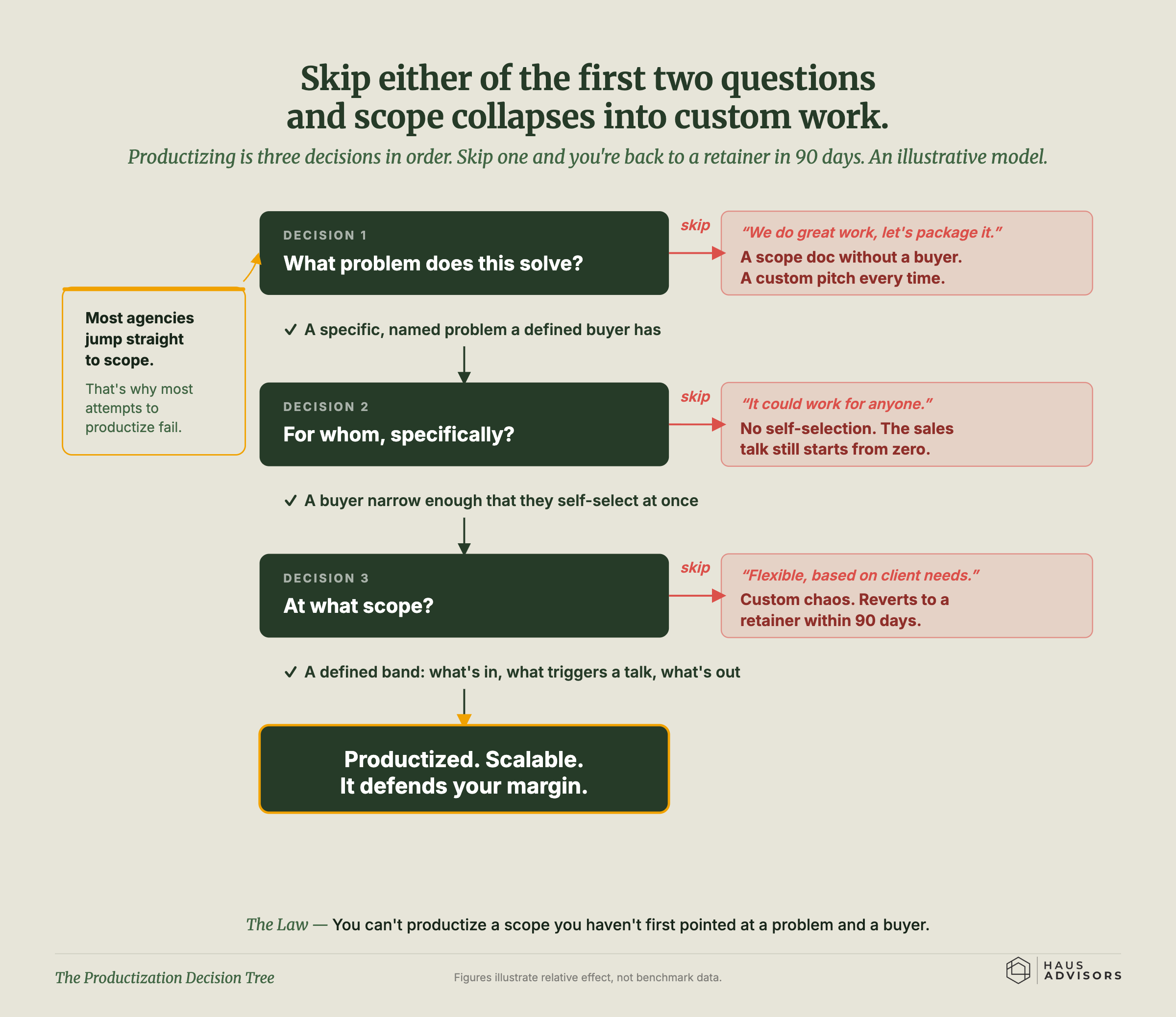
Most agencies skip straight to scope: deliverables, tiers, pricing. The offer looks finished on paper and reverts to custom work within 90 days. The three decisions have to happen in order, or the third one doesn't hold.
Here's what most founders skip entirely: the delivery constraint question. Which steps in the service require senior judgment, and which can be systematized? The best productized services are designed so the systematizable work carries the revenue. The founder's expertise is encoded into the process, not applied fresh to every engagement.
The red flag to self-apply: if the offer requires the founder to scope, approve, or quality-check every deliverable, it's not a productized service. It's a retainer with a different name.
Productized Services Examples That Solve the Founder-Dependency Trap
The most common reason technical agency founders want to productize isn't money. It's time. Their expertise is trapped in their head, and every high-stakes client deliverable flows through them. Productization is the mechanism for encoding that judgment into a repeatable process someone else can eventually run.
Roast My Landing Page ($350): Olly Meakings had 20+ years of CRO consulting before he turned it into a 15-minute video audit. The lesson isn't the price point. It's that deep expertise made the product credible at a price that would feel too cheap without it. Shallow expertise can't hold $99 for an audit; real expertise can charge $350 for 15 minutes. The expertise came first. The packaging came second.
For a software dev agency, the equivalent is a 2-day architecture review. It productizes the thing only a senior engineer can do but bounds it tightly so it can be priced, scoped, and eventually templated. The founder still delivers it initially, but it's no longer custom from scratch every time. The second delivery is 40% faster. The fifth is something a senior hire can run with light oversight.
WP Speed Fix ($495–$2,495): This offer spotted a capability gap before it built a product. WordPress speed optimization had become complex enough that generalists couldn't do it reliably. The offer didn't go looking for demand. It found a thing that was routinely needed and routinely done badly, then built a repeatable process around that constraint. The lesson for technical agency founders: look for the thing your team does routinely that no generalist can replicate consistently. That's where the product lives.
The delivery signal that tells you founder-dependency has been broken: the offer can be delivered twice in the same week without the founder losing sleep or reviewing every output. If you can't get there in six months of iteration, the offer isn't narrow enough.
Productized Service Examples That Solve Lumpy Revenue
Project-based revenue resets the pipeline to zero at the end of every engagement. A strong quarter can mask three slow months that are already baked in. Productized recurring offers change this by converting one-time buyers into monthly subscribers, and the best examples show exactly how to make that model hold.
100 Pound Social (£100–£255/mo): The name is a price. The buyer knows what they're getting before they ever speak to someone. But the subscription model works because of an explicit delivery constraint: human writers, UK-based. In a category where AI commoditization is real and accelerating, that constraint is a quality signal, not a limitation. The thing that limits them operationally is the thing that makes the offer credible commercially. Most agency founders have a version of that constraint they've been apologizing for. They should be charging for it instead.
Vidpros ($1,000–$4,000/mo): Called it "fractional video editor" instead of "unlimited editing." That framing choice reflects a delivery reality: four clients per editor, two guaranteed hours daily. The cap is what makes the quality promise credible. Unlimited editing promises breed overuse and under-delivery. A fractional model sets clear expectations from the start. If your recurring offer doesn't have a built-in cap or constraint that prevents over-servicing, you'll end up delivering more than you priced for within 60 days.
GMB Gorilla ($400/mo): One service. One platform. Google changes GBP rules constantly, and GMB Gorilla's entire team tracks nothing else. A generalist agency adding "local SEO" as a line item competes on price because they can't compete on depth. A team that only does one thing builds knowledge that a generalist can't replicate at any price.
The churn math most founders underestimate: at 8% monthly churn, a 100-client recurring business loses half its clients in nine months. Design onboarding to reduce 90-day churn. That's when most early subscribers cancel, and it's almost always because the first 30 days didn't deliver a clear win. Build the first win into the onboarding sequence, not the month-two deliverables.
Productized Services Examples Built on a Niche (The Positioning Pattern Behind the Best Ones)
The SERP for "productized services examples" shows you what to build. It doesn't show you why the best ones work. The pattern is consistent across all of them: the strongest examples are narrow before they're packaged. The niche is the engine. The product is the delivery mechanism.
KENJI ROI does Amazon seller marketing. Not e-commerce. Not marketplace marketing. Amazon. They've declined Shopify clients, eBay clients, and general e-commerce inquiries. That's not leaving money on the table. It's what makes every process, template, team member, and case study more effective. Every tool the team builds, every hire they make, and every piece of content they produce compounds on a single platform's behavior. A generalist marketing agency's knowledge spreads thin. KENJI ROI's gets deeper every quarter. Narrow positioning isn't a sacrifice. It's an operational advantage that gets harder to match over time.
Expert LLC USA targets francophone entrepreneurs forming US businesses: specifically LLC formation with ongoing compliance. Three constraints operating simultaneously: language, geography, and legal structure. No one else is optimizing all three at once. That's not a niche by accident. It's a niche by deliberate elimination of everything that would make the offer less credible to the specific buyer it's built for.
The question to apply to your own offer: "Is this narrow enough that a prospect would say 'that's exactly for someone like me'?" If the answer is "it could work for anyone," the niche isn't tight enough and the offer won't hold at a premium.
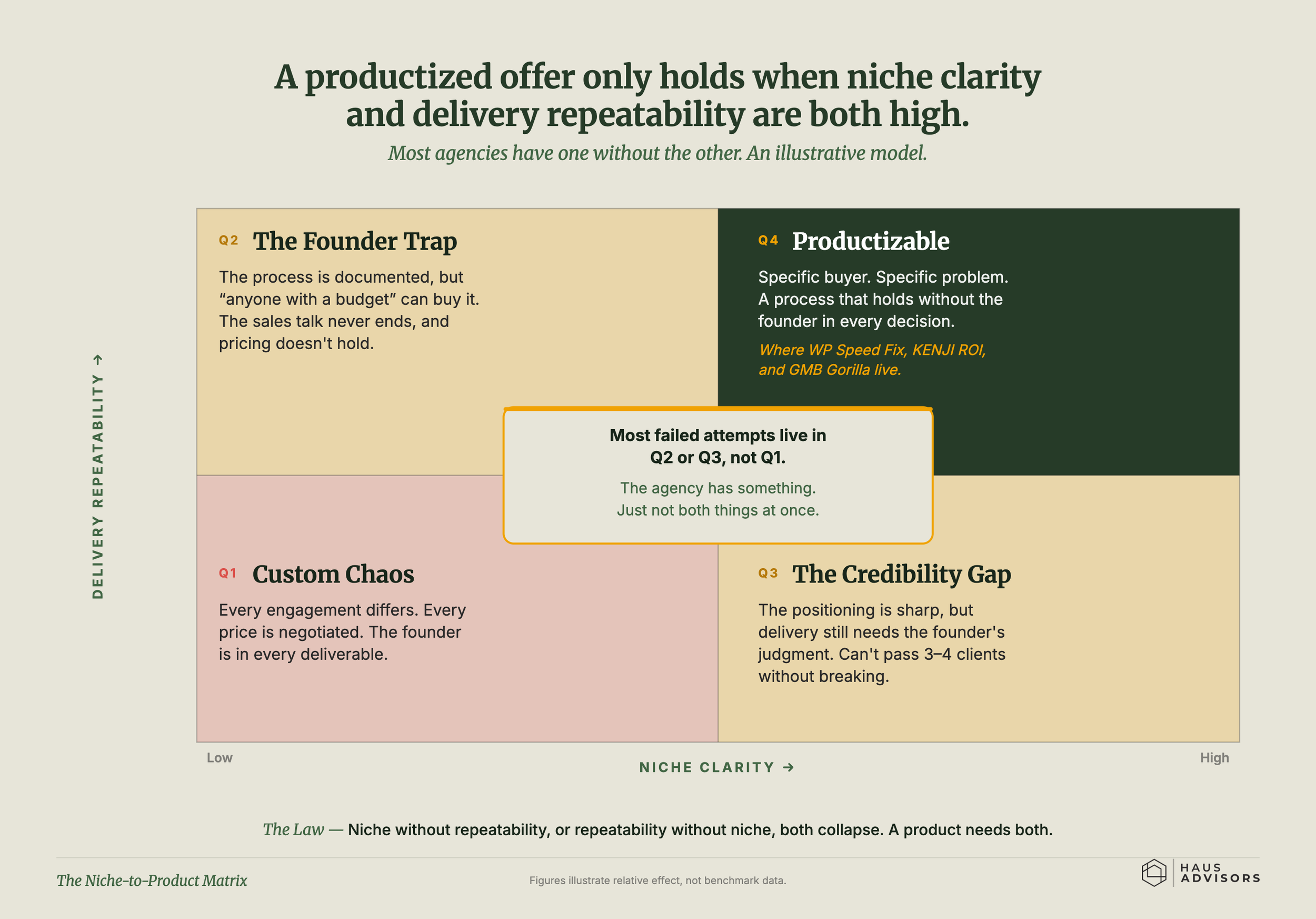
Most failed productization attempts aren't in the bottom-left. They're in Q2 or Q3: the agency has the process but no specific buyer, or the niche but still needs the founder for every deliverable. Both have to be true before the offer can hold.
Finding your agency's wedge: list your best five clients and look for what they share that most of your other clients don't. Industry, company stage, team structure, specific problem, budget range. Most founders do this exercise expecting to find an industry. They usually find a problem. That overlap in the best five clients is where the productized offer lives, not in the sector label you've been putting in your bio.
The Failure Modes: Why Most Agency Productization Attempts Revert to Custom Chaos
Every list of productized services examples shows you what worked. None of them show you why 80% of attempts fail. That survivorship bias is the most expensive thing about the genre.
Productizing the popular service, not the repeatable one. The service clients ask for most often isn't the same as the service your team can deliver with consistent quality at volume. Those are different questions. An agency whose clients constantly ask for custom integrations shouldn't productize custom integrations. They should productize the discovery process that determines which integrations are worth building.
Scope creep as the silent killer. Offers that start clean get customized back into bespoke work within 90 days. Usually because the sales process didn't filter for fit: the founder said yes to a client whose situation didn't quite match the offer, then made exceptions to close the deal. An offer without a clear "this is not included" document becomes a custom retainer within two client cycles.
Packaging before positioning. Building tiers, scope documents, and delivery workflows before deciding who the offer is for and what specific problem it solves. The packaging becomes meaningless if the positioning is vague. WP Speed Fix didn't build a scope document and then look for clients. It identified a specific capability gap in a specific platform and built the process around that constraint. Sequence matters.
Underpricing to test demand. Low prices don't validate an offer. They validate that the offer is cheap. If 20 clients sign up for a $99/month service that costs $120/month to deliver, you've validated nothing useful. Price from delivery cost plus margin. Test demand by getting five prospective clients on a call and asking what they'd pay, not by setting a price that feels safe.
It's the most common failure mode for technical agencies: the offer technically has a fixed scope, but every deliverable still requires the founder to approve. The founder-dependency trap in productized form. A retainer wearing a product costume. The test is simple: can the offer be delivered start to finish by a senior hire working from a documented process, without founder involvement? If not, the offer isn't productized yet.
Keeping existing clients on the old model indefinitely. Grandfathering every existing client into bespoke work while launching a productized offer creates two parallel businesses. The founder splits their time between both, never operates the new model long enough to learn what breaks, and ends up with a productized offer that never gets past five clients because the custom work always comes first. Set a 12-month sunset for legacy arrangements. Give existing clients first access to the new offer. Move them or lose them, but don't run both forever.
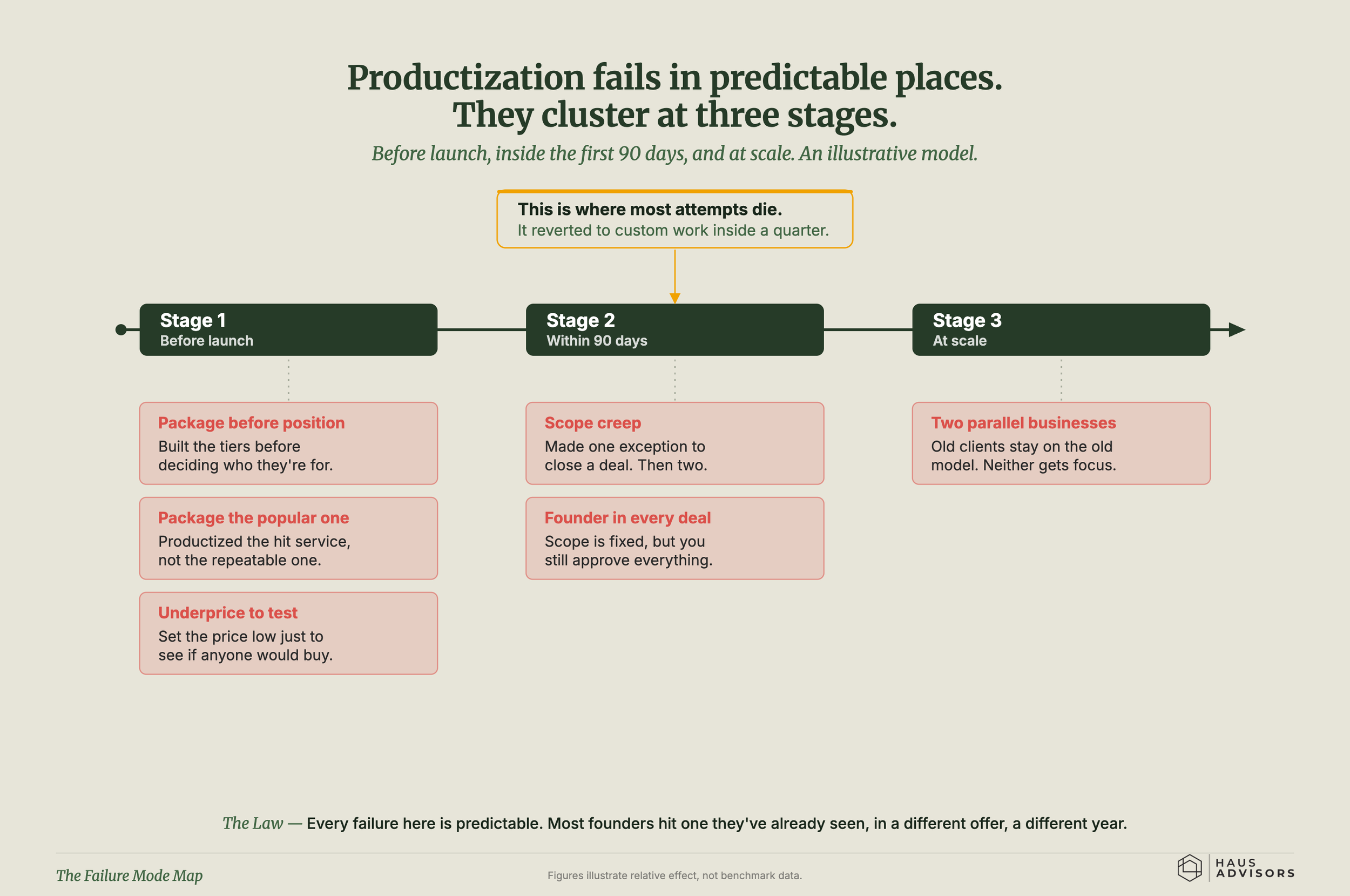
Six failure modes. Three stages. Most founders hit one they've already seen in a different offer or a different year. The pattern is predictable, which means it's preventable if you know which stage you're in.
How Haus Advisors Approaches Productization
Once founders understand what productization actually requires: specific buyer, specific problem, repeatable delivery, documented process, they usually realize they've been solving the wrong problem. They've been trying to package what they sell instead of figuring out what they can deliver consistently.
Most founders reading this already know the real problem. It isn't which example to copy. It's that the reputation, the relationships, and the judgment that make your agency worth hiring still live in your head, which is why every "productized" offer still needs you to approve every deliverable. So the business only grows when you're in the room.
That's the work we do at Haus Advisors. The New-Business Engine is six months of implementation, not a strategy document. We pull what makes your agency relevant out of your head, build it into positioning, offers, and growth plays your team can run, and hand ownership to them. If you want an agency that grows without needing you in every deal, book a call to see if it's a fit.
The productized offers that last aren't built on inspiration from example lists. They're built on an honest accounting of what the team already delivers well, narrowed to a specific buyer who needs exactly that, priced at what it's actually worth to them. That's the sequence. Everything else is just packaging.
Next Steps for Agency Founders
Where you go from here depends on which stage you're stuck in.
At the researching-examples stage: the most useful next move isn't picking a model. It's getting honest about which existing service is most repeatable. List every engagement from the past 18 months. Which had the clearest scope and the fewest surprises? The intersection of cleanest scope and smoothest delivery is usually where the right productized offer lives.
If you've tried before and it reverted to custom work: that's a scope or positioning problem, not an execution problem. The offer design needs to be revisited before any new delivery infrastructure gets built. The failure mode section above names six specific causes. Identify which one applies before building anything new.
If you're ready to move from examples to execution: that's the first phase of the New-Business Engine, where we pull what your team can actually deliver repeatably out of your head and build the offer on that evidence, not on what looked good in someone else's example list. Book a call to see if it's a fit.
Keep reading
Browse by topic
- Positioning & Strategy
- Lead Gen & Marketing
- Sales & Biz Dev
- Pricing & Productization
- Research & Data
- Operations & Delivery
- Client Retention & Expansion
- Leadership & Culture
For founders whose agency has outgrown referrals.
One idea a week that makes a hard growth problem obvious, usually with a chart that shows you the mechanism behind it.
Built from conversations with seventy-plus agency founders on the Behind the Agency podcast.