Five-Star Delivery Won't Save You From 30% Client Churn
A founder I worked with last year had a retention problem he couldn't explain. His agency had a 92 NPS score. Clients praised the work in every post-project survey. Three different clients had written unsolicited LinkedIn recommendations calling his team "the best development partner we've ever worked with."
He also lost four of his top ten clients that year. Not to competitors. Not to budget cuts. They just didn't come back. The projects ended, the deliverables shipped, everyone shook hands, and then silence. When he followed up three months later, two had hired other agencies for new initiatives. One had brought the work in-house. One said they "didn't have anything right now" and never responded again.
His read on the situation: "Maybe we need to improve our offboarding process. Send better wrap-up reports. Do more check-in calls after delivery."
He was solving the wrong problem. The issue wasn't what happened after the project. It was what the project never set up.
The Pattern Has a Name
I call it The Delivery Trap: the belief that excellent execution is sufficient to generate client retention, when retention actually requires a relationship architecture that extends beyond any single deliverable.
Here's how the trap works. An agency wins a client. The team does outstanding work. The client is happy. The project ships on time, on budget, with quality that exceeds expectations. Everyone involved would call it a success.
Then the project ends.
And when a project ends, something subtle happens. The client's problem feels solved. The engagement had a defined scope, a defined timeline, and a defined outcome. The agency delivered on all three. There is no structural reason for the relationship to continue. The client has to actively invent a reason to come back, and most clients don't do that. Not because they're ungrateful or disloyal. Because the agency gave them a finished product, not an ongoing relationship.
This is the core mechanism of the Delivery Trap: satisfaction is not the same as dependency.
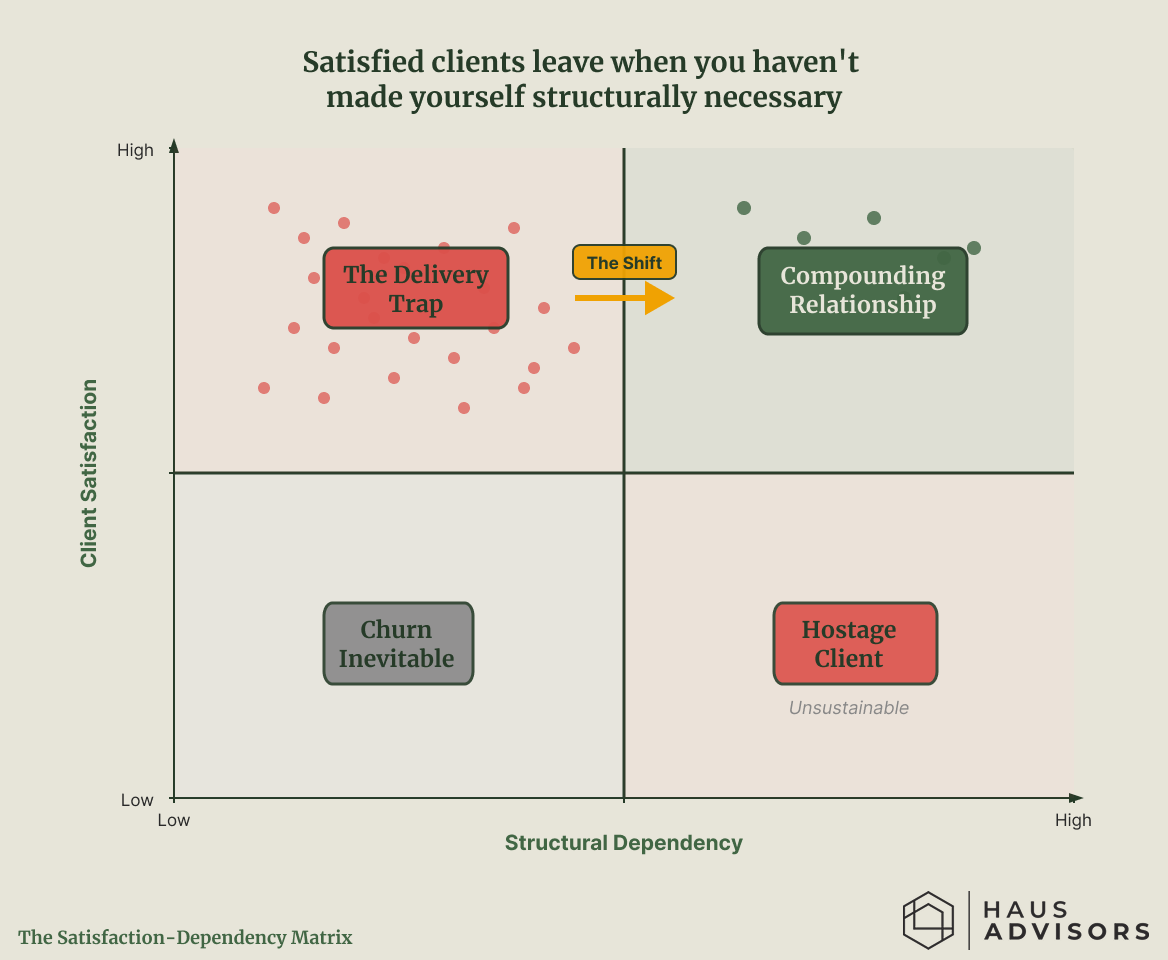
Most agencies are stuck in the upper left. High satisfaction doesn't move clients right. Only relationship architecture does.
A satisfied client will say wonderful things about you. They'll refer you to their friends. They'll give you a five-star review. But they won't necessarily hire you again, because the work you did for them is complete. You solved the problem they came to you with. There's no next step unless someone builds one.
The agency that treats delivery as its retention strategy is running a business that has to continuously replace its own clients. Not because the clients are unhappy. Because the relationship has no forward motion.
Why the Conventional Wisdom Feels True
"Do great work and they'll come back" is one of those beliefs that's impossible to argue against because it contains a real truth inside a structural error.
The real truth: quality matters. Agencies that deliver poorly don't retain clients either, and they don't get referrals. Quality is the floor. Without it, nothing else works.
The structural error: quality is necessary but not sufficient. It's a hygiene factor, not a growth driver. It prevents dissatisfaction. It doesn't create continuation. Those are two completely different forces.
Think of it this way. A restaurant can serve an exceptional meal. You leave satisfied. You'd recommend it. But you don't automatically return next week. You return next week if there's a reason to: a new menu, a reservation for a special occasion, a standing dinner with friends. The quality of the first meal made return possible. It didn't make return inevitable.
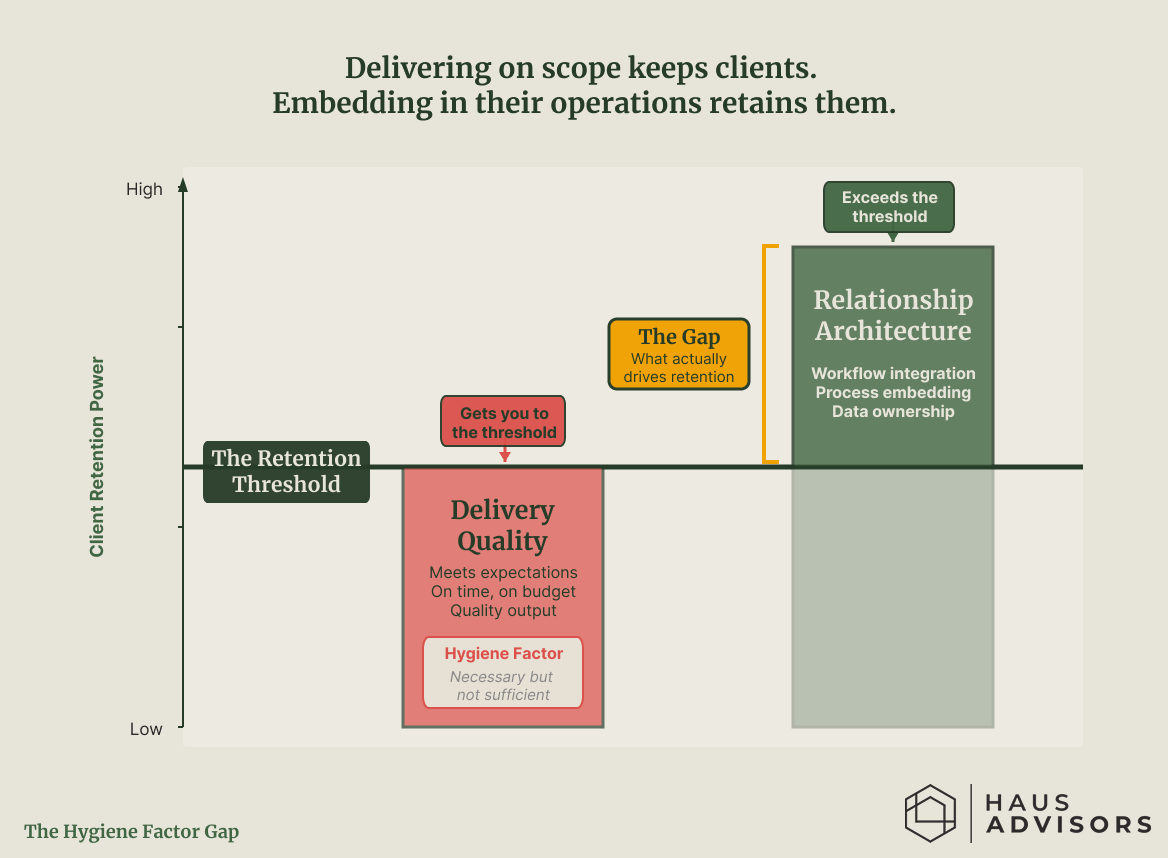
Quality gets you to the threshold. It doesn't clear it. Everything above the line is structural, not qualitative.
Agencies that rely on delivery quality for retention are hoping that clients will provide their own reason to return. Some will. Most won't. And the ones who won't aren't bad clients. They're simply responding rationally to a relationship that had a clear beginning and a clear end.
What Actually Drives Retention
The agencies I work with that retain 70% or more of their clients year over year don't deliver better work than their peers. They build a different kind of relationship. The difference is structural, not qualitative.
They diagnose more than they were asked to solve. During every engagement, they surface adjacent problems the client hasn't prioritized yet. Not as upsells. As observations. "While we were in the codebase, we noticed your authentication layer has some technical debt that's going to create problems in about 12 months." The client may not act on it today. But the agency has planted a future conversation that only this agency is positioned to have, because only this agency has the context.
They create a "next problem" pipeline inside the client. By the time the current project is wrapping up, the client already knows what the next engagement could be. Not because the agency pitched it. Because the diagnostic work during delivery revealed it. The transition from "this project" to "the next project" isn't a sales conversation. It's a natural continuation of a diagnostic relationship.
They structure deliverables that create dependency, not just satisfaction. An agency that delivers a finished application and walks away has created a completed transaction. An agency that delivers a finished application along with a technical roadmap, a quarterly review cadence, and a prioritized backlog of improvements has created an ongoing operating relationship. The second agency didn't do more work. It framed the same work inside a longer-term context.
They position themselves as problem owners, not project vendors. The project vendor says: "You hired us to build X. We built X. Here it is." The problem owner says: "You hired us because your conversion rate was declining. We built X as the first intervention. Here's what we'd recommend monitoring over the next two quarters, and here's what the second intervention looks like if the data supports it." Same deliverable. Completely different relationship frame.
This is the Doctor Frame applied to retention. The doctor doesn't discharge you and hope you come back when you're sick again. The doctor schedules a follow-up. The follow-up is a natural, expected part of the relationship. It doesn't feel like a sales call. It feels like responsible care.
The Math That Makes This Urgent
The Delivery Trap isn't just a relationship problem. It's a financial structure problem that compounds every year.
Acquisition costs dwarf retention costs. Depending on your growth channel, winning a new client costs 5 to 7 times more than retaining an existing one. An agency with 30% annual churn has to replace nearly a third of its revenue every year just to stay flat. That replacement cost is invisible on most P&Ls because it shows up as "sales and marketing" rather than "the tax we pay for not retaining clients."
Revenue becomes unpredictable. An agency that retains 80% of its clients can forecast next year's revenue with reasonable accuracy. An agency that retains 50% is guessing. That unpredictability cascades into hiring decisions, capacity planning, and the founder's willingness to invest in growth. You can't build infrastructure on revenue you can't predict.
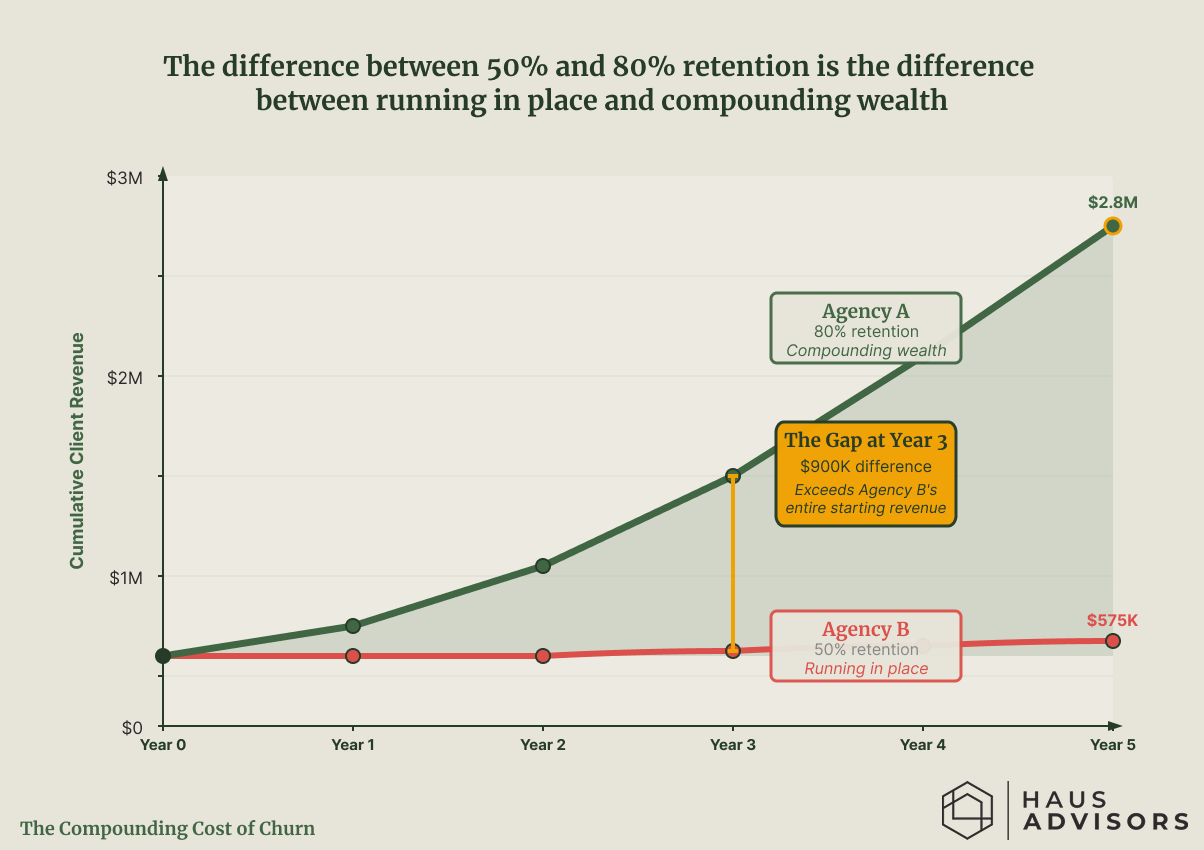
The agency that retains 80% doesn't just keep more clients. It compounds expertise, referrals, and revenue that the churning agency has to rebuild from zero every year.
Your best clients are the most likely to leave. This is the part that stings. The clients who are most satisfied with your work are often the ones with the most options. They're well-resourced, they value quality, and they have no shortage of agencies competing for their attention. If your relationship with them is purely project-based, the switching cost is zero. They liked working with you, but they'll like working with the next excellent agency too. Without structural dependency, satisfaction alone doesn't create loyalty.
Your positioning erodes. An agency that churns 30% of its clients every year can never build deep case studies, compounding domain expertise, or referral density within a market. Every lost client is a lost opportunity for the next case study, the next referral, and the next layer of domain knowledge. The Delivery Trap doesn't just cost you this year's revenue. It prevents the compounding that would make next year's revenue easier to earn.
The Objection That Sounds Reasonable
"Our clients don't churn because of us. They churn because of budget cuts, leadership changes, or shifting priorities. That's out of our control."
Sometimes that's true. Clients do leave for reasons that have nothing to do with the agency. But here's the pattern I see when I audit retention data: agencies that position themselves as problem owners lose clients to budget cuts at roughly half the rate of agencies that position themselves as project vendors.
The reason is structural. When an agency owns a problem, cutting the agency means the problem stops being managed. The client has to consciously decide to let that problem go unaddressed. That decision has visible consequences, which makes it harder to make.
When an agency is a project vendor, cutting the agency means one fewer project in the pipeline. That decision has no visible consequences, because the project was self-contained. It ended cleanly. There's nothing left to manage.
Budget cuts don't hit all vendor relationships equally. They hit the ones that are easiest to cut. Project-based relationships are the easiest to cut because they were designed to end.
The Difference in Practice
The project vendor relationship:
The agency delivers a new e-commerce platform. The client is thrilled. The site launches. The agency sends a final invoice and a thank-you email. Three months later, the agency follows up: "Any new projects on the horizon?" The client says: "Not right now, but we'll keep you in mind." The agency adds them to a quarterly check-in list and hopes something materializes.
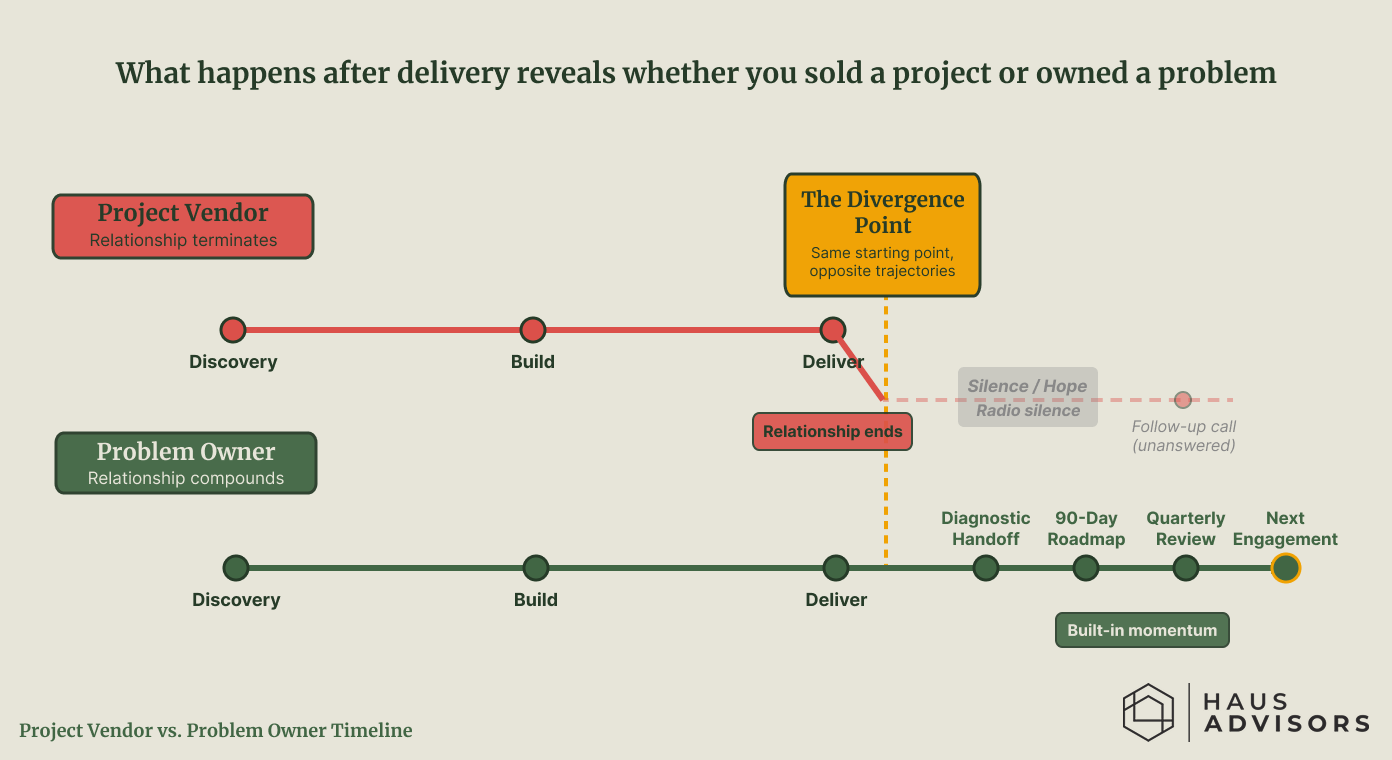
Same agency. Same capability. Same client. The only difference is what happens at the delivery point. One relationship ends. The other was designed to continue.
The problem owner relationship:
The agency delivers the same e-commerce platform. During the build, they documented three conversion optimization opportunities they didn't have time to address, a content architecture issue that would limit SEO performance within six months, and a payment flow that their data suggested was causing 8% cart abandonment. Before the final invoice, the agency presents a 90-day post-launch roadmap with prioritized recommendations and a proposed quarterly review cadence. The client doesn't have to decide whether to hire the agency again. The next engagement is a natural consequence of the diagnostic work that was already done.
Same agency. Same technical capability. Same client. One relationship ends. The other compounds.
Building the Architecture
If you're reading this and recognizing the pattern, here's what the transition looks like in practice.
Embed diagnostic work into every engagement. Every project should produce two outputs: the deliverable the client paid for and a set of observations about problems the client hasn't addressed yet. This doesn't require extra scope. It requires the team to document what they see while they're inside the client's systems, strategy, or operations. Most agencies already notice these things. They just don't formalize them.
Create a structured handoff that opens the next conversation. The end of a project should never be a clean break. It should be a bridge. A post-project roadmap, a prioritized recommendation list, a scheduled review. The format matters less than the principle: the client should leave every engagement knowing what comes next, even if they choose not to act on it immediately.
Productize your follow-up. A quarterly technical review. A six-month performance audit. An annual strategy session. These aren't upsells. They're defined products that create a natural rhythm to the relationship. The client doesn't have to invent a reason to come back. The reason is built into the structure.
Track retention as a leading indicator, not a lagging one. Most agencies track retention annually, which means they discover churn six months after the cause. Track it at the project level instead. When a project ends, is there a defined next step? If not, that client is at risk, regardless of how satisfied they are.
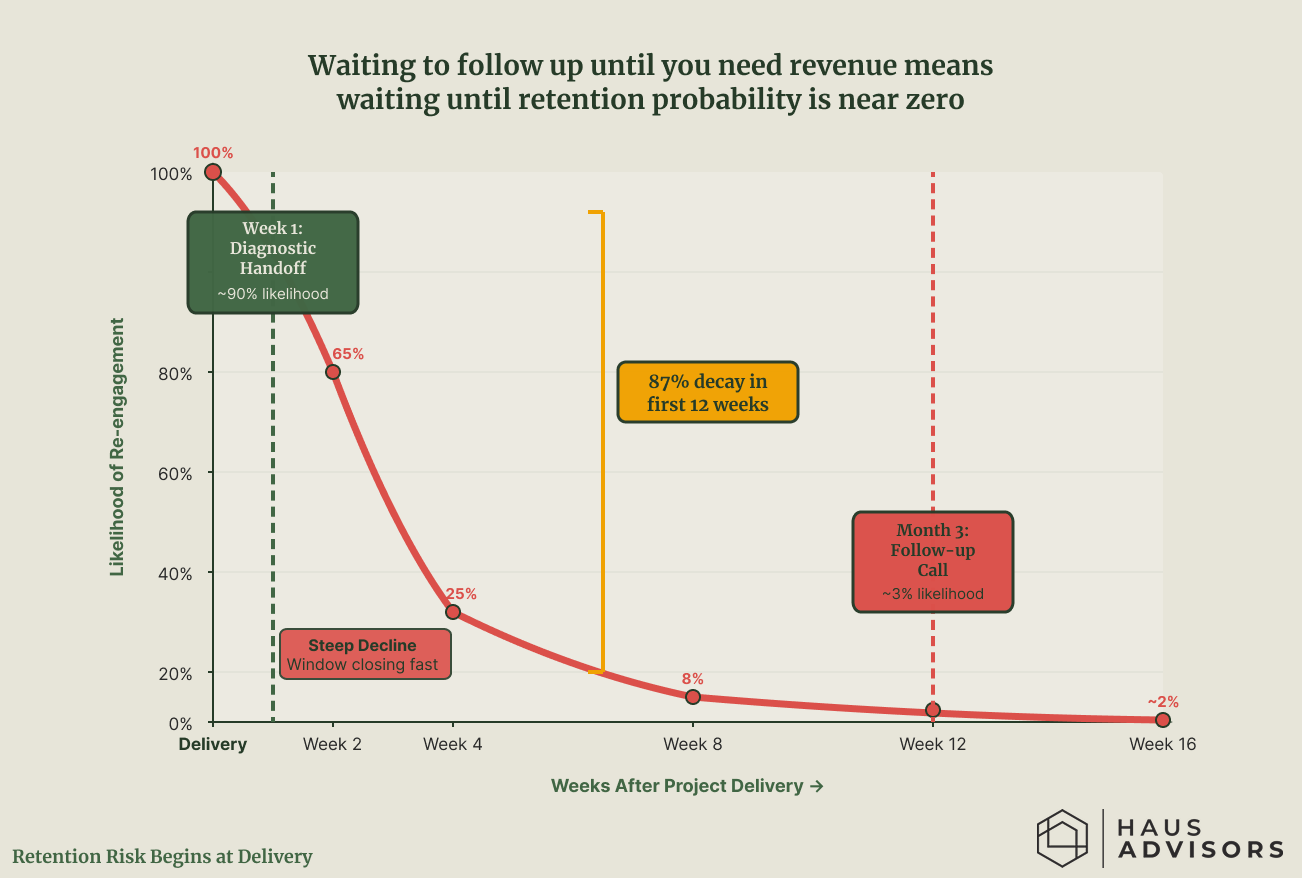
By the time you make the three-month check-in call, the client has already moved on. The retention window closes in weeks, not quarters.
The Audit
Pull up your last ten completed projects. For each one, answer three questions:
Did the engagement produce a defined next step (not a vague "let's stay in touch," but a specific recommendation, roadmap, or scheduled follow-up)?
Is that client still active today?
If they're not active, do you know why?
If fewer than half of your completed projects produced a defined next step, the Delivery Trap is active in your agency. The quality of your work isn't the issue. The architecture of your relationships is.
The principle is this:
Clients don't leave agencies that do great work. They leave agencies that give them a clean place to leave. Build the relationship so the next engagement is a continuation, not a decision, and the retention problem solves itself.
Most founders reading this already know the real problem. It isn't the quality of the work. It's that the reputation, the relationships, and the judgment that make your agency worth hiring still live in your head. So the business only grows when you're in the room.
That's the work we do at Haus Advisors. The Relevance Engineering Program is six months of implementation, not a strategy document. We pull what makes your agency relevant out of your head, build it into positioning, offers, and growth plays your team can run, and hand ownership to them. If you want an agency that grows without needing you in every deal, book a call to see if it's a fit.
Keep reading
Browse by topic
- Positioning & Strategy
- Lead Gen & Marketing
- Sales & Biz Dev
- Pricing & Productization
- Research & Data
- Operations & Delivery
- Client Retention & Expansion
- Leadership & Culture
For founders whose agency has outgrown referrals.
One idea a week that makes a hard growth problem obvious, usually with a chart that shows you the mechanism behind it.
Built from conversations with seventy-plus agency founders on the Behind the Agency podcast.