The Micro-Niche Multiplier: Why Narrowing Your Focus Expands Your Revenue
A founder of an eight-person DevOps and platform engineering agency described his pipeline problem this way: "We can help anyone running complex infrastructure. The problem is, nobody knows that."
He was right about both things. The capability was real. The market didn't know it existed.
Six years in business. Strong technical reputation locally. A handful of good client relationships from referrals. Revenue hovering in the same band year after year, with occasional projects that stretched the team, followed by gaps that stressed the pipeline.
When we dug into his last 18 months of deals, a pattern appeared. Twelve of his fourteen best-fit clients were in a single vertical: mid-market SaaS companies that had outgrown their startup infrastructure and needed to build for scale without a full-time platform team. Every single one of those engagements had started with a referral, closed in under three weeks, and produced follow-on work.
The other 26 clients in the same period? Mixed verticals, longer sales cycles, more price sensitivity, and two bad-fit relationships that had burned through margin.
He had a micro-niche. He just hadn't claimed it.
The Fear That Keeps Agencies Broad
This is Positioning Debt in its most common form: the gap between what an agency is genuinely built to serve and what the market understands about them.
The fear driving that gap is rational. If you narrow your stated focus, you might miss out on work outside that focus. If you say "we specialize in SaaS platform engineering," what about the ecommerce company that calls with an interesting project? What about the manufacturing client your biggest fan wants to refer?
I get it. The fear is understandable. Honestly, it's mostly wrong.
Here's the thing: when you position yourself for everyone, you are the obvious choice for no one. Buyers, especially buyers of technical services, are not looking for a generalist they can test. They're looking for a specialist they can trust. Those are different decisions with different risk profiles.
A buyer who thinks "these people do exactly what I need for exactly my situation" makes a fast decision. They don't negotiate hard on price. A buyer who thinks "these people seem competent and can probably figure out our situation" is making a much harder bet. They'll go slower, ask more questions, compare more alternatives.
The Gravity Gap is what results from broad positioning. You're spending marketing budget and business development energy without building independent market pull. The tactics don't work because the signal is too weak. Nothing sticks because nothing is specific enough to stick to.
Why Narrow Actually Expands Your Market
Here's the counterintuitive reality: micro-niche positioning does not shrink the market you can serve. It shrinks the market you are loudly claiming to serve, which is a different thing.
The DevOps founder still did infrastructure work for companies outside mid-market SaaS. He just stopped leading with that. His market for announced expertise narrowed. His win rate, deal size, referral velocity, and pricing power all improved because he became the obvious answer to a specific problem.
The math works for three reasons.
Win rate improvement is multiplicative. If you're currently closing 20% of qualified opportunities and micro-niching improves your win rate to 35%, that is a 75% increase in revenue from the same volume of leads. No additional marketing spend required. Most agencies focus on generating more leads. Positioning focuses on winning the ones you already have.
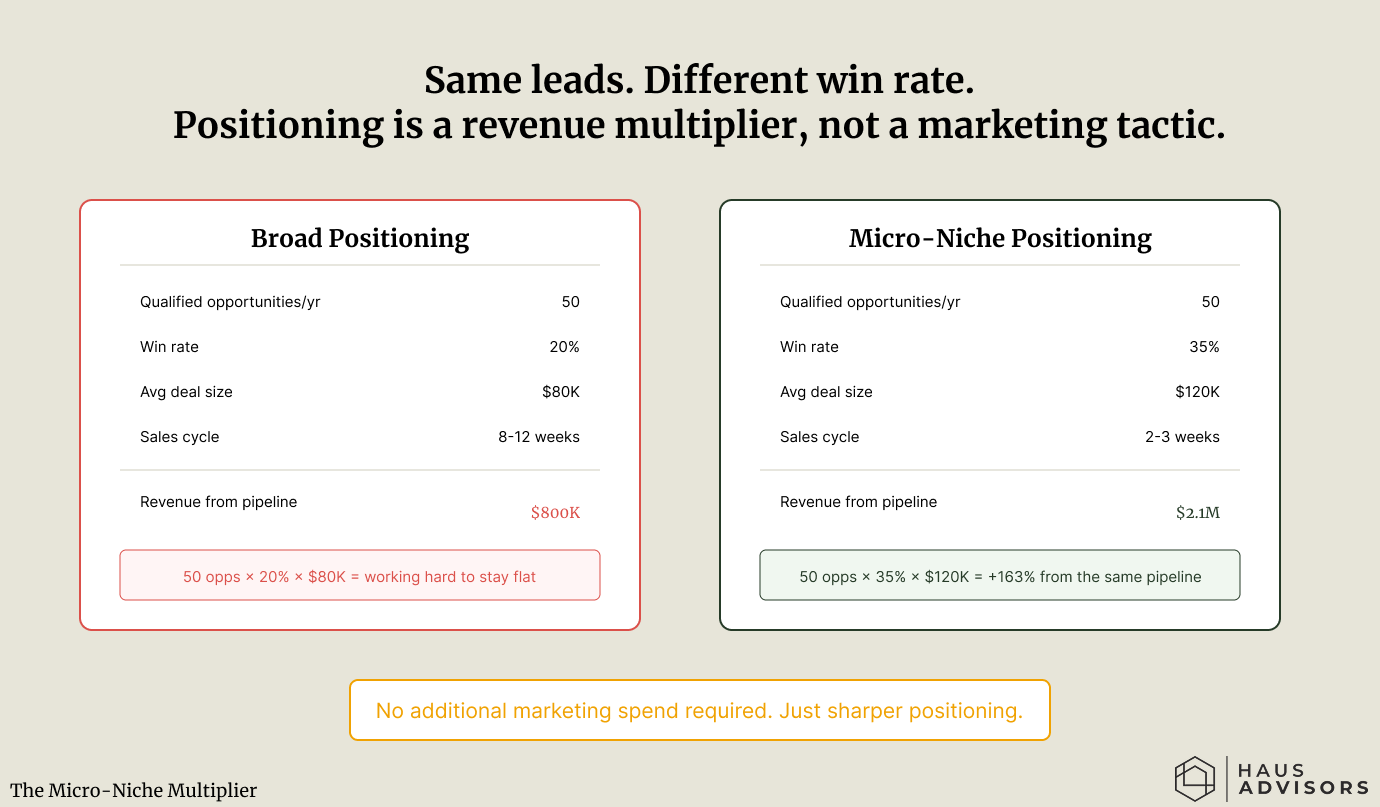
Same leads. Different win rate. Positioning is a revenue multiplier, not a marketing tactic.
Referral velocity increases dramatically. Referrals are driven by specificity. The easier it is to describe what you do and who you serve, the more often a satisfied client thinks of you when they encounter someone who needs exactly that. "They do DevOps for growing SaaS companies" travels better than "they do infrastructure and DevOps and cloud architecture and platform consulting." The first sentence creates a trigger. The second creates confusion.
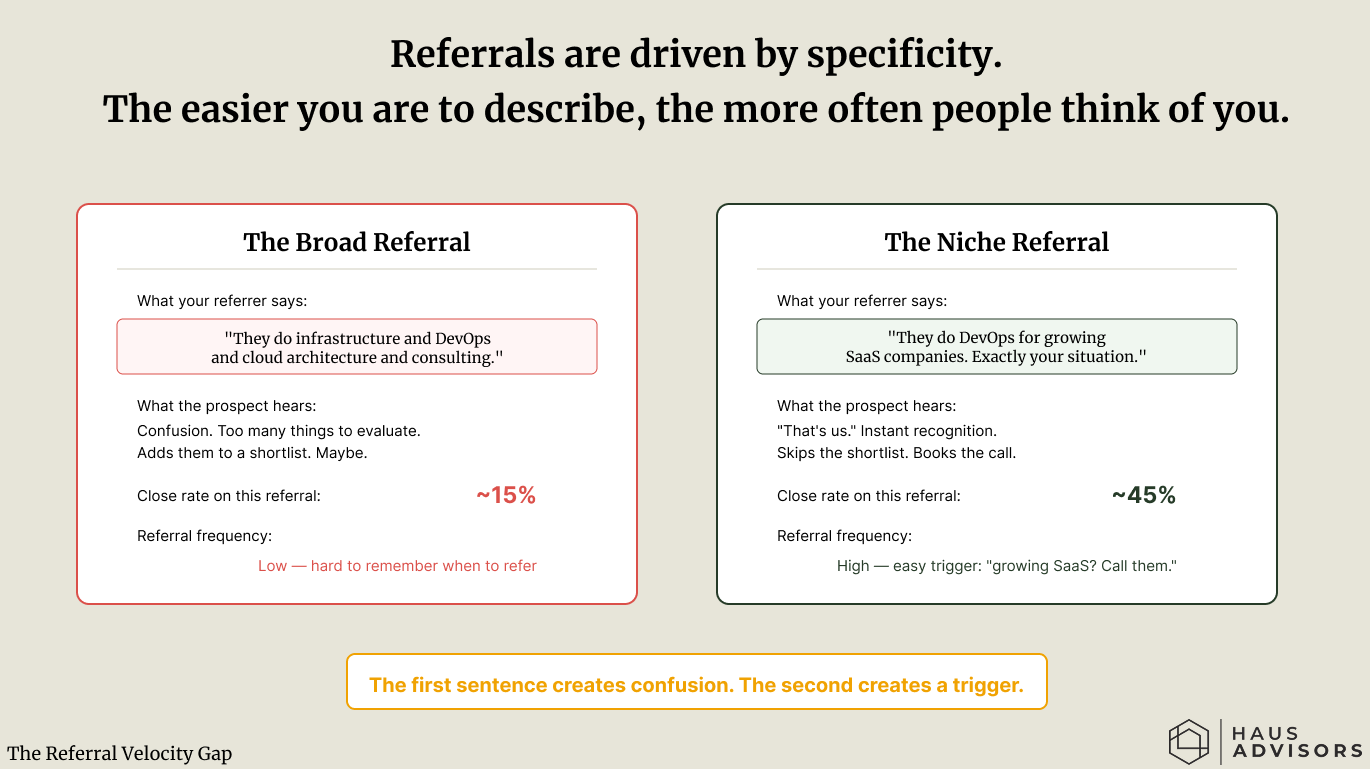
The first sentence creates confusion. The second creates a trigger.
Pricing power compounds over time. Specialists charge more than generalists for the same work. This is true across every professional services category. I talk to founders about this all the time. The reason is simple: a specialist is perceived as lower risk. They have done this before, specifically. They know the failure modes. They will not be learning on your dime. That risk reduction is worth real money to buyers, and they will pay for it without hard negotiation.
The DevOps founder repriced his core engagement within 90 days of committing to his micro-niche. Not because the work changed. Because his positioning made the value clearer and the comparison harder.
What Staying Broad Actually Costs You
Broad positioning is not neutral. It is actively expensive. The costs are diffuse, which is why they're easy to underestimate, but they compound.
Sales cycles lengthen. When you're a generalist, every new prospect requires you to establish credibility from scratch. You have to explain your process, demonstrate your thinking, prove that you understand their specific situation. That's a lot of trust-building work to do in a three-week evaluation window. A specialist arrives with assumed credibility. The question is not "can you do this?" but "when can you start?"
Referral quality degrades. Weak referrals, ones that come with "they do a lot of different things, maybe they can help", close at a fraction of the rate of strong referrals that come with "they are the best at exactly your problem." Broad positioning produces weak referrals almost by design. Your referrers cannot say the right thing because you have not given them the right words.
The talent problem compounds. Generalist agencies hire generalist talent. Specialist agencies attract and retain specialists who want to go deep in a domain they care about. Over time, specialist agencies accumulate institutional knowledge that becomes a genuine competitive moat. Generalist agencies start each engagement fresh.
The real cost of staying broad is a ceiling that most founders don't recognize as a ceiling. Revenue plateaus. Pipeline stays inconsistent. The assumption is that you need better marketing or a better salesperson. The prerequisite that's actually missing? Positioning.
How to Find and Claim Your Micro-Niche
The good news is you almost certainly already have one. The pattern is usually hiding in your best client data.
Step 1: Audit your last two years of clients. Group them by industry, company size, problem type, and deal quality. Look for the cluster where win rate was highest, sales cycles were shortest, delivery was smoothest, and expansion was most natural. That cluster is your micro-niche signal.
Step 2: Define the problem, not just the vertical. The strongest micro-niches are built around a specific, expensive problem rather than an industry alone. "We serve SaaS companies" is a vertical. "We help Series A SaaS companies build platform infrastructure that doesn't require a full-time platform team" is a micro-niche. The second version creates an immediate self-qualification filter. The right buyer reads it and thinks "that's us."
Step 3: Test the language before you commit. You don't need to redesign your website before you validate the positioning. Use the new framing in your next five sales calls. Put it in your LinkedIn bio for 60 days. Bring it to one referral conversation. Watch the response. Does it create instant recognition? Does it make the right people lean in? That is the signal that the positioning is working.
Step 4: Commit publicly. The positioning doesn't work until it's visible. Update your homepage. Change how you introduce yourself. Start writing content that speaks specifically to your target buyer. The commitment is the mechanism. Tentative positioning produces tentative results.
The founder who stays 80% committed to a micro-niche gets 20% of the benefit. Clarity only works when it's clear.
The Broad Agency vs. The Focused One
There are agencies that try to grow by expanding their stated capabilities. And there are agencies that grow by narrowing them.
The first group competes on breadth. They can do anything. They tell you so. Their pipeline is unpredictable because they have no signal strong enough to pull the right buyers toward them. They work hard to stay at the same revenue.
The second group competes on fit. They are the obvious answer to a specific problem for a specific type of buyer. Their referrers know exactly what to say. Their prospects arrive pre-sold on their expertise. Their pricing holds because there is no direct comparison.
The fear of narrowing is the thing keeping most agencies broad. But the math is not ambiguous. Narrow focus expands your win rate, your pricing power, your referral velocity, and your capacity to build real expertise. The market for the thing you are best at is almost always bigger than it looks.
One more thing, and it's the reason I'd push you to claim the niche instead of just knowing it. A claimed niche is what lets your referrers and your team say the right thing when you're not in the room. Until then, the focus lives in your head, and so does the pipeline. If you want your agency to grow without needing you in every deal, that's what the Relevance Engineering Program is built for. We map the pattern that's already in your client base and build the positioning your team can sell. Book a call to see if it's a fit.
Keep reading
Browse by topic
- Positioning & Strategy
- Lead Gen & Marketing
- Sales & Biz Dev
- Pricing & Productization
- Research & Data
- Operations & Delivery
- Client Retention & Expansion
- Leadership & Culture
For founders whose agency has outgrown referrals.
One idea a week that makes a hard growth problem obvious, usually with a chart that shows you the mechanism behind it.
Built from conversations with seventy-plus agency founders on the Behind the Agency podcast.