How to Productize Agency Services (And Why Most Founders Do It Wrong)
A founder I spoke with recently wanted to productize his agency's services. He'd already mapped out three packages, written rough scopes, and drafted pricing. He had the framework. What he didn't have was an answer to the question I asked next.
Which of these three services have you delivered at least six times in substantially the same way?
He paused. The honest answer was none of them. He'd picked the three services he was proudest of, not the three that were already repeatable. That distinction is where most productization attempts fall apart, six months before anyone notices.
Most articles on productizing agency services will tell you to document your processes, build fixed-price packages, and write SOPs. That isn't wrong. It's just out of order. If you productize before your positioning is sharp, you package the wrong service. If you productize before you know which 20% of your work solves 80% of your clients' problems, the offers don't resonate. If you productize without a system for delegating delivery, you trap yourself in a different kind of operational work. Same hours, smaller margins, fixed scope you now have to defend.
The agencies that successfully productize don't start with processes. They start with diagnosis.
For most agencies that come to me thinking they have a productization problem, it isn't. It's positioning, or publishing, or partnerships, or persistence. Productizing the wrong service, or productizing before the upstream constraint is fixed, just bakes the problem into a fixed-price offer that's now harder to walk away from.
This post is for the founders who already know productization is on their list. I'll show you how to diagnose whether it's actually your bottleneck, which service to productize first if it is, how to structure the offer so it converts, and the two operational traps that kill productized models after launch.
Why Most Agencies Fail at Productization (And What to Do Instead)
The typical productization advice tells you to document processes and create fixed packages. That misses why founders actually struggle with productization. It isn't a tactics problem. It's an identity shift.
You built your agency by saying yes to everything and solving unique problems. That approach trained you to believe custom work is what makes you valuable. Productization feels like commoditization. If you package your service into repeatable offers, you become interchangeable with cheaper competitors who can execute the same process. That's the fear.
The fear is backwards. Productization isn't the opposite of custom work. It's what custom work earns the right to charge for. Generalists competing on custom work are the ones who get commoditized, because every proposal is a negotiation on price and scope. Specialists with productized offers compete on a different axis. Prospects arrive already understanding what you do and why it matters, which removes the price-shopping dynamic before it starts.
The agencies that successfully productize don't start by building packages. They start by diagnosing which constraint is actually blocking growth. This is exactly the work we do in The Bottleneck: figuring out whether productization is the actual constraint, or whether something else is the upstream problem you should fix first.
Technical founders also tend to apply a Stage 1 operating model to a Stage 3 problem. Hustle, custom everything, founder-in-every-meeting works at $500K. It breaks at $3M. Productization is the operating system upgrade. Diagnose the constraint. Design the architecture. Install the delivery system. Hold the line long enough for the system to run without you.
Step 1: Diagnose Whether Productization Is Actually Your Constraint
Most agencies assume they need productization when their real constraint is somewhere else.
If you can't clearly articulate in 20 seconds who you serve and what problem you own, your constraint is positioning. Productizing before positioning is sharp creates vague packages that don't resonate. The fix is positioning first. (See Agency Positioning Strategy and Vertical vs. Horizontal Positioning for the upstream work.)
If your pipeline is empty and you're not publishing content that demonstrates diagnostic expertise, your constraint is publishing. Productized offers are easier to market than custom services, but they still require content that proves you can think about the problem before prospects will trust you to solve it. (The Authority Paradox covers this directly.)
If you're spending all your time on cold outreach with low conversion rates, your constraint is partnerships. You need warm distribution before you need productized offers. (Mutually Beneficial Referral Partnerships and The Swap Fallacy explain why most partnership attempts fail.)
If you've tried productization before and abandoned it when a big custom opportunity showed up, your constraint is persistence. You don't need better packages. You need accountability that makes it harder to walk away from the system than to stick with it.
The diagnostic is simple. Audit your last 20 client engagements. Identify which services were requested most often, which outcomes you delivered successfully through repeatable methods, and which client problems caused the most pain. That data tells you whether productization is the real constraint, and if it is, which service to start with.
Only then should you move to productization. Otherwise you're optimizing the wrong part of the system.
Step 2: Identify the 20% of Services That Solve 80% of Client Problems
Most agencies try to productize everything at once. WordPress builds for legal firms. SEO retainers for B2B SaaS. Custom Shopify work for DTC brands. Strategy sprints for funded startups. Ongoing advisory for anyone who'll buy it. The result is overlapping offerings that confuse prospects and exhaust founders.
The first productized service shouldn't be the one you're proudest of. It should be the one that bores you.
It's not your most profitable service, not your most impressive service, and not the service you personally enjoy most. It's the one you've delivered so many times that the process is almost mechanical. Boring means predictable. Predictable means systematizable.
For technical agencies, this usually surfaces as one of a few patterns. Technical architecture audits for SaaS companies. Conversion diagnostic sprints for growth-stage products. Migration execution for platform transitions. MVP scoping sessions for funded startups. Whatever the pattern is for you, it shows up as the engagement you've delivered six or more times with substantially similar inputs, methods, and outputs.
The test is repeatability. The service must produce outcomes through a repeatable methodology, not through custom problem-solving every time. If every engagement still requires significant founder creativity and judgment, it's not ready to productize. You're looking for the service where 80% of the delivery follows the same pattern and only 20% requires customization. That 80% is what you systematize first.
Once that first productized service runs without your constant involvement and generates consistent revenue, you can productize the next service. Trying to do three or four simultaneously creates half-built systems that all require founder attention. The math doesn't favor parallel productization. Sequential productization works.
Step 3: Structure Your Productized Offer as a Trust Bridge
The mistake agencies make is thinking productization means packaging existing services at lower price points to attract more clients. That creates a race to the bottom where you compete with cheaper offshore providers.
Productization doesn't commoditize you. It's the only thing that lets you stop competing as a commodity.
Real productization creates trust bridges. Defined entry points where prospects can say yes to a small commitment that demonstrates your expertise, which leads naturally to larger engagements. The traditional custom proposal asks prospects to cross a chasm of trust in one leap. They're supposed to commit $50K+ to an agency they just met based on a document that describes work they don't fully understand. The bridge fixes the leap.
A productized stack might look like this. A $5K technical audit that diagnoses the problem and proves you understand their business. A $15K strategy roadmap that outlines the solution and shows how you think. A $50K+ implementation that executes the full engagement. Each step is small enough that the risk feels manageable, and each step accumulates evidence that you're the right choice. By the time prospects reach the large engagement, the buying decision feels obvious rather than risky.
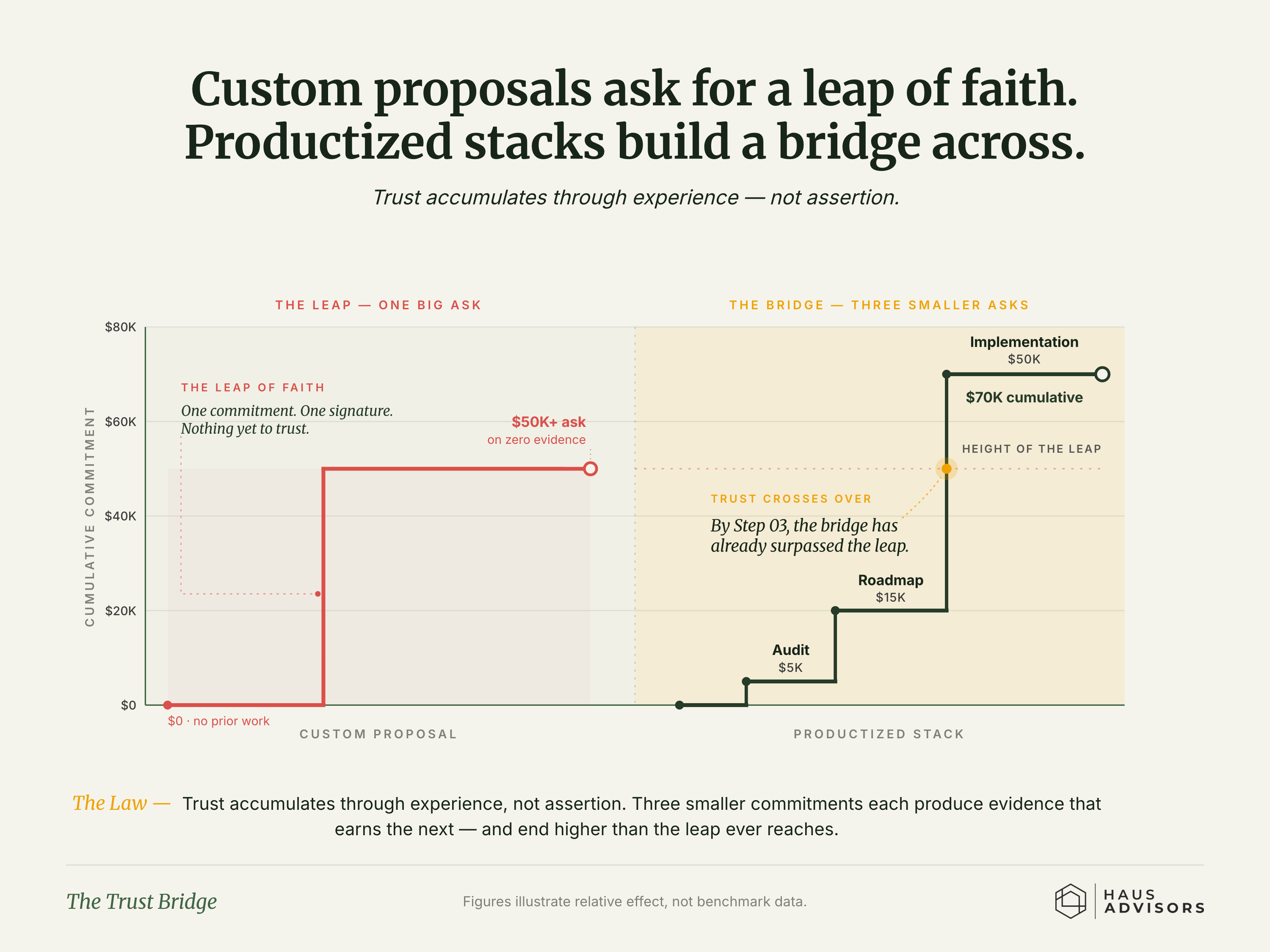
The single proposal asks the prospect to bet $50,000 on a stranger. The staircase lets them bet $5,000 on a meeting, then decide whether to keep going. Same destination, very different risk.
This isn't about creating cheaper versions of your services. It's about creating risk-appropriate entry points that let prospects accumulate trust through experience instead of asking them to front-load it through faith.
The structure converts better than asking for the full commitment upfront because the risk is distributed across smaller decisions rather than concentrated in one large one. It also gives you something most agencies don't have: a clear, repeatable entry point that the rest of the business can be built around.
A note on pricing. The trust-bridge structure assumes you're pricing each tier on the value of the outcome it produces, not on the hours it takes to deliver. That's a separate problem with its own mechanics, and I won't repeat that work here. If pricing is where you actually get stuck, three posts cover the terrain: The Pricing-Positioning Gap explains why vague positioning forces price competition, The Efficiency Penalty explains why hourly billing is structurally broken in the AI era, and Value-Based Pricing for Agencies walks through the discovery conversation and the math. Read those alongside this post if pricing is part of what you're solving.
The Two Operational Traps That Kill Productized Models
Most productized models don't die at launch. They die six months in, after two specific failures.
Trap 1: You packaged the service but never systematized the delivery.
The reason productization fails after you've structured good offers is that founders don't document the delivery process in enough detail for someone else to execute it. Every productized engagement still requires founder involvement, which means you've packaged the service but trapped yourself inside it.
"How we do things" lives in your head as tacit knowledge. You know what good looks like, you know which questions to ask in discovery, you know when to push back on client requests, you know how to adapt the process when something doesn't fit the template. Documentation means extracting that tacit knowledge into SOPs detailed enough that a team member can deliver the productized service and achieve the same outcomes you would.
The process starts with doing the productized engagement yourself two or three times while screen-recording your work and narrating your decisions out loud. "I'm pulling this data because." "I'm asking this question to uncover." "I'm pushing back on this request because it's outside scope, and here's how I'd phrase that to the client." Those recordings become the training material for the first team member who takes over delivery. They watch you execute, then they execute the next one while you review their work and fill in gaps in the documentation.
The goal isn't a rigid script that removes all judgment. It's documenting the 80% of decisions that follow a pattern so team members only need your input on the 20% that require strategic judgment. Skip this work and productization just creates a new operational trap. You've packaged the service but you're still personally delivering it.
Trap 2: You abandoned the system when a big custom check showed up.
Here's the pattern. Launch productized offer. Win a few clients. Deliver successfully. Then a custom opportunity shows up that pays more than three productized clients combined, and you take it. You tell yourself it's just one exception. Then another one shows up. Then another. Within six months, the productized offers are gathering dust and you're buried in custom project work again.
This is what I call the Bespoke Identity Trap. The agency knows productization is the right strategic move and has the systems half-built, but each individual custom opportunity feels more valuable than the productized pipeline because it's bigger and more flattering. The dopamine of closing a big custom deal beats the grind of delivering smaller productized engagements. The math says the opposite. Productized services compound over time. Custom projects reset to zero after each delivery.
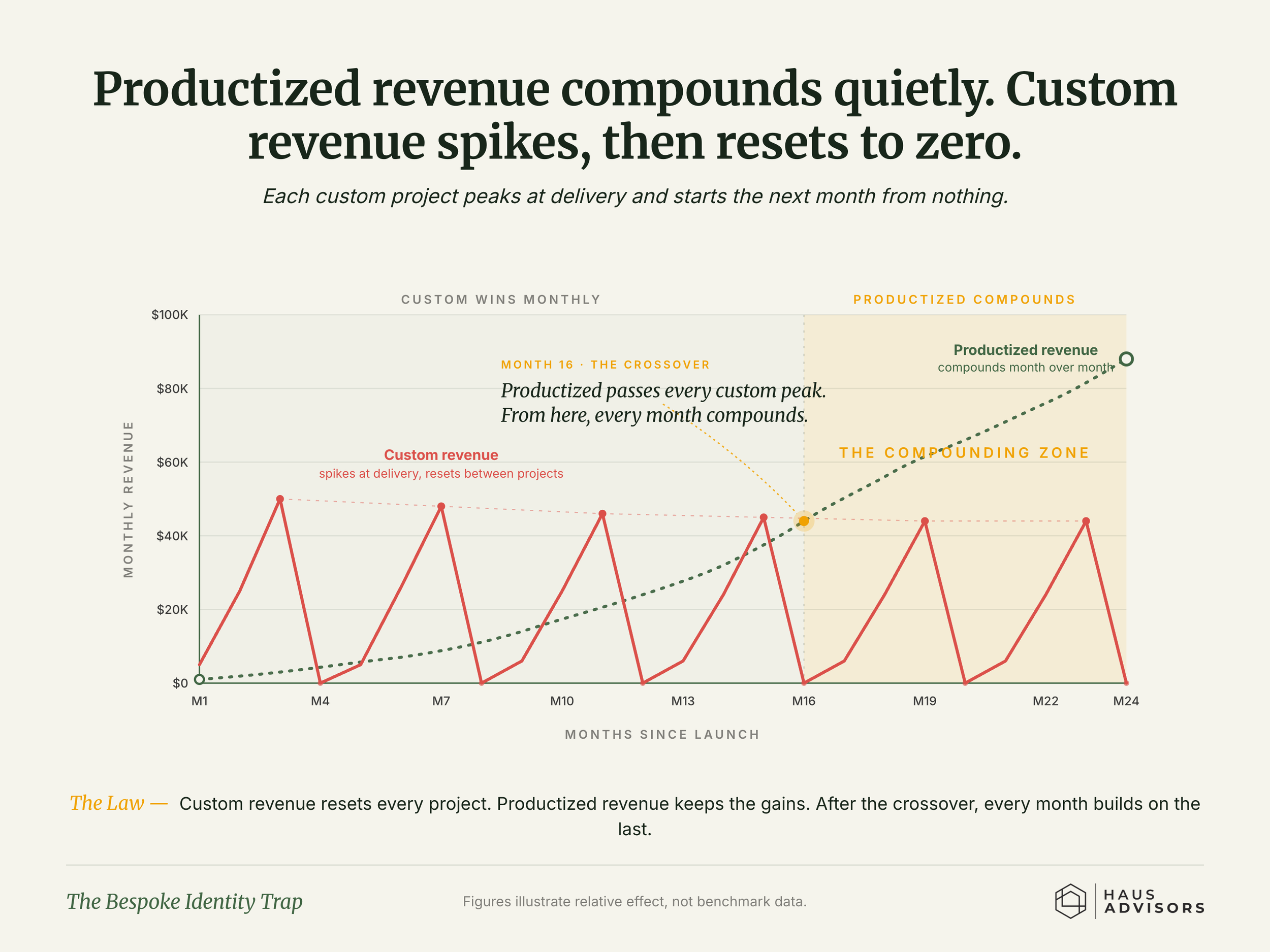
Two founders, same monthly revenue at the start. One takes every custom check that appears. The other holds the productized line. By month fourteen, the second founder's baseline is higher than the first founder's peaks.
The solution isn't more discipline. It's accountability that makes it harder to abandon the system than to stick with it. A weekly check-in (internal, with a partner, or with an advisor) where you report what productized revenue came in, what custom opportunities you said no to, what marketing activities ran, and what delivery processes you delegated. The act of reporting creates social friction that competes with the pull of the next custom deal.
You also need a clear filter for evaluating custom opportunities. Does this advance our productized positioning, or distract from it? If the custom project serves your ideal client profile and proves you can deliver an outcome you want to productize next, take it. If it's outside your positioning and requires capability you don't want to build, pass. Most founders don't have this filter, which is why every custom opportunity becomes a debate instead of a decision.
The Bespoke Identity Trap is the difference between agencies that dabble in productization and agencies that build productized businesses. One treats productization as a project. The other treats it as an operating system that runs whether you feel like it or not.
Why Productization Alone Won't Save You
Productized services solve the delivery scalability problem. They don't solve the demand problem, which is why many agencies productize and still struggle with empty pipelines.
If you productize before positioning is sharp, you'll package the wrong service for the wrong market. Productization amplifies positioning, which means bad positioning gets amplified into bad offers. If you productize without publishing, prospects won't find you. If you productize without partnerships, you're still dependent on cold outbound. If you productize without persistence, you'll abandon the system the first time a big custom check shows up.
The diagnostic question isn't "should I productize?" The question is "is productization my actual constraint, or is something else blocking my growth?" Answering that correctly determines whether productization creates breakthrough results or just adds complexity to an already broken system.
So here's the test, and the only one that matters this week. If you audited your last 20 engagements tomorrow, would you find a single service you've delivered six or more times in substantially the same way? If yes, you have a candidate, and the next question is whether positioning, publishing, partnerships, and persistence are sharp enough to support productizing it. If no, productization isn't your problem yet. Something upstream is, and packaging the wrong thing won't fix it.
Which answer is yours?
Keep reading
Browse by topic
- Positioning & Strategy
- Lead Gen & Marketing
- Sales & Biz Dev
- Pricing & Productization
- Research & Data
- Operations & Delivery
- Client Retention & Expansion
- Leadership & Culture
For founders whose agency has outgrown referrals.
One idea a week that makes a hard growth problem obvious, usually with a chart that shows you the mechanism behind it.
Built from conversations with seventy-plus agency founders on the Behind the Agency podcast.