The Two Agency Growth Plateaus (and Why the Wrong Fix Makes Both Worse)
A founder I talked to last quarter runs a development agency that did $3.2M two years ago. Last year: $3.1M. This year is tracking to $3.2M again.
His delivery is the best it's ever been. Twenty-two people, strong senior bench, client satisfaction scores most agencies would frame. And he's been staring at the same flat revenue line for twenty-six months.
His plan for breaking the agency growth plateau was to hire a salesperson. He'd already written the job description.
I asked him one question before he posted it: where did your last ten clients come from? He pulled up his CRM. Nine traced back to referrals or past clients. The tenth came from a conference talk he gave in 2021.
That's the plateau most technical agencies actually have. Not a sales problem. Not an effort problem. Twenty-two people, and the reasons anyone hires the agency still live with one of them. Every client came in through his relationships, his reputation, his talk. The value is real. But the company can't use any of it unless he's in the room, and the network he built it on finally stopped expanding.
But there's something underneath his specific situation that matters more: there are two completely different reasons an agency stops growing, and both are ways growth still routes through the founder. One is a delivery ceiling, where demand exists but the founder is inside every project, so you can't fulfill it. The other is a demand ceiling, where you could fulfill more but the founder is the only source of relevance the agency has, so the pipeline won't produce it. They need opposite fixes. Most plateau advice mixes prescriptions for both, which is why most plateau advice doesn't work.
The first job is figuring out which ceiling is yours. Because the wrong fix doesn't just waste money. It burns the six to twelve months of focused founder attention you get before the plateau starts feeling permanent.
The Two Ceilings: Why Most Plateau Advice Makes Things Worse
Search "agency growth plateau" and you'll find the same article written a dozen ways. Define the plateau. List seven possible causes. List seven strategies. Run a SWOT, improve your sales and marketing, invest in your team.
It all sounds reasonable. None of it tells you what's wrong with your agency.
Here's the distinction that actually matters. Every plateau is one of two ceilings, and they're not just different problems. They're opposite problems.
The delivery ceiling. Demand exists, but you can't fulfill more of it. The signals: utilization running hot, lead times stretching, the founder personally inside every significant project, hiring pressure that never lets up. When you turn work away or quietly hope a prospect doesn't sign, you're at a delivery ceiling.
The demand ceiling. You could deliver more, but the pipeline won't produce it. The signals: bench time you don't talk about, proposals lost to "we went with someone who specializes in this," referrals arriving slower each year, and a founder doing all the selling between everything else.
The fixes are opposites. A delivery ceiling needs delegation, process, pricing power, and management structure. A demand ceiling needs sharper positioning, published expertise, and a pipeline that doesn't depend on who you already know.
You can hear the difference on a diagnostic call. The delivery-ceiling founder says, "I just need more senior people." The demand-ceiling founder says, "I just need more at-bats."
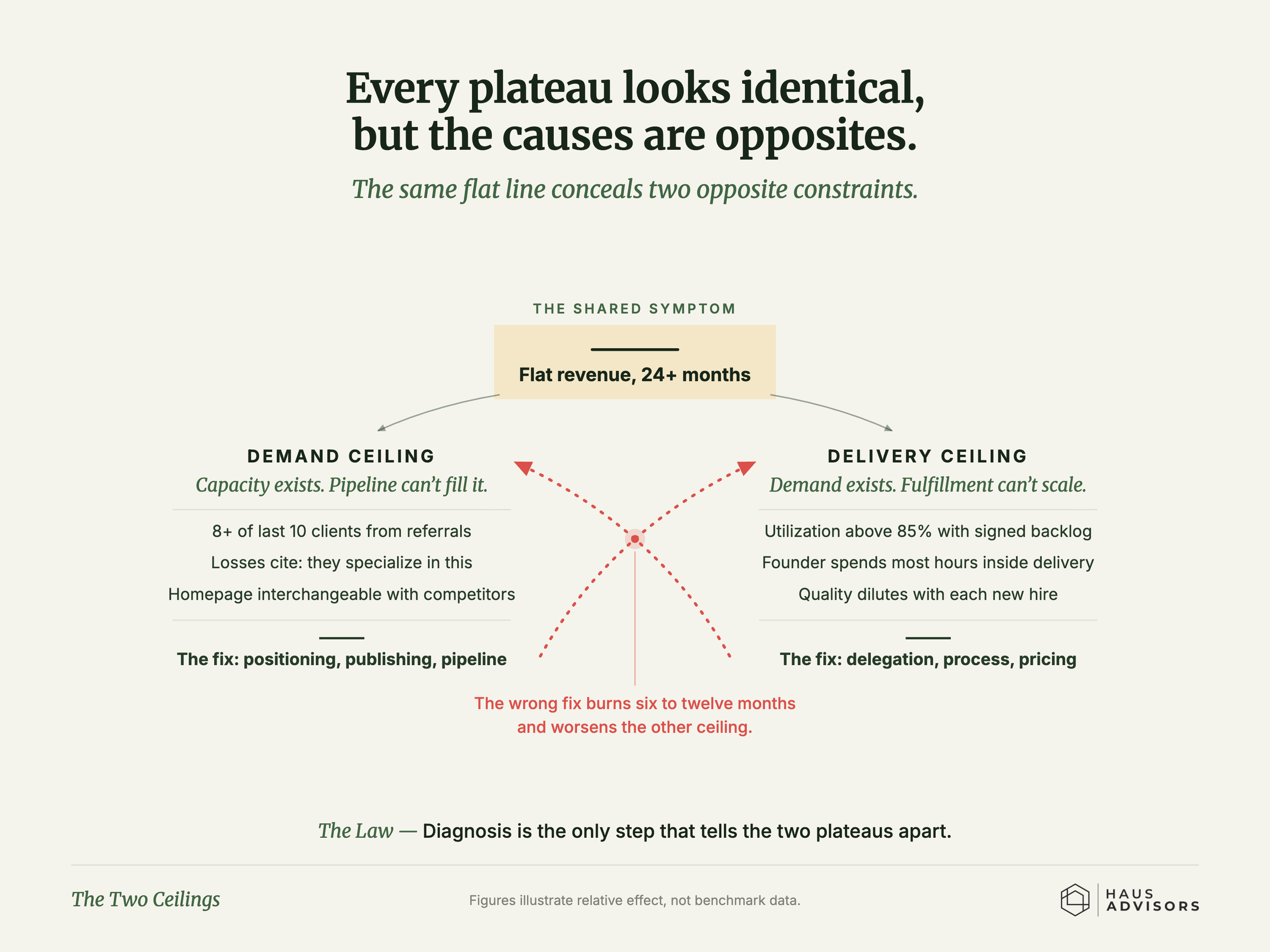
One flat revenue line, two opposite causes. The dashed arrows show why the wrong fix costs six to twelve months.
Now apply the standard advice to the wrong ceiling. Tell a demand-constrained founder to invest in systems and team, and he'll spend a year building delivery capacity for clients who never arrive. Tell a delivery-constrained founder to ramp up marketing, and she'll generate demand she can't serve, miss deadlines, and damage the reputation that was driving her referrals.
Either way, the founder is back at the same flat line a year later, with less money and less confidence. That's the real cost of cause-menu advice. It's not that it's wrong. It's that it's half wrong for everyone, and you don't know which half.
One more thing about the timeline, because it changes how you think about the fix. Your plateau didn't start when the chart flattened. For most referral-built agencies, it started years earlier, the day growth became dependent on a finite network of people who already knew you. The flat line is just the moment your network's growth rate became your agency's growth rate. The cause has been compounding quietly for years. Which is good news, actually. It means the cause is findable.
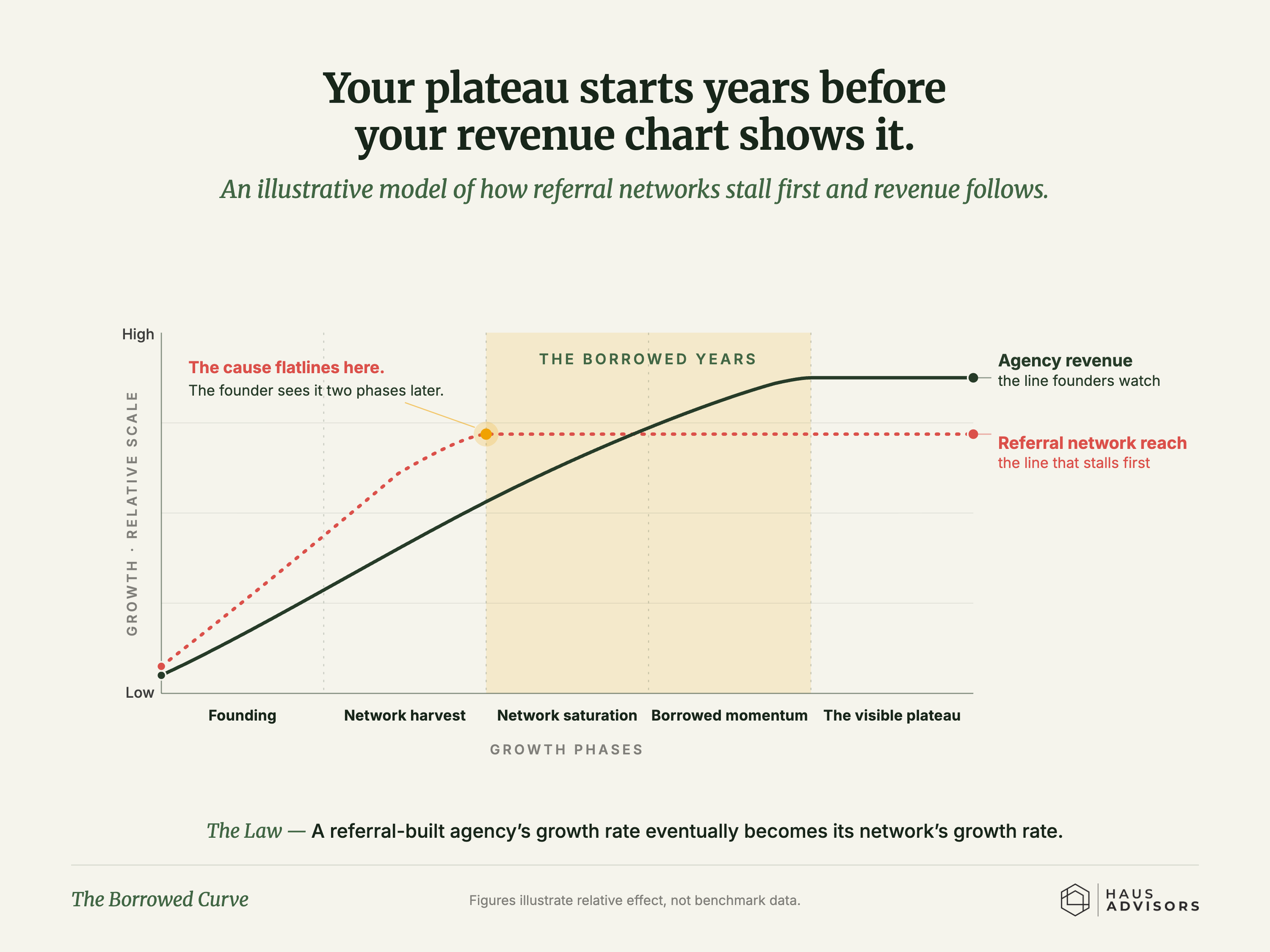
Revenue inherits the network's flatline two phases late. The shaded band is the gap between when the plateau starts and when the chart admits it.
Why Technical Agencies Plateau Differently
Almost everything ranking for this topic was written for marketing agencies. If you run a dev shop, a software consultancy, or a technical services firm, your plateau has different mechanics, and the generic advice misses all of them.
Start with how you grew. Technical agencies grow on borrowed relevance: referrals from past employers, intros routed through platform partnerships, word of mouth between technical buyers who trust each other more than they trust any website.
This works beautifully from zero to somewhere between $1M and $3M. Then the network is fully harvested, and the growth rate quietly hands itself over to the network's growth rate. Which is roughly zero.
Project-based revenue makes it worse by hiding it longer. A retainer business sees a flat trendline immediately. A project shop sees lumpy invoices, a big Q2, a soft Q3, a strong Q4, and can tell itself a story about timing for two full years before admitting the trailing average hasn't moved.
Then there's the founder. Technical founders over-invest in delivery excellence as a growth strategy, because it's the lever they know how to pull. The work gets better every year. The pipeline doesn't notice.
Great work retains clients and generates referrals from the existing network, but it cannot reach buyers who've never heard of you. That's the Delivery Trap, and technical agencies fall into it harder than anyone because the craft is genuinely satisfying to improve.
The positioning problem is also worse in technical services. Pull up your website next to your three closest competitors. Quality engineering. True partnership. Full-stack expertise. Shuffle the logos and a buyer couldn't tell which site was whose.
When every agency makes the same claims, buyers nod politely at all of them and default to the only differences they can see: price and availability. The agency that names their exact problem is the one that makes them lean forward. That's the Look-Alike Problem, and it's the reason your proposals feel like coin flips.
And now AI is compressing the timeline. The technical capabilities that differentiated an agency in 2022 are table stakes in 2026. Buyers assume competence. The plateau that used to arrive at year eight is arriving at year five.
If you're a technical founder reading the standard plateau advice, you're reading a map of someone else's territory.
The Plateau Diagnostic: Which Ceiling Are You Actually Hitting?
You can settle the ceiling question in about an hour, with data you already have. I call this the Ceiling Check, and it's three demand-side signals, three delivery-side signals, and one trap to avoid.
Demand-side signals
The ten-client origin analysis. Open your CRM and trace your last ten clients to their true origin. Not the channel they closed through, the moment they first heard of you. If eight or more trace to referrals, past clients, or personal relationships, you have a demand ceiling regardless of how busy you feel; busy just means the borrowed relevance is still paying out while the balance runs down.
The homepage interchangeability test. Write down your positioning statement from your homepage. Then write down your top three competitors' statements from theirs. Hand all four to someone outside your company and ask them to match statements to firms. If they can't, you're in a Decision Vacuum: the buyer has no basis for choosing you except price, so the decision stalls or defaults to the cheapest credible option.
Loss reasons. Go through your last ten lost proposals and write down the stated reason. "We went with someone who specializes in X" is not a sales loss. It's a positioning loss wearing a sales costume. If specialization shows up in three or more of ten, the ceiling is demand-side.
Delivery-side signals
Utilization with a real backlog. If billable utilization is running above roughly 85% and you have signed work waiting to start, that's a genuine delivery ceiling. Demand is proving itself in the only way that counts: contracts you can't get to.
Founder hours. Track a week honestly. If more than half of founder time is inside delivery, treat the constraint as operational even when the pipeline looks weak, because nobody is selling. This is the one configuration where both ceilings show up at once, and delivery has to be fixed first to free the founder.
Quality per hire. If each new hire dilutes quality and the founder becomes the rework department, you have a systems problem, not a demand problem. More leads would just break it faster.
The misdiagnosis trap
Here's why founders get this wrong even with the data in front of them. The delivery diagnosis is flattering. It says demand for your work exceeds your ability to supply it. The demand diagnosis is uncomfortable. It says the positioning you built, or never quite built, is the problem.
So founders reach for the comfortable conclusion, and the most expensive version of that reach is hiring a salesperson to fix a demand ceiling. A salesperson cannot sell positioning that doesn't exist. They'll spend six months discovering your agency has no answer to "why you," then leave, and you'll conclude that sales hires don't work. That's Premature Sales Delegation, and it costs $120K to $180K in salary plus a year of pipeline standing still.
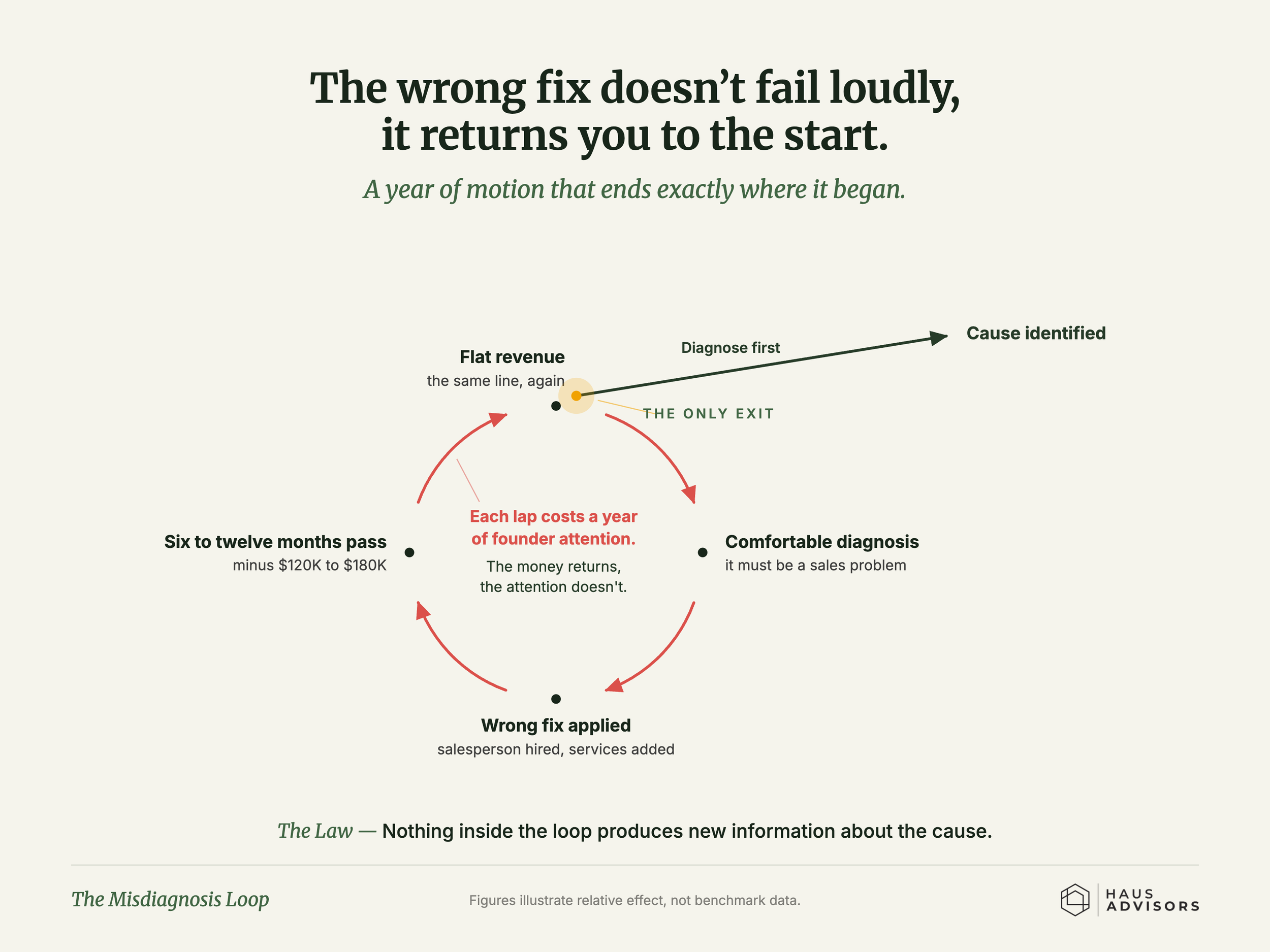
The loop a plateaued agency runs without a diagnosis. Each lap ends at the same flat line, and the diagnosis step is the only exit.
The founder from the opening had nine of ten clients from referrals, an interchangeable homepage, and "they specialize in our space" in four of his last ten losses. Three signals, one ceiling. The salesperson job description went in the drawer.
Why the Standard Advice Fails
It's worth being specific about why the common prescriptions don't move a plateaued agency, because you've probably already tried some of them.
"Run a SWOT, revisit your business plan." Analysis without a causal model produces longer documents, not different decisions. You'll list weaknesses and opportunities, feel productive, and still not know which ceiling you're hitting. Diagnosis isn't a brainstorm. It's a sequence of checks against evidence.
"Improve your sales and marketing." These point at different ceilings, and a founder who tries both at once splits the only scarce resource a plateaued agency has, which is focused founder attention, across opposite fixes. Six months later both are half-built and neither works.
"Add new services." This is the most seductive one, because revenue from anywhere feels like progress. But complexity is a cause of plateaus, not a cure. Every service you add makes your positioning broader, your homepage vaguer, and your Look-Alike Problem worse. You're not expanding the business. You're diluting the claim.
"Work your referral network harder." Referrals are a finite asset being asked to behave like a renewable one. You can optimize the harvest with better follow-up and asks. You cannot expand the acreage. A referral network's ceiling is structural, and pushing on it harder just gets you to the ceiling faster.
All four prescriptions share one feature: they let you skip the diagnosis, which is the whole reason they're popular.
The Strongest Case Against Changing Anything
Before any prescription, the rebuttal deserves a fair hearing. Because there's a genuinely good argument for staying the course, and you've probably already made it to yourself.
It goes like this. Referrals are the highest-converting, lowest-cost channel in professional services. A referred prospect arrives pre-sold, closes faster, and stays longer. Positioning work and pipeline building mean trading a channel with those economics for one that's unproven, slow, and expensive in founder time. And narrowing your positioning adds concentration risk: claim one problem and one buyer, and you're betting the agency on that claim being right.
That argument is correct on every individual point. Referral economics really are the best in the business. Narrowing really does concentrate your claim. If your referral network were still expanding, I'd tell you to keep harvesting it and skip the rest of this article.
Here's where the logic hits the wall: conversion rate doesn't matter when volume is structurally capped. A channel that converts at 60% but produces four opportunities a year is a smaller business than one that converts at 20% and produces thirty. The plateau is the proof that the cap is real. You're not choosing between a great channel and a risky one. You're choosing between a finished channel and the only kind left to build.
And the concentration objection has the risk backwards. Nine of ten clients from one finite network is the concentration. Sharp positioning backed by published expertise is what diversifies it, because it makes you findable by buyers who owe you nothing.
How Relevance Engineering Approaches the Plateau
The pattern I kept seeing across plateaued technical agencies is the reason Relevance Engineering exists. The plateau happens when an agency's relevance stops compounding. Referrals were borrowed relevance, trust transferred from other people's relationships, and nearly all of it routed through one person. The plateau is what surfaces when there's no owned relevance behind the founder: no sharp positioning, no published expertise, no offer a buyer can evaluate without already knowing you. So the agency is worth hiring, and only the founder can prove it.
Because the whole argument of this article is diagnosis before prescription, the Relevance Engineering Program runs in that order. Four phases, six months, all of it implementation.
Extract is the diagnostic done properly. We run the Ceiling Check with real data: client origin analysis, positioning audit against your actual competitors, pipeline and loss-reason review. Then we go one step further, because the evidence usually points at the same place. We pull the positioning, the judgment, and the real reasons your best clients hired you out of your head and get them written down. The output is a named ceiling and the single highest-leverage lever, not a forty-page deck.
Engineer is where that raw material becomes something the company owns. We use the five P's (Positioning, Productization, Publishing, Partnerships, Persistence) as the lens for which lever to pull first, because sequence matters when problems stack. For a demand-ceiling agency that usually means repositioning around the problems your best clients actually hired you for, then packaging an offer a buyer can say yes to without a custom proposal.
Transfer is the part most engagements skip. The positioning, the offer, and the publishing system get handed to your team with ownership, so the work keeps happening when you're buried in delivery. Compound is the last stretch, where the plays start stacking on each other and a stranger can trust the agency before anyone talks to you.
That's the work we do at Haus Advisors. The Relevance Engineering Program is six months of implementation, not a strategy document. We pull what makes your agency relevant out of your head, build it into positioning, offers, and growth plays your team can run, and hand ownership to them. If you want an agency that grows without needing you in every deal, book a call to see if it's a fit.
This is the part most people miss: prescription without diagnosis is the plateau's best friend.
The Mistakes That Extend a Plateau by Years
A plateau is recoverable. These five moves are what turn a two-year plateau into a five-year one.
Hiring a salesperson before fixing positioning. Covered above, but it leads the list because it's the most common and the most expensive. Sales talent amplifies positioning. It cannot substitute for it.
Rebranding instead of repositioning. New logo, new website, same Decision Vacuum. If the buyer still can't tell why you over the next firm, you've repainted a door that doesn't open.
Chasing a second service line. A sharper claim on your first service beats a broader menu every time. The agencies that break plateaus narrow before they grow.
Treating content as a publication instead of a library. Sporadic posting on whatever's interesting that week builds nothing. A library of content organized around the problems you diagnose, where every piece compounds the same claim, is what makes a stranger trust you before the first call. Your blog is not a publication. It's evidence.
Waiting for the referral network to recover. It won't. The network didn't slow because of the economy or the season. It slowed because it's finite and the harvest is mostly done.
What to Do This Quarter
You don't need to hire anyone to get the diagnosis done. Here's the sequence.
This week, run the ten-client origin analysis. One hour, your CRM, true origins. Eight or more from referrals and repeat work settles the question for most agencies.
Next, run the homepage interchangeability test. Your statement, three competitors' statements, one outside reader. If the statements are interchangeable, the demand ceiling is confirmed and positioning is the work.
Then pick one lane and commit for two quarters. Demand ceiling: positioning first, then publishing, then pipeline. Delivery ceiling: delegation and process before any new demand work. Plateau recovery dies from split attention faster than from wrong effort.
The founder from the opening did this in January. He didn't hire the salesperson. He spent one quarter repositioning around the integration work his five best clients all had in common, rewrote the homepage around that claim, and published three pieces diagnosing the problem for buyers who'd never heard of him. By May he'd closed two clients with zero referral connection. First time in the agency's history.
Flat revenue for twenty-six months, and the fix started with one question about where his clients came from.
If you want a second set of eyes on your own diagnosis, send me your website and I'll record a short Loom teardown: what your positioning is actually claiming, what a stranger sees, and which ceiling your evidence points to. No call required.
In the end, every plateaued agency is doing one of two things: harvesting relevance it borrowed, or building relevance it owns. The flat line is just the moment the ledger catches up.
Keep reading
Browse by topic
- Positioning & Strategy
- Lead Gen & Marketing
- Sales & Biz Dev
- Pricing & Productization
- Research & Data
- Operations & Delivery
- Client Retention & Expansion
- Leadership & Culture
For founders whose agency has outgrown referrals.
One idea a week that makes a hard growth problem obvious, usually with a chart that shows you the mechanism behind it.
Built from conversations with seventy-plus agency founders on the Behind the Agency podcast.