The Authority Paradox: Why Your Content Isn't Closing the Gap
I was recently talking to a partner at a $4M dev agency who was frustrated. They had been publishing weekly for six months: case studies, "how-to" guides, tech stacks, but the only people reading it were their own developers and a few competitors. When a real prospect finally landed on their site, they stayed for 30 seconds and bounced.
On paper, they were doing everything "right." They were consistent. They were technical. But their content was suffering from a specific structural ailment: The Documentation Trap.
The Logic of the Teacher
If your content feels like a technical manual or a generic list of "tips," it’s because you are operating from a place of genuine helpfulness. You want to prove you know your stuff, so you teach. You explain the "how" of a React migration or the "what" of a new API. In the early stages of an agency, this positions you as a capable technician. It proves you can do the work, which is enough to win mid-level contracts.
But for a founder or a VP of Engineering looking to hire a $200k+ agency, they aren't looking for a teacher. They are looking for an Advisor. They don't want to know how the sausage is made; they want to know why their current kitchen is on fire and how you are the only person who knows how to put it out.
From Education to Insights
In the $1M–$5M range, your content shouldn't just educate; it should diagnose. Most agency content is "low-intensity", it provides information that the reader could find elsewhere with a quick search or a prompt to an AI. When you provide low-intensity information, you are participating in a commodity market.
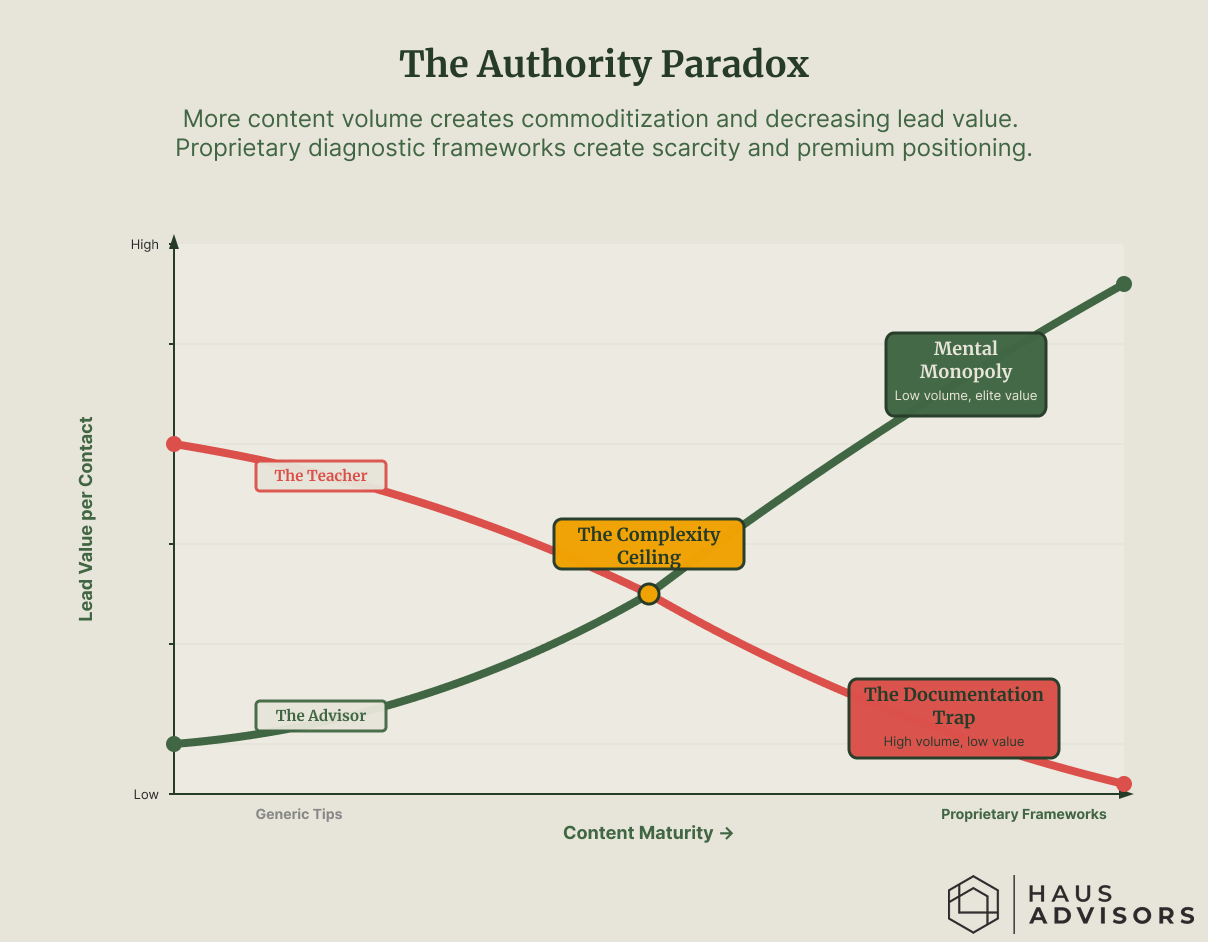
"High-volume, generic content follows the law of diminishing returns: the more you sound like a 'how-to' guide, the more you are treated like a commodity. This chart maps the necessary transition from 'Market Education' to 'Mental Monopoly', where your unique perspective becomes the only logical solution to a client’s problem."
The downstream consequence of low-intensity publishing is commoditization. If your content sounds like a slightly more polished version of a documentation page, your agency feels like a slightly more polished version of a freelancer. You end up competing on price because you haven't used your content to build a "Category of One." This isn't a failure of your writing team's ability to string sentences together; it’s a failure to inject a proprietary perspective into the work.
The Distinction: Reporting vs. Point of View
Content only brings in the right buyers on its own when it moves from "Reporting on the Industry" to "Asserting a Point of View." And that point of view has to be one the company owns, not one that only shows up when the founder writes.
Reporting (The Teacher): "Here are five ways to improve your app's performance." This is generic, replaceable, and has low stakes. It’s a "nice to have" read that gets bookmarked and forgotten.
Point of View (The Advisor): "The reason your app's performance is stalling isn't your code, it's your legacy architecture's inability to handle X, and here is why 90% of agencies will give you the wrong fix."
This is the part most people miss.
High-impact content doesn't just attract anyone; it repels the wrong people and creates an immediate "Yes" for the right ones. When you stop trying to be "helpful" to everyone, you become "essential" to a few. Content that converts isn't a brochure; it’s a filter.
The Intelligent Rebuttal
The strongest argument against taking a bold, diagnostic stance is The Alienation Risk. You might feel that if you are too specific, too opinionated, or too critical of "standard" industry practices, you’ll scare off potential clients who don't fit that exact mold. You worry about shrinking your "Total Addressable Market" (TAM) at a time when you feel you need every lead you can get.
The Boundary
You are right to avoid being controversial just for the sake of it. If you become a "thought leader" who doesn't actually deliver technical excellence, you'll lose credibility the moment you start a discovery call. The market sees through "hot takes" that lack substance.
However, there is a wall where "playing it safe" makes you invisible. In a crowded market, being "okay for everyone" is the same as being "the first choice for no one." You don't need to reach 10,000 people; you need to reach the ten people this month who are currently experiencing the exact structural problem you've just diagnosed. Accuracy beats volume every time.
Reducing the Fragility
Building a content engine isn't about increasing your word count or your posting frequency. It’s about increasing your insight density. We start by moving away from generic "Tips" and toward "Proprietary Frameworks", the unique, opinionated way your agency solves problems that no one else can replicate because they don't see the world the way you do.
This creates Mental Monopoly. By the time a prospect finally calls you, they haven't just seen your work; they’ve adopted your philosophy. The sale is already 70% done because you aren't selling a service anymore, you’re selling the only logical solution to a problem you helped them define.
The Principle: Information is a commodity, perspective is a premium. One fills a page, the other fills a pipeline.
The Next Step
Most founders reading this already know the real problem. It isn't how often you publish. It's that the perspective that fills the pipeline, along with the reputation and the relationships, still lives in your head. Your content only has a point of view when you write it. So the business only grows when you're in the room.
That's the work we do at Haus Advisors. The New-Business Engine is six months of implementation, not a strategy document. We pull what makes your agency relevant out of your head, build it into positioning, offers, and growth plays your team can run, and hand ownership to them. If you want an agency that grows without needing you in every deal, book a call to see if it's a fit.
Keep reading
Browse by topic
- Positioning & Strategy
- Lead Gen & Marketing
- Sales & Biz Dev
- Pricing & Productization
- Research & Data
- Operations & Delivery
- Client Retention & Expansion
- Leadership & Culture
For founders whose agency has outgrown referrals.
One idea a week that makes a hard growth problem obvious, usually with a chart that shows you the mechanism behind it.
Built from conversations with seventy-plus agency founders on the Behind the Agency podcast.