Your Real Competitor Isn’t the Cheaper Agency. It’s the Decision to Do It In-House.
A founder I advise lost a $180K engagement last quarter. Not to another agency. Not to a cheaper offshore firm. The prospect decided to hire two senior developers and build the thing themselves.
When he debriefed the loss, he was confused. His team was better suited to the work. The in-house approach would take twice as long. The total cost, once you factored in recruiting, onboarding, management overhead, and the opportunity cost of pulling the CTO into technical oversight, would exceed what his agency had quoted.
None of that mattered. The prospect saw his agency as an expense line and the in-house hires as an investment. The framing was different, and the framing determined the decision.
His positioning had failed. But not in the way he thought. He'd spent months differentiating from other agencies: better process, stronger team, sharper technical skills. He'd prepared for the competitive comparison and won it. The problem was that the prospect had already moved past the "which agency?" question and was asking a more fundamental one: "Do we need an agency at all?"
He had no answer for that question, because his positioning had never addressed it.
This is what happens when agency positioning stops at differentiation and never reaches the deeper question of why an external partner creates value that an internal team can't.
The Pattern Has a Name
I call it The Wrong Competitor Problem: the habit of positioning your agency against other agencies when the real competitive threat is the prospect's belief that they can solve the problem without external help.
This problem has always existed in some form. Prospects have always considered building in-house, deferring the project, or assigning it to an existing team member. But three forces have made it dramatically more acute:
AI tooling has compressed perceived complexity. Tools like Copilot, Cursor, and GPT-based coding assistants have given non-technical buyers the impression that software development is becoming faster, simpler, and more automatable. Whether that impression is accurate for their specific situation is irrelevant. It changes the perceived value of hiring an external team.
The talent market has shifted. Senior developers who were impossible to recruit two years ago are now available. Prospects who previously turned to agencies because they couldn't hire are now reconsidering. The constraint that drove them to external help has loosened, and their default preference was always to keep things in-house.
Budget scrutiny has intensified. In a tighter economic environment, external spend gets questioned before internal spend. An agency engagement is a vendor expense on the P&L. An in-house hire is a team investment. The accounting treatment is different, the optics are different, and the organizational politics favor the latter.
When these forces converge, the prospect's decision tree changes. They're no longer comparing your agency to three other agencies on a spreadsheet. They're asking whether they need an agency at all. And most agency positioning is completely unprepared for that question, because it was built to win a comparison that the prospect has already moved past.
Why Your Positioning Targets the Wrong Competitor
Because agency-vs-agency differentiation is the only positioning framework most founders have been exposed to. Every guide, every consultant, every conference talk says the same thing: find your niche, define your ICP, articulate what makes you different from other agencies. The entire positioning conversation is framed as a competitive differentiation exercise within the agency category.
That framework made sense when the primary decision point was "which agency should we hire?" In that context, differentiation wins. The agency with the sharpest positioning, the most relevant case studies, and the clearest articulation of their value gets the deal.
But when the primary decision point shifts to "should we hire an agency or handle this internally?" the differentiation framework breaks down. Being the best agency in the comparison set doesn't help when the prospect has decided the comparison set isn't worth evaluating. You've won the tournament and the prize doesn't matter.
In the early years of an agency, this distinction rarely surfaces. Your clients come through referrals, the trust is pre-built, and the decision to work with an external team has already been made before you enter the conversation. The "why an agency?" question never gets asked because the referrer has already answered it implicitly.
But as you try to grow beyond referrals and reach prospects who don't have that pre-built context, the question becomes central. Cold prospects, inbound leads, and conference connections are all evaluating you against a broader set of alternatives that includes doing nothing, building in-house, and waiting until next quarter. Your positioning has to address those alternatives, or it's fighting the wrong battle.
What the Wrong Competitor Problem Actually Costs You
Lost deals you never see. The most expensive consequence is invisible. Prospects who might have hired you never enter your pipeline because they've already decided, based on your website and initial impression, that you're a vendor offering hands-for-hire rather than a strategic partner offering something they can't replicate internally. They don't reject you. They simply never consider you. The deal is lost before the conversation begins.
Price anchoring to payroll, not value. When a prospect is comparing you to an in-house hire, their mental price anchor is a salary, not a project value. A senior developer costs $150K to $200K per year. Your $180K project quote sounds like "paying agency rates for what one employee could do." The framing makes your pricing feel inflated even when the total cost of the in-house alternative is higher, because salary feels like an investment and agency spend feels like an expense.
The "hands for hire" trap. If your positioning describes what you do (build software, write code, develop applications) rather than what you solve (de-risk a product launch, eliminate a conversion bottleneck, compress time-to-market by six months), you're positioning yourself as a substitute for headcount. And substitutes for headcount will always be evaluated against actual headcount. The only way to escape that comparison is to position around outcomes that an in-house hire can't deliver.
Commoditization by AI narrative. Every prospect who reads about AI coding assistants comes away with the same question: "If AI can write code, why do I need an agency?" If your positioning is anchored to technical execution, you have no answer. You're competing against a narrative that says your core service is being automated. The agencies surviving this narrative shift are the ones positioning around strategic thinking, business impact, and problem diagnosis, things AI can't do and in-house juniors backed by AI still can't replicate.
Vendor vs. Strategic Partner
This is the part most people miss.
Most agency positioning falls on a spectrum between vendor and strategic partner, and where you sit on that spectrum determines which competitor you're actually fighting.
A vendor sells capabilities. They build what they're told to build. Their value proposition is execution: faster, cleaner, more reliable than the client could do alone. A vendor competes against other vendors, against in-house teams, and against AI tools, because all of them offer the same fundamental thing: the ability to turn requirements into code.
A strategic partner sells judgment. They tell the client what needs building and why. Their value proposition is de-risking: identifying the right problem, designing the right solution, and compressing the timeline between investment and return. A strategic partner doesn't compete against in-house developers, because in-house developers don't do what a strategic partner does. The comparison doesn't apply.
The shift from vendor to strategic partner isn't a rebrand. It's a fundamental change in what you're positioning around.
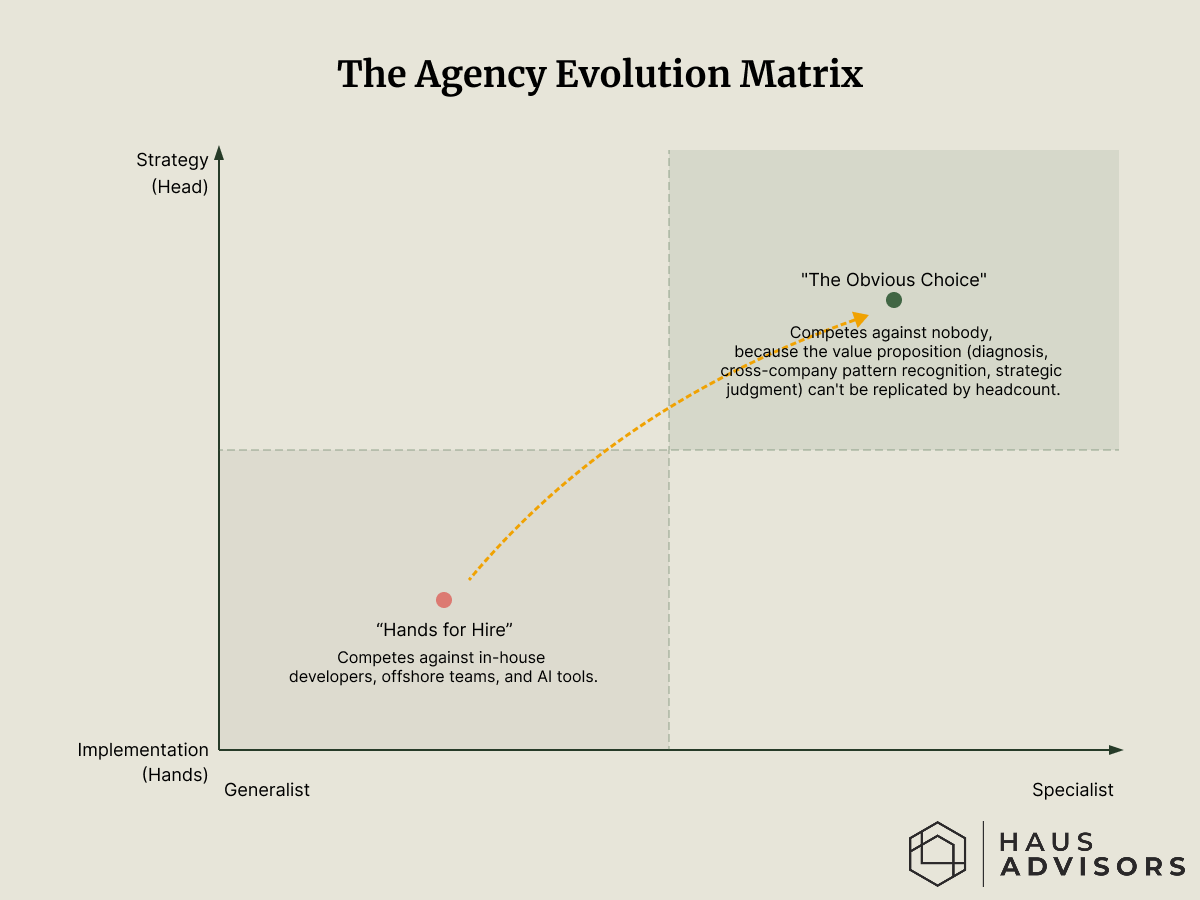
Your position on this matrix determines which competitor you're actually fighting. Move up and right and the in-house alternative stops being a threat.
A vendor says: "We build custom software using React, Node.js, and AWS." A strategic partner says: "We help Series B SaaS companies identify and fix the onboarding friction that's costing them $40K per month in churned trials. Here's how we diagnosed it for three companies at your stage."
The first statement competes with every developer who knows React. The second competes with nobody, because nobody else has framed the problem that way for that specific buyer. The in-house alternative evaporates, not because you've argued against it, but because you've redefined the purchase. The prospect isn't buying code. They're buying a diagnosis and a solution that their internal team doesn't have the perspective to produce.
Positioning Against the Real Alternatives
Once you recognize that your positioning needs to address the in-house and do-nothing alternatives, the strategy shifts:
Lead with the problem's cost, not your solution's features. The prospect deciding between "hire an agency" and "hire a developer" is evaluating inputs. The prospect who understands that their onboarding friction is costing $40K per month in churn is evaluating the cost of inaction. When the cost of the problem is clear, the agency vs. in-house question becomes irrelevant. The question becomes "who can fix this fastest?" And speed of diagnosis, not speed of coding, is where agencies have an insurmountable advantage over new hires who need six months to understand the codebase.
Position your agency as the thing an in-house team can't replicate. A senior developer can write code. They can't bring pattern recognition from solving the same problem across fifteen similar companies. They can't arrive with a diagnostic framework that identifies the three highest-impact interventions in the first two weeks. They can't compress the learning curve from six months to six weeks because they've seen this exact situation before. That accumulated expertise, applied cross-company, is the asset that makes the in-house comparison irrelevant. But only if your positioning articulates it.
Frame your engagement as acceleration, not execution. The in-house alternative is slower by definition. New hires need to be recruited, onboarded, and integrated before they produce anything. An agency with deep domain expertise can start producing diagnostic value in week one. That time advantage, framed as "months of revenue you'd otherwise lose while waiting for an internal team to ramp," changes the financial calculus entirely. You're not an expense. You're an accelerant.
Make the risk of the alternative visible. In-house builds fail quietly. There's no external accountability, no milestone-based delivery, no structured diagnostic process. The project drifts. The CTO gets pulled into oversight. The timeline extends. The opportunity cost compounds. Your positioning should make this risk explicit: not by attacking the in-house approach, but by demonstrating that your process is designed to prevent exactly the failure modes that internal builds are prone to.
The Honest Objection
Here's the strongest argument against positioning for the in-house alternative: most of your deals still come down to agency-vs-agency comparisons. The prospect has already decided to hire an agency and is evaluating three options. Positioning against the in-house threat is solving a problem that doesn't show up in most sales conversations.
That's partially true. If most of your current pipeline comes through referrals or warm introductions, the "do we need an agency?" question has usually been answered before you arrive. Your immediate competitive set is other agencies.
Where That Logic Hits a Wall
But here's the boundary: you only see the deals where the prospect decided to evaluate agencies. You don't see the deals where the prospect decided not to evaluate agencies. Those prospects never enter your pipeline. They never appear in your CRM. They're invisible losses.
And as AI tools improve, as talent becomes more available, and as budget scrutiny intensifies, the percentage of prospects who skip the agency evaluation entirely is growing. The deals you're losing to the in-house alternative aren't the ones you're fighting for and losing. They're the ones you never get a chance to fight for at all.
Positioning that addresses the in-house alternative doesn't just help you win new deals. It expands the set of deals that are possible. It moves prospects who would have defaulted to "we'll handle it internally" into your pipeline, because your positioning reframes what they're buying from "code" to "strategic expertise they can't build internally."
That expansion is where the real growth comes from. Not from winning a larger share of the same agency-vs-agency comparisons, but from entering conversations that your current positioning doesn't even qualify you for.
The Next Step
You don't need to reposition your entire agency this quarter. You need to test whether the Wrong Competitor Problem is active in your market.
Start here: think about the last three deals that went cold or were lost. Not the ones you lost to another agency. The ones where the prospect decided to defer, build in-house, or "handle it with our existing team." Ask yourself: did your positioning give them any reason to believe that your agency offered something their internal approach couldn't replicate? Or did your pitch describe the same thing an in-house team would do, just with a different org chart?
If your positioning is anchored to execution (we build, we develop, we implement), every prospect with a technical team will do the in-house math and conclude they don't need you. If your positioning is anchored to diagnosis, strategic expertise, and cross-company pattern recognition, the in-house math doesn't apply. You're selling something they can't build internally, regardless of how many developers they hire.
That reframe changes which deals enter your pipeline, not just which deals you win.
The principle is simple:
There are agencies that position against other agencies, and there are agencies that position against the decision to go without one.
The first group fights for market share. The second group expands the market.
Most founders reading this already know the real problem. It isn't the in-house hire. It's that the pattern recognition that makes your agency worth hiring over one, along with the reputation and the relationships, still lives in your head. Nobody else in the business can sell it without you. So the business only grows when you're in the room.
That's the work we do at Haus Advisors. The Relevance Engineering Program is six months of implementation, not a strategy document. We pull what makes your agency relevant out of your head, build it into positioning, offers, and growth plays your team can run, and hand ownership to them. If you want an agency that grows without needing you in every deal, book a call to see if it's a fit.
Keep reading
Browse by topic
- Positioning & Strategy
- Lead Gen & Marketing
- Sales & Biz Dev
- Pricing & Productization
- Research & Data
- Operations & Delivery
- Client Retention & Expansion
- Leadership & Culture
For founders whose agency has outgrown referrals.
One idea a week that makes a hard growth problem obvious, usually with a chart that shows you the mechanism behind it.
Built from conversations with seventy-plus agency founders on the Behind the Agency podcast.