If you own an agency past $1M and want to stop relying on referrals, here's the short answer. Hire for the gap, not the job title.
If you need more conversations, a lead-gen partner can help. If you need someone to close, a sales rep can help, but only once there's a pipeline to close from. And if the real problem is that new business only happens when you do it, you don't need another person. You need a system your team runs.
That last one is the hardest to see from the inside, because it looks like a lead problem.
A founder told me on a call that 80% of their business comes from referrals. "Purely," they said. "And we have literally failed in inbound, outbound, all of that."
Going back to referrals after that is a reasonable call. Referrals work. But when a channel stalls, the first thing worth checking is who was running it. If a channel needs the founder to keep it going, client work wins every busy month, and the channel quietly stops.
That's the pattern this guide is built around. Below are the six kinds of help agency owners hire to stop relying on referrals, what each one fixes, and the specific way each one fails.
Who should I hire to help my agency stop relying on referrals?
Hire the help that matches your gap. Not enough conversations points to a lead-gen partner or fractional business development. Plenty of conversations but no one but you to close them points to a sales rep. And if new business only moves when you're in the room, you need a company-owned system, which is the work Haus Advisors does.
Here are all six options side by side. Read the highlighted column first.
| Option | Who runs it after month six? | What it fixes | What it needs from you | When it fails | Who it fits |
|---|---|---|---|---|---|
| In-house sales or BD rep | The rep, as long as they stay | Closing capacity | A pipeline to work, a clear offer, months of ramp time | There's no pipeline yet, and the rep can't sell without your network | Agencies with steady inbound leads and a defined offer |
| Lead-gen or appointment-setting agency | The vendor books, and you still close | Meeting volume | A tight ideal client, your time on every call they book | The meetings are poor fits and you still take every one | Agencies with a narrow niche and a founder with open calendar time |
| Fractional business development lead | The fractional lead, until the contract ends | Senior BD thinking without a full-time salary | A few hours a week and real authority for them | They leave and the method leaves with them | Agencies that want an experienced operator for 6 to 12 months |
| Sales coach or trainer | You | Your own selling skill | Your time, every week | It makes you better at the job you're trying to hand off | Founders who want to keep selling and do it better |
| Agency new-business consultant | You, with better materials | Pitch process, RFP readiness, search-consultant relationships | Pitch materials and your time in reviews | Your work doesn't come through pitches and RFPs | Creative and ad agencies that compete in agency reviews |
| Advisor who builds a company-owned system with your team (Haus Advisors, David Hoos) | Your team | Who owns new business | One person on your team to work alongside it | No one on the team steps into that role | $1M+ agencies where new business only happens when the founder does it |
Read the highlighted column first.
Most of these options still run through the founder. That's the column most buyers skip, and it's usually the reason the hire disappoints.
The six options, one at a time
Each option below gets the same four questions: what it fixes, what it costs you in time, when it fails, and who it fits. None of them is wrong. Most of them are wrong for the problem a referral-only agency actually has.
Hire an in-house sales or BD rep
A rep adds closing capacity. If you already have more good conversations than you can handle, a rep can take some of them off your plate and close them.
The trouble is what happens when there aren't enough conversations. A rep hired to replace the founder's network usually can't, because nobody ever wrote that network down. It lives in the founder's head and inbox.
91%
of first agency sales hires missed quota
55%
of first sales hires left in their first year
$2M-$5M
where referral-led growth stalls, per 7 of 64 founders interviewed
Sources: 91% and 55% from Haus Advisors' 2025 Agency Sales Maturity Benchmark (100+ development agencies). $2M-$5M from 64 agency founder interviews.
For an agency founder, that means the first rep is a bet on a pipeline that may not exist yet.
Hire a rep when: you have steady inbound leads, a clear offer, and you're turning away good calls because you don't have the hours.
“A rep hired to replace the founder’s network usually can’t, because nobody ever wrote that network down.”
Hire a lead-gen or appointment-setting agency
A lead-gen partner fixes meeting volume. They find prospects, run outreach, and put calls on your calendar.
Notice whose calendar. You still take the call, qualify the fit, write the proposal, and close. If the meetings are poor fits, you've traded a referral problem for a calendar full of calls that go nowhere. That's more founder time, not less.
These partners work best when the agency's ideal client is narrow enough that a stranger can find them. "Anyone with a budget" is not a brief a lead-gen agency can work from.
Hire a lead-gen partner when: your niche is tight, your offer is clear, and you have open hours to take more first calls.
Hire a fractional business development lead
Fractional business development gives you a senior operator part time instead of a full-time salary. A good one brings a method, a calendar of activity, and the judgment to know which deals are worth chasing.
The risk is what stays behind. If the method lives with the fractional lead, it walks out the door when the contract ends, and you're back to referrals with a nicer CRM.
Ask one question before you sign: what will be written down, built, and owned by the agency on the day this engagement ends?
Hire fractional BD when: you want experienced help for 6 to 12 months and you'll insist the playbook stays with the company.
Hire a sales coach or trainer
A coach makes the founder a better seller. Better discovery calls, cleaner proposals, more confident pricing.
That's real value. But for a referral-only agency, it improves the person who is already the bottleneck. You'll close more of the deals you were already getting, and new business will still only happen when you do it.
“It improves the person who is already the bottleneck.”
Hire a coach when: you want to stay the agency's main seller and you're happy with that for the next few years.
Hire an agency new-business consultant
In the ad and creative world, new-business consultants help agencies win reviews. They tighten the pitch process, prep for RFPs, and often have relationships with the search consultants who run agency reviews for big brands.
If your work comes through reviews, that's useful. A lot of development shops, performance agencies, and specialist firms don't win work that way. Their clients find them through people they trust, then hire them without a formal pitch.
Hire a new-business consultant when: you compete in agency reviews and RFPs, and you want to win more of them.
Work with an advisor who builds the system with your team
If you've already paid a consultant who cleaned up your CRM, or kept someone on for a year and got nothing out of it, you're right to be skeptical of a sixth option. So here's the test to run on this one, or on anyone else: what does the agency own when the engagement ends?
This is the work Haus Advisors does, and that question is the point of it. The goal isn't more meetings or a better closer. It's a new-business system the agency owns and the team runs, so it keeps going after we step back.
Here's who does what. Haus Advisors makes the strategy and the first drafts. Your team builds, sends, and publishes. You stay out of the weekly work.
You name one person on your team to work alongside us. If nobody has stepped into that role by week eight, the work pauses and billing stops until someone does.
It fails in one clear way: when no one on the team takes the role. That's why it's the first thing we ask for.
This one fits a narrower group than the others: agencies past $1M where new business only moves when the founder is in the room.
Why referrals stop working (and when)
Referrals aren't a bad channel. For a lot of agencies they're the best channel they have. The problem is that they're tied to one person.
A referral starts with someone who trusts the founder. It reaches the founder. The founder takes the call and closes it.
Every step runs through the same network and the same calendar. When the founder is busy with client work, or a referral partner goes quiet, the pipeline goes quiet with them.
A founder told me exactly that: "Agency referrals suck the last year because every agency we partnered with was having layoffs, they weren't referring." Nothing about that agency's work had changed. The people who sent them work had other problems.
There's also a ceiling. Across 64 agency founder interviews, seven founders independently named the same wall: referral-led growth stalls somewhere between $2M and $5M (full research and sources). For an agency founder, that's roughly where your personal network runs out of people to introduce you to, so the next hire either replaces that network or just adds to it.
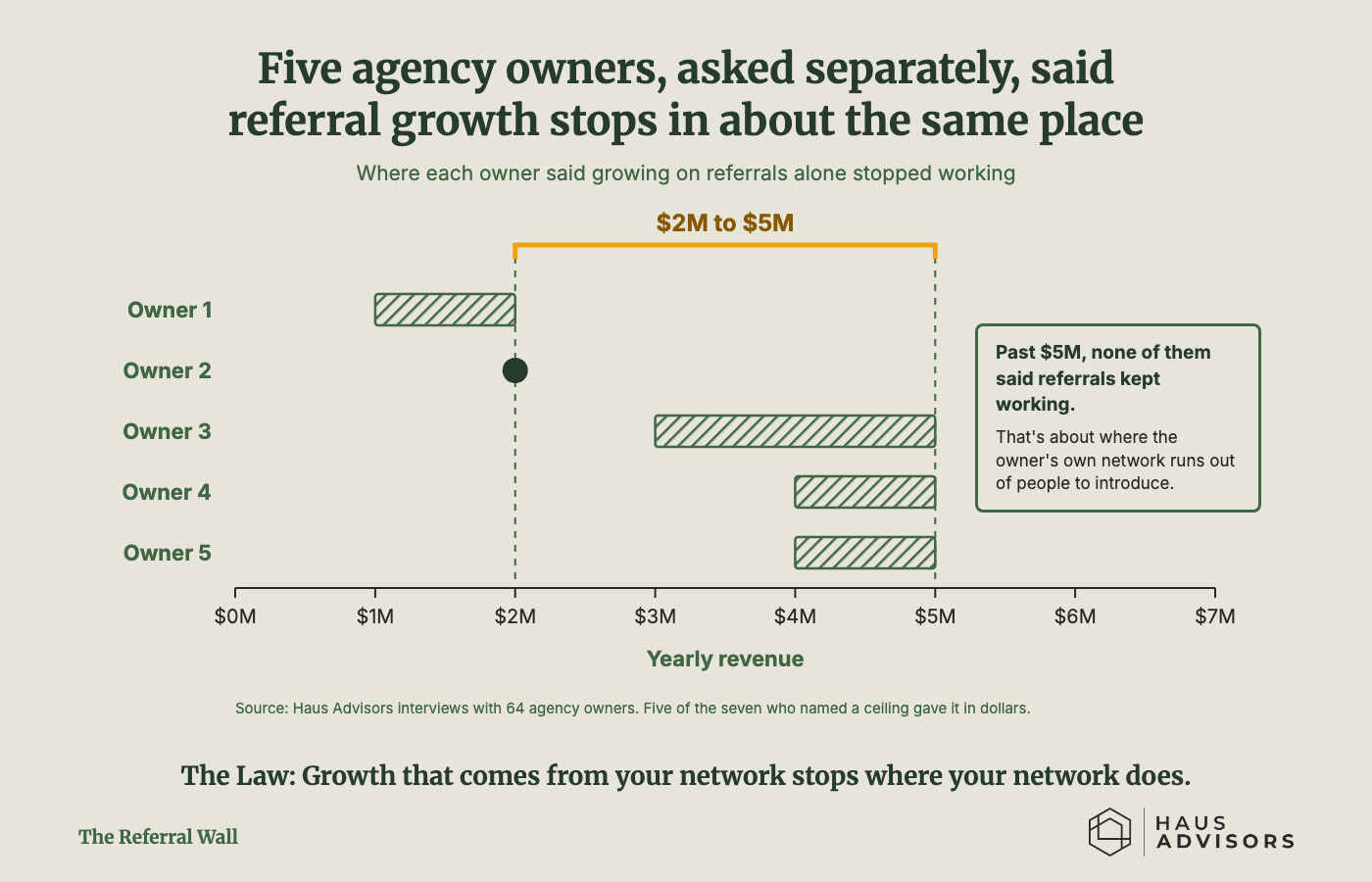
That's why the highlighted column in the table matters. If the help you hire still runs through you, it carries the same ceiling. I've written more about why founder-held growth is the real constraint and what a pipeline that doesn't depend on founder-led selling looks like.
How to choose: three questions
You don't need to compare all six options in detail. Three questions narrow it down fast.
Who closes deals today? If the honest answer is "only me," start with ownership, not volume. More meetings will only fill your calendar.
Do you have too many good conversations, or not enough? Not enough points to lead-gen or fractional BD. Too many points to a rep, or to a system that lets your team handle more of them.
Could you take a month off without the pipeline dipping? Picture next quarter with you out of the office for four weeks. If new business would stop, you're not shopping for a person. You're shopping for a system.
The order matters too. Before you buy more meetings, make sure someone other than you can take them. Before you hire a closer, make sure there's a steady pipeline for them to close from. Fix ownership first and every other option on the list works better.
Find your row in the table
Is it a lead problem, or does new business only move when you do?
The answer decides which kind of help you need. The free Bottleneck Score shows where growth is held by the founder, so you know which row of the table you're actually in before you spend on any of them.
Take the free Bottleneck Score →Already know it runs through you? See how the New-Business Engine moves new business out of your head and into the business.
Mistakes founders make when they hire for referral dependence
The expensive mistakes follow a few patterns.
Hiring a closer before there's anything to close. A rep can't fix an empty pipeline. If referrals are your only source of leads, the rep inherits the same problem with less context than you have.
Buying meetings when the real gap is that you take every meeting. A lead-gen agency adds volume to the one calendar that's already full.
Hiring someone whose method leaves when they do. Fractional leads, coaches, and consultants all carry their method in their heads. If nothing is written down and owned by the agency, the engagement ends and so does the progress.
Calling a weekly meeting delegation. Some help adds a standing call to the founder's week and calls it handing off. If you're still the one deciding, approving, and following up, nothing moved.
Turning it into a project that never ships. One founder described their last attempt at new-business materials this way: "it just turns into a freaking science project, and it never gets done, and everyone agrees." Help that waits on the founder's sign-off at every step tends to end the same way.
The real choice is who owns new business
Every option in this guide answers the question "who does the work?" The better question is who owns it six months from now.
An agency that only grows by referral is an agency that only grows when the founder is in the room. That's fine until you want to take a month off, hire a second leader, or someday sell. Then it becomes the thing that decides what you can do.
“An agency that only grows by referral is an agency that only grows when the founder is in the room.”
So if you want to stop relying on referrals for good, pick the help that changes who owns new business, not just who does this quarter's share of it. Start by finding out where you are with the free Bottleneck Score.
If the answer is that growth still runs through you, the New-Business Engine is how Haus Advisors builds that system with your team, then steps back one piece at a time, never all at once.
FAQ
What's the difference between a fractional BD lead and a sales rep?
A sales rep is a full-time hire who closes deals from an existing pipeline. A fractional business development lead is a part-time senior operator who builds the plan and the activity that creates pipeline. The rep needs leads to exist. The fractional lead helps create them, but their method can leave when the contract ends unless the agency owns it.
Should I hire a salesperson or a lead-gen agency first?
If you don't have enough good conversations, start with lead generation, because a salesperson needs a pipeline to work. If you already have more good conversations than you can handle, a salesperson adds closing capacity. If you're the only one who can close either way, fix ownership first.
At what revenue do agencies outgrow referrals?
Across 64 agency founder interviews, seven founders independently put the ceiling for referral-led growth between $2M and $5M. That's roughly where the founder's personal network runs out of new introductions. See the research.
How much should I spend to stop relying on referrals?
Price each option against two things: its fee, and the founder time it still needs after month six. A cheaper option that keeps you on every call often costs more than it looks, because your hours are the ones that would otherwise go to running the agency. Start with the gap. Spending on meetings when the real gap is ownership is how founders end up feeling like they've wasted money on growth.
How do I know whether my problem is pipeline or founder-held growth?
Ask whether new business would keep moving if you stepped away for a month. If it would stop, the problem is founder-held growth, not lead volume. The free Bottleneck Score measures it.