B2B Referral Marketing Statistics You Need to Know in 2026
Referral marketing is the dominant force in B2B pipeline, yet most companies have no systematic program to activate it. And for agency founders there’s a catch the numbers below don’t show: a referral proves the quality of the work, but it’s attached to a person, and that person is usually you. This page compiles the most-cited B2B referral marketing statistics from analyst firms, primary buyer surveys, and peer-reviewed research, organized so you can find the right number fast.
Key B2B Referral Marketing Statistics
The top-line numbers that define how referrals work in B2B, drawn from the most authoritative sources available.
73% of B2B marketing executives rank word of mouth and peer recommendations as the most influential factor in deciding which vendors to consider. (Source: Wynter B2B Software Buying Study, 2024)
Word of mouth is the primary factor behind 20–50% of all purchasing decisions across categories. (Source: McKinsey & Company)
88% of consumers trust recommendations from people they know above all other forms of marketing messaging. (Source: Nielsen Trust in Advertising Study, 2021)
92% of B2B buyers start their purchasing journey with at least one vendor already in mind before any formal evaluation begins. (Source: Forrester Research, 2024)
94% of buying groups rank their vendor shortlist in order of preference before initiating contact with sales — and the vendor ranked first wins approximately 80% of the time. (Source: 6Sense B2B Buying Research, 2025)
Referred customers have 16% higher lifetime value than non-referred customers with comparable demographics. (Source: Journal of Marketing, Wharton School)
83% of satisfied customers are willing to refer after a positive experience — yet only 29% actually do. (Source: Texas Tech University)
For over half of consultants, 60% of their business comes via referral. (Source: Impact.com Referral Marketing Statistics, 2025)
What 64 Agency Founders Told Us About Referrals
Every number above this line came from somebody else's survey. This section is ours.
We analyzed 64 in-depth interviews with independent agency founders from our Behind the Agency podcast, episodes 1 to 65. This is qualitative pattern analysis, not a survey. These are the founders we talked to, not a census of the industry. Where founders who have never met each other name the same number on their own, that agreement is the finding.
$2M to $5M
Where referral-led agency growth stalls, or about twenty people. Seven founders who had never met each other named the same wall.
0 of 64
Founders who credited cold outbound as their primary growth engine. More than a dozen rejected it outright.
Haus Advisors, from 64 in-depth interviews with independent agency founders on the Behind the Agency podcast. Qualitative pattern analysis, not a representative census.
Referral-led growth stalls between about $2M and $5M, or around twenty people.
Seven founders named the same wall independently. Joe Barsness of Fjorge put it at about twenty people. Andrew Drach of Solway said referral-only growth stalls around $2M. Sam Tomlinson of Warshavsky described a ceiling of roughly 25 clients on a referral network. Tony Wilson of Wilson Talbot and Ryan Watson of Upsourced both put it at $4M to $5M. Paul Wilson of Massive Growth Partners named $3M to $5M as the point where founder-led selling becomes a real bottleneck. Jason Swenk of Agency Mastery 360 sees agencies stuck under $1M to $2M for the same reason.
That is the finding the rest of this page cannot show you. Referrals are the most trusted channel in B2B, and they also have a ceiling. The ceiling arrives earlier than most founders expect. The same wall shows up from the headcount side as the twenty-person wall in our revenue-per-employee benchmarks.
Not one of the 64 credited cold outbound as their primary growth engine.
More than a dozen rejected it outright. Adam Kurzawa of Infinum described mass cold email as spam with a CRM attached. TJ Pitre of Southleft has taken cold outreach off the table entirely. Hunter Jensen of Barefoot Solutions said it stopped working after 2020. Warren Wilansky of Plank replaced it with no-pitch emails to people he admires. Nick Wilkinson of Steamclock puts it as selling like a doctor rather than a car salesman.
So the practical question is not referrals versus outbound. For this cohort, outbound was never the answer. The question is what carries the agency after referrals flatten.
Referral dependence is the most common pattern in the entire dataset.
Across all 64 interviews, no theme recurred more often than growth that arrived through relationships the founder personally held. It is also the hardest one to see from inside, because a referral engine looks healthy right up until it doesn't. A referral arriving today may have started with a client you impressed three years ago, which means the pipeline runs on a delay and the warning comes late.
Most agencies underfund the thing that would replace referrals.
Founders converge on a benchmark worth flagging as theirs rather than ours: most agencies spend 3 to 8 percent of revenue on sales and marketing, while high-growth firms spend 15 to 25 percent. Tony Wilson and Kate Hamilton both cite that range. JP Holecka of Power Shifter puts the realistic number at 7 to 12 percent of gross revenue. Sam Shepler of StorySnap argues 10 percent or more is affordable at healthy margins.
We mark that one differently on purpose. The $2M to $5M ceiling and the cold-outbound finding are patterns from our own interviews. The spending range is a benchmark the founders cited from the wider industry, so it corroborates rather than belongs to us.
If you cite this page, the four findings in this section are original to Haus Advisors and drawn from the interview set described above. Everything else on the page belongs to the sources named beside it.
How B2B Buyers Find Vendors
Peer networks dominate vendor discovery in B2B. Cold outreach and paid advertising are near the bottom. These numbers explain why.
“42% of B2B SaaS CMOs ranked word of mouth as the #1 channel for getting a vendor into their consideration set. Paid advertising and cold outreach each received 2%.”
73% of B2B marketing executives rank word of mouth and peer recommendations as the most influential factor in vendor consideration. (Source: Wynter B2B Software Buying Study, 2024)
58% of B2B marketing executives rely on their professional networks to build a shortlist of vendors. (Source: Wynter B2B Software Buying Study, 2024)
Only 9% of B2B buyers consider vendor websites reliable sources of information when evaluating solutions. (Source: G2 Buyer Behavior Report, 2024)
Public product review sites are now the most consulted information source (31%) for software buying decisions. (Source: G2 Buyer Behavior Report, 2024)
56% of B2B buyers consult with existing product users before purchasing — rising to 71% for enterprise purchases. (Source: TrustRadius B2B Buying Disconnect, 2024)
92% of B2B buyers start their journey with at least one vendor already in mind; 41% start with a single preferred vendor before any formal evaluation. (Source: Forrester Research, 2024)
Between 10–35% of new customers across B2B categories come from referrals. (Source: Impact.com State of Referral Marketing, 2025)
What Gets a B2B Vendor into the Consideration Set
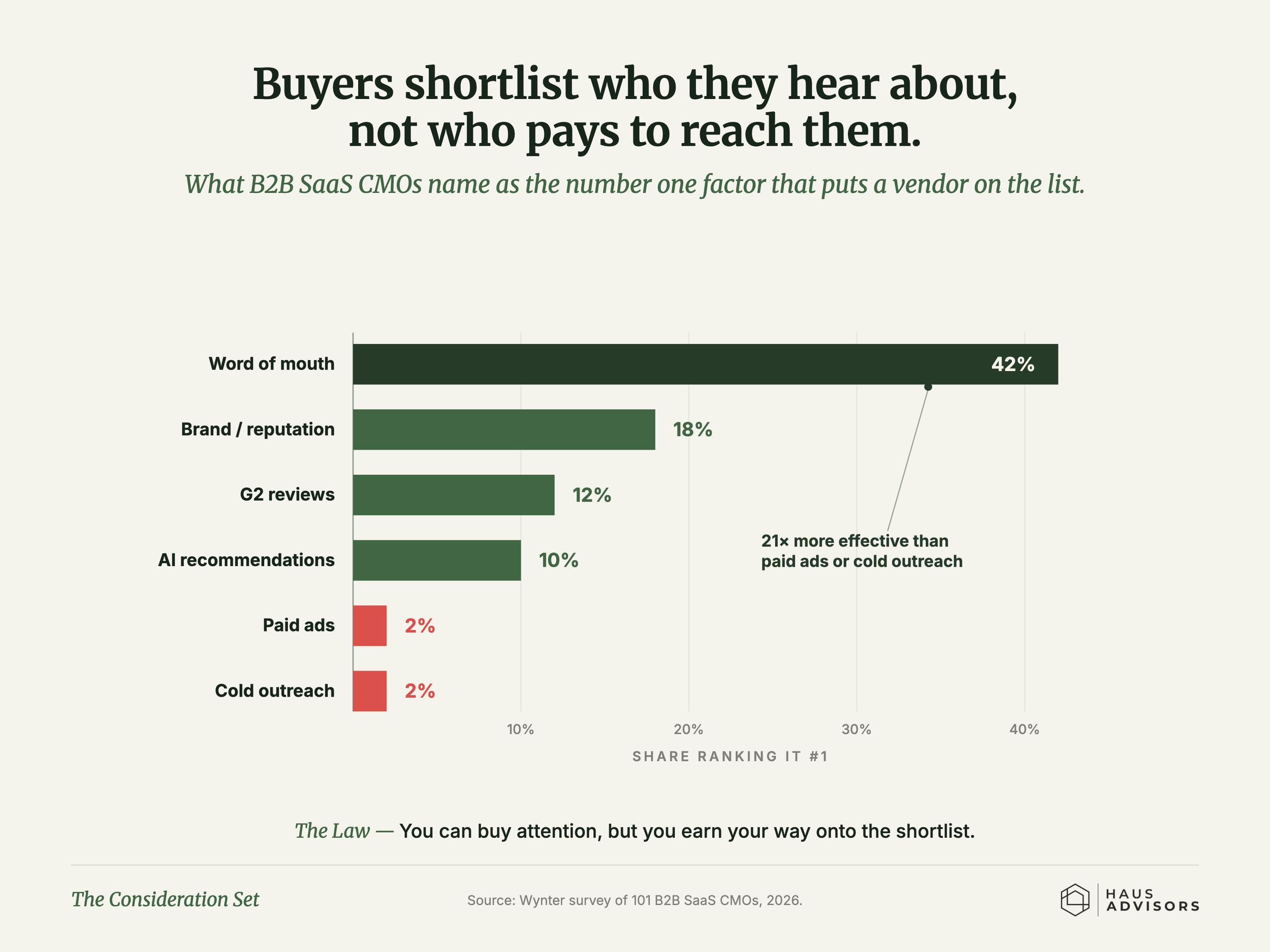
Wynter survey of 101 B2B SaaS CMOs, 2026. Percentages represent share of respondents ranking each as the #1 factor.
Who B2B Buyers Actually Trust
Not all information sources are equal. Forrester's 2025 research maps exactly which sources B2B buyers trust — and which ones they've largely stopped using.
“Coworkers and internal management are the most trusted B2B information sources — trusted by 82% of buyers. Social media influencers rank last at 44%.”
Coworkers and internal management are trusted by 82% of B2B buyers as an information source during purchasing. (Source: Forrester Research, 2025)
Vendors they currently work with are trusted by 79% of B2B buyers — second only to internal colleagues. (Source: Forrester Research, 2025)
Industry peers, analysts, and vendor executives or customers have trust levels ranging from 66–72% among B2B buyers. (Source: Forrester Research, 2025)
Social media influencers rank last, trusted by only 44% of B2B buyers. (Source: Forrester Research, 2025)
88% of consumers trust recommendations from people they know above all other forms of marketing messaging. (Source: Nielsen Trust in Advertising Study, 2021)
77% of B2B buyers consult user reviews during their purchasing journey. (Source: Sopro State of Prospecting, 2025)
54% of B2B buyers speak directly with current users of a product or service before making a purchase decision. (Source: Sopro State of Prospecting, 2025)
57% of younger B2B buyers (Millennials and Gen Z) consult peers before purchasing, versus 49% of Baby Boomers. (Source: Sopro State of Prospecting, 2025)
Only 14% of B2B buyers consult analyst reports — a 60% drop since 2022. (Source: Sopro State of Prospecting, 2025)
B2B Buyer Trust by Information Source
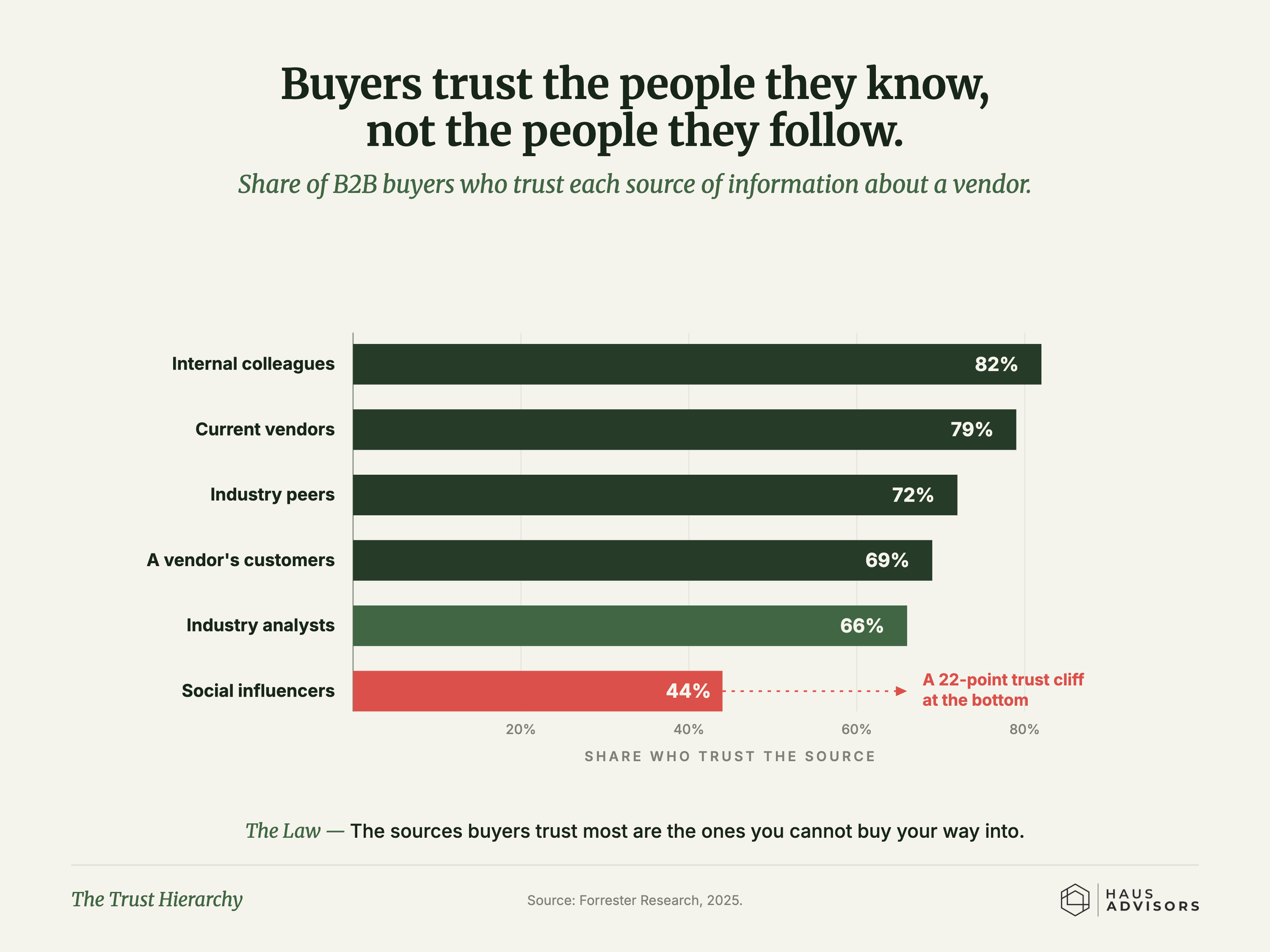
Forrester Research: "B2B Buyers Rate Their Most Trusted Information Sources," 2025. Percentage = share of B2B buyers who trust each source.
Referral Customer Value: LTV, Loyalty, and Retention
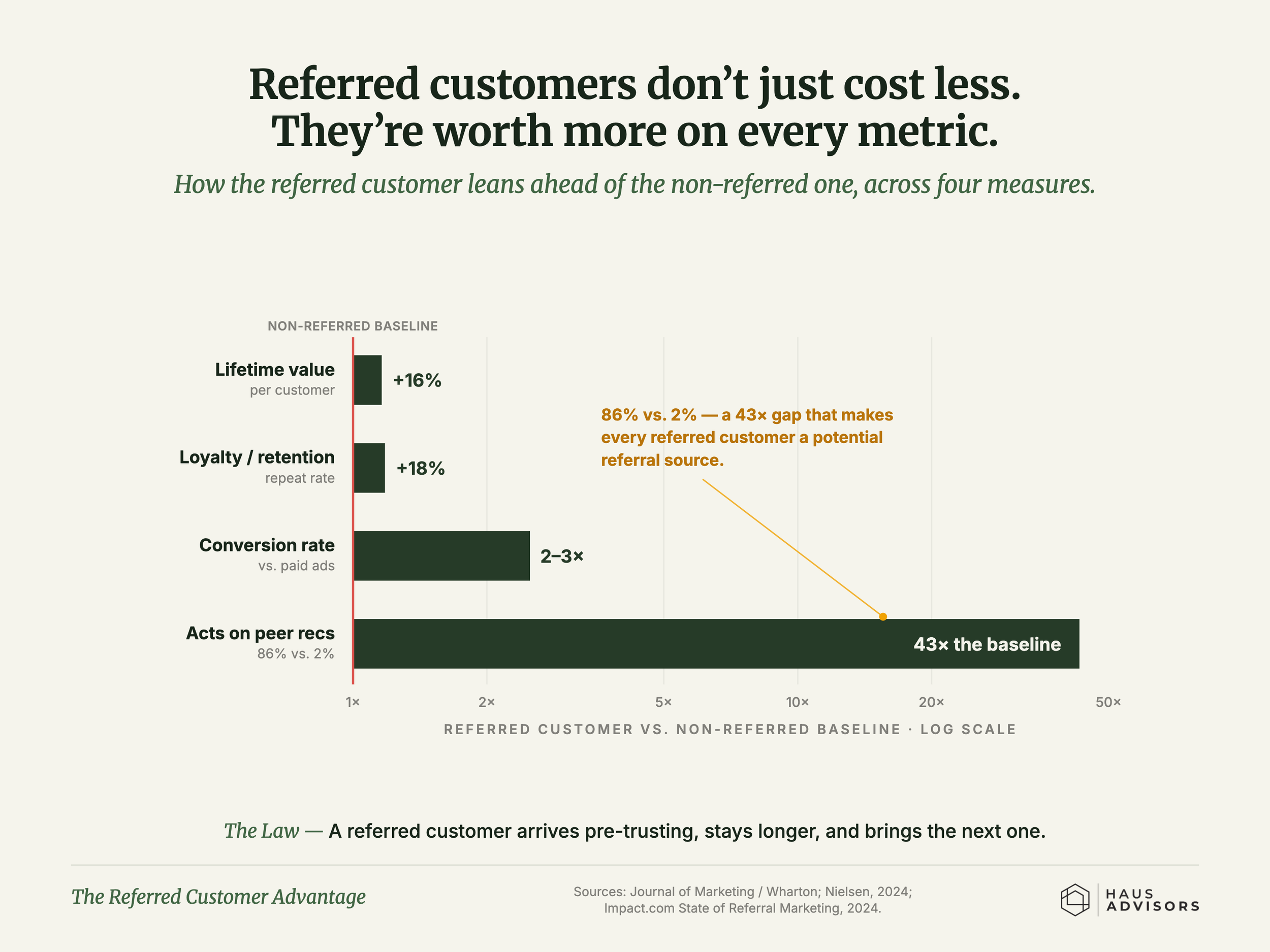
Referred customers aren't just cheaper to acquire — they're structurally better customers. The research on lifetime value and retention makes a compelling case for treating referrals as a distinct customer segment.
“Referred customers have 16% higher lifetime value than non-referred customers with comparable demographics — even after controlling for acquisition channel effects.”
Referred customers have 16% higher lifetime value than non-referred customers with comparable demographics. (Source: Journal of Marketing, Wharton School)
Referred customers are 18% more loyal than customers acquired through other channels. (Source: Wharton School)
Word of mouth generates 2–3x more conversions than paid advertising. (Source: Nielsen, 2024)
86% of consumers say recommendations and reviews influence their purchase decisions — only 2% say the same about traditional advertising. (Source: Impact.com State of Referral Marketing, 2024)
92% of young millennials (aged 28–35) value referrals from people they know when making purchasing decisions. (Source: Impact.com State of Referral Marketing, 2024)
Word of mouth is the primary factor behind 20–50% of all purchasing decisions, making it larger than any single paid channel. (Source: McKinsey & Company)
Word of mouth was 2–10x more effective than paid advertising in driving incremental purchasing behavior. (Source: Boston Consulting Group, 2013)
The Referral Gap: Willingness vs. Action
The biggest untapped asset in most B2B businesses isn't a new marketing channel — it's the referrals that satisfied clients would make, but never get asked for. The data on this gap is striking.
“83% of satisfied customers are willing to refer after a positive experience. Only 29% actually do. The gap, 54 percentage points, represents the structural referral opportunity for most B2B service providers.”
83% of satisfied customers are willing to refer after a positive experience — but only 29% actually do. (Source: Texas Tech University)
44% of consumers participate in referral programs when one is offered to them. (Source: Impact.com State of Referral Marketing, 2024)
60% of referral program non-participants say they have never received a referral code or link from someone they know — the inaction is structural, not motivational. (Source: Impact.com State of Referral Marketing, 2024)
Word of mouth is the primary factor behind 20–50% of all purchasing decisions — yet most B2B companies have no formal program to activate it. (Source: McKinsey & Company)
86% of consumers say recommendations and reviews influence their purchase decisions, but most vendors invest disproportionately in advertising (trusted by 2%). (Source: Impact.com State of Referral Marketing, 2024)
B2B Buying Journey: Why Referrals Win Before the Sale Starts
The B2B buying journey is largely invisible to vendors. By the time a buyer reaches out, they've already done most of their research — and usually have a preferred vendor. Referrals determine who gets that first-position advantage.
“94% of buying groups rank their shortlist in order of preference before initiating contact with any sales team. The vendor ranked first wins approximately 80% of the time.”
Buyers mostly or fully define their purchase requirements 83% of the time before speaking with a sales representative. (Source: 6Sense B2B Buying Research, 2025)
8 in 10 B2B buyers make their first vendor contact after completing approximately 70% of their buying journey. (Source: Sopro State of Prospecting, 2025)
B2B buyers review an average of 11 pieces of content before contacting a vendor. (Source: Sopro State of Prospecting, 2025)
81% of B2B buyers initiate first contact with sellers — not the other way around. (Source: 6Sense B2B Buying Research, 2024)
61% of B2B buyers prefer an overall rep-free buying experience; 73% actively avoid suppliers that send irrelevant outreach. (Source: Gartner, 2025)
72% of B2B purchases involve high-complexity buying groups spanning IT, operations, finance, and end users. (Source: Demandbase, 2025)
86% of B2B purchases stall during the buying process — making pre-established trust (via referral) a significant deal-velocity advantage. (Source: Forrester Research, 2024)
Nearly half of B2B buyers (49%) say economic conditions shortened their buying cycles — creating more pressure to enter the consideration set early, via trusted referral. (Source: 6Sense B2B Buying Research, 2025)
Frequently Asked Questions
-
Research consistently shows referrals dominate B2B pipeline. For professional services and consulting specifically, over 60% of business comes via referral for more than half of all consultants. Across B2B categories, Wynter's 2026 survey of B2B SaaS CMOs found that 42% ranked word of mouth as the top channel getting vendors into their consideration set — compared to just 2% for paid ads and 2% for cold outreach.
-
Research published in the Journal of Marketing (Wharton School) found that referred customers have 16% higher lifetime value than non-referred customers with similar demographics. Wharton School research also found referred customers are 18% more loyal. The compounding effect: referred customers are more likely to refer again themselves, creating a self-reinforcing growth loop.
-
Texas Tech University research found that 83% of satisfied customers are willing to refer — but only 29% actually do. The primary reason is structural, not motivational: most businesses have no systematic process for asking. Impact.com's 2024 State of Referral Marketing report found that 60% of referral program non-participants say they have never received a referral code or link from someone they know.
-
Forrester's 2025 research found that coworkers and internal management are the most trusted B2B information sources (trusted by 82% of buyers), followed by current vendors (79%), then industry peers and analysts (66–72%). Social media influencers rank last at 44%. Only 9% of buyers consider vendor websites reliable, according to G2's 2024 Buyer Behavior Report. This hierarchy is why a warm referral from a trusted colleague consistently outperforms cold digital marketing.
-
6Sense's 2025 research found that 94% of buying groups rank their shortlist in order of preference before initiating contact with any sales team — and the vendor ranked first wins approximately 80% of the time. Separately, Forrester found that 92% of B2B buyers start their journey with at least one vendor already in mind. This means a vendor's position in a buyer's peer network — built through referrals and reputation — determines deal outcomes before the formal sales process begins.
-
Yes — arguably more than for any other business model. Professional services relationships are high-trust by nature, and peers in adjacent roles make ideal referral sources. Impact.com's research shows between 10–35% of new customers across B2B categories come from referrals, but for consulting-adjacent services the proportion is typically higher. For over half of consultants, 60% of their business comes via referral — making word of mouth not just a nice-to-have but a primary growth engine.
Sources
Every statistic on this page is sourced from one of the following organizations or publications. Where multiple aggregators cited the same number, we traced to the named primary source.
Forrester Research
Gartner
McKinsey & Company
Nielsen (Trust in Advertising Study)
6Sense (B2B Buying Research)
Wynter (B2B Software Buying Studies)
G2 (Buyer Behavior Report)
TrustRadius
Impact.com (State of Referral Marketing)
Sopro (State of Prospecting)
Wharton School / Journal of Marketing
Boston Consulting Group
Texas Tech University
Demandbase
Haus Advisors original research. The four findings in the section What 64 Agency Founders Told Us About Referrals come from 64 in-depth interviews with independent agency founders on the Behind the Agency podcast, episodes 1 to 65 excluding 22, mined in June 2026. The sample is independent, founder-led agencies, mostly custom software and marketing or creative firms. It is self-selected, since these were podcast guests, and it is qualitative pattern analysis rather than a statistical survey. These are patterns among the founders we interviewed, not a representative census of all agencies.
If referrals are most of your pipeline
The conversion numbers are real. Referrals do close better than anything else you can run. But that’s also what makes them easy to over-trust, and the trouble shows up late — a referral-built agency stops growing years before the revenue chart says so, because the network quietly maxes out first.
So what’s carrying your growth when that happens? There are twelve charts in the vault on exactly that question. The Borrowed Curve and The Referral Ceiling are the two to start with.
About the author
David Hoos
Founder, Haus Advisors
David helps the founders of software and services agencies build a business that grows without needing them in every deal. He hosts Behind the Agency, a podcast with 70+ episodes on what actually drives agency growth, and runs the Relevance Engineering Program at Haus Advisors: six months of implementation that moves the reputation, the relationships, and the judgment out of the founder’s head and into the business.
Keep reading
Browse by topic
- Positioning & Strategy
- Lead Gen & Marketing
- Sales & Biz Dev
- Pricing & Productization
- Research & Data
- Operations & Delivery
- Client Retention & Expansion
- Leadership & Culture
For founders whose agency has outgrown referrals.
One idea a week that makes a hard growth problem obvious, usually with a chart that shows you the mechanism behind it.
Built from conversations with seventy-plus agency founders on the Behind the Agency podcast.