How to Get Predictable Pipeline Without Founder-Led Selling (And Why Most Agencies Fail at the Transition)
The story usually goes like this…the founder hires a salesperson, BDR, or head of sales. Six months later, the hire is handing deals back to the founder or getting written off as a bad fit. The founder concludes sales delegation doesn't work and goes back to selling everything themselves.
The hire didn't fail. The hire was set up to fail. And the next one will fail the same way unless something changes upstream.
If you're searching for how to get predictable pipeline without founder-led selling, you've probably been through this loop at least once. The problem isn't the hire. It's the sequence.
The short answer: You get predictable pipeline without founder-led selling by building the replacement system in four phases, in order.
Position before you productize. Sharpen who you serve and what problem you own until right-fit prospects self-select.
Productize before you hire. Build one defined offering with fixed scope and price that sells without custom scoping.
Publish before you outbound. Put your diagnostic expertise in public so prospects arrive pre-convinced.
Hire only to operate the system. The hire runs the engine you built. They don't build it.
Skip a phase and the hire fails the same way the last one did. The rest of this article covers each phase, the evidence test that tells you it's done, and the mistakes that break the sequence.
What Founder-Led Selling Actually Produces
Before you can replace founder-led selling, you have to be honest about what it's producing.
When a prospect talks to the founder of a technical agency, they get four things a generic sales hire cannot deliver. Technical trust from someone who has shipped code. Custom scoping decisions made in real time. Credibility rooted in demonstrated expertise. A sales conversation that feels like a consulting conversation.
That's the offer. Not the pitch. The offer.
Most founders assume they can hand this off to someone with a sales background and a phone. That's the error behind the failed-hire pattern. The prospect isn't buying "an hour with a salesperson." They're buying access to the person who can actually solve their problem.
“The prospect isn’t buying ‘an hour with a salesperson.’ They’re buying access to the person who can actually solve their problem.”
When you hire a BDR to replace yourself, the prospect immediately asks to talk to you anyway. The hire has no way to provide the four things your prospects were actually buying.
The pattern isn't the hire's fault. It's what happens when you skip the steps that would have made the hire workable.
The Vacation Test: Could You Disconnect for Two Weeks?
Here's a diagnostic you can run in thirty seconds.
Could you take two weeks off, fully disconnected, without the pipeline drying up in 90 days? If the answer is no, founder-led selling is operating as your entire revenue engine. If the answer is yes, you've already built the system this article describes and you don't need to keep reading.
The Vacation Test works because it reveals whether pipeline depends on founder activity or on a standing system.
“Recent results lie. The Vacation Test doesn’t.”
A dependent pipeline looks fine when the founder is active. It only reveals itself when the founder steps away. By then, the consequences are irreversible. The next revenue dip is already being built during your current busy period.
Most founders score their pipeline on recent results. Recent results lie. The Vacation Test doesn't.
Why Your Pipeline Stops When You Do
Three mechanisms explain why founder-led pipelines always collapse the same way.
The Bandwidth Ceiling. Revenue gets hard-capped at the founder's weekly selling capacity. You can only have so many discovery calls, write so many proposals, close so many deals. Every hour of delivery is an hour not selling.
Every hour of selling is an hour not delivering. The math doesn't compound. It trades off.
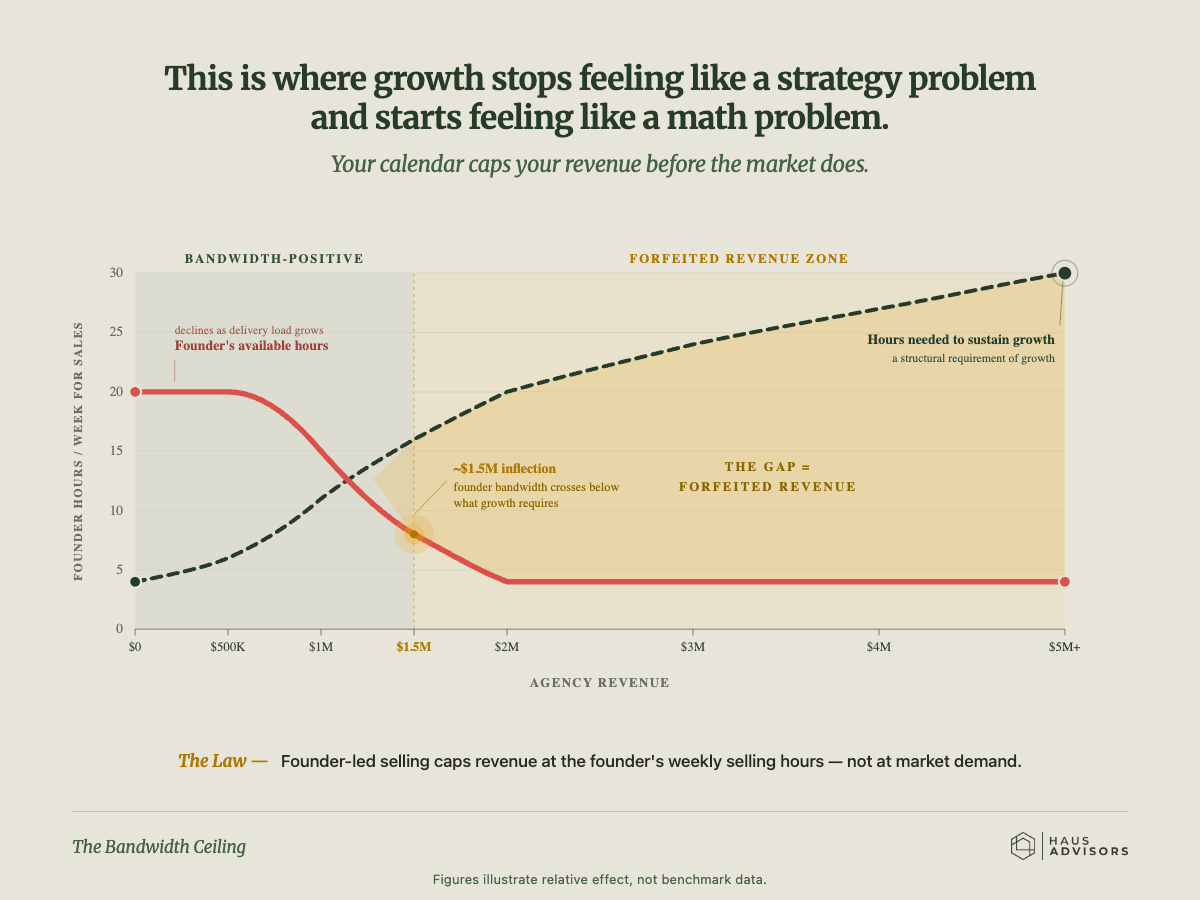
The Delivery-Sales Swap. When delivery gets busy, sales activity drops. When sales slows, delivery has capacity but no new work.
This creates the revenue rollercoaster. Busy quarters produce empty pipelines ninety days later. Empty pipelines produce panic quarters. The cycle repeats.
The Vacation Test failure. Any time you step away from active selling, the pipeline stops generating. Not "slows down." Stops. Your two weeks off show up as a revenue gap one quarter later.
These aren't character flaws. They're built-in outcomes of a system where one person is doing what a system should.
The Replacement Fallacy: Why Sales Hires Can't Replace You
The failed-hire pattern I opened with has a name. Call it the Replacement Fallacy.
“The hire didn’t fail. The hire was set up to fail.”
The Replacement Fallacy is the belief that a pipeline problem caused by founder-dependence can be solved by hiring someone to replace the founder in the sales function. It can't. The founder wasn't just doing sales activity. The founder was providing technical trust, custom scoping decisions, and credibility that the hire has no way to replicate.
When you hire a generic sales rep to replace yourself, you remove the thing that was actually working and leave the hire with nothing to sell.
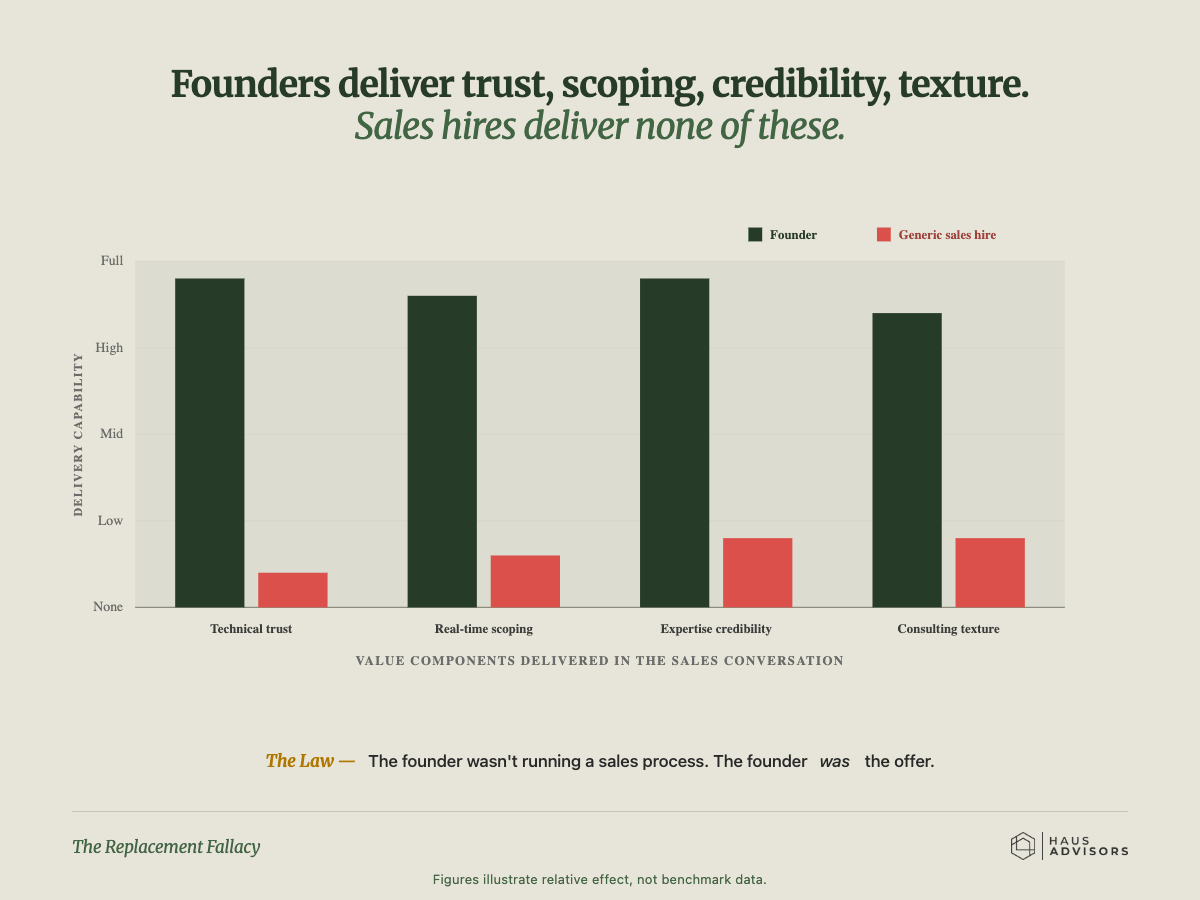
The correct reframe: you don't need to replace the founder. You need to replace what the founder was providing. Those are different problems with different solutions.
That's the exact question the Bottleneck diagnostic answers — which phase of the transition is stuck for your agency, and the one pattern to fix first.
Get Your Bottleneck ScoreThe Transition Sequence: From Founder-Led to Predictable Pipeline
The actual path out of founder-led selling runs through four phases, in order. The order is not optional. Most transition failures are order failures.
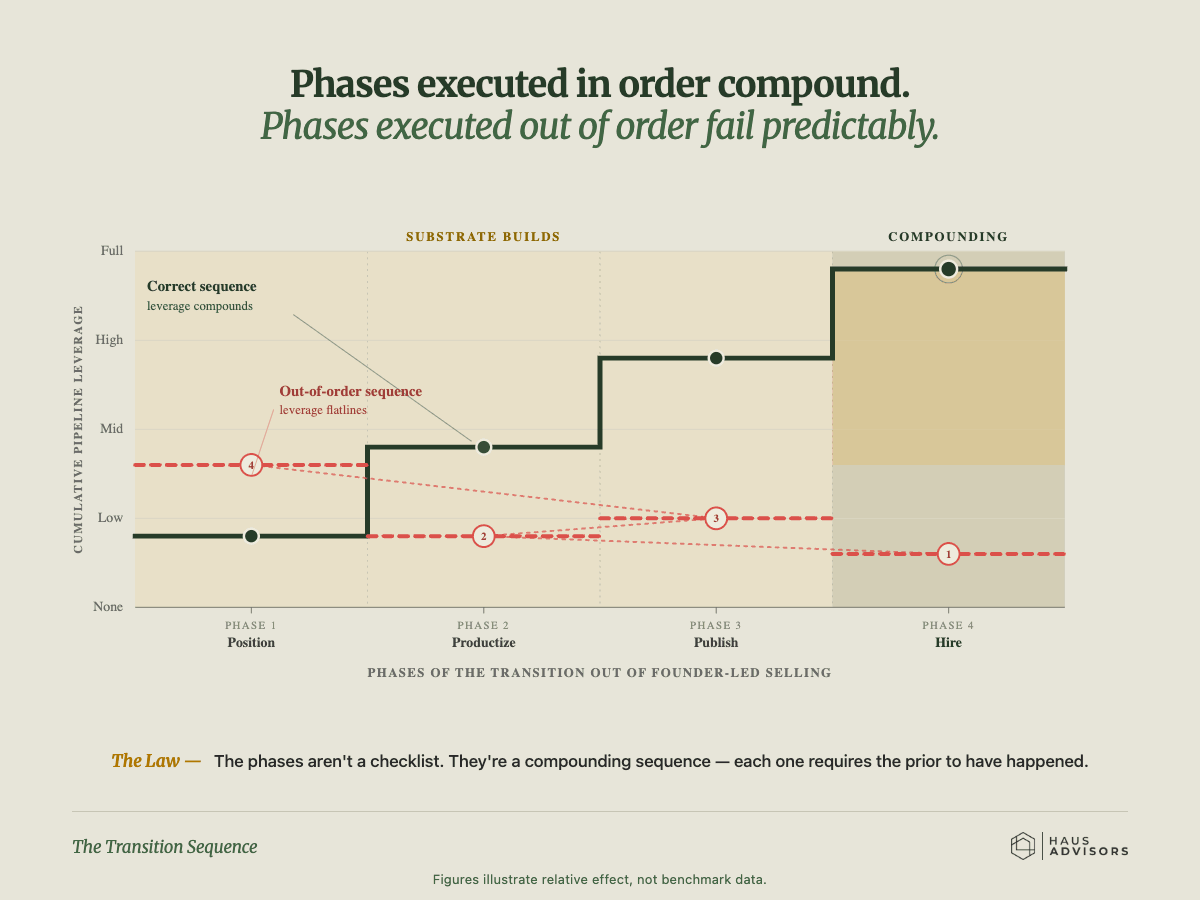
Phase 1: Position Before You Productize
The diagnostic: Can you state in one sentence who you serve and what specific problem you own? Not what you do. What you own.
"We build custom software" is not positioning. "We fix onboarding conversion for growth-stage SaaS companies" is positioning.
The mechanism: sharpen your positioning until the right prospect self-selects and the wrong one self-eliminates. This is the foundation for everything downstream. A generic positioning produces generic content, generic offerings, and generic sales conversations where you have to manually qualify every prospect because the prospect can't qualify themselves.
The evidence test: your best-fit prospects show up to discovery calls already convinced you're the right vendor. If they're still evaluating whether you do their kind of work, you're not positioned yet.
Phase 2: Productize Before You Hire
The diagnostic: Do you have at least one defined offering with clear scope, deliverables, and price? If every engagement is custom-scoped, your current offer is "an hour of the founder's thinking." That's not productized.
The mechanism: build a productized entry point, typically a diagnostic or a sprint, that can be sold without custom scoping. The trick is making it small enough that the prospect can say yes without committing to a big engagement, while still being specific enough that it demonstrates expertise on the exact problem your positioning claims.
This is harder than it sounds because most founders productize what they want to sell, not what the prospect wants to buy first. The productized entry point is not your best service. It's the lowest-risk way for a prospect to find out whether you're right for them.
The evidence test: you've sold the productized offering at least three times without discounting it or redefining the scope. If every sale requires renegotiation, it's not productized yet. It's a custom deal wearing a productized costume.
“The order is not optional. Most transition failures are order failures.”
Phase 3: Publish Before You Outbound
The diagnostic: Is there published content that demonstrates your diagnostic expertise on the specific problems your positioning targets? Not generic industry commentary. Named patterns, specific mechanisms, documented frameworks.
The mechanism: establish a consistent publishing cadence. One piece a month, built around a specific diagnostic pattern, is more valuable than ten pieces of generic industry content. Every piece should name something your positioning owns and explain it with the texture only someone who has been in the room ten times can explain it.
The point is not volume. The point is signal density. Published expertise creates pre-built credibility. By the time a prospect reaches a sales conversation, they've already read your thinking and concluded you understand their problem. The sales conversation shifts from "can you help us?" to "how do we start?" That's the shift that makes a hire workable.
The evidence test: prospects reference your content unprompted during discovery calls. If they're finding out what you do during the call itself, you haven't published enough for your positioning to take hold in the market.
Phase 4: Hire Only to Operate the System
The diagnostic: Does the hire have a system to step into, or are you asking them to build one?
Most sales hires fail because the founder skipped to Phase 4 without doing Phases 1 through 3 first. The hire is asked to build the pipeline engine. That's not a sales role.
That's a founding role. It's also why the hire fails.
The mechanism: hire once positioning is sharp, the productized offering is selling, and published content is drawing qualified prospects. The hire's job is to operate the system you built, not to replace you in building it.
The evidence test: the hire closes the productized offering at a rate comparable to what you were closing it at, within 90 days. If they can't, the problem is usually upstream in Phases 1-3, not in the hire.
Five questions, straight from the diagnostics above. Answer honestly — recent results lie.
1. Could you take two weeks off, fully disconnected, without the pipeline drying up in 90 days?
2. Can you state in one sentence who you serve and what specific problem you own?
3. Do you have a defined offering with clear scope, deliverables, and price?
4. Do prospects reference your published content unprompted during discovery calls?
5. If you hired a salesperson tomorrow, what would they step into?
Answer all five questions first.
The Mistakes That Break the Sequence
A few patterns I see over and over in failed transitions.
The hire has nothing repeatable to sell. Every deal still requires the founder. The hire becomes a lead qualifier at best, a cost center at worst.
The productized offering is generic and doesn't attract the right buyer. You have something to sell, but to whom?
You're writing, but about topics any agency could write about. The content attracts practitioners, not buyers.
Phase 1 doesn't finish before Phase 2 starts. They run in parallel once each has enough foundation. The sequence is about what you start first, not what you complete first.
Client delivery is loud. Pipeline activity is quiet. The quiet thing loses every time, unless you protect it the way you protect a client deadline.
How Haus Advisors Helps Agencies Run This Transition
Everything Haus Advisors does is built around this transition. We don't do marketing strategy in the abstract. We diagnose where in the sequence you're stuck, and we build the specific mechanism to move you forward.
Most agencies don't need more tactics. They need to know which one thing to fix first. That's what the diagnostic produces.
What to Do This Week
You don't need to commit to anything to start.
Run the Vacation Test on paper. Could you take two weeks off without the pipeline drying up in 90 days? Write down why or why not.
Count your productized offerings. Scope defined, price defined, timeline defined, sold at least three times without discounting. If the count is zero, Phase 2 is the bottleneck.
Audit your last five discovery calls. Are prospects arriving pre-convinced you're the right fit, or are they still evaluating? If they're still evaluating, Phase 1 or Phase 3 is weaker than you think.
If more than one of those returns a hard no, you know where the transition has to start.
The founders who get out of founder-led selling aren't the ones with more energy. They're the ones who built the replacement system in the right order and protected it through busy quarters. The compounding took care of the rest.
Everyone else is still the bottleneck.
Keep reading
Browse by topic
- Positioning & Strategy
- Lead Gen & Marketing
- Sales & Biz Dev
- Pricing & Productization
- Research & Data
- Operations & Delivery
- Client Retention & Expansion
- Leadership & Culture
For founders whose agency has outgrown referrals.
One idea a week that makes a hard growth problem obvious, usually with a chart that shows you the mechanism behind it.
Built from conversations with seventy-plus agency founders on the Behind the Agency podcast.