Most of what's written about go-to-market strategy assumes you're launching a product. You pick a market, set a price, line up sales and marketing, and circle a launch date.
But agencies don’t launch things in the same way that product companies do, which is why go-to-market strategy for agencies looks so different. It sells every month, and in the majority of agencies, most of that selling still runs through the founder. So when an agency owner tells me they need a go-to-market strategy, they're almost never asking for a plan. They're asking who is going to own new business, because right now it's them, or it's nobody.
I watched that play out in a workshop this summer. I was walking the CEO of an ecom agency through a list of mistakes to avoid when the CEO stopped me. "Before we get into what not to do, I'm going to forget to ask this," they said. "We've made plenty of hires, and those hires have failed."
Money wasn't the issue. The CEO said they'd be comfortable writing a check for $30,000 to $40,000 a month for the right people, and that the firm underspends on go-to-market as it is. What they'd gotten wrong, in their words, was "the sequencing of hires."
The year before, they'd hired a head of go-to-market. On paper it was the best hire they could make: great interviews, a stellar reputation and a background inside another company's well-built system. It was, the CEO said, "the classic someone too senior, not in the weeds enough," who leaves that system and "falls right on their face." Without the content and marketing people they used to lean on, the new hire realized they didn't know how to position anything.
Part-time outside help hadn't gone better. A couple of days after the workshop, the CEO described the excuse they kept hearing from contractors: "Well, so-and-so didn't get back to me, and like, I don't even work here." And when the CEO stopped checking in for a month, the update they'd get back was some version of this: "I didn't want to bother you, but this thing was a blocker, so I just have been twiddling my thumbs for the last 3 weeks."
Here's what stuck with me. This agency had everything a go-to-market guide tells you to build.
It had dozens and dozens of case studies. It had strong brands and its own technology. It had a newsletter list of "tens of thousands of people," and the CEO admitted, "We never email."
"It's like everything you could possibly want in terms of the puzzle pieces," the CEO said. "We're just not executing against said puzzle pieces."
The numbers said the same thing. In three months, over 200 inbound leads came in, and only one became a client. But when this agency gets a real conversation with a good fit brand, it wins 75% to 90% of the time, by the CEO's estimate.
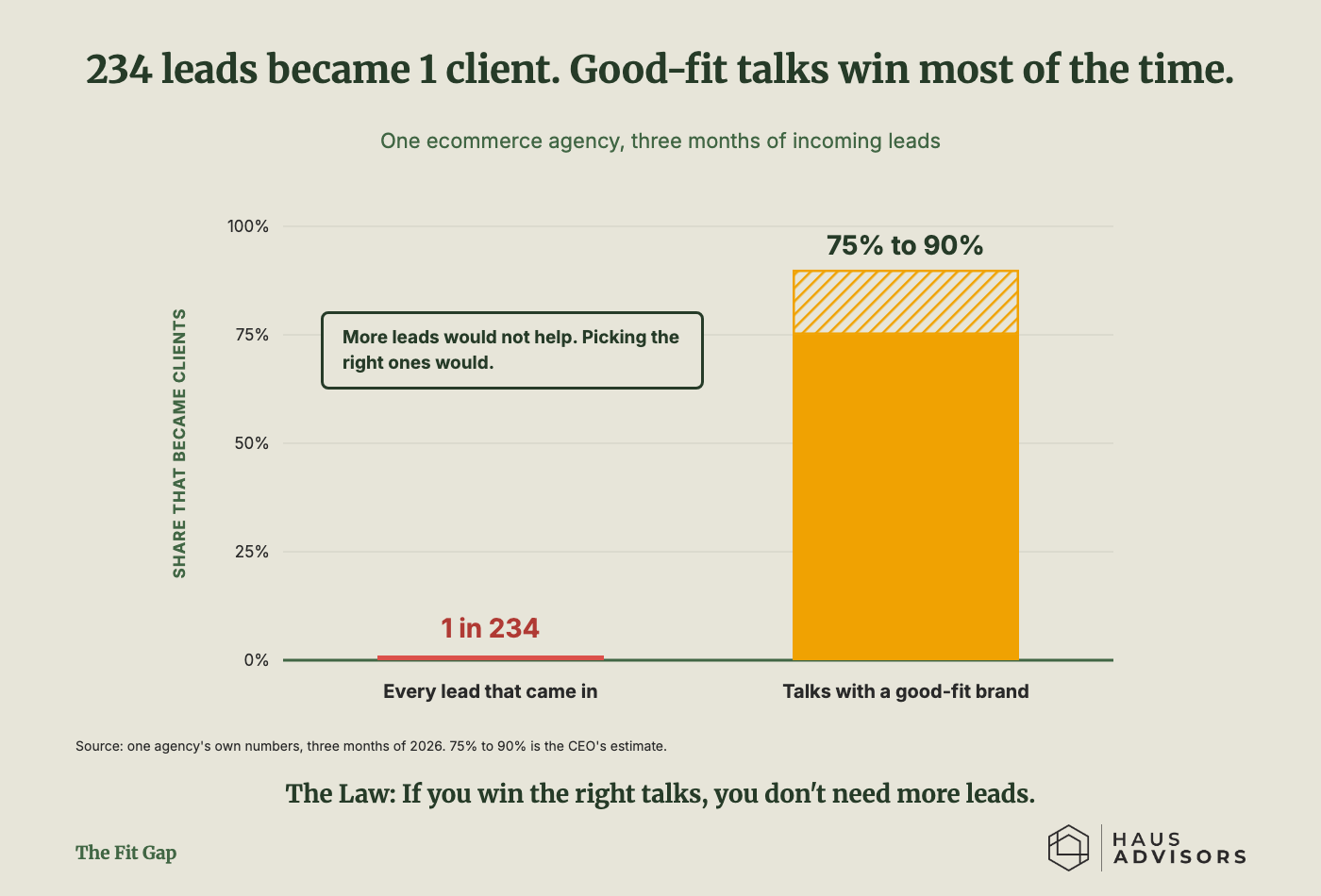
So the agency didn't have a strategy problem. It had an ownership problem, and the CEO knew it. "It's an ownership thing," they told me. "Someone's gotta be held accountable."
What go-to-market strategy actually means for an agency
The textbook definition is fine as far as it goes. A go-to-market strategy, or GTM strategy, is your plan for reaching buyers and winning them: who you target, what you offer, how you price it and where you find them. I agree with all of it.
The trouble is the assumption underneath. Every version of that definition assumes there's a team waiting to carry the plan out. In a $5M agency, the marketing team, the sales team and the person who knows the clients are usually the same person, and that person is busy on a client call.
For an agency, I'd define it more narrowly. Your go-to-market strategy is the set of decisions about which clients you go after, what you sell them and who owns winning them, made clearly enough that someone other than the founder can act on them.
“The agency didn’t have a strategy problem. It had an ownership problem.”
Founders feel this before they have a name for it. One told me, "I don't really have like a sales motion. I guess the hot word is go-to-market plan."
Another founder, running a firm well past $5M, said it more bluntly: "The go-to market organization is immature. Most of the business comes from me or [my partner]."
Now, if you're a software startup getting ready for launch day, the usual playbooks will serve you better than this will. This is for you if you’re the agency owner of a firm that’s made it past $1M, but where new business still depends on one or two people. It's also for the owner who has bought a few of those firms, which I'll get to.
Why go-to-market hires fail in agencies
Most owners try to solve this with a hire. It's a reasonable instinct. In agencies it fails more often than it works, and it tends to fail in one of three ways.
The senior hire is the one from the workshop. They arrive with a great résumé and a playbook from a bigger company. But the bigger company handed them positioning, packaged offers, content and a marketing team. The agency hands them a revenue goal.
They can't sell an offer nobody has defined, so they stall, and the founder decides they hired the wrong person.
The expensive hire is the same story with a bigger invoice. "I've hired a $250,000 VP of sales," one founder told me. "It just took my money."
The part-time hire can be very good at the work and still get nowhere. "I don't even work here" sounds like an excuse, and sometimes it is. But it's also a fair point when nobody has told the team what the contractor owns.
All three fail for the same reason. Each person was hired to carry out decisions nobody had made, and given a goal without the authority to reach it.
They couldn't change which clients the agency went after, because that lived in the founder's head. They couldn't change the offer, because the founder kept reshaping it on sales calls. And they couldn't walk away from a bad-fit lead without looking like they weren't trying.
“Each person was hired to carry out decisions nobody had made, and given a goal without the authority to reach it.”
The CEO in that workshop had diagnosed it before I did. The problem was the order. You make the decisions first, write down who owns what, and only then hire someone to run it.
If you're about to post a job, try this first. Write three lists: what the new person will decide alone, what they'll decide with you and what stays yours. If your list is the longest, you aren't ready to hire yet. You're ready to decide.
Before you post the job
Which of these decisions is still sitting with you?
Most go-to-market hires fail because they're hired into decisions nobody made. The free Bottleneck Score shows which parts of your new business still run through you, so you know what to hand off before you hire anyone to run it.
Take the free Bottleneck Score →Already know where you're stuck? See how the New-Business Engine moves it out of your head and into the business.
The decisions that have to come before the hire
Who you sell to comes first. The test is whether someone besides the founder can use it to turn a deal down. Most agencies have a description of their ideal client. Very few have one a team member can use on a Tuesday afternoon, with a prospect on the phone, to walk away from a bad fit without asking permission.
This matters more than lead volume, and the founders who know it say so. One told me their team is "really good at closing. If somebody needs development and they have money, we can close them." They didn't want a flood of leads. They'd "be happy with two honestly."
Another founder doesn't even ask their sales team for leads: "I tell them I need qualified meetings, because I don't even care how many leads they generate."
What you sell comes second. In a lot of agencies, the offer is whatever the founder describes on the call that day. That works while the founder is on every call. It breaks the first time someone else has to explain what the firm does, and they end up pitching everything or nothing.
A packaged offer fixes that. It has a name, it solves one clear problem and it has a price range someone other than the founder can quote. It's also the core of your agency positioning. If your positioning only works when the founder delivers it, it isn't positioning yet.
“If your positioning only works when the founder delivers it, it isn’t positioning yet.”
Who owns it comes third, and it's the one most agencies skip. Owning go-to-market means owning the first two decisions week to week, with a short list of things you're allowed to change without asking. It doesn't mean owning the revenue number while the founder keeps every important call.
A go-to-market strategy example for a services firm
Here's what those decisions looked like when I wrote them down for the ecom agency, at the start of a 90-day plan. I've left out anything that identifies them.
| The decision | Before | In the 90-day plan |
|---|---|---|
| Who we sell to | Any lead that came in | Brands that fit the profile, with a real budget, a real problem and someone in the conversation who can approve the deal or push for it. Selling more to current clients counts |
| What we sell | Whatever each lead asked for | A short list of offers, each tied to a problem the agency's case studies already prove it can solve |
| Who owns it | The CEO, the account leads and a string of hires who didn't last | One person, every week, working from a written list of who owns what |
| The number we watch | Leads | Qualified conversations per week |
| How we'll know it worked | No test | At day 90, the team can explain how go-to-market runs without using my name |
Two rows are worth a word.
The number changed. Counting leads made no sense for an agency that already had 234 and won one. In one of the workshops, I told the team I think of a lead as a qualified conversation. It's a strict definition, but for an agency it's the only one that means much.
This agency usually wins those, so the plan is judged on one thing: more of the conversations it already knows how to win.
Then look at the last row. I wrote that test against myself. It says the team should be able to explain how go-to-market runs without using my name, not just without the CEO's. If the new system only works while I'm around, all we've done is move the dependency from one person to another.
The first piece of work wasn't a campaign, either. It was a list of who owns what, built from a conversation with everyone who touches new business. Every past attempt at this agency had stalled on "who owns this," so that question went first.
How agency go-to-market changes as you grow
Most agencies get to their first couple of million on the founder's relationships. In the 70+ interviews with agency founders on my podcast, that was the most common pattern by far. Not one of the 70+ said cold outreach was their main way to grow.
It works, and then it stalls. Seven of those founders, who'd never met each other, named the same wall: somewhere between $2M and $5M a year, or about twenty people. Referrals come to the founder because of the founder's reputation, so the founder takes every call, so the reputation stays with the founder. I wrote more about breaking that loop separately.
After that, the fix is the same move at a bigger size. Around $3M, the first person besides the founder owns new business. Past $10M, the leaders of each service line need to sell their own area, all in the same way.
Once you start buying other firms, every firm comes with its own founder-led go-to-market attached. That's where this gets expensive.
Go-to-market after an acquisition: when five founders have to sell as one firm
I talked with a CEO recently who has been buying agencies and services firms and plans to sell the combined company someday. It's a common playbook: buy several founder-led firms, turn each one into a practice area and grow the whole thing toward an exit.
This CEO knew exactly where it gets hard. Each of those firms has always sold its services as itself. Now they need a common framework. Each former owner has to become a practice leader who can market their own area and sell the others' work too.
The CEO also wants to stay away from the low-value, low-multiple services that drag down what the whole company is worth at the end.
That worry is well placed. A founder who merged a development shop with a marketing shop told me how theirs went: "The thesis was that there would be a lot of cross-selling between the dev clients as well as the marketing clients. That was not true at all. So they function as two separate divisions till this day."
Nobody did anything wrong in that story. Nobody changed how they sold, either. Blue Ridge Partners says the same thing from the consulting side: the extra sales disappear when salespeople keep selling the way they always have. BCG's research on combining companies says those gains only show up with a baseline of what each firm would have sold anyway, a named owner for each account, training and pay that rewards it.
Buyers notice. The ecom agency's CEO, who has thought hard about selling part of the firm, told me back in July that "being able to control your destiny from a go-to-market and sales perspective is one of the most critical things an acquirer is going to be looking at." Telling a buyer that most new business arrives by referral was not a conversation the CEO was looking forward to.
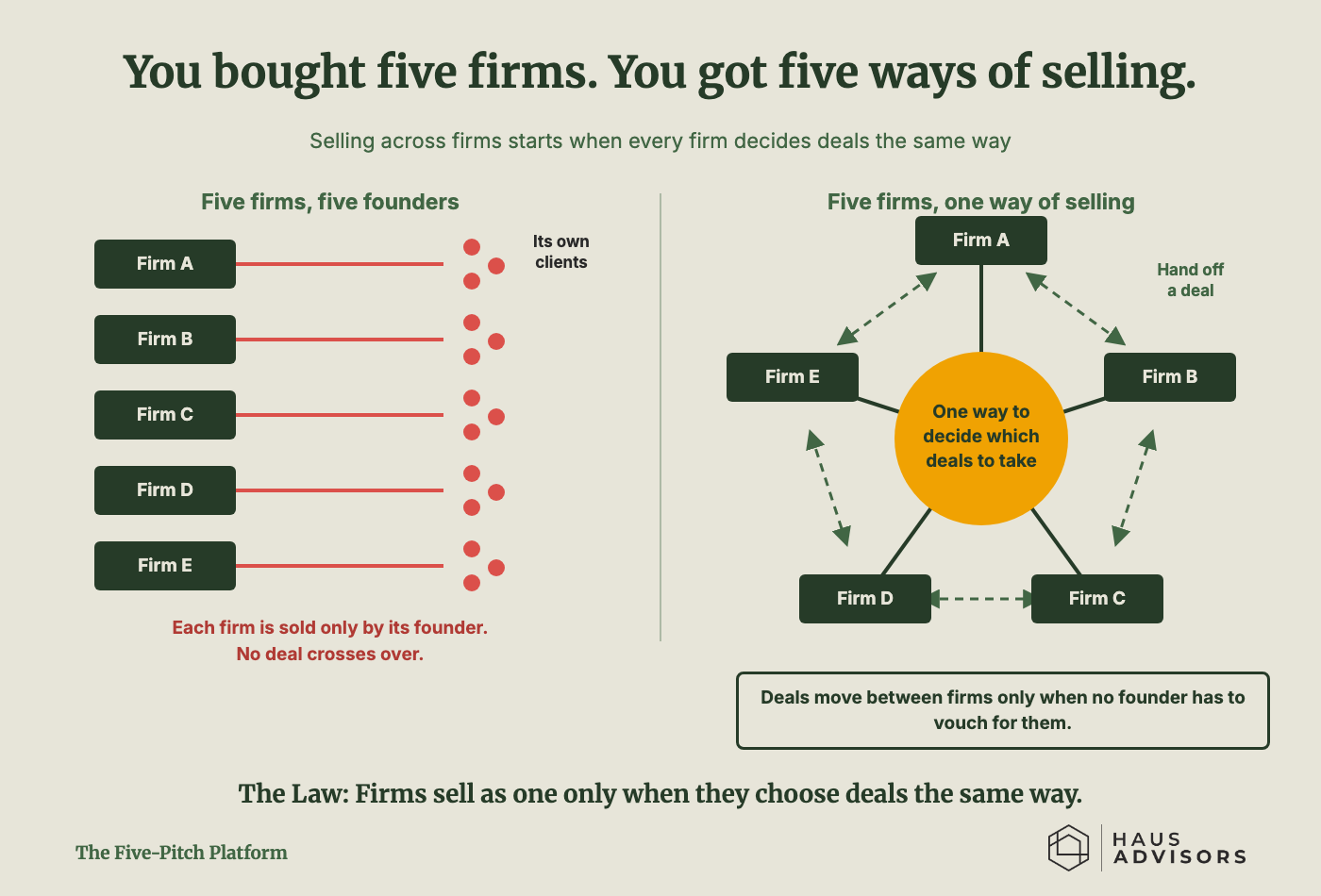
So after an acquisition, the go-to-market work is the same set of decisions, made once for the whole company instead of five times by five founders. Every firm uses one way of deciding which deals to take, so a lead can move from one firm to another without a founder vouching for it. Each important client has a named owner. People get paid for handing a deal to another firm, not just for closing their own.
If you're getting the company ready to sell, the exit-ready version of this is how a buyer prices revenue that doesn't depend on any one founder.
The test for whether your agency has a go-to-market strategy
Ask your team to explain how your agency wins new clients without using the founder's name. Then ask yourself what would happen to new business if the founder did no selling for 90 days.
If the honest answer is "it would drop," you do have a go-to-market strategy. It just lives in one person.
I'll say who this is wrong for. If you like being the rainmaker and plan to stay one, keep doing it. Some founders run their agencies that way on purpose, and it's a perfectly good business.
The cost is real, too. Moving these decisions takes a few months of your attention, and new business can dip while you step out of deals.
But if you want the firm to keep winning clients when you're not in the room, the work is getting those decisions out of your head and giving them an owner. The CEO from the workshop had tried to hire that owner three different ways. Each time, the missing piece wasn't the person. It was something for the person to own.
This is the work we do in the New-Business Engine: we make those decisions with you and build the system that keeps new business coming in after we step away.
If you want to see where your agency stands first, the free Bottleneck Score shows which parts of new business still run through you. Or see how the New-Business Engine works.
Go-to-market strategy for agencies: common questions
What's the difference between an agency marketing plan and a go-to-market strategy?
A marketing plan is about getting attention and leads: content, ads, events, outreach. A go-to-market strategy decides which leads you want, what you'll offer them and who owns turning them into clients. You can have a great marketing plan and no go-to-market strategy. That's how an agency ends up with 234 leads and one new client.
Who should own go-to-market in an agency?
One named person who can make decisions about fit and offers without asking the founder. Under about $3M, that's usually still the founder, which is fine as long as the decisions are written down. Past $3M it should be someone else, with their authority written down too, or the role will stall.
What is a go-to-market agency?
Usually it's a firm that helps software and product companies launch: positioning, messaging, demand generation and sales training. If you run an agency and want to fix how your own firm wins clients, you don't need a launch. Look for help with founder-led sales and with deciding who owns new business.
Is go-to-market strategy different for IT services and consulting firms?
Not much. Most IT services and consulting firms also win clients through a founder or a few partners, so the same decisions apply. The difference shows up after acquisitions, which are common in IT services, when several founder-led firms have to learn to sell as one.
How do you combine go-to-market after buying an agency?
Start with how the firms decide which deals to take and how they hand deals to each other, before you merge their brands. Give every firm one shared way to qualify a deal, name an owner for each important client, coach each practice leader to sell their own area and pay for handoffs between firms. Then measure the new sales against what each firm would have sold anyway.