The Service-Level Product: How to Make Custom Dev Easy to Buy
A founder of a 15-person custom development agency was closing about one in four discovery calls. That sounds decent until you do the math. Six to eight calls a month, roughly three hours per call in prep, follow-up, and proposal writing. For every four calls, three prospects went quiet, went to a competitor, or replied "we need to think about it" and never came back.
He assumed the problem was his price. He tried discounting on two deals. Both still didn't close. Then he tried adding a more detailed scope breakdown to his proposals. Same result.
What he hadn't considered was that buyers weren't confused about his price. They were confused about what they were buying.
Custom development is inherently difficult to evaluate before purchase. The buyer can't touch it, benchmark it, or compare it to a clear standard. They're being asked to commit $50,000, $150,000, or more to something that doesn't exist yet, built by a team they've just met, using a process they've never seen. The risk isn't just financial. It's organizational. If it goes wrong, they own that decision.
When buyers feel that level of uncertainty, they don't say "your price is too high." They say "let us think about it." And then they disappear.
The Confusion That Kills Custom Dev Sales
This is The Decision Vacuum — specifically, the process confusion variant. Prospects ghost not because they found a better option, but because they couldn't complete the mental calculation required to say yes.
Buyers make purchasing decisions by comparing the cost of action against the cost of inaction, then adjusting for perceived risk. When the risk is hard to assess, the calculation never completes. They don't say no. They delay until the delay becomes a no.
Custom development creates high perceived risk by design. The phrase "custom" signals that no predefined path exists. The buyer interprets that as: the outcome is uncertain, the timeline is uncertain, the cost might change, and I have no way to know if I'm making a smart decision.
Here's what's interesting: most custom development agencies have more process structure than buyers ever see. The team knows their standard phases—discovery, architecture, sprint cycles, QA, deployment. They've done it twenty times. But because the output is "custom," the agency never surfaces that structure to buyers. They present it as bespoke when buyers want evidence of a proven system.
The Craftsmanship Ceiling is what happens to agencies that stay in this model long-term. "Custom" becomes a synonym for "unpredictable" in the market's mind. The more sophisticated the buyer, the more they associate custom work with the risk of scope creep, timeline slippage, and cost overruns. Your reputation for craft gets overshadowed by the category risk.
Why "Trust Us, We're Good" Doesn't Close Deals
The standard response to buyer hesitation is more proof. More case studies. More testimonials. Longer proposals with more detail. The assumption is that uncertainty is a trust deficit and trust is fixed by social proof.
That's partially true, but it misses the mechanism. Social proof reduces uncertainty about the agency. It does not reduce uncertainty about the buying decision. A buyer can believe you are excellent and still not understand what they are agreeing to.
Here's the distinction that matters: buyers want to know what will happen, not just that you are capable. They want a map of the journey, not a portfolio of past trips.
Think about how buyers evaluate other professional services. A lawyer quotes a retainer and describes the process in stages. An accountant outlines what they need, what they deliver, and when. A management consultant presents a phased engagement with defined outcomes at each milestone. None of those engagements have guaranteed outputs, but all of them give the buyer a clear picture of what the process looks like.
Technical agencies are often the last to structure their services this way, despite having the most complex and expensive services to sell.
The result is measurable. Research on B2B professional services buying behavior consistently shows that buyers are willing to pay 15–25% more for services that are clearly scoped and staged versus services presented as open-ended or fully custom. The additional premium isn't for better work. It's for reduced risk.
What Custom Services Are Costing You in Closed Deals
The math on poor service structure is straightforward, even if most founders haven't run it.
If you're closing 25% of qualified opportunities and your average deal is $75,000, you are leaving three unclosed deals for every one you win. At $75,000 each, that's $225,000 in deals you're working for and not closing each quarter. Some of that is legitimate fit mismatch. But research consistently shows that 30–40% of B2B service deals lost to "no decision" could have been won with better framing of the offer, not better pricing.
Longer sales cycles have a second-order cost that most founders undercount. Every additional week in the sales cycle is a week of founder attention, proposal iteration, and follow-up work. For a founder doing two to three deals a month, the cost of a six-week average cycle versus a three-week cycle is roughly a half-day per week of principal time. At $500/hour opportunity cost, that's $10,000 to $15,000 per month in invisible overhead.
Churn on discovery engagements—projects where the client opts out or disengages early because the process wasn't what they expected—is the most expensive outcome. It combines direct cost with reputational risk. Structured service design reduces early churn by aligning buyer expectations before the work begins.
Designing Your Service-Level Product
A Service-Level Product (SLP) is not a rigid package. It is a structured frame around flexible work. The goal is to give buyers a predictable map of what happens at each stage, with defined outcomes at each gate, without eliminating the flexibility that custom work requires.
Three elements define a well-designed SLP.
1. Named Phases with Clear Exits.
Every engagement has phases. Most agencies execute phases without naming them externally. The fix is to name and describe each phase from the buyer's perspective, with a clear statement of what is delivered and decided at the end of each one.
A discovery phase is not just "we learn about your project." It is "a two-week structured audit that produces an architecture recommendation, a phased build plan, and a risk register you own regardless of whether you continue." That second framing gives the buyer something concrete to evaluate and agree to. It also converts discovery into a purchasable product—a lower-commitment first step that builds confidence before a larger investment.
2. Fixed Inputs, Flexible Outputs.
The trap most agencies fall into is trying to productize the output (fixed price, fixed scope, fixed result). That rarely works for complex custom work because too many variables are genuinely unknown. The better structure is to productize the inputs: fixed process, fixed team structure, fixed cadence, fixed communication protocol.
"We run two-week sprints with a defined kickoff, mid-point check-in, and retrospective. You get weekly progress summaries and have unlimited access to your lead developer on Slack. Scope is adjusted at sprint boundaries based on what you've learned." That is a predictable process with flexible output. Buyers can imagine being in it. They can say yes to the structure even when the final product isn't fully defined.
3. Decision Gates, Not Just Milestones.
Traditional project milestones are internal. "We hit 50% of the codebase." That means nothing to a buyer who doesn't read code.
Decision gates are external. "At the end of Phase 1, you will have a working prototype with the three core user flows, a documented architecture, and a go/no-go recommendation for Phase 2 based on what we learned." The buyer knows what they're getting. They know when the decision point comes. They know what they're deciding.
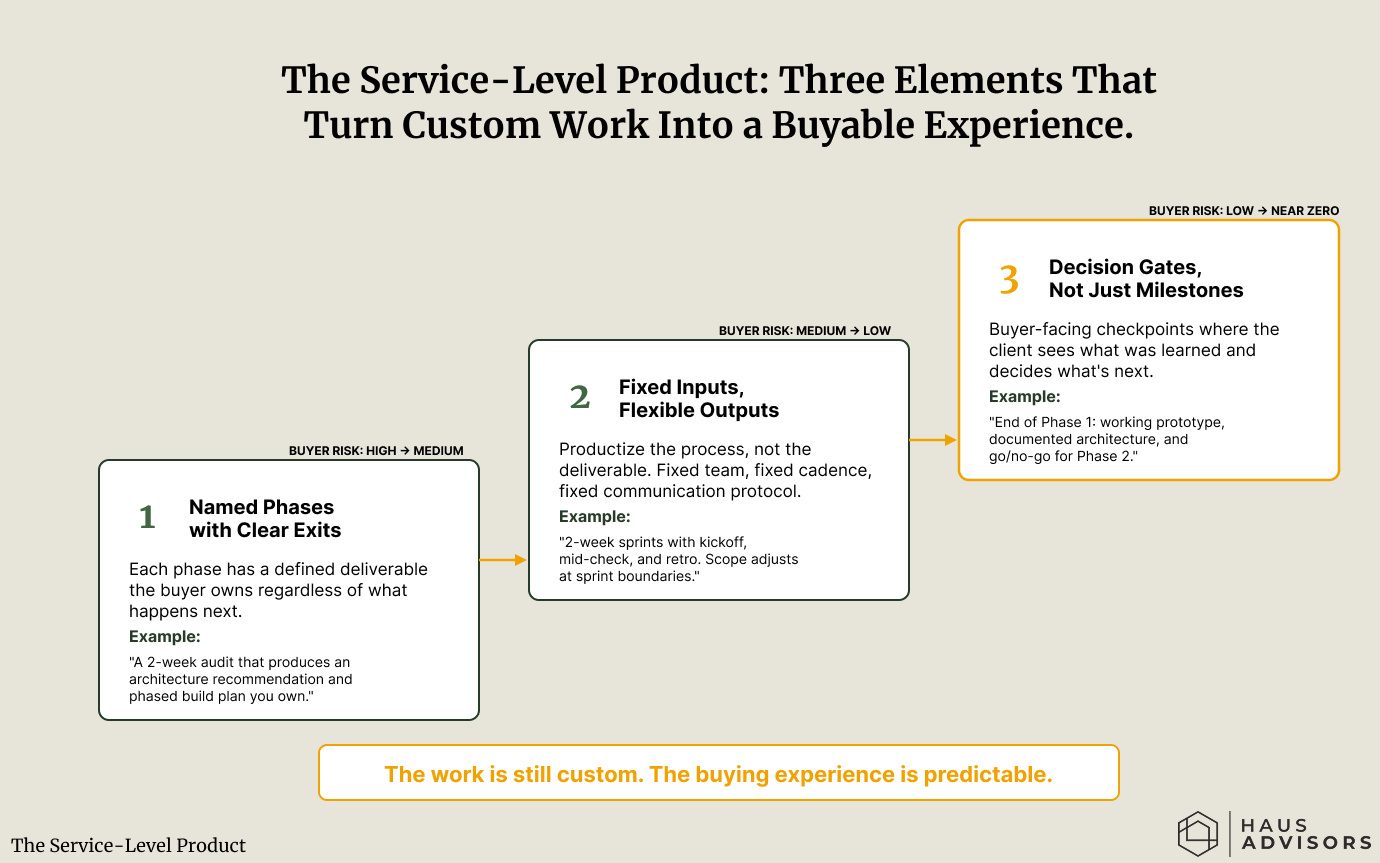
The work is still custom. The buying experience is predictable.
Decision gates do two things: they reduce early-stage risk for the buyer (they're not committed to the full engagement up front) and they increase deal velocity for you (a smaller, structured first step closes faster than a large, ambiguous full project).
The agency that had the discovery call problem above rebuilt his sales process around a structured SLP with two phases. A 4-week "Architecture and Roadmap Sprint" at $18,000, followed by a structured build engagement with defined sprint cadence. His close rate on the first step went from 25% to over 50% within three months.
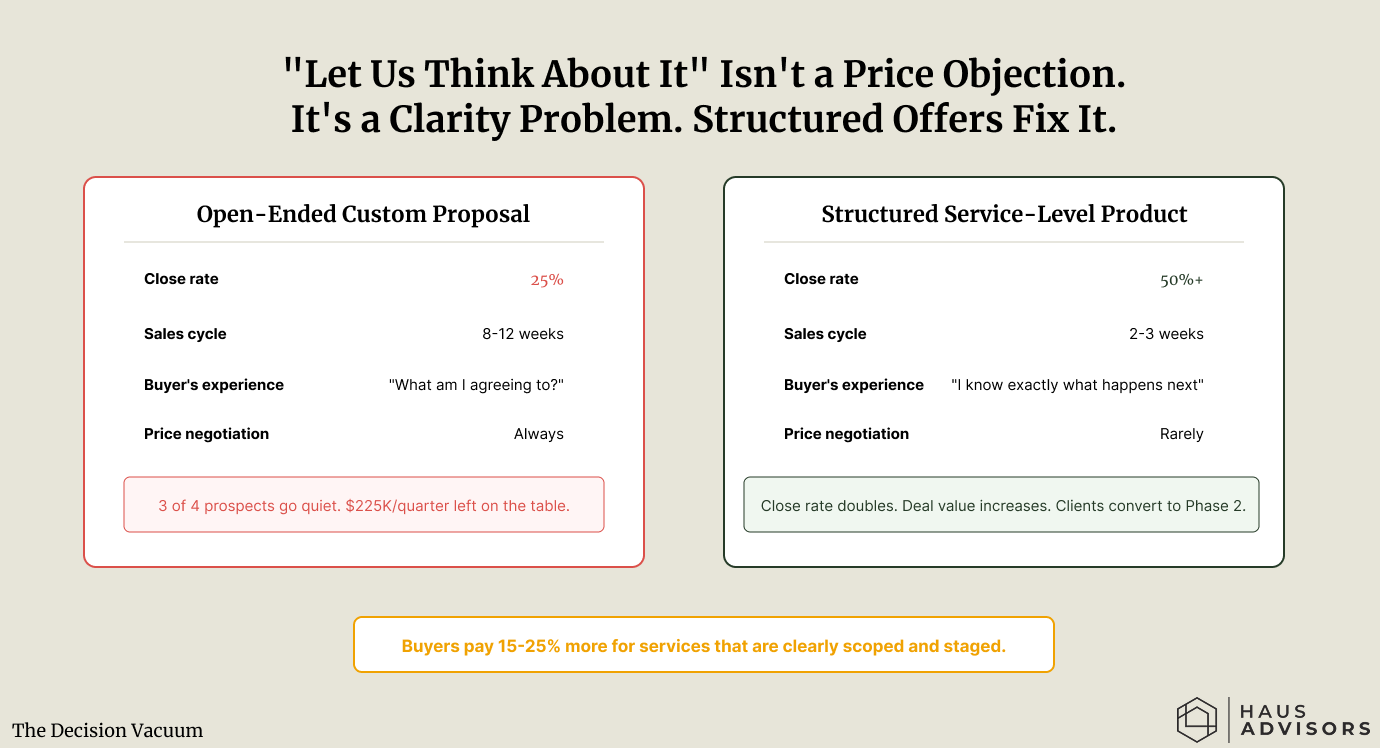
"Let us think about it" isn't a price objection. It's a clarity problem.
The total deal value per client increased because clients who buy a structured first phase convert to the build phase at a much higher rate.
Custom Doesn't Have to Mean Confusing
There are agencies that sell custom development as exactly that—custom. Everything negotiated, scoped, and explained from scratch with every new client. They do good work. But the buying experience is uncertain, the sales process is long, and the pipeline is feast-or-famine because nothing about the offer is easy to repeat.
And there are agencies that wrap their custom work in a structured product frame. Fixed phases, clear exits, defined inputs, decision gates. The work inside the frame is still bespoke. But the buying experience is predictable. Prospects understand what they're agreeing to. The conversation moves from "can we trust you?" to "when do we start?"
The second group closes faster, charges more, and retains clients longer. Not because their development is better, but because their offer is clearer.
Custom doesn't have to mean confusing. If your sales cycle is longer than it should be, it's worth asking whether the problem is your price or your product structure.
Most founders reading this already know the real problem. It isn't your price. It's that the reputation, the relationships, and the judgment that make your agency worth hiring still live in your head. So the business only grows when you're in the room. A Service-Level Product is the first piece of that judgment written down in a form someone other than you can sell and run.
That's the work we do at Haus Advisors. The Relevance Engineering Program is six months of implementation, not a strategy document. We pull what makes your agency relevant out of your head, build it into positioning, offers, and growth plays your team can run, and hand ownership to them. If you want an agency that grows without needing you in every deal, book a call to see if it's a fit.
Keep reading
Browse by topic
- Positioning & Strategy
- Lead Gen & Marketing
- Sales & Biz Dev
- Pricing & Productization
- Research & Data
- Operations & Delivery
- Client Retention & Expansion
- Leadership & Culture
For founders whose agency has outgrown referrals.
One idea a week that makes a hard growth problem obvious, usually with a chart that shows you the mechanism behind it.
Built from conversations with seventy-plus agency founders on the Behind the Agency podcast.