The Authority Ladder: Move From Vendor to Strategic Partner
A founder of a 12-person custom software shop came to me after losing a long-term client he thought was locked in. His team had delivered a six-month platform rebuild on time, under budget, with zero bugs at launch. The client signed off, posted a glowing review on G2, and four months later put the next initiative out to bid.
He found out through a LinkedIn notification. The client had announced a new technology partner.
He went back through the emails looking for friction, looking for a missed deadline or a cost overrun. Nothing. The relationship had been smooth from kickoff to handoff. The only explanation he could find was that the client saw him as a contractor, not an advisor. Someone you hire for a specific job and release when it's done.
The work was excellent. But the positioning was wrong.
The Ladder Every Agency Climbs (or Stays Stuck On)
I think of this as The Documentation Trap. Technical agencies prove competence by demonstrating what they can build. The assumption is that if you do excellent work, the relationship deepens automatically. It doesn't.
Here's what I've seen: relationships deepen when clients experience you as someone who understands their business problems, not just someone who executes well against a defined scope. The distinction is structural, not personal. And it determines everything—renewals, referrals, pricing power, and whether you get the call before the RFP or after.
There are four rungs on what I think of as the Authority Ladder:
Rung 1 — Vendor: Hired for tasks. Evaluated on execution. Replaced when the job is done.
Rung 2 — Preferred Supplier: Trusted to deliver reliably. Kept for more of the same type of work.
Rung 3 — Trusted Advisor: Consulted before decisions are made. Brought in to help think through options.
Rung 4 — Strategic Partner: Embedded in planning. The client can't imagine making major decisions without you.
Most technical agencies live on rungs 1 and 2. They get there through good work. They stay there because no one told them the rules to climb.
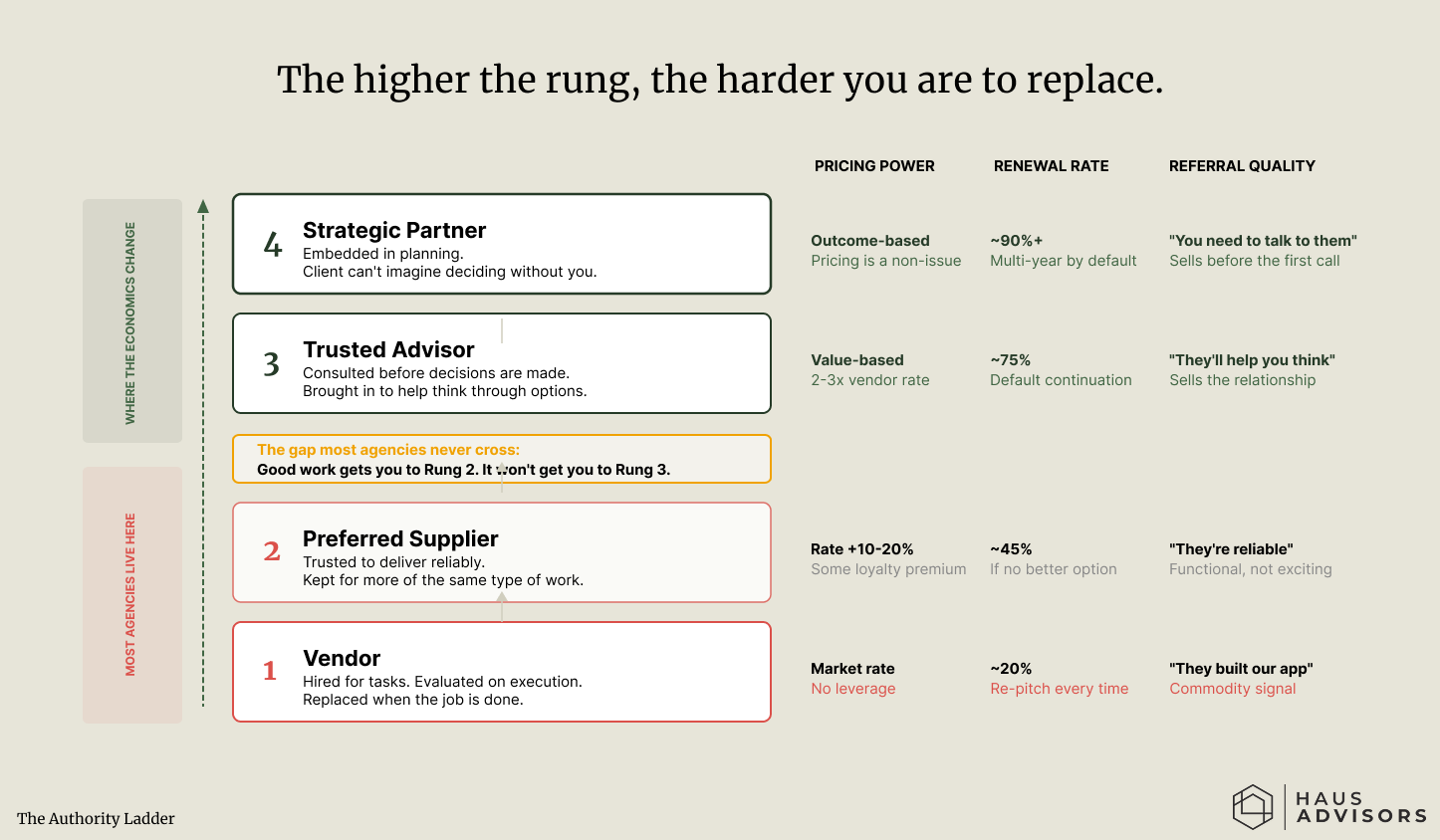
The higher the rung, the harder you are to replace. Most agencies live on rungs 1 and 2, not because of their work, but because of how they frame it.
Why Good Work Keeps You at the Bottom
Here's the thing that catches most founders off guard: the behaviors that get you to rung 2 are the same behaviors that anchor you there. When you consistently deliver what was asked, you signal that you're excellent at receiving instructions. That's rung 2 positioning. It earns you repeat work. It does not earn you a seat at the planning table.
And then the economics diverge sharply. Buyers price vendors differently than advisors. I've watched this play out dozens of times. If a client thinks of you as a build shop, they'll compare you to other build shops. That means rate comparisons, RFP processes, and margin erosion over time.
If a client sees you as a strategic advisor? They stop comparing you. There's no apples-to-apples alternative for someone whose judgment they trust.
Research from Bain on B2B professional services found that clients in "trusted advisor" relationships spend 2–3x more annually than clients in "preferred supplier" relationships, for comparable underlying services. Same work. Different relationship frame.
Every signal you send positions you. A proposal that opens with your technology stack is rung-1 positioning. A case study that highlights delivery speed without mentioning business outcome? That's rung 2. A discovery call that starts with "tell us what you want to build"—rung 1.
You're telling clients where to put you. Honestly, most agencies are accidentally sending the wrong message.
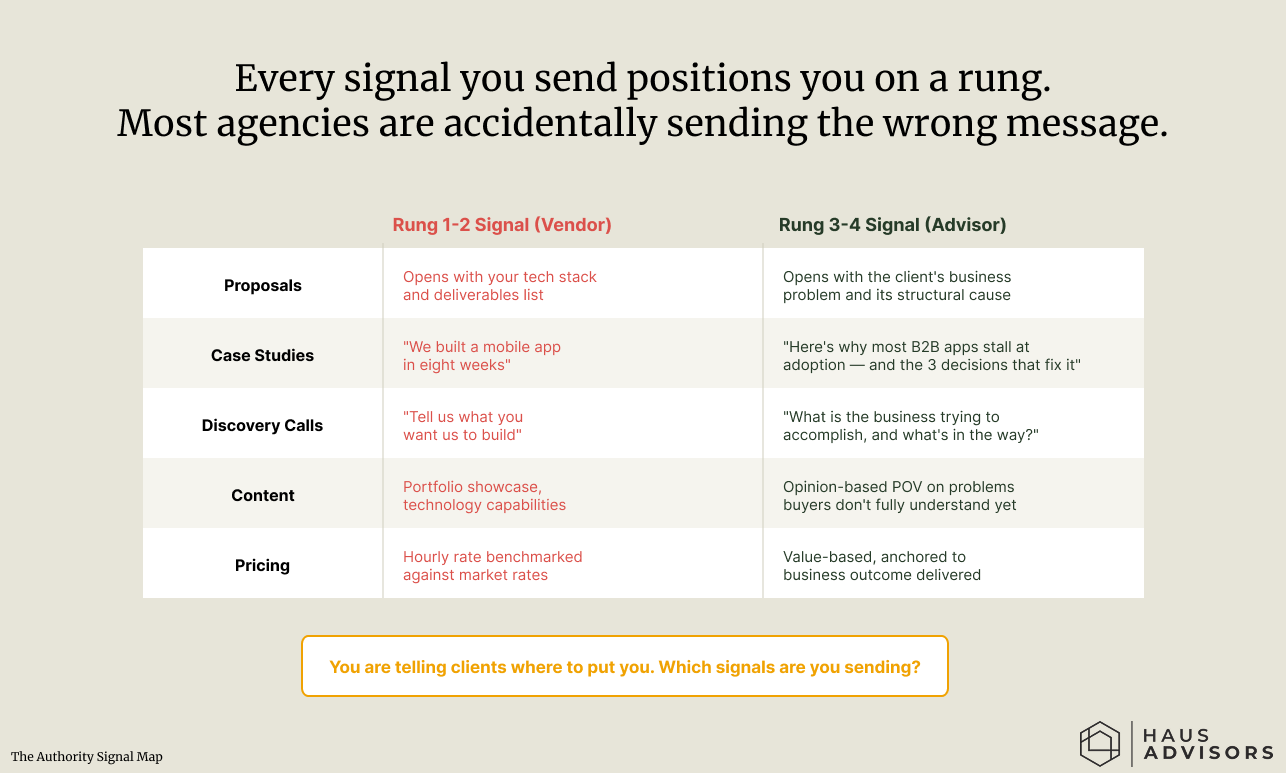
Every signal you send positions you on a rung. Which signals are you sending?
What Staying at Rung 1 or 2 Actually Costs
When clients see you as a vendor, the downstream effects compound faster than most founders realize.
Renewals require pitching. There is no default continuation. Every engagement ends with a reset. You have to re-earn the business, often against competitors, often at lower margins than the original engagement.
Referrals are weak. "They built our platform" is a rung-2 referral. It helps, but it doesn't differentiate you from a dozen other shops with similar portfolios. Compare that to "they helped us rethink our entire client onboarding model and then built the system to run it." The second referral sells the relationship before the first call.
Pricing is always negotiable. At rung 1, pricing is a function of market rates. At rung 3, pricing is a function of value delivered. I've heard from founders that the clients who push back hardest on price are the ones who see the least daylight between you and your competitors.
The aggregate math is rough. Agency average annual churn on project-based relationships runs around 35–45%. If you're generating 40% of your revenue from existing clients, you're losing approximately 15–18% of total revenue each year just to normal relationship decay. And expansion revenue? Expansion only flows from rung 3 and above. It costs 10–15x less to generate than new client revenue.
That founder who lost his long-term client wasn't failing. He was succeeding at rung 2. He was just being replaced when a rung-3 option appeared.
The Three Shifts That Move You Up
Climbing the Authority Ladder isn't about adding new services. It's not about a rebrand. It's about changing how you frame conversations, proposals, and content.
Shift 1: Diagnose before you prescribe.
The most valuable thing a trusted advisor does is define the problem before proposing a solution. Most agencies skip straight to solution because that's where their expertise lives. The problem is that solution-first framing signals that you're a builder waiting for instructions.
In every discovery conversation, the goal should be economic: "What is the current-state cost of this problem?" If you can't put a number on the cost of inaction, you can't justify the investment in action.
The question isn't "what do you want us to build?" The question is "what is the business trying to accomplish, and what is getting in the way?" That reframe alone shifts the dynamic. The client starts explaining their business instead of writing a spec. You start responding with perspective instead of quoting capacity.
That is what rung 3 feels like to a buyer.
Shift 2: Publish your thinking, not just your work.
Case studies that say "we built a mobile app in eight weeks" are rung-2 content. They prove you can deliver. They don't prove you can think.
Content that says "here's why most B2B mobile apps stall at user adoption, and the three decisions made in the first two weeks of a project that determine the outcome"—that's rung-3 content. It shows buyers that you understand the problem at a structural level, not just the technical level.
The Documentation Trap pulls most agencies toward showcasing execution. But buyers looking for a strategic advisor aren't evaluating your execution capability. They assume it. They're evaluating your judgment.
One piece of opinion-based content per month, published consistently, does more for your positioning than a portfolio rebuild. The bar is not high because almost no technical agency does it. Write for buyers, not peers. Lead with the problem, not the solution. Take a position that could be disagreed with. That is the brand of an advisor.
Shift 3: Lead with the path, not the output.
When a client says "we need a new platform," the rung-2 response is "here's our process for building platforms." The rung-3 response is "before we scope this, let's pressure-test whether a new platform is actually the right investment."
That is a sentence almost no agency says. It feels risky to say it because you might lose the deal. In practice, it almost always strengthens the relationship. Buyers remember being told what they needed to hear, not what they wanted to hear.
Same logic applies to proposal structure. A proposal that opens with deliverables is rung-2. A proposal that opens with the client's business problem, explains the structural cause, and then recommends a specific response—that's rung-3. The second proposal closes faster and negotiates less. Because the client is saying yes to a business decision, not a service line.
Two Agencies, Two Rungs, Two Outcomes
There are agencies that win clients by demonstrating what they can build. And there are agencies that win clients by demonstrating that they understand the client's situation better than the client does.
The first group competes on capability. They win deals when their portfolio is strong and their rate is right. They lose clients to whoever makes the next convincing pitch. Their relationships are transactional. Their revenue is unpredictable.
The second group competes on insight. Their clients bring them into planning conversations before scope is written. Their referrals lead with "they'll help you think through the problem." Their retainers renew because clients can't afford to stop having that conversation.
The Authority Ladder is real. Every rung is available to you. The question is whether your positioning, your content, and your client conversations are making clear which rung you're standing on.
One more thing, because I see it on nearly every call: the rung 3 and rung 4 relationships are usually held by the founder personally. The team delivers. You advise. If you want a team that can diagnose before it prescribes, so the agency climbs the ladder without you in every room, that’s what the Relevance Engineering Program is built for. Book a call to see if it’s a fit.
Keep reading
Browse by topic
- Positioning & Strategy
- Lead Gen & Marketing
- Sales & Biz Dev
- Pricing & Productization
- Research & Data
- Operations & Delivery
- Client Retention & Expansion
- Leadership & Culture
For founders whose agency has outgrown referrals.
One idea a week that makes a hard growth problem obvious, usually with a chart that shows you the mechanism behind it.
Built from conversations with seventy-plus agency founders on the Behind the Agency podcast.