Cold Outreach Doesn't Fail Because It's Cold. It Fails Because It's Generic.
A founder I work with hired an outbound agency last year. The pitch was compelling: 5,000 emails per month, a dedicated SDR, personalized sequences, and a guaranteed 15 to 20 meetings per quarter. The agency had testimonials from SaaS companies that had scaled pipeline by 300%.
He ran it for four months. The outbound agency sent 20,000 emails. They booked nine meetings. Of the nine, two were remotely qualified. Neither closed. Total investment: $24K in agency fees plus $8K in tooling. Revenue generated: zero.
His conclusion: "Outbound doesn't work for agencies."
I asked him to show me the emails. The opening line of the main sequence read: "Hi [First Name], I noticed [Company] is growing and might benefit from a technology partner who can help you scale your digital products."
I asked him what specifically his agency did. He said they rebuilt legacy healthcare systems for mid-market hospital networks. They'd done it seven times. They understood HIPAA compliance, HL7 integration, EHR interoperability, and the specific workflow constraints of clinical environments.
None of that was in the email. The outbound agency had stripped every piece of specificity from his positioning and replaced it with a message that could have been sent by any of the 40,000 development agencies in the United States. The emails weren't bad. They were empty. They carried no signal about who this agency was, what specific problem they solved, or why the recipient should care enough to reply.
Twenty thousand emails. Zero signal. Zero revenue. The volume was fine. The content had nothing to amplify.
The Pattern Has a Name
I call it The Volume Fallacy: the belief that outbound success is primarily a function of volume (more emails, more calls, more touchpoints), when for services businesses it's primarily a function of signal quality (relevance, specificity, and demonstrated expertise per message). The Volume Fallacy is the reason agencies spend $20K to $40K on outbound programs that produce nothing, then conclude the channel is broken.
Here's the mechanism. Outbound playbooks are designed for SaaS companies selling products with broad applicability, clear feature sets, and low switching costs. In that context, volume works. If you're selling a $200/month project management tool, one out of every 200 cold emails producing a demo is viable math. The product sells itself in the demo. The sales cycle is short. The numbers work at scale.
Agency services operate on fundamentally different math. The average deal is $75K to $200K. The sales cycle is three to six months. The buyer isn't evaluating features. They're evaluating trust, diagnostic capability, and domain expertise. They're making a high-risk decision with significant financial exposure. No one signs a $150K services engagement because they got a compelling cold email. They sign because they believe this specific agency understands their specific problem better than the alternatives.
Volume-based outbound can't create that belief. A thousand generic emails to a thousand random prospects produces a thousand instances of noise. The recipient scans the subject line, reads the first sentence, recognizes it as a template, and deletes it. Not because they're hostile to cold outreach. Because the email gave them no reason to think this agency is relevant to their situation.
Precision outbound creates that belief by demonstrating relevance before asking for anything. The recipient reads the email and thinks "this person understands the problem I'm dealing with." That reaction doesn't come from personalization tokens or clever subject lines. It comes from specificity: a message that names a problem the recipient actually has, describes a pattern the sender has seen in similar organizations, and offers a perspective the recipient hasn't considered.
Why the SaaS Outbound Playbook Fails for Agencies
I've written about this elsewhere as Framework Mismatch: the structural incompatibility between product-shaped growth tactics and services-shaped businesses. Outbound is the clearest example of the mismatch.
SaaS outbound optimizes for meetings. The goal is to get the prospect into a demo, where the product can sell itself. The email only needs to generate enough curiosity for a 15-minute call. Volume works because the ask is small and the product does the heavy lifting.
Agency outbound needs to build trust. The goal isn't a meeting. It's a relationship with a qualified buyer who believes you understand their problem. The email needs to demonstrate diagnostic expertise, not just generate curiosity. Volume fails because each generic email actively damages trust by signaling that you don't know who the recipient is or what they need.
SaaS outbound can target by firmographic criteria. "Companies with 50-200 employees using Salesforce" is a viable targeting filter for a SaaS product. The product is broadly relevant to that segment.
Agency outbound needs to target by problem. "Companies with 50-200 employees" tells you nothing about whether they need your specific expertise. The right targeting filter for the healthcare agency isn't company size or industry. It's: "mid-market hospital networks currently running legacy patient-facing systems that are creating operational bottlenecks." That's a problem-based filter, and it produces a target list of 200, not 20,000.
SaaS outbound scales linearly. Send twice as many emails, get roughly twice as many demos. The economics stay constant.
Agency outbound scales inversely. Send twice as many emails by broadening your targeting, and the signal quality drops. The emails become more generic to fit the wider audience. Response rates decline faster than volume increases. The economics get worse, not better.
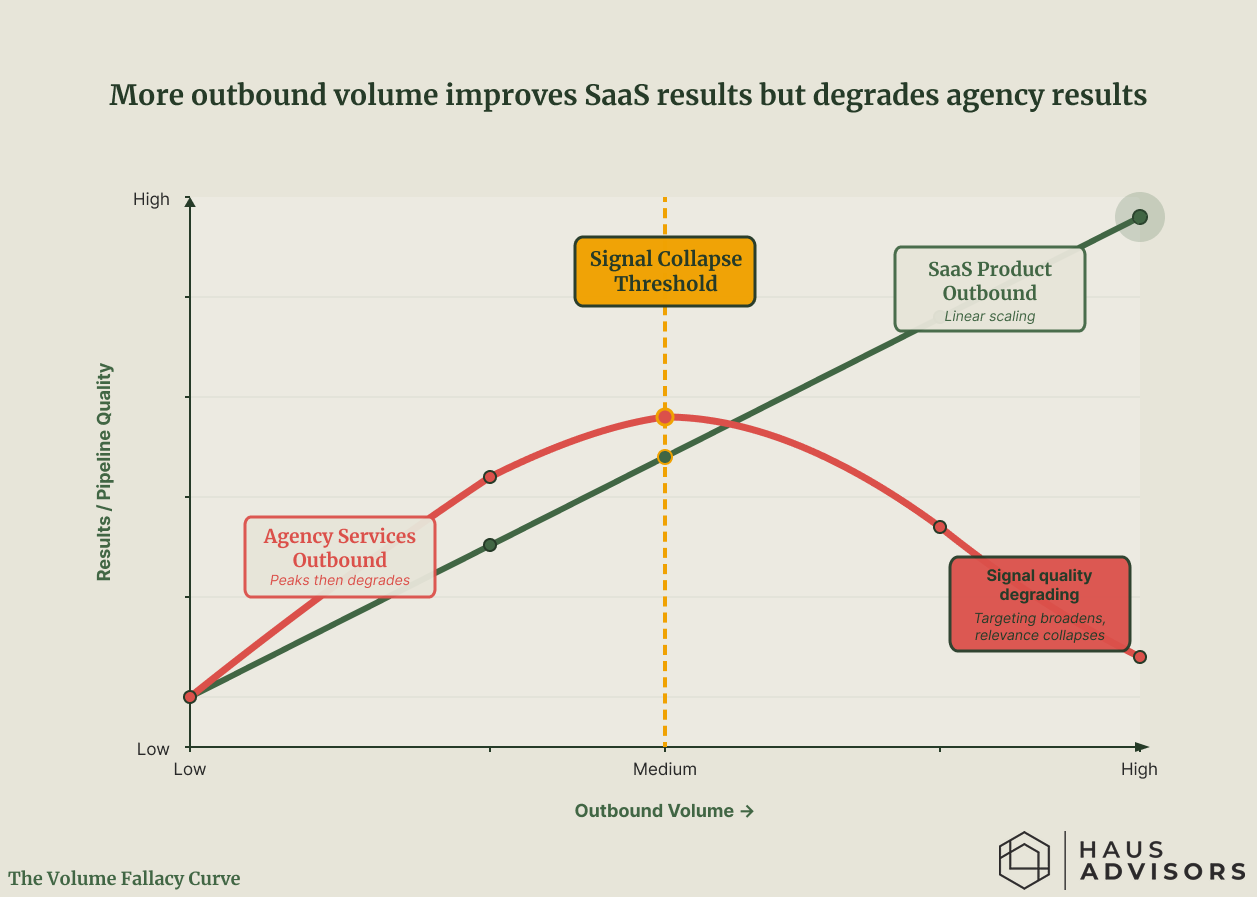
For SaaS products, volume scales linearly. For agency services, volume hits a threshold where every additional email dilutes the signal. Most outbound programs operate well past the collapse point.
What Precision Outbound Actually Looks Like
Precision outbound for agencies reverses the SaaS playbook. Instead of maximizing volume and accepting low conversion, you minimize volume and maximize relevance per message. The target: 10 to 15 highly researched, problem-specific outreach messages per week. Not 500.
Step 1: Build the 50-Person Target List
Your positioning determines your target list. If you rebuild legacy healthcare systems for mid-market hospital networks, the list is: technology decision-makers (VP Engineering, CTO, VP Digital, Director of IT) at hospital networks with 3 to 15 facilities that are currently running legacy patient-facing systems.
Finding these targets requires research, not a purchased list. Signals that indicate the right target:
Job postings. A hospital network posting for a "Digital Transformation Lead" or "EHR Integration Specialist" is signaling investment in exactly the type of work you do.
Technology indicators. Tools like BuiltWith or Wappalyzer reveal the technology stack behind a company's patient portal. A portal running on a 10-year-old CMS is a legacy indicator.
Leadership changes. A new CTO or VP of Digital at a hospital network typically triggers a technology review. The first 90 days of a new technology leader is the highest-probability window for vendor evaluation.
Conference speakers and attendees. Decision-makers presenting at HIMSS or CHIME on topics related to digital transformation are actively thinking about the problem you solve.
Published strategic plans. Many hospital networks publish annual strategic plans that explicitly mention digital transformation priorities. These are public documents that tell you exactly what the organization is investing in.
Building this list takes time. A realistic pace: 5 to 10 new targets per week, researched individually. At that pace, you have a 50-person list in less than three months. The list is small. Every name on it is a real prospect with a real problem you can specifically address.
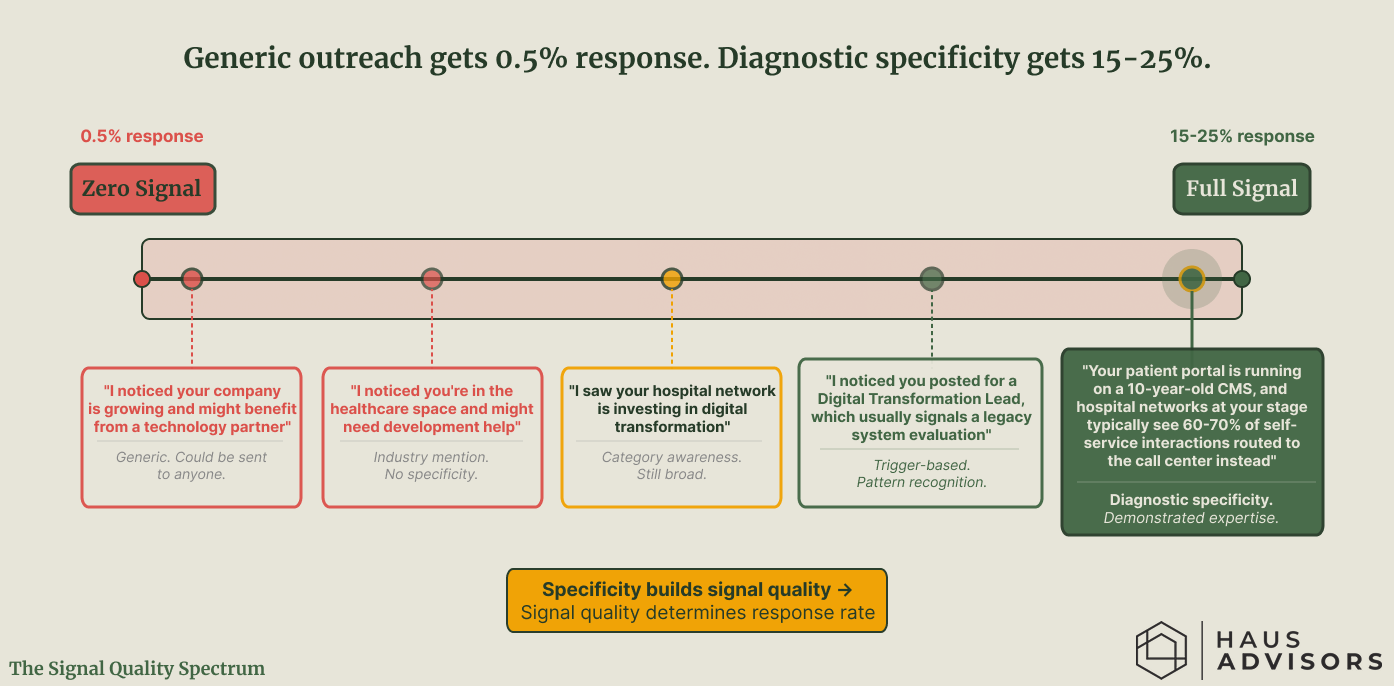
The difference between 0.5% and 25% response rates isn't volume or subject lines. It's how much signal each message carries about the recipient's actual situation.
Step 2: Write the Trigger-Event Email
The email that works for agencies looks nothing like the email that works for SaaS. It's not a pitch. It's a diagnostic observation.
The anatomy of a precision outbound email:
Line 1: The trigger. Reference the specific signal that put this person on your list. Not a generic compliment. A specific observation.
"I noticed [Hospital Network] posted for a Digital Transformation Lead last month, which usually signals a technology evaluation cycle for patient-facing systems."
Line 2-3: The pattern. Describe a pattern you've seen in organizations like theirs. This is where you demonstrate diagnostic expertise without being asked.
"We've worked with seven mid-market hospital networks going through similar transitions, and the challenge that consistently surfaces is that the legacy patient portal was built around clinical workflows rather than patient tasks. The result is usually a support center handling 60-70% of interactions that should be self-service."
Line 4: The value offer. Offer something specific and useful, not a meeting.
"I put together a brief diagnostic framework we use to assess patient portal modernization readiness. It covers the five workflow patterns that typically drive the highest support cost. Happy to share it if it's relevant to what you're evaluating."
Line 5: The low-friction ask.
"Worth a 15-minute conversation, or would you prefer I just send the framework?"
That email is 120 words. It contains zero pitching, zero capability claims, and zero "we're a full-service agency" language. It demonstrates three things: you know what's happening at their organization (the trigger), you've solved this specific problem before (the pattern), and you can provide value before they commit to anything (the framework offer).
The response rate on this type of email, sent to a well-researched target, is 15% to 25%. Compare that to the 0.5% to 1% response rate on volume-based generic outreach. Fifteen emails like this per week produces two to four conversations. Fifty weeks of that cadence produces 100 to 200 conversations per year from a 200-person target list. That's a pipeline.
Step 3: The Follow-Up Sequence (Three Touches, Not Twelve)
Volume outbound uses 8- to 12-touch sequences because each individual touch has near-zero probability of response. The math only works through repetition.
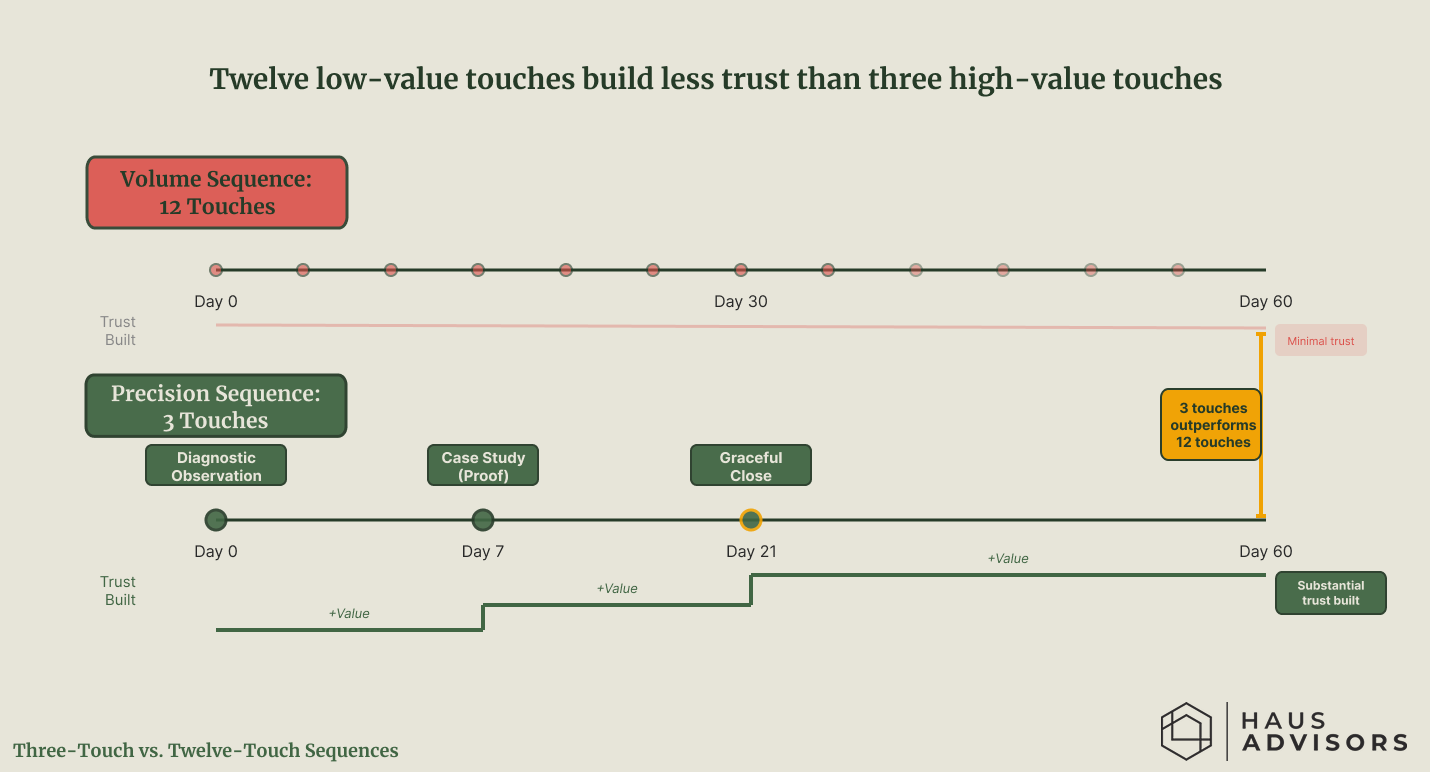
Twelve low-signal touches build less trust than three high-signal ones. More follow-ups don't fix an empty first message.
Precision outbound uses three touches because each touch carries real signal. More than three touches on a highly specific email crosses from persistence into noise.
Touch 1 (Day 0): The trigger-event email described above.
Touch 2 (Day 7): The case study share. If no response, send the relevant diagnostic case study. "I wanted to share a case study from our work with [similar hospital network]. They were dealing with [specific problem] and we helped them reduce [specific metric] by [specific amount]. Thought it might be relevant to what you're evaluating." No ask. Just value.
Touch 3 (Day 21): The graceful close. "I know timing is everything. If patient portal modernization isn't on your radar right now, no worries at all. I'll keep publishing our healthcare infrastructure research, and you're welcome to follow along if it's useful down the road. If the timing does line up, I'm here."
Three touches. Each one provides value (diagnostic framework, case study, ongoing research). None of them pitch. The prospect who doesn't respond after three high-value touches isn't ignoring you because you didn't email enough times. They're either not in-market or your specific expertise isn't relevant to their current priorities. Both are fine. Move to the next target.
Step 4: The Weekly Rhythm
Precision outbound works as an operating rhythm, not a campaign. The cadence:
Monday: Research. Identify 3 to 5 new targets using the signal-based criteria. Add them to the list. Research their organization, their technology, and the specific trigger that makes them relevant.
Tuesday-Wednesday: First touches. Send 10 to 15 trigger-event emails to new and existing targets.
Thursday: Follow-ups. Send Touch 2 and Touch 3 messages to targets on their scheduled follow-up days.
Friday: Pipeline review. Review responses, schedule conversations, update the target list with new signals.
Total time investment: 5 to 8 hours per week. That's less time than most founders spend on scattered LinkedIn posting, conference attendance, and unstructured networking combined. And unlike those activities, this rhythm produces measurable pipeline with attributable results.
The Content That Makes Outbound Work
Precision outbound requires an asset to offer. The "diagnostic framework" or "case study" referenced in the emails has to exist. You can't offer a patient portal modernization readiness assessment if you haven't built one.
This is where outbound connects to publishing, which is the lever I'd pull right before it. The content you publish isn't just for inbound traffic. It's ammunition for outbound. Every diagnostic article, every case study, every framework document you create is an asset you can deploy in a precision email.
The minimum viable outbound content library:
One diagnostic framework relevant to your positioning. A self-assessment, a readiness checklist, a decision matrix. Something the prospect can use independently that demonstrates your expertise. This is the "offer" in your first-touch email.
Two to three diagnostic case studies that demonstrate outcomes for organizations similar to your targets. These are the assets for your second-touch email.
One piece of ongoing research or analysis (a quarterly newsletter, a published benchmark, an industry analysis) that gives you a reason to stay in touch with prospects who aren't ready now but might be in six months. This is what your third-touch email references.
If you don't have these assets yet, build them before launching outbound. Outbound without content is the Prerequisite Gap applied to a specific channel: the tactic is correct, the inputs it requires don't exist yet.
Outbound + Inbound: The Compound Effect
Precision outbound works best when it compounds with inbound activity. The mechanics:
A prospect receives your trigger-event email. They don't reply immediately, but the email was specific enough that they remember your name. Two weeks later, they search for "patient portal modernization" and your article appears. They read it. The article confirms the expertise the email suggested. They click to your website. The website confirms the positioning. They book a call.
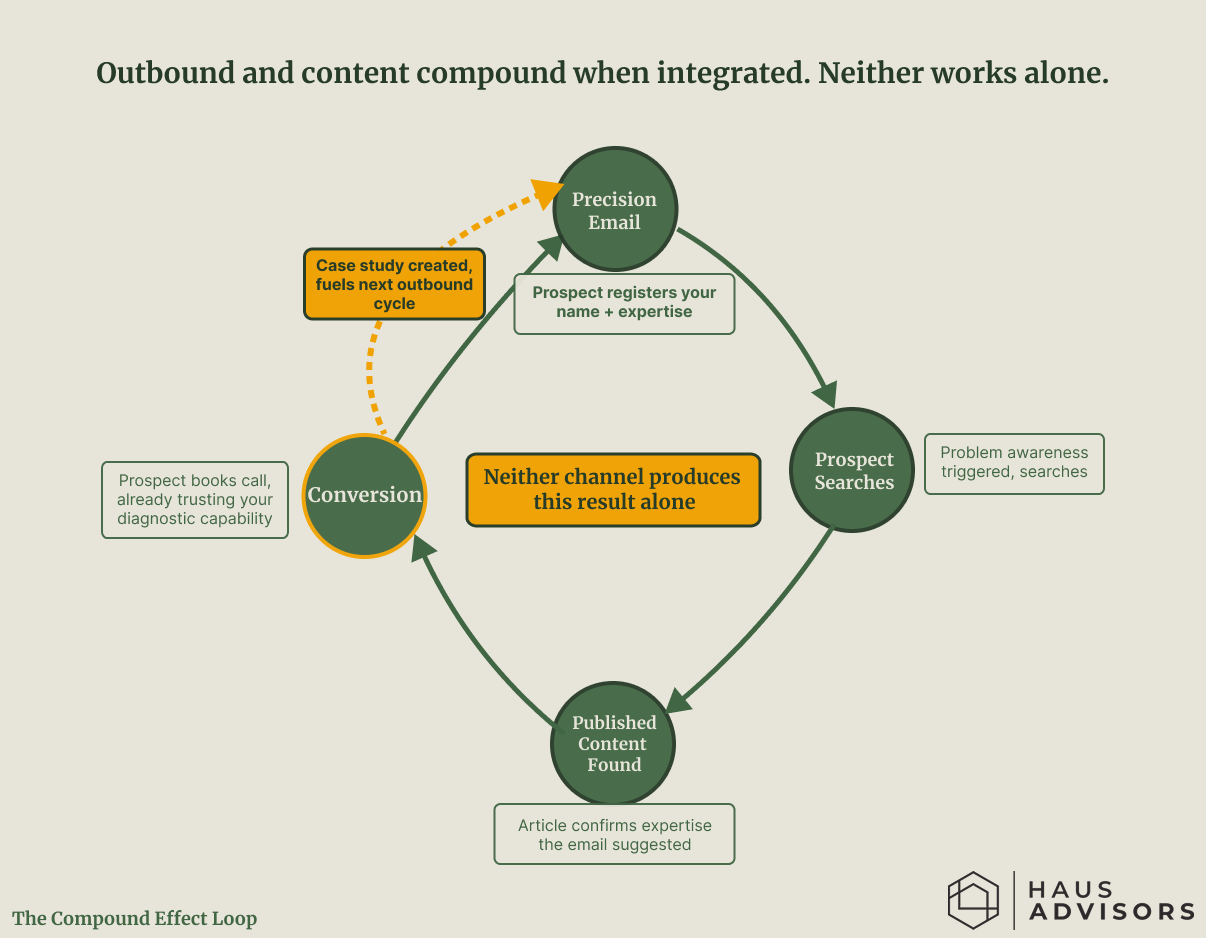
The prospect thinks they found you through search. The outbound email is what made your search result click-worthy. Precision outbound and published content compound each other in a loop that volume outbound can never enter.
In their mind, they found you through search. In reality, the outbound email primed the recognition that made the search result click-worthy. Without the email, they might have scrolled past your article. Without the article, the email might not have converted. Together, the two channels produce a result neither could produce alone.
This compound effect is why precision outbound at 15 emails per week outperforms volume outbound at 5,000 emails per month. The 15 emails are targeted at people who are likely to encounter your content through other channels. Each touchpoint reinforces the others. The 5,000 emails are scattered across people who will never see your content, never visit your website, and never think about your agency again.
Measuring What Matters
Volume outbound measures vanity metrics: emails sent, open rates, reply rates. These metrics optimize for volume. More emails sent, better subject lines for opens, more aggressive CTAs for replies.
Precision outbound measures pipeline metrics: conversations started, qualification rate, proposals sent, revenue generated. These metrics optimize for relevance. Better targeting, more specific messaging, higher-value conversations.
Conversations per week. At 10 to 15 first-touch emails per week with a 15% to 25% response rate, you should generate 2 to 4 new conversations per week. If conversations are below this range, the targeting or the messaging needs refinement. The volume doesn't need to increase.
Qualification rate. What percentage of conversations are with genuine prospects who have the problem you solve, the budget to address it, and the authority to make a decision? Precision outbound should produce a 50%+ qualification rate. If it's below 30%, your targeting criteria are too broad.
Pipeline attribution. Track which closed deals had outbound as a touchpoint anywhere in the buyer's journey, including the compound effect (outbound touch followed by inbound conversion). Most agencies that run precision outbound find that 30% to 40% of closed deals had at least one outbound touchpoint, even when the prospect ultimately converted through a different channel.
The Honest Objection
Here's the strongest argument against precision outbound: it doesn't scale. Fifteen emails per week is a fraction of what automated outbound can produce. If the agency needs to fill a large pipeline gap quickly, the careful research and personalization of precision outbound feels too slow. Volume outbound, even at low conversion rates, might produce more absolute meetings through sheer quantity.
That's a fair concern about speed. Precision outbound is not an emergency pipeline fix.
Where That Logic Hits a Wall
But the volume alternative doesn't actually fix the emergency either. Twenty thousand generic emails producing nine meetings and zero revenue (the founder's actual experience) isn't filling the pipeline gap. It's spending $32K to produce the illusion of pipeline activity. The meetings are unqualified. The conversations are generic. The prospects aren't evaluating you as a specialist. They're evaluating you as one more cold emailer who showed up in their inbox.
Precision outbound at 15 emails per week produces fewer conversations, but the conversations it produces are with people who have the specific problem you solve, who have already received evidence of your expertise, and who are predisposed to view you as a specialist rather than a commodity. The close rate on these conversations is 20% to 30%, compared to 2% to 5% on volume-sourced meetings.
The math: 15 precision emails per week × 20% response rate × 50% qualification rate × 25% close rate = roughly 1 closed deal per month from outbound alone. At $100K average deal value, that's $1.2M per year from 8 hours per week of research and outreach.
The volume alternative: 5,000 emails per month × 0.5% response rate × 20% qualification rate × 5% close rate = roughly 0.25 deals per month. At $100K average deal value, that's $300K per year from $40K+ in outbound agency fees and tooling.
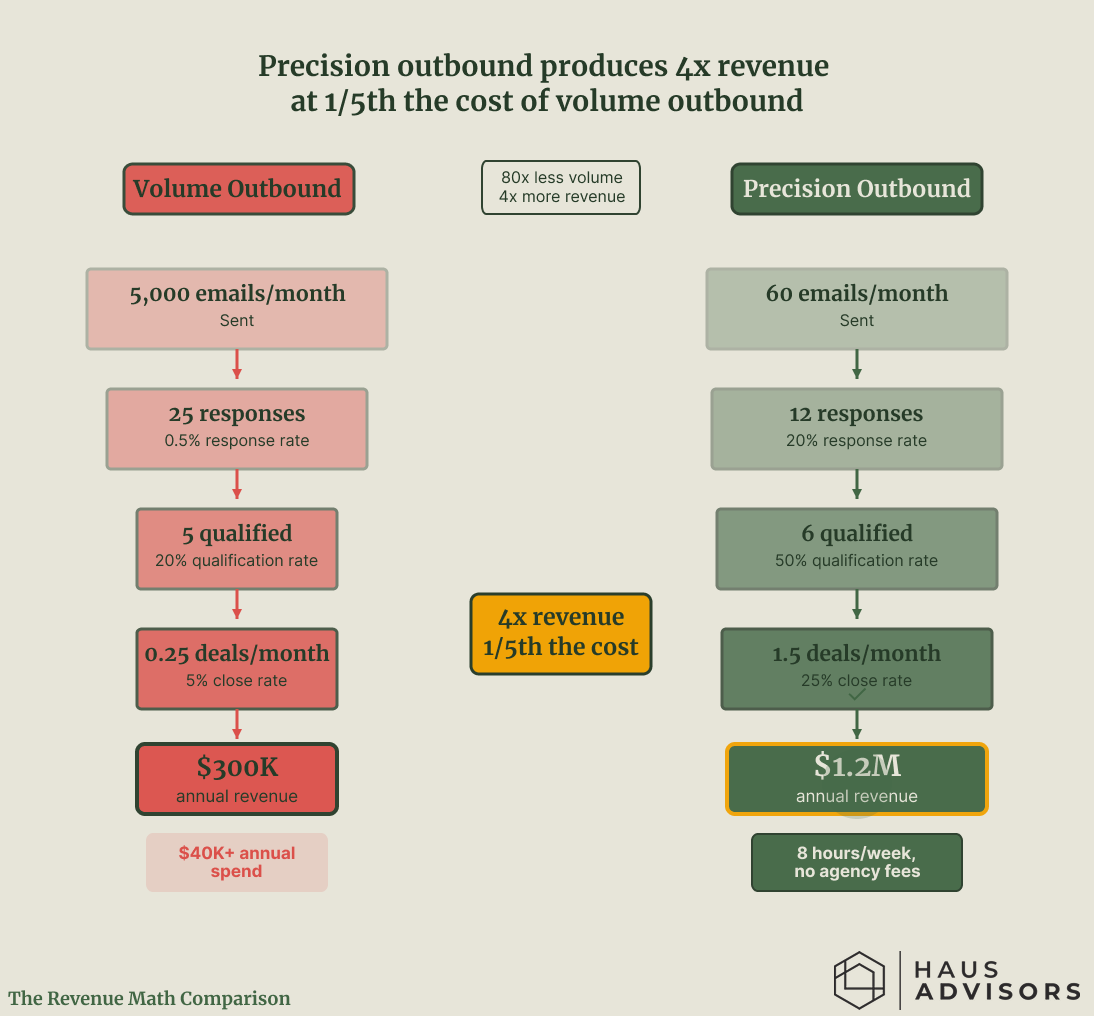
Sixty emails per month at high relevance outperform five thousand emails per month at low relevance by a factor of four. The math doesn't reward volume. It rewards signal.
Precision produces 4x the revenue at a fraction of the cost. It's slower to start (the first month is mostly list-building and research). But by month three, the pipeline is producing at a rate volume outbound never reaches, because every conversation starts at a higher level of trust and relevance.
The Next Step
You don't need to hire an outbound agency or buy a 50,000-person prospect list. You need to send one precision email to one researched target and see what happens.
Start here: identify one company that fits your positioning criteria. Research them for 20 minutes. Find the trigger event (a job posting, a leadership change, a published strategic priority, a technology signal). Identify the decision-maker. Write the email using the four-part anatomy: trigger, pattern, value offer, low-friction ask.
Send it. See if the response is different from what you've experienced with generic outreach.
If it is (and in most cases, the difference is immediate and obvious), you've found the rhythm. Ten to fifteen of these per week, compounding with your published content and partnership activity, produces a pipeline that doesn't depend on referrals, doesn't require volume spam, and gets better over time as your target list deepens and your content library grows.
The outbound channel isn't broken. The signal that most agencies push through it is empty. Fill the signal with diagnostic specificity and the channel works.
The principle is simple:
There are agencies that send more emails to fix outbound, and there are agencies that send better emails to fix outbound.
The first group optimizes for volume and measures open rates. The second group optimizes for relevance and measures closed deals.
Most founders reading this already know the real problem. It isn't the email volume. It's that the pattern language that tells a researcher which 15 companies to pick and a writer what to say to them, along with the reputation and the relationships that make your agency worth hiring, still lives in your head. So the rhythm only runs when you run it, and the business only grows when you're in the room.
That's the work we do at Haus Advisors. The New-Business Engine is six months of implementation, not a strategy document. We pull what makes your agency relevant out of your head, build it into positioning, offers, and growth plays your team can run, and hand ownership to them. If you want an agency that grows without needing you in every deal, book a call to see if it's a fit.
Keep reading
Browse by topic
- Positioning & Strategy
- Lead Gen & Marketing
- Sales & Biz Dev
- Pricing & Productization
- Research & Data
- Operations & Delivery
- Client Retention & Expansion
- Leadership & Culture
For founders whose agency has outgrown referrals.
One idea a week that makes a hard growth problem obvious, usually with a chart that shows you the mechanism behind it.
Built from conversations with seventy-plus agency founders on the Behind the Agency podcast.