Your Growth Budget Isn't Too Small. It's Pointed in the Wrong Direction.
I was on a call last week with a fractional CFO who also works with dev agencies. He told me that the question he hears more than any other is some version of "where is the best place to put my growth dollars?"
He said the answers are always the same. Should I run ads? Should I hire a salesperson? Should I invest in content marketing? Should I sponsor events?
But the thing that struck him, and strikes me, is that founders ask this question like they're picking a channel. Like growth is a vending machine and the only decision is which button to press.
It isn't. And the reason most agencies waste their growth dollars has nothing to do with which channel they pick. It has to do with the order in which they invest.
The Number That Should Bother You
The average digital agency spends about 7% of its revenue on sales and marketing. That includes salaries, tools, media spend, everything. For context, the SBA recommends companies under $5M spend 7 to 8 percent of revenue on marketing alone, and B2B services firms average closer to 9 percent.
Seven percent isn't aggressive. For most agencies at $1M to $3M, it's barely maintenance. An agency doing $2M in revenue at 7% is spending $140K a year on everything related to generating new business. That's roughly one full-time marketing hire with no budget left for tools, ads, content production, or events.
This matters because the data is clear: agencies that want to grow faster than 15 to 20 percent per year need to be spending closer to 10 percent of revenue on marketing. Agencies targeting 30 percent or higher growth are spending 20 percent or more. The gap between what most agencies spend and what fast-growing agencies spend is not marginal. It's a multiple.
So the first problem is volume. Most agencies under-invest in their own growth.
But the second problem is worse.
The Allocation Inversion
When agencies do decide to invest in growth, they almost always start with demand generation. Paid ads. Outbound campaigns. Event sponsorships. A salesperson. Sometimes all four at once.
This makes intuitive sense. You need leads. You need pipeline. The fastest way to get both feels like putting money into the top of the funnel and turning it on.
I call this The Allocation Inversion. It's the pattern of investing in generating demand before building the system that makes demand convertible.
Here's what it looks like in practice. A founder decides to "get serious about marketing." They hire a marketing person or an agency. That person starts running LinkedIn ads, writing blog posts, or building an outbound list. Traffic goes up. Maybe a few leads come in. But the close rate is terrible. The leads don't convert. The founder concludes that "marketing doesn't work for us" and goes back to relying on referrals.
The problem wasn't the channel. The problem was the sequence.
Why the Sequence Matters
Think about what happens when a prospect arrives at your agency through any non-referral channel. They don't have the context that a referred prospect has. Nobody told them you're great. Nobody vouched for your work. They're evaluating you cold.
When that prospect hits your website, reads your content, or gets on a call with you, they're looking for signals. They want to know: Do these people understand my specific problem? Have they solved it before? Can they articulate what makes their approach different?
If you haven't done the positioning work, every one of those signals is weak or absent. Your website says you "build custom software for growing companies." Your case studies describe the technical stack but not the business outcome. Your sales conversation is a capabilities walkthrough instead of a diagnostic conversation.
The demand generation worked. It got someone to your door. But the door opened into a room that looked like every other agency's room. So they left.
This is why the order matters. Demand generation amplifies whatever is already there. If what's already there is a clear, differentiated position with proof and a defined sales process, demand generation compounds it. If what's already there is a generic message and a capabilities deck, demand generation just burns money faster.
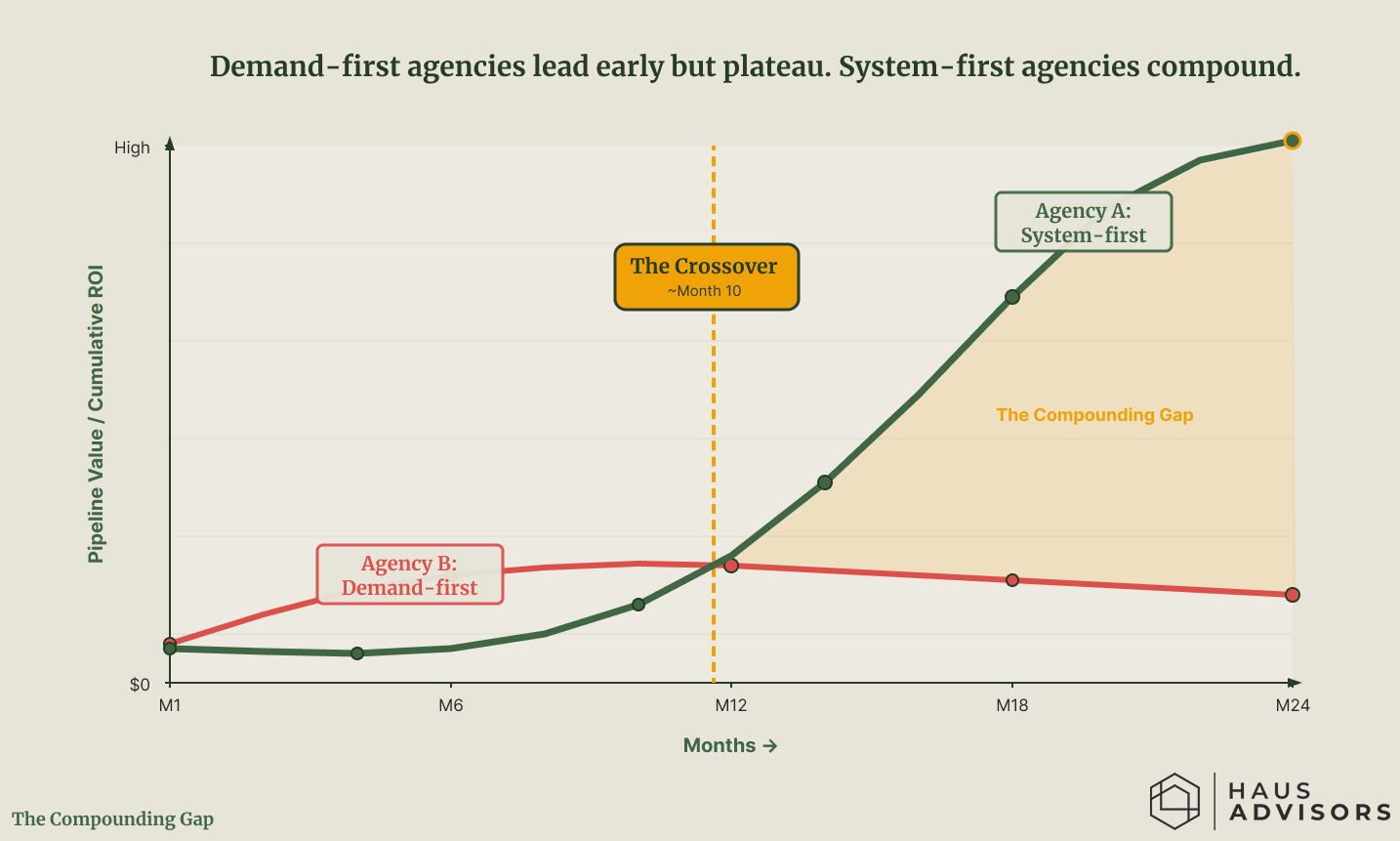
The Compounding Gap. Both agencies invest the same total dollars over 24 months. Agency B (demand-first) generates activity faster but hits a ceiling when the underlying system can't convert. Agency A (system-first) appears slower at first but compounds because every dollar of demand generation lands on a positioned, productized, published foundation.
The Investment Sequence
Here's where the CFO question gets a real answer. The best place to put your growth dollars depends entirely on where you are in the sequence. And the sequence maps to five layers, each one building on the last.
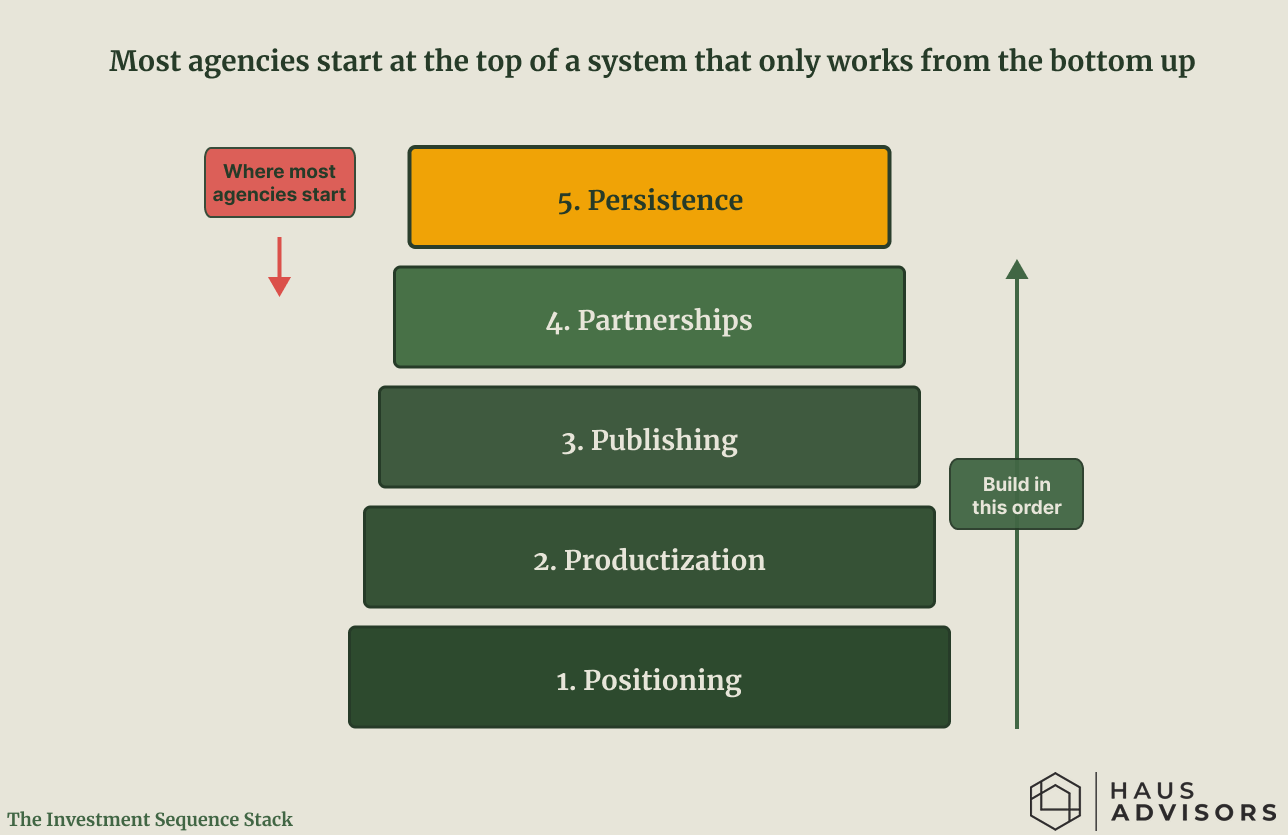
The Investment Sequence. Each layer compounds the one above it. Persistence (demand generation, ads, outbound) is the most visible layer and the one founders invest in first. But its ROI is determined by the four layers underneath it. Build from the bottom.
Layer 1: Positioning. This is the foundation. Before you spend a dollar on demand, you need a clear answer to who you serve, what specific problem you solve, and why your approach is different. Not different in the "we care more" sense. Different in the structural, "here's why our methodology produces a better outcome for this type of company" sense. This is the cheapest layer to invest in. It's mostly thinking, research, and decision-making. But it's the layer most agencies skip because it feels like it's not "doing marketing."
Layer 2: Productization. Once you know who you serve and what you solve, you need to package your expertise into something a prospect can evaluate without a 90-minute discovery call. This doesn't mean turning your agency into a product company. It means creating named offerings, defined scopes, and clear outcomes that make your expertise tangible. A productized diagnostic. A defined engagement model. A framework your prospects can see and understand before they buy. This layer costs more than positioning but less than demand generation. It's the layer that determines whether your sales conversations end with "let me think about it" or "when can we start?"
Layer 3: Publishing. Now you have something worth talking about. Publishing means creating content that demonstrates your positioning and productized expertise to the market. Blog posts that diagnose specific problems your ICP faces. Case studies that show outcomes, not just deliverables. Podcast episodes that prove you understand the landscape. This is where most agencies start, which is why most agency content is generic. If you publish before you position and productize, you have nothing distinctive to say. If you publish after, every piece of content reinforces a clear, differentiated message.
Layer 4: Partnerships. Once your positioning is clear and your content demonstrates your expertise, you become referrable in a way you weren't before. Not "they do good work" referrable. "They're the people who solve X for Y companies" referrable. This layer is about building strategic relationships with people who serve the same audience but don't compete with you. Fractional CTOs, CFOs, management consultants, adjacent service providers. Partnerships are force multipliers, but only when your positioning gives partners a specific reason and specific language to refer you.
Layer 5: Persistence. This is where demand generation finally belongs. Paid ads. Outbound. Events. SEO campaigns. All of the channels that founders want to invest in first. They work now because every other layer is in place. Your ads drive traffic to a site with a clear position. Your outbound messages reference a specific problem you solve. Your event conversations lead to a defined next step. The ROI on persistence is dramatically higher when it sits on top of the other four layers than when it's the only layer.
"But I Need Leads Now"
I hear this constantly. And I understand the urgency. When your pipeline is thin and you're three months from a cash crunch, "invest in positioning" sounds like telling a hungry person to learn agriculture.
Here's what I'd say to that. First, if you're in a genuine cash emergency, the fastest path to revenue isn't demand generation anyway. It's working your existing network and past clients harder. That's free and it's fast.
Second, the first three layers of the sequence don't take as long as people think. A focused positioning sprint takes weeks, not months. Productizing your first offering takes days once the positioning is clear. Publishing your first three to five pieces of proof content takes a month. You're not signing up for a year-long rebrand. You're building the minimum infrastructure that makes every dollar of demand generation actually convert.
Third, and this is the part most people miss. The reason you need leads "right now" is almost always because you didn't build this system earlier. The urgency itself is a symptom of the Allocation Inversion. Agencies that invest in the sequence don't have pipeline emergencies because the system generates opportunities continuously, not in bursts.
The Audit That Reveals Everything
Pull up your last 12 months of growth spending. Every dollar. Marketing hires, tools, agencies, ads, events, sponsorships, content production, sales commissions. All of it.
Now sort it into two buckets.
System Spending: Anything that improved your positioning, productized your offerings, created proof content, or built partnership infrastructure. Work that compounds over time regardless of whether you're actively running campaigns.
Demand Spending: Anything that generated direct inbound or outbound activity. Ads, events, outbound tools, sales salaries, sponsorships. Work that produces results only while the spend continues.
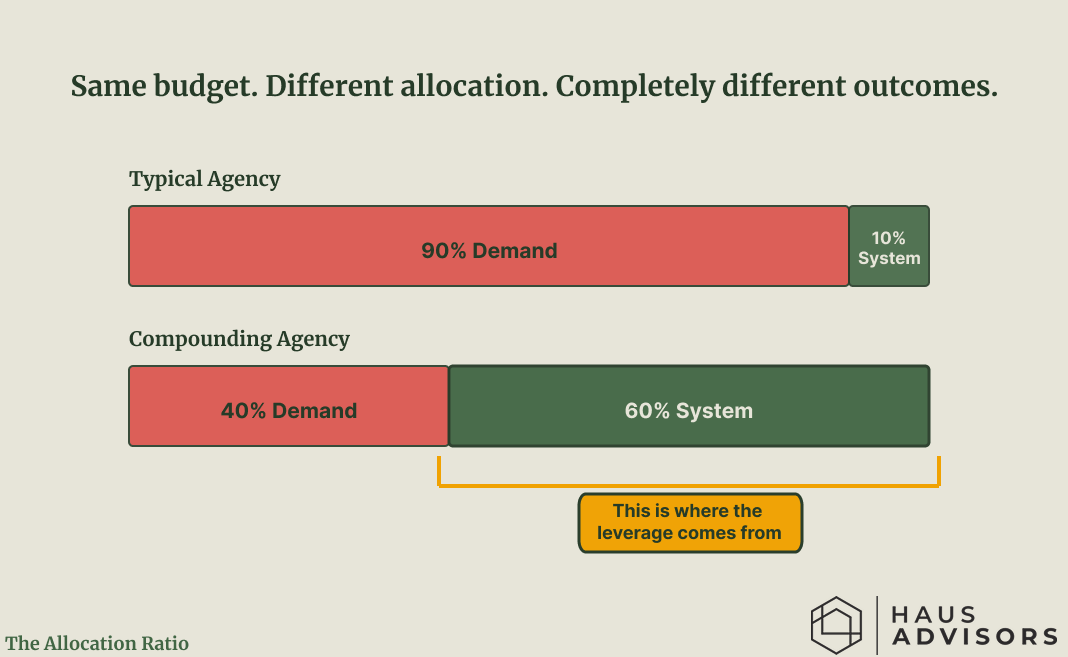
The Allocation Ratio. Both agencies spend the same total dollars on growth. The typical agency puts 90% into demand generation and 10% into system building. The compounding agency inverts the ratio. The difference isn't how much they spend. It's what they spend it on.
Most agencies I work with discover their ratio is somewhere around 90/10 in favor of demand spending. Some are even more extreme. They've been pouring money into generating attention while the system that converts attention into revenue barely exists.
A healthier ratio for an agency at $1M to $3M that's trying to build sustainable pipeline: closer to 60/40 in favor of system spending. Eventually, as your system matures, you can shift more toward demand. But most agencies never get there because they start with demand and never build the system.
The Principle
There are two kinds of growth investments. The kind that compounds and the kind that depletes. Demand spending without system spending depletes. It burns budget, produces disappointing results, and convinces founders that marketing doesn't work for agencies.
System spending compounds. Every dollar you invest in positioning, productization, publishing, and partnerships makes every future dollar of demand generation more effective.
The question isn't "where should I put my growth dollars?" The question is "have I built the system that makes growth dollars work?"
Data Sources Referenced:
Promethean Research 2025 Digital Agency Industry Report: average digital agency invests 7.1% of revenue in sales and marketing
SBA: companies under $5M should spend 7-8% of revenue on marketing
CMO Survey 2025: B2B services firms spend ~9% of revenue on marketing
Sakas & Company: agencies targeting 30%+ growth spend 20%+ of revenue on marketing; 15-20% growth targets require ~10%
Keep reading
Browse by topic
- Positioning & Strategy
- Lead Gen & Marketing
- Sales & Biz Dev
- Pricing & Productization
- Research & Data
- Operations & Delivery
- Client Retention & Expansion
- Leadership & Culture
For founders whose agency has outgrown referrals.
One idea a week that makes a hard growth problem obvious, usually with a chart that shows you the mechanism behind it.
Built from conversations with seventy-plus agency founders on the Behind the Agency podcast.