AI Outreach Statistics You Need to Know in 2026
AI has made it easier than ever to send more outreach. Whether it leads to more pipeline is a different question. This page compiles the most-cited statistics on AI sales outreach (reply rates, personalization impact, buyer trust, and revenue results) sourced from primary research by Gartner, Salesforce, HubSpot, McKinsey, and 20+ other named organizations. Updated June 2026.
Key AI Outreach Statistics (2026)
The headline numbers from across all six sections below.
The average cold email response rate is 5.1% — with most campaigns falling between 1% and 5%. (Source: Belkins Cold Outreach Benchmarks, 2025)
Advanced personalization doubles reply rates — 18% for highly personalized outreach vs. 9% for generic emails. (Source: Sopro State of Prospecting, 2026)
AI usage among sales reps rose 79% year-over-year — from 24% in 2023 to 43% in 2024. (Source: HubSpot State of Sales, 2025)
57% of B2B decision-makers say most sales outreach feels impersonal and irrelevant — even as AI outreach volume rises. (Source: Sopro State of Prospecting, 2026)
Sellers who effectively partner with AI are 3.7x more likely to hit quota than those who don't. (Source: Gartner, 2025–2026)
The average cold email conversion rate is 0.2153% — one deal closed per 464 emails sent. (Source: Focus Digital, 2024)
Gartner projects 95% of seller research workflows will begin with AI by 2027 — up from less than 20% in 2024. (Source: Gartner, 2025)
Only 40–52% of recipients viewed AI-assisted messages as sincere — vs. 83% for low-AI messages. (Source: University of Florida / USC, International Journal of Business Communication, 2025)
Reply Rates & Volume Benchmarks
What real data shows about outreach volume, cadence, and the reply rates teams actually achieve.
A 2-email sequence with one follow-up generates the highest response rate at 6.9% — adding more emails beyond that reduces it.— Belkins Cold Outreach Benchmarks, 2025
The average cold email response rate is 5.1%, with most campaigns falling between 1% and 5%. (Source: Belkins, 2025)
The average B2B cold email open rate is 27.7% in 2026, up from 16.6% in 2019 — driven largely by Apple Mail Privacy Protection inflating open tracking. (Source: Snov.io analysis of 10M+ emails, 2026)
Response rates vary sharply by audience: HR specialists reply at 8.5%, C-level professionals at 4.2%, and non-C-level executives at 5.6%. (Source: Belkins, 2025)
Legal services companies achieve the highest industry cold email response rate, reaching up to 10%. (Source: Belkins, 2025)
Smaller lists consistently outperform larger blasts: sequences sent to fewer than 100 recipients drive up to a 5.5% reply rate. (Source: Belkins, 2025)
Campaigns targeting 50 or fewer recipients average a 5.8% response rate, versus 2.1% for campaigns over 100 recipients. (Source: Belkins, 2025)
Cold email response rates can increase by nearly 49% after one follow-up. The second email in a sequence consistently outperforms the first. (Source: QuickMail, 2025)
Disabling open tracking increased reply rates from 1.08% to 2.36% in an analysis of 44M+ emails — open-tracking pixels appear to trigger spam filters. (Source: Snov.io, 2025)
LinkedIn outreach delivers roughly double the response rate of cold email — approximately 10% vs. 5%. (Source: Sopro State of Prospecting, 151M outreach data points, 2026)
61% of B2B decision-makers still prefer email as the primary channel for outreach, ahead of LinkedIn, phone, and social. (Source: Snov.io, 2026)
Cold Email Response Rate by List Size

Source: Belkins Cold Outreach Benchmarks, 2025
Personalization Impact on Outreach Results
The evidence on what personalization actually does to reply rates, open rates, and revenue — and how few teams fully apply it.
“Highly personalized campaigns using multiple custom fields boost replies by 142% compared to non-personalized outreach — yet only 5% of teams personalize every email.”
Advanced personalization increases cold email response rates to 18%, compared to 9% for generic emails. (Source: Sopro State of Prospecting, 2026)
Personalized cold emails generate a 32% higher response rate than non-personalized messages. (Source: Sopro State of Prospecting, 2026)
Personalized subject lines achieved a 20.79% open rate, compared to 14.96% for generic subject lines. (Source: Snov.io analysis of 10M+ emails, 2026)
Personalized campaigns generated stronger click rates (1.80% vs. 0.82%) and reply rates (0.58% vs. 0.42%) across the board. (Source: Snov.io, 2026)
Personalization within emails generates six times higher transaction rates compared to unpersonalized messages. (Source: McKinsey & Company, 2024)
80% of people are more likely to make a purchase from a personalized email than a generic one. (Source: Epsilon, 2024)
Personalized emails increase open rates by 26%. (Source: Campaign Monitor, 2024)
Signal-based personalization — a specific trigger event plus a relevant value proposition — achieves 15–25% reply rates, versus the 3–5% industry average for cold email. (Source: Instantly.ai 2026 benchmarks; Belkins 2025)
89% of sales teams see a positive ROI when using personalization in cold email campaigns. (Source: Sopro State of Prospecting, 2026)
51% of teams use segment-based personalization; only 5% personalize every individual email. (Source: Sopro State of Prospecting, 2026)
57% of sales and marketing decision-makers say most outreach feels impersonal and irrelevant — a gap the AI volume wave is widening, not closing. (Source: Sopro State of Prospecting, 2026)
79% of consumers say they will only engage with an offer email if it reflects previous interactions with the brand. (Source: Marketo, 2024)
AI Adoption in Sales Outreach
How fast AI is entering the sales workflow — and how teams are actually using it.
“81% of sales teams are either experimenting with or have fully implemented AI — up from roughly 50% just two years ago.”
AI usage among sales reps rose from 24% in 2023 to 43% in 2024 — a 79% year-over-year increase. (Source: HubSpot State of Sales, 2025)
56% of sales professionals now use AI daily, and daily AI users are twice as likely to exceed their sales targets. (Source: LinkedIn State of Sales, 2024–2025)
Only 19% of sales reps use AI features built into their sales tools; the majority rely on general-purpose chatbots instead. (Source: HubSpot State of Sales, 2025)
64% of reps save 1–5 hours per week through AI automation; sellers using AI for prospect research save an average of 1.5 hours per week. (Source: HubSpot State of Sales, 2025)
83% of sales teams using AI report revenue growth in the same period. (Source: Salesforce State of Sales, 2024)
The top AI use cases in email marketing are content personalization (50%), retargeting (47%), and subject line optimization (47%). (Source: Mailbutler, cited in Forbes Advisor, 2024)
47% of email marketers say they use AI when creating email campaigns. (Source: Litmus, cited in Forbes Advisor, 2024)
Among small businesses with 10–100 employees, AI adoption in sales and marketing jumped from 47% to 68% between 2024 and 2025. (Source: Thryv, 2025)
91% of SMBs using AI report it boosts revenue, and 90% say it makes operations more efficient. (Source: Salesforce SMB Trends Report, 2024)
58% of small business AI users save more than 20 hours per month through automation. (Source: Thryv, 2025)
AI Adoption Among Sales Reps: 2023 vs. 2024
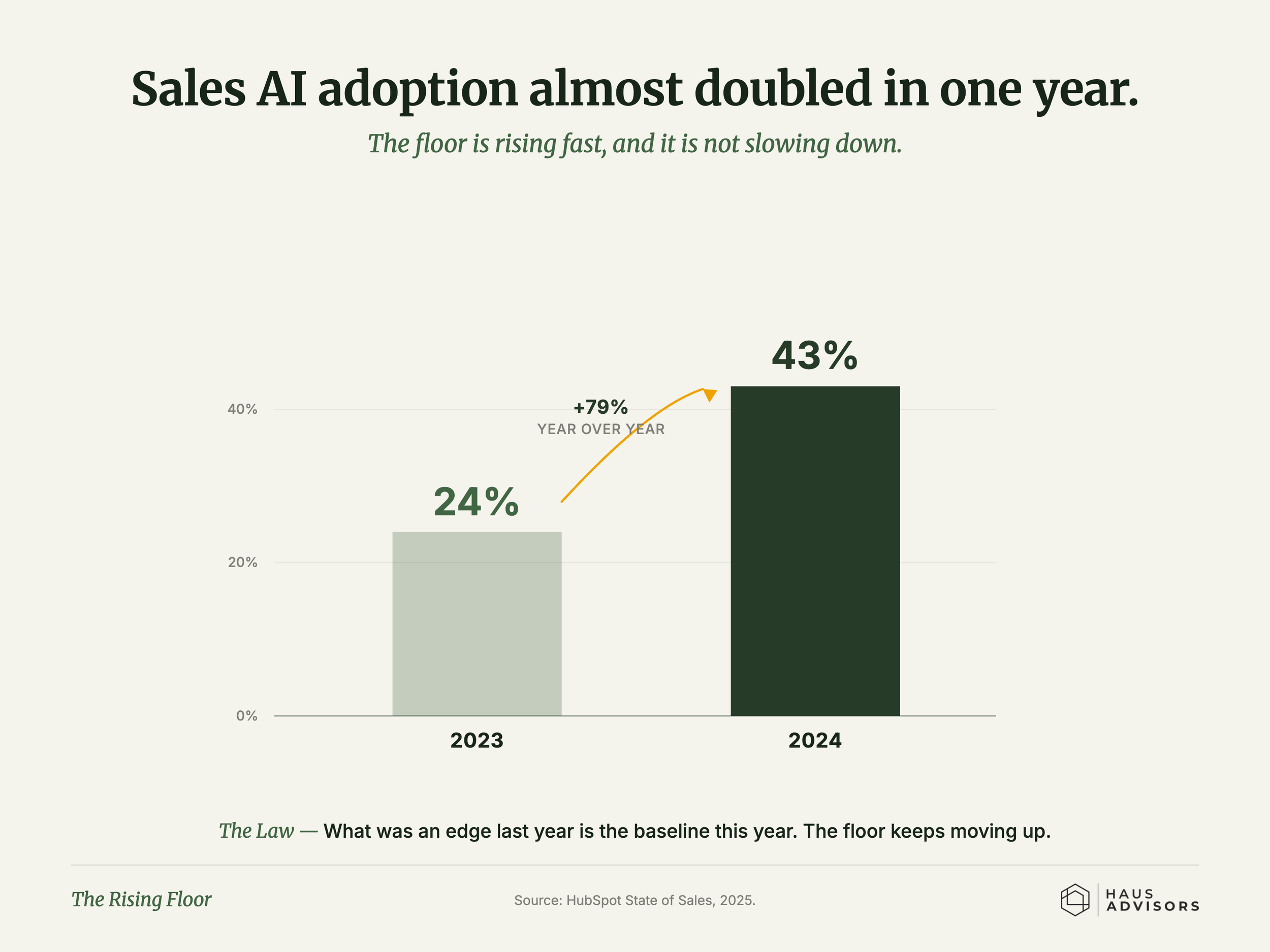
Source: HubSpot State of Sales Report, 2025
Buyer Perception & Trust in AI Outreach
What happens on the receiving end, and why volume alone is not the answer.
“Labeling content as AI-generated leads buyers to see it as less natural and less useful, and reduces willingness to engage, even when the content is identical to a human-written version.”
Only 21% of respondents trust AI companies and their promises, and only 20% trust AI itself. (Source: Nuremberg Institute for Market Decisions, representative survey of 1,000 respondents each in the USA, UK, and Germany, 2024)
Only about 25% of consumers believe they can recognize AI-generated content; only 28% understand how their personal data is used by AI for personalization. (Source: Nuremberg Institute for Market Decisions, 2024)
An ad described as AI-made was perceived more negatively than an identical human-made ad — especially regarding emotional aspects — and participants were less likely to click or engage. (Source: Nuremberg Institute for Market Decisions, 2024)
Only 40–52% of employees viewed supervisors as sincere when they used high levels of AI writing assistance, compared to 83% for low-assistance messages. (Source: University of Florida / University of Southern California, International Journal of Business Communication, 2025)
95% of respondents found low-AI messages professional; this dropped to 69–73% when the sender relied heavily on AI tools. (Source: University of Florida / USC, International Journal of Business Communication, 2025)
81% of sales and marketing decision-makers engage with cold outreach when it is tailored to their company or context. (Source: Sopro State of Prospecting, 2026)
79% of decision-makers reply to cold outreach to ask questions or request more information — cold outreach still works when it's relevant. (Source: Sopro State of Prospecting, 2026)
83% of decision-makers will Google the company before clicking any link in a cold outreach message. (Source: Sopro State of Prospecting, 2026)
36% of decision-makers use cold outreach to discover new business solutions and service providers. (Source: Sopro State of Prospecting, 2026)
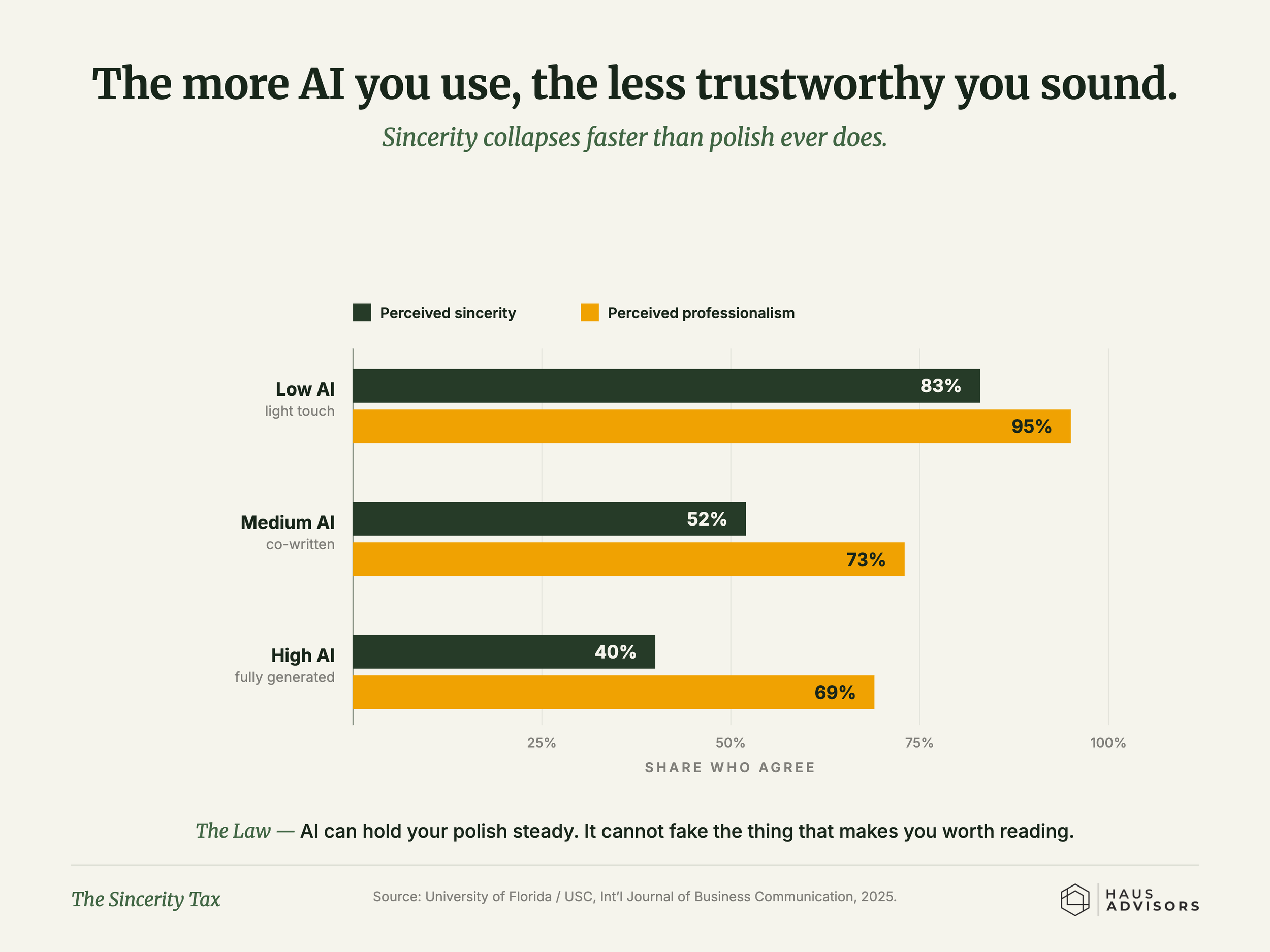
(Source: University of Florida / USC, International Journal of Business Communication, 2025 — study of 1,100 professionals)
Pipeline & Revenue Impact
What the data shows about the connection between AI outreach and actual business outcomes.
“Organizations using signal-qualified leads report 47% better conversion rates, 43% larger average deal sizes, and 38% more closed deals per quarter — compared to traditional lead scoring.”
Sales teams using AI are 1.3x more likely to see revenue growth: 83% of AI-using teams reported revenue growth vs. 66% of teams without AI. (Source: Salesforce State of Sales, 2024)
Sellers who effectively partner with AI tools are 3.7x more likely to meet quota than those who don't. (Source: Gartner, 2025–2026)
Companies using enriched, signal-augmented CRM data generate 44% more sales-qualified leads than those relying on base contact data alone. (Source: Salesforce Research, 2024)
Companies using a CRM are 86% more likely to exceed sales targets. (Source: Salesforce, cited by Sopro, 2025)
The average cold email conversion rate is 0.2153% — one closed deal per 464 emails sent. (Source: Focus Digital, 2024)
Email marketing ROI averages $36 for every $1 spent. (Source: Litmus, cited in Forbes Advisor, 2024)
Automated email flows generate up to 30 times more revenue per recipient than standard broadcast campaigns. (Source: Omnisend, cited in Forbes Advisor, 2024)
People are three times more likely to purchase from email marketing than from social media. (Source: McKinsey & Company, cited in Forbes Advisor, 2024)
Sales professionals using social selling are 51% more likely to hit quota. (Source: LinkedIn, 2024–2025)
Vendors contacting funded firms within 48 hours of a funding announcement see 400% higher conversion rates than baseline outreach. (Source: Jolly Marketer B2B sales trigger analysis, 2025)
31% of sales and marketing decision-makers report excellent or very good ROI from cold calling — it remains viable in multi-channel sequences. (Source: Sopro State of Prospecting, 2026)
Future Outlook: AI in Sales Outreach
Analyst projections on where AI outreach is heading over the next two to five years.
“The AI SDR market is projected to reach $15.01 billion by 2030, growing at a 29.5% CAGR — driven by demand for automated prospecting, personalization at scale, and pipeline acceleration.”
Gartner projects that 95% of seller research workflows will begin with AI by 2027, up from less than 20% in 2024. (Source: Gartner, 2025)
22% of teams have already fully replaced human SDRs with AI. (Source: MarketsandMarkets, cited via Autobound, 2025)
Gartner predicts AI agents will outnumber human sellers by 10x by 2028. (Source: Gartner, 2025)
Gartner predicts 40% of enterprise apps will feature task-specific AI agents by 2026, up from less than 5% in 2025. (Source: Gartner, 2025)
Over 40% of agentic AI projects will be canceled by end of 2027 due to poor governance and unclear ROI. (Source: Gartner, 2025)
IDC forecasts a 10x increase in AI agent usage and 1,000x growth in inference demand by 2027. (Source: IDC, 2025)
By 2030, 80% of Chief Sales Officers will require AI-augmented plans to navigate future-of-sales disruptions. (Source: Gartner, 2025)
McKinsey estimates AI agents could add $2.6–$4.4 trillion in annual business value across use cases including sales and marketing. (Source: McKinsey & Company, 2025)
88% of organizations now use AI in at least one business function, yet nearly two-thirds remain in experimental or pilot mode. (Source: McKinsey State of AI Report, 2025)
58% of companies already use physical AI to some extent, and adoption is projected to reach 80% within two years. (Source: Deloitte State of AI in the Enterprise, 2026)
Frequently Asked Questions
-
The average cold email response rate is around 5.1%, with most campaigns falling between 1% and 5% (Belkins, 2025). Campaigns that use advanced personalization can reach 18%, roughly double the generic average of 9% (Sopro State of Prospecting, 2026).
-
Yes — significantly. Personalized cold emails generate a 32% higher response rate than non-personalized messages (Sopro, 2026). Highly personalized campaigns using multiple custom fields can boost replies by 142% compared to generic outreach (Martal, 2025). However, 57% of sales and marketing decision-makers say most outreach still feels impersonal and irrelevant, meaning the bar for standing out is lower than it appears.
-
Rapidly. AI usage among sales reps rose from 24% in 2023 to 43% in 2024 — a 79% year-over-year increase (HubSpot State of Sales, 2025). 81% of sales teams are either experimenting with or have fully implemented AI (Salesforce State of Sales, 2024). Among small businesses, 55% used AI in some form in 2025, up from 39% in 2024 (Thryv, 2025).
-
Not by default. Academic research finds that labeling content as AI-generated reduces perceived sincerity, naturalness, and likelihood to engage — even when the content is identical to a human-written version (Nuremberg Institute for Market Decisions, 2024). A 2025 study found that only 40–52% of employees viewed managers as sincere when using high levels of AI writing assistance, versus 83% for low-assistance messages (University of Florida / USC, 2025).
-
Not automatically. The average cold email conversion rate is 0.2153% — one deal per 464 emails sent (Focus Digital, 2024). Smaller, more targeted lists consistently outperform high-volume blasts: campaigns targeting 50 or fewer recipients average a 5.8% response rate, versus 2.1% for larger lists (Belkins, 2025). Signal-based outreach that contacts qualified prospects within 48 hours of a trigger event sees 400% higher conversion rates than baseline (Jolly Marketer, 2025).
-
AI's role will grow significantly. Gartner projects that 95% of seller research workflows will begin with AI by 2027, up from less than 20% in 2024. The AI SDR market is forecast to reach $15.01 billion by 2030, growing at 29.5% CAGR (MarketsandMarkets, 2025). However, 88% of organizations remain in experimental or pilot mode, and Gartner warns that over 40% of agentic AI projects will be canceled by 2027 due to poor governance and unclear ROI.
Sources
Every statistic on this page is sourced from one of the following organizations or publications. Source URLs are retained in the page's audit trail (view source) for verification but not rendered as outbound links.
Belkins (Cold Outreach Benchmarks Report, 2025)
Snov.io (analysis of 10M+ emails, 2026)
QuickMail (2025)
Sopro (State of Prospecting 2026, 151M data points)
Salesforce (State of Sales 2024; SMB Trends 2024; Research 2024)
HubSpot (State of Sales / Sales Strategy Report, 2025)
LinkedIn (State of Sales, 2024–2025)
Gartner (2025–2026)
McKinsey & Company (State of AI 2025; Forbes Advisor, 2024)
MarketsandMarkets (2025)
IDC (2025)
Deloitte (State of AI in the Enterprise, 2026)
Landbase (intent signal data analysis, 2025)
Instantly.ai (2026 benchmarks)
Martal (B2B cold email research, 2025)
Nuremberg Institute for Market Decisions (NIM, 2024)
University of Florida / University of Southern California (International Journal of Business Communication, 2025)
U.S. Chamber of Commerce (Empowering Small Business Report, 2025)
Thryv (AI Adoption Survey, 2025)
Litmus (cited via Forbes Advisor, 2024)
Epsilon (cited via Forbes Advisor, 2024)
Campaign Monitor (cited via Forbes Advisor, 2024)
Omnisend (cited via Forbes Advisor, 2024)
Marketo (cited via Forbes Advisor, 2024)
Focus Digital (2024)
Jolly Marketer (B2B sales trigger analysis, 2025)
Mailbutler (cited via Forbes Advisor, 2024)
Before you scale the sending
The volume numbers work right up until everyone has them. And underneath the reply rates there’s a second curve the benchmarks don’t show. The bigger the list gets, the smaller the share of people who answer. So the agencies still winning on outreach aren’t the ones sending more — they’re the ones with a point of view worth replying to.
Two charts in the vault make that concrete. The List-Size Penalty and The Opinion Deficit. Free, no signup.
About the author
David Hoos
Founder, Haus Advisors
David helps the founders of technical agencies (web, mobile, software, DevOps) build a business that grows without needing them in every deal. Most of what makes an agency worth hiring still lives in the founder’s head: the reputation, the relationships, and the judgment. His work at Haus Advisors moves it out of the founder’s head and into the business. He hosts Behind the Agency, a podcast with 70+ episodes on what actually drives agency growth.
Keep reading
Browse by topic
- Positioning & Strategy
- Lead Gen & Marketing
- Sales & Biz Dev
- Pricing & Productization
- Research & Data
- Operations & Delivery
- Client Retention & Expansion
- Leadership & Culture
For founders whose agency has outgrown referrals.
One idea a week that makes a hard growth problem obvious, usually with a chart that shows you the mechanism behind it.
Built from conversations with seventy-plus agency founders on the Behind the Agency podcast.