Your Best Client Just Asked "Do You Also Handle SEO?" The Answer You Give Determines Your Next Two Years.
A founder told me about the moment his agency started losing money while looking like it was growing. A long-standing client, one of his best, asked whether the team could handle their SEO alongside the development work. The relationship was strong. The revenue was easy. He said yes.
Six months later, he was overseeing a freelance SEO contractor who wasn't delivering consistently, his project managers were stressed managing a discipline they didn't understand, and the margins on that account had dropped from 50% to 18%. Worse, the SEO work was consuming management bandwidth that should have been spent on new business development. The "easy revenue" was costing him more in operational drag than it was generating in profit.
He'd added a service line based on the most common trigger in agency growth: a good client asked for it. The revenue looked additive. The complexity was exponential.
The Pattern Has a Name
I call it The Complexity Tax: the exponential increase in operational overhead that accompanies each new service line, disproportionate to the linear revenue the service generates. Agencies view expansion arithmetically ("we had three services, now we have four, so we've added 25% more revenue potential"). The actual math is geometric: each new service introduces a new delivery process, a new quality standard, a new vocabulary for project management, new revision cycles, new margin characteristics, and new positioning complications that interact with every existing service.
Here's the mechanism. A development agency has refined its delivery for one core discipline over years. The team knows the tools, the workflow, the common pitfalls, and the quality benchmarks. Project management is calibrated to this discipline. Pricing reflects deep understanding of actual costs. Margins are healthy because efficiency has been built through repetition.
Adding a new service, even a seemingly adjacent one, resets this efficiency to zero for that service line. The team doesn't know the tools as deeply. The workflow isn't refined. The quality benchmarks are borrowed from the core discipline and may not apply. Project managers are suddenly overseeing work they can't evaluate. Pricing is guesswork because there's no history to reference. And the management overhead of running two delivery processes is not double the overhead of running one. It's significantly more, because the interaction between the two creates coordination costs that didn't exist before.
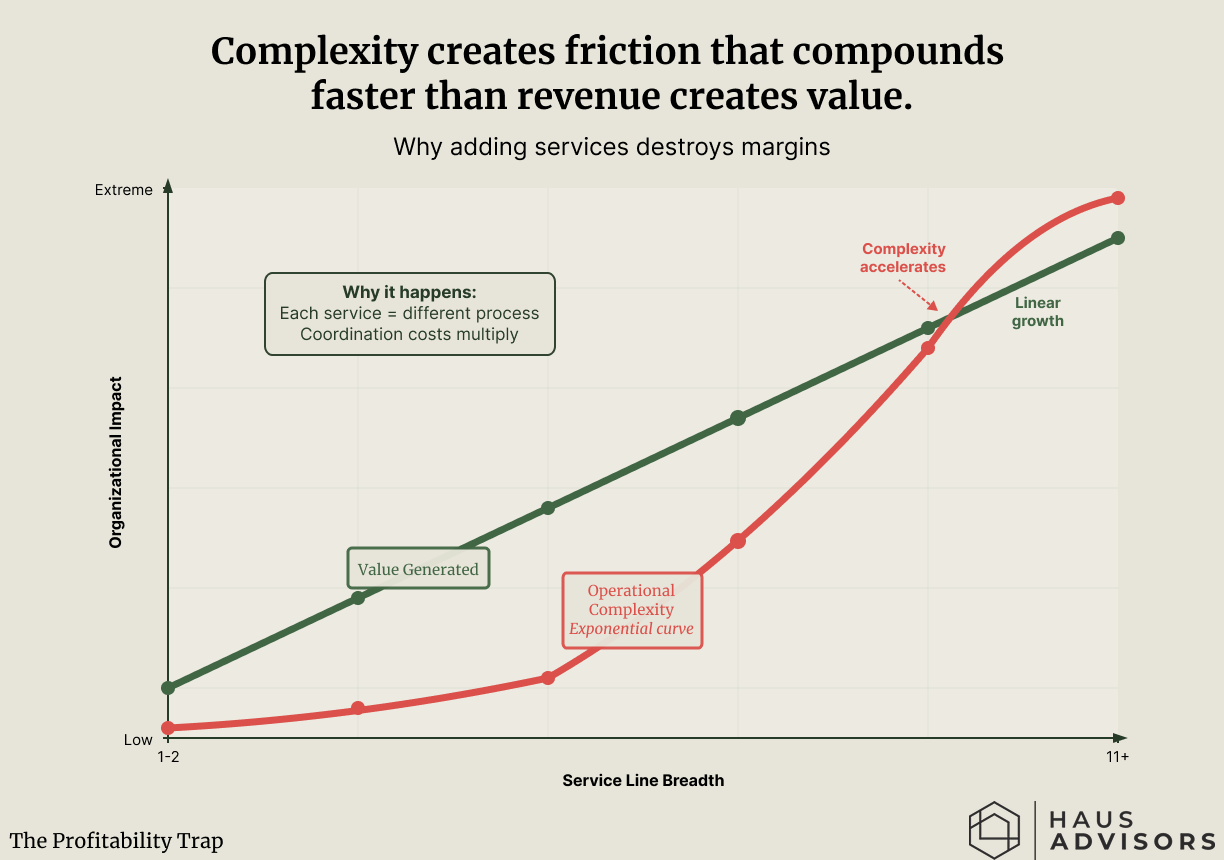
The expansion math agencies get wrong: Adding a service looks like 25% more revenue potential. In practice, it adds exponentially more management complexity: new delivery processes, new quality standards, new PM skills, new margin calculations, and new positioning complications. Eventually the complexity curve crosses the value curve, and you're working harder to make the business less profitable. The Complexity Tax is why 'full-service' agencies often have worse margins than focused specialists.
The Complexity Tax is invisible at first because the new service generates revenue immediately (the client is already paying for it). The costs accumulate gradually: the PM's frustration, the founder's attention diverted from business development, the positioning dilution that makes the next sales conversation harder, the margin compression that only shows up in quarterly financials. By the time the true cost is visible, the service is embedded in the client relationship and difficult to remove.
Why the Best Client's Request Is the Most Dangerous
Because it bypasses every filter that would normally protect you from bad decisions.
When a stranger asks if you handle SEO, you evaluate the request objectively: does this fit our capabilities? Does it align with our positioning? Can we deliver at quality? When your best client asks the same question, the evaluation is contaminated by relationship dynamics. You want to keep them happy. The revenue is warm. Saying no feels like letting them down or, worse, sending them to a competitor who might eventually take the development work too.
This is reactive expansion: adding services in response to individual client requests rather than strategic market analysis. Reactive expansion is the primary driver of the "Frankenstein Agency," a business that offers an incoherent collection of services accumulated through years of saying yes to good clients. Each individual yes seemed reasonable. The cumulative result is an agency that can't explain what it does, can't deliver consistently across its service portfolio, and can't command premium pricing because the positioning has been diluted beyond recognition.
The filter that reactive expansion bypasses is the Relevance Test: does adding this service make it easier or harder to explain why clients should choose you? If the answer is harder, the service is weakening your positioning regardless of the revenue it generates. The revenue is real. The positioning damage is also real. And over time, the positioning damage costs more in lost deals and compressed pricing than the reactive service generates in revenue.
How to Evaluate Expansion Opportunities
Not all expansion is dangerous. The distinction is between expansion that deepens your core expertise and expansion that broadens beyond it. Deepening creates leverage. Broadening creates complexity.
Three filters before committing to any new service:
The Client Overlap Test. Would this service appeal to at least 70% of your existing ideal client base? If a service only interests a small subset of your clients, it creates operational complexity without enough revenue to justify the overhead. The best expansions serve the same buyer you already serve, at a different point in their journey with you.
The Expertise Distance. How far is the new service from your current core competency? Adding performance optimization to a development agency is low distance: same team, same tools, same knowledge base. Adding creative branding is high distance: different team skills, different project management vocabulary, different quality evaluation criteria. High-distance expansions typically require a different type of project manager and a different sales process, which means you're essentially starting a second agency inside your first.
The Relevance Multiplier. Will this service make it easier or harder to explain what you do? If you have to add a comma and a paragraph to your elevator pitch ("We do software development, and also SEO, and also branding, and also..."), the service is failing the relevance test. If the service makes your pitch sharper ("We build and maintain resilient platforms for high-compliance industries"), it's passing.
The Expansion Tiers
I've categorized the most common agency expansion paths by leverage, from highest-leverage (deepening your core) to highest-risk (broadening beyond it).
Tier 1: Deepening Expansions (High Leverage, Low Complexity)
These use your existing technical knowledge and team. They require minimal new skills and create recurring revenue.
Adjacent service integration. Maintenance, performance optimization, security auditing, DevOps. You already understand the systems because you built them. Clients prefer working with the team that knows their infrastructure. The margins are high because the knowledge transfer cost is near zero. And the recurring nature of these services smooths revenue volatility in a way that project-based work can't.
Productized diagnostic packages. Architecture audits, scalability assessments, technical debt evaluations, migration roadmaps. You're already doing this thinking during sales conversations, often for free. Packaging it as a paid deliverable accomplishes three things: it creates a low-risk entry point for new clients (the Trust Bridge), it generates revenue from work you're currently giving away, and it positions you as the diagnostic authority rather than the execution vendor.
Vertical depth. Instead of adding new services horizontally, go deeper in your existing vertical. If you serve fintech, build specialized compliance tooling. If you serve healthcare, develop HIPAA-specific architecture frameworks. Vertical depth creates reusable code, transferable expertise, and pricing power that horizontal breadth never achieves.
Tier 2: Strategic Extensions (Medium Effort, High Authority)
These require some new processes but position you as a more complete partner.
Platform specialization. Become the recognized expert for a specific technology platform (Contentful, Shopify Plus, Webflow, a specific cloud provider). Deep platform expertise creates referral loops from the platform's partner program. It focuses your marketing on a specific ecosystem with high-intent buyers. And it builds relationships with partner managers who send pre-qualified leads.
Retainer and advisory models. Shift from project-based work to recurring revenue through fractional technical leadership, optimization retainers, or ongoing advisory relationships. Retainers smooth cash flow, keep you visible to the client (so you see the next project before it goes to bid), and change your positioning from vendor to ongoing partner. The margin characteristics are typically better than project work because the delivery is less intensive.
Training and enablement. Leverage your expertise to offer team training, technical workshops, or capability assessments to clients' in-house teams. This commands premium pricing with minimal overhead (no tools, no subcontractors). It positions you as the trusted advisor, not the hired hands. And it often leads to project work when the client realizes the problem is bigger than their internal team can handle.
Tier 3: Danger Zone (High Risk, Proceed With Extreme Caution)
These look like easy revenue and often become margin traps.
"Virtual" expansion through partnerships. Offering design, SEO, or content services by partnering with external providers. The financial risk is lower than hiring, but the reputation risk is significant. If the partner underdelivers, your client blames you. Use this only as a demand-testing bridge before deciding whether to build the capability in-house.
White-label and subcontracting. Providing development services to larger agencies who manage the client relationship. This keeps utilization high during slow periods but destroys enterprise value over time. You have no control over the client relationship, you're typically squeezed on margins, and you're building someone else's brand instead of your own. Useful for cash flow management, dangerous as a growth strategy.
Unrelated service additions. The "do you guys handle SEO too?" category. Services that are outside your core expertise, require different team skills, and introduce new operational complexity. These are the primary drivers of the Complexity Tax and the main source of the Frankenstein Agency pattern. The revenue is visible. The cost is hidden in management overhead, margin compression, and positioning dilution.
The 90-Day Pilot Protocol
Even for Tier 1 expansions, never publicly launch a service before testing it with existing clients.
Sell it to three existing clients first. Use the delivery to debug the process, calibrate the pricing, and evaluate the margin. If the pilot produces healthy margins and happy clients, productize it. If the pilot reveals that the delivery requires more founder involvement or PM complexity than expected, the Complexity Tax is higher than the revenue justifies.
Measure the fully loaded margin. Not just the direct cost of delivery. Include the PM time, the founder's oversight hours, the impact on other projects, and the positioning complexity. If the fully loaded margin is below your core service margin, the expansion is a drag on the business even if it's generating revenue.
Watch the positioning impact. After three pilot deliveries, test whether you can still explain your agency's value proposition in one sentence without the new service making it longer or fuzzier. If the service passes the Relevance Multiplier, proceed. If it fails, the service may generate revenue while costing you deals you can't see.
The Honest Objection
Here's the strongest argument against this cautious approach: clients want a single point of contact. If you don't provide SEO, design, or content alongside development, the client will find an agency that does. You lose the relationship entirely rather than just the additional service revenue.
That's a real competitive pressure. The "one-stop shop" preference is genuine among certain buyers.
Where That Logic Hits a Wall
But the agencies I've watched try to be one-stop shops at the $1M to $3M stage almost always regret it. The additional services dilute positioning, compress margins, and create management complexity that the founder's bandwidth can't absorb. The agency that tries to do everything ends up doing nothing exceptionally, which makes them easier to replace, not harder.
The alternative is the partnership model from Tier 2: build referral relationships with trusted providers for the services outside your core. You maintain the client relationship by being the one who introduces them to the right partner. You don't lose the relationship. You strengthen it by demonstrating that you care more about the client's outcome than capturing every dollar of their budget.
The agencies that grow profitably past $3M almost always do so by deepening rather than broadening. The service expansion that compounds is the one that makes your core offering more valuable, not the one that adds a new line item to your invoice.
The Next Step
You don't need to evaluate your entire service portfolio today. You need to check whether the Complexity Tax is active in your current operations.
Start here: look at your service lines and calculate the fully loaded margin for each one (including PM time, founder oversight, and any coordination overhead). If any service line has a margin more than 15 points below your core service, it's likely generating revenue while reducing overall profitability. That's the Complexity Tax in action.
Then ask: did this service start as a client request or a strategic decision? If it started as a client request and it's dragging margins, the reactive expansion pattern is active. The service felt like easy revenue when it arrived. It's been quietly expensive ever since.
The fix isn't necessarily killing the service. It might be productizing it so the delivery is standardized and the margins improve. It might be partnering it out so you maintain the client relationship without the operational burden. Or it might be sunsetting it and redirecting the management bandwidth to business development, which almost certainly has a higher ROI than a low-margin service line.
The principle is simple:
There are agencies that expand by saying yes to what clients ask for, and there are agencies that expand by going deeper into what they already do best.
The first group becomes full-service and forgettable. The second group becomes specialized and indispensable.
Most founders reading this already know the real problem. It isn't the service line you said yes to. It's that the judgment about which work to take, along with the reputation and the relationships that make your agency worth hiring, still lives in your head. So every yes runs through you, and the business only grows when you're in the room.
That's the work we do at Haus Advisors. The New-Business Engine is six months of implementation, not a strategy document. We pull what makes your agency relevant out of your head, build it into positioning, offers, and growth plays your team can run, and hand ownership to them. If you want an agency that grows without needing you in every deal, book a call to see if it's a fit.
Keep reading
Browse by topic
- Positioning & Strategy
- Lead Gen & Marketing
- Sales & Biz Dev
- Pricing & Productization
- Research & Data
- Operations & Delivery
- Client Retention & Expansion
- Leadership & Culture
For founders whose agency has outgrown referrals.
One idea a week that makes a hard growth problem obvious, usually with a chart that shows you the mechanism behind it.
Built from conversations with seventy-plus agency founders on the Behind the Agency podcast.