You Don't Have to Pick One Vertical. But You Do Need a Red Thread.
A founder told me she was relieved when she read that agencies should specialize. Then she looked at her revenue breakdown: 30% SaaS companies, 25% healthcare, 20% fintech, 15% e-commerce, 10% various. All profitable. All long-term relationships. All referred by happy clients in their respective industries.
She asked the question I hear from every multi-vertical agency founder: "Am I supposed to fire 70% of my clients to pick a niche?"
No. But she did need to solve the problem that multi-vertical agencies face and single-vertical agencies don't: every new sales conversation started from zero. The healthcare prospect didn't know she'd built compliant data systems for six other healthcare companies. The fintech buyer didn't know her team had deep experience with regulatory frameworks. Each prospect evaluated her as a generalist who happened to have one relevant case study, rather than a specialist who happened to serve multiple industries.
Her revenue was diversified. Her sales process was not. Each deal required the same uphill climb of building relevance from scratch, because nothing in her positioning communicated a through-line that connected her work across verticals.
She didn't need to narrow her market. She needed a positioning structure that made her expertise recognizable regardless of which vertical the prospect came from.
The Pattern Has a Name
I call it The Diversification Paradox: the condition in which serving multiple verticals stabilizes revenue (by reducing market concentration risk) while destabilizing sales (by diluting positioning clarity). The agency gets the operational benefit of diversification but pays for it with increased friction in every new business conversation.
Here's the mechanism. Single-vertical agencies have a straightforward positioning story: "We serve fintech. Here are twelve fintech case studies. We understand your regulatory requirements, your integration challenges, and your growth patterns." Every element of their marketing, sales, and content reinforces the same message. The prospect recognizes themselves immediately.
Multi-vertical agencies have a fragmented positioning story. Their website tries to speak to healthcare, SaaS, fintech, and e-commerce simultaneously. Their case studies span unrelated industries. Their content addresses problems from different domains. The prospect from any single vertical sees an agency that serves their industry plus four others, which reads as "generalist" rather than "expert." The prospect has to do the mental translation: "They did this for a healthcare company, so maybe they could do something similar for my fintech company?"
That mental translation is friction. And friction, in sales, produces the Decision Vacuum I've written about elsewhere: the prospect can't easily articulate why your agency is the right choice for their specific situation, so they stall, compare you on price, or ghost.
The Diversification Paradox doesn't mean multi-vertical is wrong. It means multi-vertical requires a different positioning architecture than single-vertical. You need a structure that communicates coherent expertise across diverse applications.
Why "We Do Everything for Everyone" Doesn't Work (Even When You Actually Can)
Because buyers don't evaluate capability. They evaluate recognizability.
When a healthcare CTO evaluates agencies, they're not asking "can this team technically build what we need?" They're asking "how many unexpected complications will arise during this project?" An agency that has built six healthcare systems signals low risk. An agency that has built one healthcare system and five unrelated projects signals higher risk, even if the technical capability is identical.
This is pattern recognition. Buyers look for evidence that you've navigated their specific constraints before. A firm that regularly solves a recognizable problem appears predictable. A firm that solves many unrelated problems appears capable but unpredictable. Capability earns a meeting. Predictability earns the contract.
Multi-vertical agencies lose deals not because they lack capability, but because their positioning doesn't help the buyer recognize a pattern. The buyer sees breadth (you've done lots of different things) instead of depth (you've repeatedly solved problems like mine).
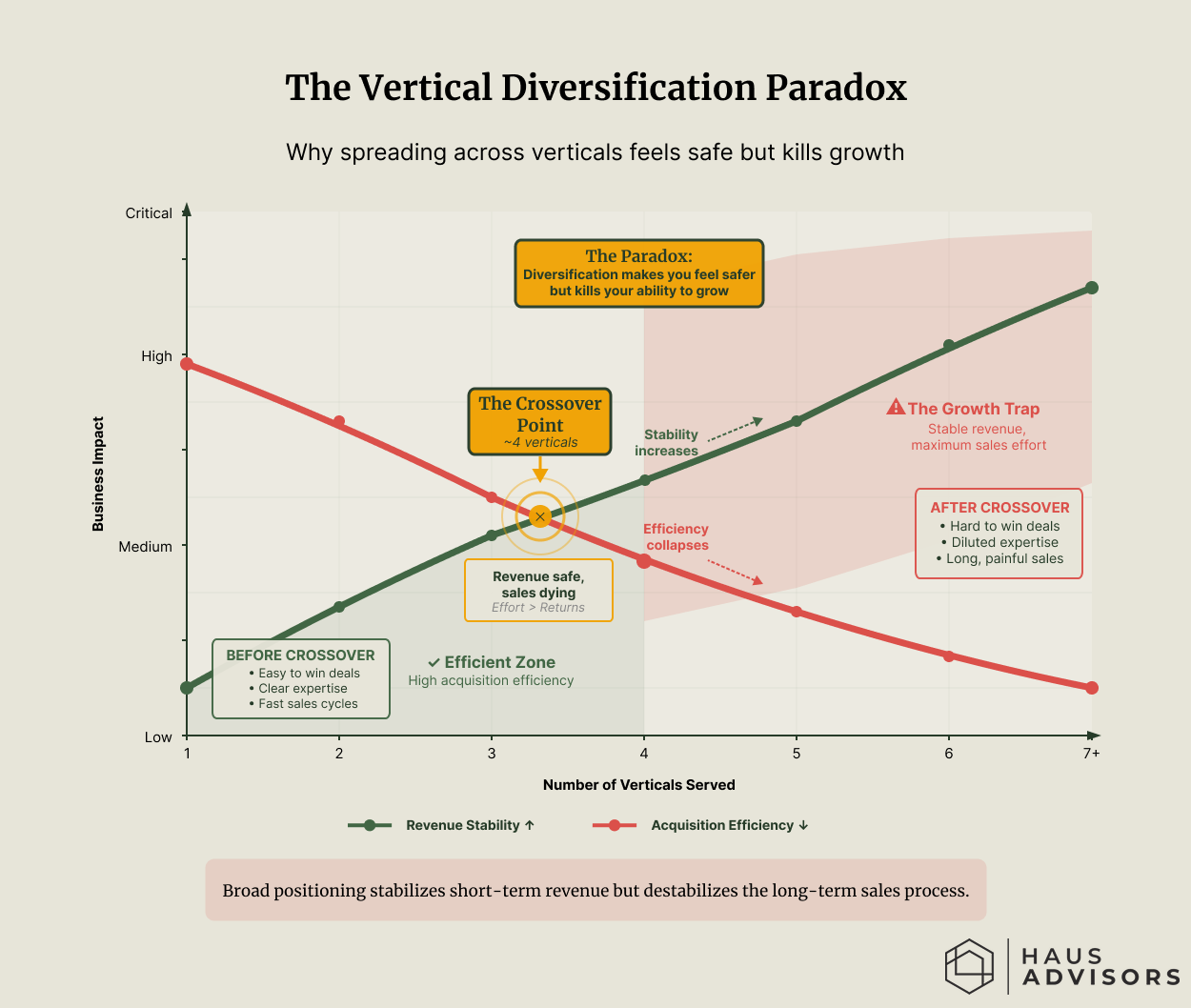
The multi-vertical tradeoff: Adding verticals increases revenue stability by reducing market concentration risk. But it simultaneously decreases acquisition efficiency by diluting the positioning signal. Most multi-vertical agencies stall at the intersection where the cost of acquiring each new client exceeds the stability benefit of serving diverse markets. The framework below is designed to shift the Acquisition Efficiency curve upward without sacrificing diversification.
The Red Thread: Positioning for Multi-Vertical Agencies
The solution isn't choosing one vertical. It's identifying the through-line that connects your work across verticals and making that through-line the center of your positioning.
I call it the Red Thread: the core capability, methodology, or outcome that appears in your best work regardless of which industry the client operates in. It's the answer to the question: "What is the one thing you do exceptionally well that matters in every vertical you serve?"
For the founder I mentioned earlier, the Red Thread was resilient platform architecture for high-compliance industries. Her healthcare work involved HIPAA-compliant data systems. Her fintech work involved PCI-compliant transaction processing. Her SaaS work involved SOC 2-compliant infrastructure. Different regulations, different industries, but the same core expertise: building systems that are both performant and compliant.
Once she identified the Red Thread, her positioning stopped being "we build software for multiple industries" and became "we build resilient platforms for industries where compliance isn't optional." Every vertical she served fit under that umbrella. Every case study reinforced the same core competence. The prospect from any single vertical could see not just one relevant project, but a pattern of solving compliance-architecture challenges across multiple high-stakes contexts.
The Red Thread isn't a rebrand. It's a recognition. It's already in your work. You just haven't named it or organized your messaging around it.
The Hub-and-Spoke Messaging Architecture
Once you've identified the Red Thread, you need a messaging structure that communicates it clearly while maintaining relevance to each vertical. This is the Hub-and-Spoke model.
The Hub is your core positioning: the Red Thread expressed as a clear capability and outcome statement. "We build resilient platforms for high-compliance industries." This appears on your homepage, in your elevator pitch, and at the top of every piece of content. It communicates what you do and why it matters without referencing a specific industry.
The Spokes are vertical-specific applications of the Hub. Each spoke translates the Red Thread into the language and concerns of a specific industry:
Healthcare spoke: "We build HIPAA-compliant platforms that protect patient data without sacrificing clinical workflow speed."
Fintech spoke: "We build PCI-compliant transaction systems that handle regulatory audits without slowing product development."
SaaS spoke: "We build SOC 2-compliant infrastructure that scales with your customer base without creating security debt."
Each spoke uses the industry's specific language, references their specific regulations, and addresses their specific concerns. But every spoke connects back to the Hub: resilient, compliant architecture. The prospect from any vertical sees two things simultaneously: industry-specific relevance (the spoke) and deep, cross-industry expertise (the hub).
This architecture prevents two common failures:
The generic homepage. Without the Hub-and-Spoke model, multi-vertical agencies default to "we build custom software for companies across industries," which communicates nothing. The Hub gives you a specific, memorable positioning statement that's true across all your verticals.
Scattered marketing syndrome. Without the model, agencies try to maintain separate campaigns for each vertical, spreading resources too thin. The Hub-and-Spoke lets you create foundational content about your methodology (the hub) and supplement it with vertical-specific case studies and applications (the spokes). One content engine. Multiple entry points.
Vertical-Specific Value Mapping
The Spokes aren't just messaging variations. They're structured translations of your Red Thread into each vertical's problem language.
For each vertical you serve, document three things:
The industry-specific problem. Not your service. Their pain. E-commerce clients face platform crashes during traffic spikes. Healthcare clients face audit failures from non-compliant data handling. SaaS clients face churn from reliability issues as they scale.
How your Red Thread solves it. The connection between your core capability and their specific constraint. Your resilient architecture methodology prevents the crash, passes the audit, or maintains uptime during the scaling phase.
The proof in their language. A case study from their industry (or an adjacent one) that quantifies the outcome in terms they care about. "Reduced audit preparation time by 60%" for healthcare. "Zero downtime during Black Friday at 10x normal traffic" for e-commerce. "99.99% uptime through a 5x user growth period" for SaaS.
This mapping doesn't require becoming an industry expert. It requires translating your genuine expertise into the language and priorities of each buyer. The technical substance stays constant. The framing shifts to match the audience.
When Multi-Vertical Positioning Doesn't Work
The framework above works when certain conditions are true. If they're not, single-vertical positioning is likely a better path.
Your core capability must transfer across industries. If the work you do for healthcare clients is fundamentally different from the work you do for SaaS clients (different technology, different methodology, different team members), there's no Red Thread. You're running multiple agencies under one roof, and the multi-vertical positioning will feel forced because it is.
You need proof in at least two verticals. The Spoke only works if you have case studies and outcomes to back it up. If you have twelve healthcare projects and one fintech project, the fintech spoke is thin. You're a healthcare agency that once did a fintech project. Lead with the vertical where your evidence is strongest.
The buyer must value your cross-industry perspective. Some buyers see cross-industry work as a feature: "They bring best practices from consumer interfaces into enterprise software." Others see it as a risk: "They're not focused on our industry." The framework works best in markets where the buyer values the cross-pollination.
If these conditions don't describe your situation, the Vertical vs. Horizontal decision framework I've written about elsewhere is likely a better starting point. Concentrate where your evidence is deepest and build from there. For the fundamentals of positioning your agency before tackling the multi-vertical question, start with the core framework.
The Honest Objection
Here's the strongest argument against the Hub-and-Spoke approach: it's trying to have it both ways. Positioning theory says specificity wins. Trying to be relevant to four industries simultaneously, even with a Red Thread connecting them, is less specific than owning one industry completely. The single-vertical agency will always be more relevant to the prospect from that specific vertical than the multi-vertical agency with a spoke.
That's true in a head-to-head comparison. The pure specialist has an inherent positioning advantage within their vertical.
Where That Logic Hits a Wall
But the comparison assumes the alternative is single-vertical positioning, which may not be realistic for an agency with existing revenue across multiple markets. The relevant comparison isn't "Hub-and-Spoke vs. single vertical." It's "Hub-and-Spoke vs. no positioning structure at all." And in that comparison, the Hub-and-Spoke model dramatically outperforms the status quo.
The agencies I've watched implement this framework didn't achieve the positioning clarity of a pure specialist. They achieved something more practical: enough clarity in each vertical to start the sales conversation halfway to trust instead of at zero. The Hub gave them a memorable positioning statement. The Spokes gave each vertical's prospects a reason to believe the agency understood their specific context. It wasn't perfect positioning. It was functional positioning that reduced the sales friction from unbearable to manageable while preserving the revenue diversification the founder valued.
For some agencies, this framework is a permanent model. For others, it's a transition structure that clarifies which vertical to ultimately concentrate in. Either outcome is better than staying at the origin point with no positioning at all.
The Next Step
You don't need to restructure your entire brand. You need to find the Red Thread.
Start here: look at your best project from each vertical you serve. For each one, write down: what was the core technical challenge, what methodology did you use, and what outcome did you deliver?
Now look across those projects. Is there a capability, methodology, or outcome type that appears in all of them? A consistent approach to architecture? A shared emphasis on compliance? A recurring focus on performance at scale? That recurring element is your Red Thread candidate.
Test it: can you write a single sentence that describes what your agency does, using the Red Thread, that would be true for every vertical you serve? If yes, you have your Hub. The Spokes will follow naturally from translating that Hub into each vertical's language.
If no recurring element emerges, that's also informative. It may mean your verticals are genuinely unrelated, in which case the framework won't help and single-vertical positioning is the better path.
The principle is simple:
There are multi-vertical agencies that position separately for each market, and there are multi-vertical agencies that position around the thread that connects all their markets.
The first group runs four mediocre marketing engines. The second group runs one coherent engine with four entry points.
Most founders reading this already know the real problem. It isn't which vertical to pick. It's that the Red Thread, the reputation, and the judgment that make your agency worth hiring still live in your head. You're the only one who can walk into a healthcare call and a fintech call and make both sound like the same firm. So the business only grows when you're in the room.
That's the work we do at Haus Advisors. The New-Business Engine is six months of implementation, not a strategy document. We pull what makes your agency relevant out of your head, build it into positioning, offers, and growth plays your team can run, and hand ownership to them. If you want an agency that grows without needing you in every deal, book a call to see if it's a fit.
Keep reading
Browse by topic
- Positioning & Strategy
- Lead Gen & Marketing
- Sales & Biz Dev
- Pricing & Productization
- Research & Data
- Operations & Delivery
- Client Retention & Expansion
- Leadership & Culture
For founders whose agency has outgrown referrals.
One idea a week that makes a hard growth problem obvious, usually with a chart that shows you the mechanism behind it.
Built from conversations with seventy-plus agency founders on the Behind the Agency podcast.