Episode 76: 4 Bids, 5x Apart. He Built It Himself in 3 Months.
"We had four bids with identical inputs, and what came back was a four to five times spread. That told me the numbers were just opinions."
Watch
TL;DR — Key Takeaways
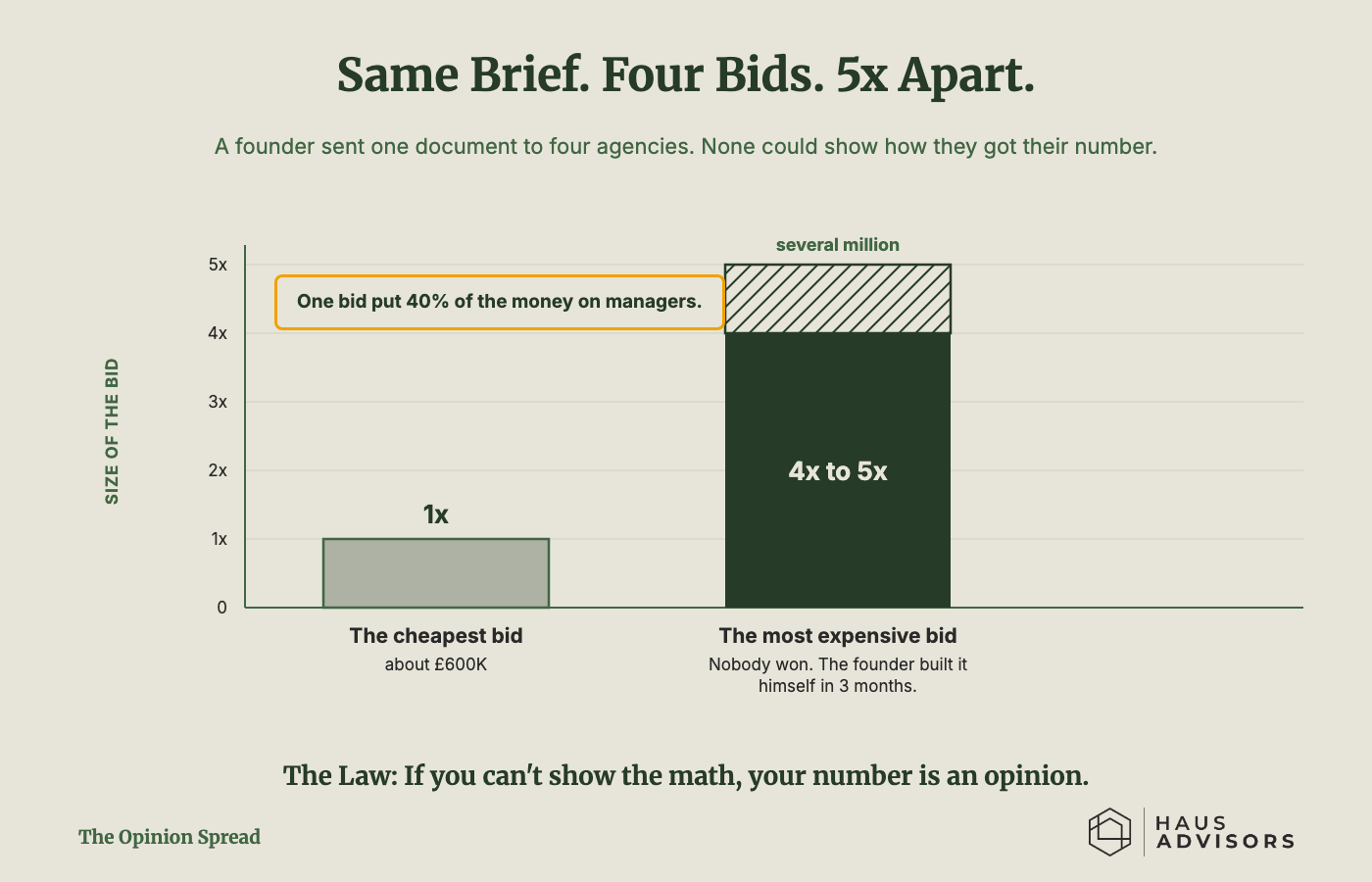
One brief went to four agencies. The quotes came back between roughly £600K and several million, a four-to-five-times spread on identical inputs. Nobody could show the data behind their number.
Every agency said yes to the AI question. None could evidence it. One gave a genuinely strong demonstration, and then sent a contract with fixed scope and a change-request fee on every deviation.
One bid put 40% of a multi-million-pound budget on management. That was a no before the meeting.
The bid he privately wanted to win was priced honestly, as a range rather than a number. It lost on a risk nobody had answered: a transient workforce.
Nobody won. The founder built the whole module to production grade in Cursor in three months, then hired people from one of the losing agencies as augmentation he manages himself.
Skills are no longer the differentiator. Fit is. Skills can be augmented; understanding the buyer's world cannot.
Test for today: take your last proposal and ask what evidence sits behind the number. If the answer is experience and instinct, you are selling an opinion.
Does This Sound Familiar?
You put a lot into a proposal. You price it carefully. You lose, and you never really find out why.
And the reason you never find out is that the person who decided is not going to tell you. They have their own reasons, their own board, their own risk they are managing. So you guess. Maybe it was price. Maybe they went cheaper. Maybe it was always going to be the incumbent.
Tatum Bisley is that person. He sits on the other side of the table as a fractional CPO, which means he writes the brief, reads what comes back, and tells the client which way to go. He ran exactly this process for a UK construction company that wanted to turn an internal tool into a product they could sell. It ended with no agency hired and the product shipped anyway: the founder built the module to production grade in three months.
Four agencies. One document. And an answer none of them saw coming.
Take the free Bottleneck Score →
Meet the Guest
Tatum Bisley is a fractional CPO and the founder of Hoursly. As a fractional CPO he works alongside founders, CEOs and CTOs, usually on nought-to-one products. He takes one-to-three-day seats rather than full-time roles, which puts him on the buying side of agency pitches more often than most people ever are. He describes the job as a bridge between the client and the delivery team.
Hoursly, which he is building now, is a delivery ledger for people who sell delivery — agencies, consultants, fractional operators — that records the effort behind the work, whether that effort was a person, an AI agent, or both. It is in closed beta.
Episode Summary
1. Why the work went out to tender at all
Tatum does not normally run a competitive process. He has two or three agencies he trusts, relationships built over years, and he uses them. But this was construction, and construction gets three quotes for everything. It is just what the industry does.
So he did the work properly. He architected what the SaaS product would be, listed the requirements, and made sure every bidder could get into the in-house systems so their estimate would resemble reality. Same document, same access, four agencies, one of them UK and the rest overseas.
That matters, because it removes the usual excuse. Nobody was working from a worse brief than anybody else.
2. The spread
The quotes came back somewhere between £600K for a year of effort and several million for two.
Sit with that. Identical inputs, a four-to-five-times spread. And when Tatum went looking for the reasoning, there wasn't any he could inspect. "No one could actually show me the data that turned that estimate into a number rather than just a feeling."
This is the line in the episode I keep coming back to. Not because agencies are dishonest, but because most pricing genuinely is a feeling — an experienced person's gut, dressed in a spreadsheet. That works fine until a buyer asks to see behind it.
3. Everyone said yes to AI. Nobody could show it.
The brief asked how each agency used agentic coding and AI. Every one of them said yes. Not one could demonstrate it in their response. The best honest answers were in-house templates and code reuse, which is real, but it is not what was asked.
Tatum was not looking for a buzzword. He wanted one of three things back: lower cost, faster delivery, or higher quality. Break the triangle somewhere. Show me where.
He is fair about the timing, and this matters. This was about a year ago. There were no agent factories then, no Slack ticket that becomes a bug fix and a production deploy inside an hour. He would expect more today than he did then. What he wanted at the time was simply alignment between what an agency claimed and how it proposed to work.
4. The demo that was great and the contract that wasn't
One vendor did demonstrate it, and did it well. Token usage, AI doing a large share of the QA, the whole picture. Genuinely impressive.
Then the contract arrived. Fixed scope. Heavier upfront requirements. Every deviation routed through a change-request process with its own labour cost attached.
"The commercial model wasn't aligned to the way of working."
That is a sentence worth reading twice if you sell agile delivery on a waterfall paper. The delivery team was telling the truth about how they work. The contract was written by people solving for a different risk. The buyer sees both and concludes the demo was theatre — even when it wasn't.
5. Why each bid actually lost
Here is the part you rarely get to hear.
One came back with a cost breakdown that put roughly 40% of a multi-million-pound proposal on the management team. Instant no. There was barely any detail beneath it, just stage gates and weekly meetings offered as the answer to change control.
One was a Nepalese agency he had used before and liked, but only as an extension of himself, where he fed them the work in pieces. Given the whole thing up front, they could not evidence that they could deliver it, and the client had no frame of reference for that part of the world.
One was Eastern European, and this is the one he wanted. They priced on labour cost plus a thin markup, and they gave a minimum and a maximum instead of a single number. Honest, and harder to sign off. "I would have loved to have gone with them." They lost on a transient workforce nobody had given the client confidence about.
And the last one had the lowest unit costs, clear technical capability, and — crucially — had actually worked in construction. That empathy is what took them to the final round. Then the contract lost it.
6. Nobody won, and what happened next
No bid. The client accepted none of them.
The founder, who is not a developer but had built the original internal tool in Power Apps, sat down with Cursor and built the entire module at production grade in three months. Then they hired a full-stack developer and a junior. Tatum's work was done and he moved on.
Months later the founder told him something better than any of it. His whole team now comes from one of the agencies that lost — as augmentation he briefs, manages and controls directly, paying the agency rather than employing the people. And he likes it that way.
So the agency did not lose the relationship. It lost the shape of the relationship it wanted, and kept a worse-margin version of it. Meanwhile that agency went from around 700 people to about half that, and moved to full agentic delivery.
7. Skills are not the differentiator any more
Asked what a strong response would have looked like, Tatum's answer is not about proposals at all.
"We're now in a world where skills are less important than fit." Skills can be augmented with AI now, and there is no reason to hide that. So the question becomes how you fit the organisation — whether you can turn business talk into technical delivery, whether you understand the security posture they are worried about, whether you know their user.
His example of that last one is the best argument for niching I have heard in a while. On a construction site the average age is 60s and 70s. Big hands. Often a missing finger or two. If your UI shows that you know that, you have proved more than a capability deck ever will.
8. And the triangle only works with context
One more thing, because it is the cheapest fix in the episode. Faster, cheaper, better is meaningless on its own. Cheaper than what — your last project, or a pint of milk? Better than your in-house team or the last agency you fired? Faster than which go-live date?
Ask first. Speak 20%, listen 80%. Then your number has something to sit against.
Notable Quotes
"We had four bids with identical inputs, and what came back was a four to five times spread. That told me the numbers were just opinions."
"No one could actually show me the data that turned that estimate into a number rather than just a feeling."
"The commercial model wasn't aligned to the way of working."
"We're now in a world where skills are less important than fit."
"Just because you can doesn't mean you should."
Related Episodes
Learn More / Get in Touch
Tatumdale (his fractional CPO practice) →
Want More Interviews Like This?
Subscribe to the show on YouTube →
Subscribe to my weekly newsletter →
If this resonates, here's your next step.
Pick the path that fits where you are right now. No pitch deck. No pressure. Just clarity.