Your Prospects Aren't Ghosting You Because They Found Someone Better. They're Ghosting Because They're Confused.
A founder told me he'd had a great discovery call with a VP of Engineering at a Series B SaaS company. The conversation lasted forty-five minutes. The prospect described their problem in detail. The founder asked good questions. They discussed timeline, team, and approach. The prospect said, "This sounds great. Send me a proposal."
The founder spent twelve hours on the proposal. Sent it. Followed up three days later. No response. Followed up a week later. No response. Followed up two weeks later with a "just checking in" email. Nothing.
He assumed the prospect found a cheaper agency. When I asked if he'd tried a different follow-up approach, he said he'd sent four more emails over the next month, each one shorter and more tentative than the last. Nothing worked.
Six months later, the prospect reached out to a colleague of mine for the same project. My colleague asked what had happened with the previous agency conversations. The prospect said, "We talked to a few shops, but none of them really made it clear what we'd be getting. We just kind of stalled out."
Not cheaper. Not better. Not a deliberate rejection. The prospect couldn't make a decision because the process didn't give them enough clarity to commit. Silence was easier than saying "I'm confused."
The Pattern Has a Name
I call it The Decision Vacuum: the condition in which a prospect has genuine interest and genuine need but cannot convert that interest into a commitment because the agency's positioning, process, or proposal creates ambiguity that the prospect can't resolve on their own. In the absence of clarity, the default action is inaction. Ghosting isn't rejection. It's the prospect's response to confusion they don't know how to articulate.
Here's the mechanism. The prospect encounters your agency through a referral, search result, or outreach. They have a real problem. They're genuinely interested in solving it. They get on a call and the conversation feels productive. But somewhere between "this sounds great" and "let's sign," something creates friction they can't name. Maybe they can't explain to their CFO why your agency costs three times what the offshore option costs. Maybe they don't understand what they're actually buying. Maybe they can't assess the risk of the engagement well enough to put their reputation behind the decision.
The friction doesn't produce a "no." It produces silence. Because saying "I'm confused about what I'm getting" feels awkward. Saying "I can't justify your price to my boss" feels confrontational. Saying "I'm not sure this is worth the risk" feels like an insult to the agency. So the prospect says nothing, intending to "get back to it" when they have more clarity. That clarity never arrives, because the agency's follow-up emails repeat the same ambiguous messaging that created the confusion in the first place.
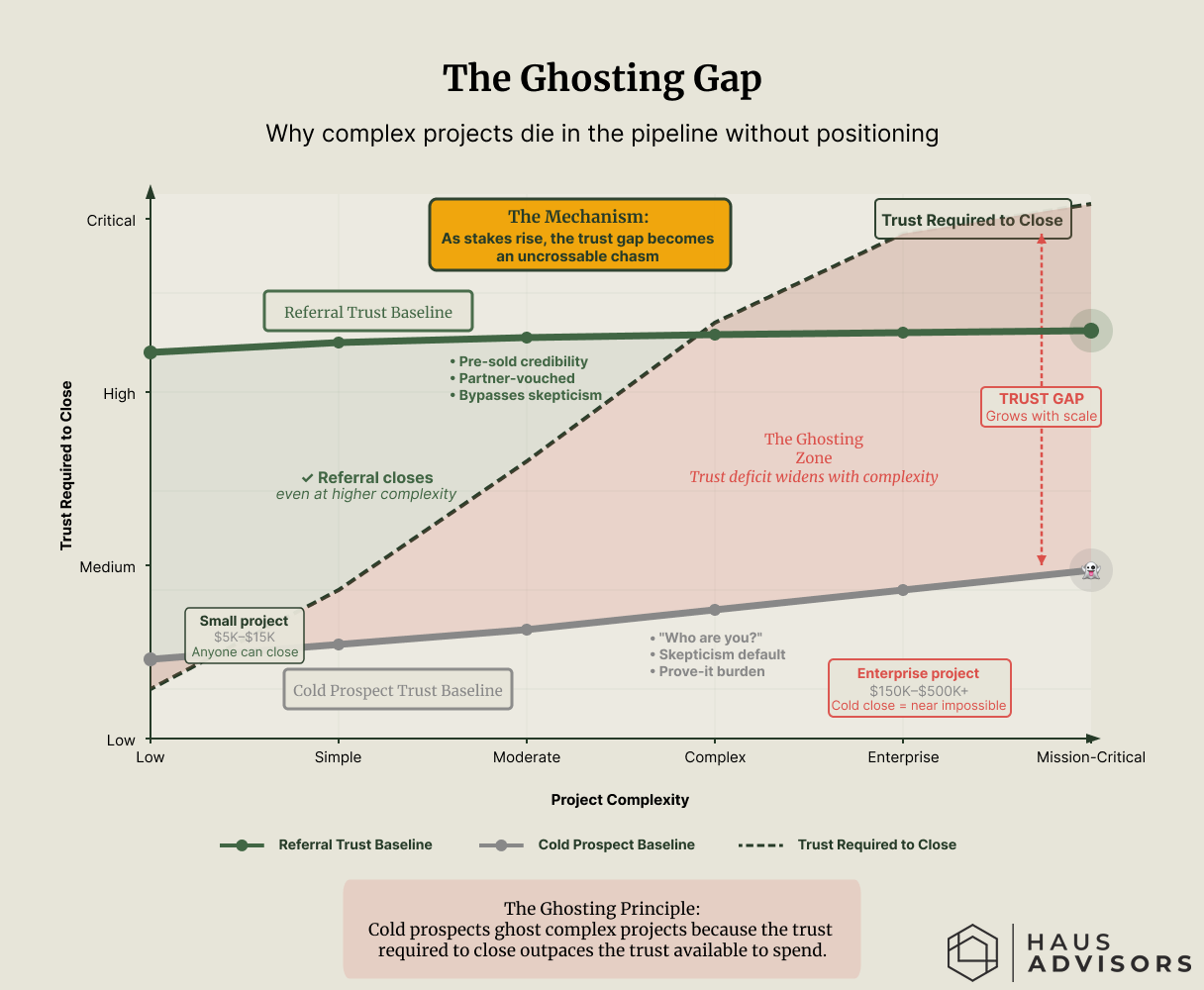
The ghosting threshold: Every engagement has a complexity level that requires a corresponding level of trust and clarity. When the complexity of what you're proposing exceeds the clarity you've established, the prospect enters the Decision Vacuum. They want to move forward but can't. They don't say no. They go silent. The gap between the complexity of your proposal and the clarity of your positioning is the ghost zone.
The Decision Vacuum is distinct from competitive loss. When a prospect chooses a competitor, they usually tell you (or you can infer it). When a prospect ghosts, they haven't chosen anyone. They're stuck. And the conventional response, more follow-up emails, doesn't fix the problem because the emails are downstream of the confusion. The confusion was created upstream, in the positioning, the sales conversation, and the proposal.
Three Types of Confusion That Produce Ghosting
Ghosting isn't one problem. It's three different types of confusion that each create the Decision Vacuum through a different mechanism.
Relevance Confusion: "I can't tell why you're different."
This is the most common type and the one most directly connected to positioning. The prospect had a good conversation but can't articulate to their team, their board, or even to themselves why your agency is the right choice compared to alternatives that cost less or promise similar outcomes.
The root cause: your value proposition sounds like every other agency's value proposition. "We build custom software" or "we're a trusted technology partner" gives the prospect no framework for making a decision. When they try to evaluate you against alternatives, the only differentiator visible to them is price, and you're not the cheapest. So the evaluation stalls.
This confusion is particularly acute when the prospect needs to sell the decision internally. A VP of Engineering who understands your technical depth might be personally convinced, but if they can't explain to their CEO in one sentence why your agency is worth $75K instead of the $25K offshore alternative, the internal conversation stalls. And when the internal conversation stalls, the external one goes silent.
The fix is positioning specific enough that the prospect can repeat it to their team. Not "they're a good dev shop" but "they specialize in fixing the exact onboarding conversion problem we have, and they've done it for six companies at our stage." That sentence survives the internal meeting. "They seem really talented" doesn't.
Process Confusion: "I don't understand what I'm buying."
The prospect is interested but can't clearly picture what the engagement looks like: what happens first, what they'll receive, how long it takes, what it costs, and what their involvement will need to be. The proposal is either too vague (a capabilities overview with a large number at the bottom) or too detailed (a forty-page scope document that overwhelms rather than clarifies).
Two specific versions of process confusion produce the most ghosting:
Pitch shock. The prospect's expectations, set by your website or initial conversation, don't match the proposal. They expected a $20K engagement and received a $75K proposal. Not because the price is wrong, but because nothing in the process prepared them for the scope. The gap between expectation and reality creates an awkward situation the prospect would rather avoid than confront.
Stakeholder mismatch. The prospect you've been talking to isn't the only decision-maker. The CTO who loved your technical approach needs to get buy-in from the CEO who cares about ROI and timeline, or the CFO who cares about cost structure and payment terms. Your proposal speaks to the technical stakeholder but provides nothing the business stakeholder can evaluate. The internal conversation stalls because different people in the buying group need different answers, and your materials only provided one set.
The fix has two parts. First, surface pricing expectations early. Include "engagements typically start at X" language in the first conversation or on your website. This prevents pitch shock by calibrating expectations before the proposal. Second, design your proposal to address multiple stakeholders: a business case summary for the CEO/CFO and a technical approach section for the CTO. Give the internal champion the ammunition they need to sell the decision to the people who weren't on the call.
Risk Confusion: "I can't assess whether this is safe."
The prospect understands what you do and can see the value. But hiring an agency is a high-stakes career decision. If the project fails, they lose budget, time, and potentially their credibility within the organization. The prospect can't determine from your sales process whether the risk is manageable.
This confusion is especially powerful in development agency sales because the deliverable is intangible until delivery. The prospect can't evaluate the product before they buy it. They're making a commitment based on trust and signals, and if those signals don't explicitly address risk, the prospect's default is caution. Caution, in a sales process, looks like ghosting.
The specific risks the prospect can't assess: What happens if the project goes over budget? What happens if the timeline slips? What's the process for scope changes? How have you handled similar problems in the past? What does the first month look like in practice? If your sales process doesn't answer these questions proactively, the prospect carries the uncertainty silently. And uncertainty, like confusion, produces inaction.
The fix is making risk management visible. Not buried in contract terms. Visible in the sales conversation. Describe your process for handling scope changes. Show case studies that include the challenges that arose and how they were resolved, not just the polished outcome. Offer a low-risk entry point (a productized audit or diagnostic sprint) that lets the prospect experience your work before committing to a large engagement. The entry point doesn't just lower the financial risk. It lowers the career risk, which is what actually produces the commitment.
Why Follow-Up Doesn't Fix the Decision Vacuum
Because follow-up addresses the symptom (silence) without addressing the cause (confusion). A "just checking in" email to a confused prospect reminds them that they're confused. It doesn't resolve the confusion. A "wanted to see if you had any questions" email assumes the prospect can articulate what they're unclear about. Usually they can't. The confusion is diffuse, not specific.
The only follow-up that actually works in the Decision Vacuum is follow-up that adds clarity. A case study showing how you solved the exact problem the prospect described, with quantified outcomes, resolves relevance confusion. A one-page summary of "what the first 30 days look like" resolves process confusion. A client testimonial that specifically mentions how you handled a scope change or timeline challenge resolves risk confusion.
Each piece of follow-up should close one of the three confusion gaps. If the follow-up doesn't add clarity, it's just noise that reminds the prospect they couldn't make a decision.
The Honest Objection
Here's the strongest argument against this diagnosis: sometimes prospects ghost because they're busy, lost budget, had priorities shift, or simply chose someone else and didn't bother telling you. Not every ghost is a confused ghost. Some are just gone.
That's true. External circumstances kill deals regardless of positioning quality. Not every ghost is recoverable.
Where That Logic Hits a Wall
But here's the boundary: if ghosting is happening consistently, across many prospects, the common denominator isn't their circumstances. It's your process. One ghost is bad luck. A pattern of ghosting is a signal that the Decision Vacuum is active in your sales process. The specific type of confusion may vary by prospect, but the structural condition (insufficient clarity relative to the complexity of what you're proposing) is consistent.
The agencies I've watched reduce their ghosting rate didn't improve their follow-up sequences. They improved the three upstream inputs: positioning specific enough to survive internal meetings, proposals structured for multiple stakeholders with early pricing signals, and risk made visible through entry-point offerings and transparent process documentation. When these inputs are strong, the follow-up conversation changes from "just checking in" to "here's the next step whenever you're ready." And prospects who have clarity don't ghost. They either say yes or they say no. Both are better than silence.
The Next Step
You don't need to overhaul your sales process. You need to diagnose which type of confusion is producing the ghosting.
Start here: look at your last five prospects who went silent. For each one, ask three questions:
Could the prospect explain to their team, in one sentence, why your agency was the right choice? If not, relevance confusion is active.
Did the prospect have a clear picture of what the engagement would look like, what it would cost, and what their involvement would need to be before the proposal arrived? If not, process confusion is active.
Did your sales process explicitly address what happens when things go wrong (scope changes, timeline slips, budget overruns)? If not, risk confusion is active.
Whichever question produces the clearest "no" is your primary ghost zone. Fix that type of confusion first. Then check whether the ghosting rate changes.
The prospects who go silent aren't saying no. They're saying "I can't say yes with what you've given me." Give them enough clarity, and the silence turns into a decision.
The principle is simple:
There are agencies that respond to ghosting with more follow-up, and there are agencies that respond to ghosting with more clarity.
The first group sends five emails and hears nothing. The second group sends one case study and gets a meeting.
Most founders reading this already know the real problem. It isn't your follow-up sequence. It's that the reputation, the relationships, and the judgment that make your agency worth hiring still live in your head. So the business only grows when you're in the room. And the clarity a prospect can repeat to their team is the same clarity your team needs before they can sell without you.
That's the work we do at Haus Advisors. The New-Business Engine is six months of implementation, not a strategy document. We pull what makes your agency relevant out of your head, build it into positioning, offers, and growth plays your team can run, and hand ownership to them. If you want an agency that grows without needing you in every deal, book a call to see if it's a fit.
Keep reading
Browse by topic
- Positioning & Strategy
- Lead Gen & Marketing
- Sales & Biz Dev
- Pricing & Productization
- Research & Data
- Operations & Delivery
- Client Retention & Expansion
- Leadership & Culture
For founders whose agency has outgrown referrals.
One idea a week that makes a hard growth problem obvious, usually with a chart that shows you the mechanism behind it.
Built from conversations with seventy-plus agency founders on the Behind the Agency podcast.