Predictable Pipeline Isn't a Channel. It's an Operating Rhythm.
A founder showed me her pipeline spreadsheet last year. It was empty. Not thin. Empty. Zero active opportunities. Zero conversations in progress. The last entry was from eleven weeks earlier.
She wasn't new to this. Her agency had done $2.4M the previous year. She had a strong reputation, loyal clients, and a team of twelve. But she'd spent the last quarter fully booked, delivering a large engagement that consumed her time and attention. During that period, she'd published nothing, attended no events, had no partnership conversations, and sent no outreach. The pipeline wasn't empty because she'd failed at lead generation. It was empty because she'd stopped doing the work that fills it.
Eleven weeks of zero pipeline activity had produced zero pipeline. The math was obvious once you looked at it. But during those eleven weeks, she hadn't been looking at it. She was delivering.
This is the most common version of the predictable pipeline problem. The founder doesn't need a better channel. They need a rhythm that continues regardless of delivery load. The pipeline dies not because the lead gen approach is wrong, but because the lead gen approach is intermittent.
For a deeper look at breaking founder-led sales specifically, see ng.
The Pattern Has a Name
I call it The Intermittency Problem: the structural condition in which pipeline generation is treated as a project (something you do when you need it) rather than an operating rhythm (something that runs continuously). The result is a pipeline that reflects the founder's availability rather than the market's demand. Busy quarters produce empty pipelines. Empty pipelines produce panic quarters. The cycle repeats.
I've written elsewhere about the Utilization Trap, which describes the mechanism: full capacity eliminates the time and motivation for demand generation, creating the conditions for the next revenue crash. The Intermittency Problem is the operational expression of that mechanism. It's not about why pipeline activity stops. It's about what to build so that it doesn't.
The distinction matters because most founders who recognize the Utilization Trap respond with willpower: "I'll make sure to keep marketing even when we're busy." Willpower doesn't work. When the largest client is demanding your attention and the team needs your guidance on a complex delivery, the thing that produces no immediate consequence (pipeline activity) will always lose to the thing that produces immediate consequence (client satisfaction). Every time.
Predictable pipeline requires a system that operates independently of the founder's willpower. Not a channel. Not a tactic. A rhythm with defined activities, assigned ownership, and a cadence that continues whether the founder is available or not.
Why Agencies Confuse Channels With Predictability
Because every piece of lead gen advice focuses on what to do: try cold email, run LinkedIn ads, build an SEO content engine, activate partnerships. The advice assumes that finding the right channel solves the predictability problem.
It doesn't. A channel that's active for six weeks and then dark for twelve weeks produces less total pipeline than a modest effort maintained consistently over the full eighteen weeks. The consistency of the input matters more than the intensity of the input. An agency that publishes one positioning-specific article per month, has one active partnership producing three introductions per quarter, and sends ten personalized outreach messages per week will generate more predictable pipeline than an agency that runs a $20K cold email campaign for two months and then stops.
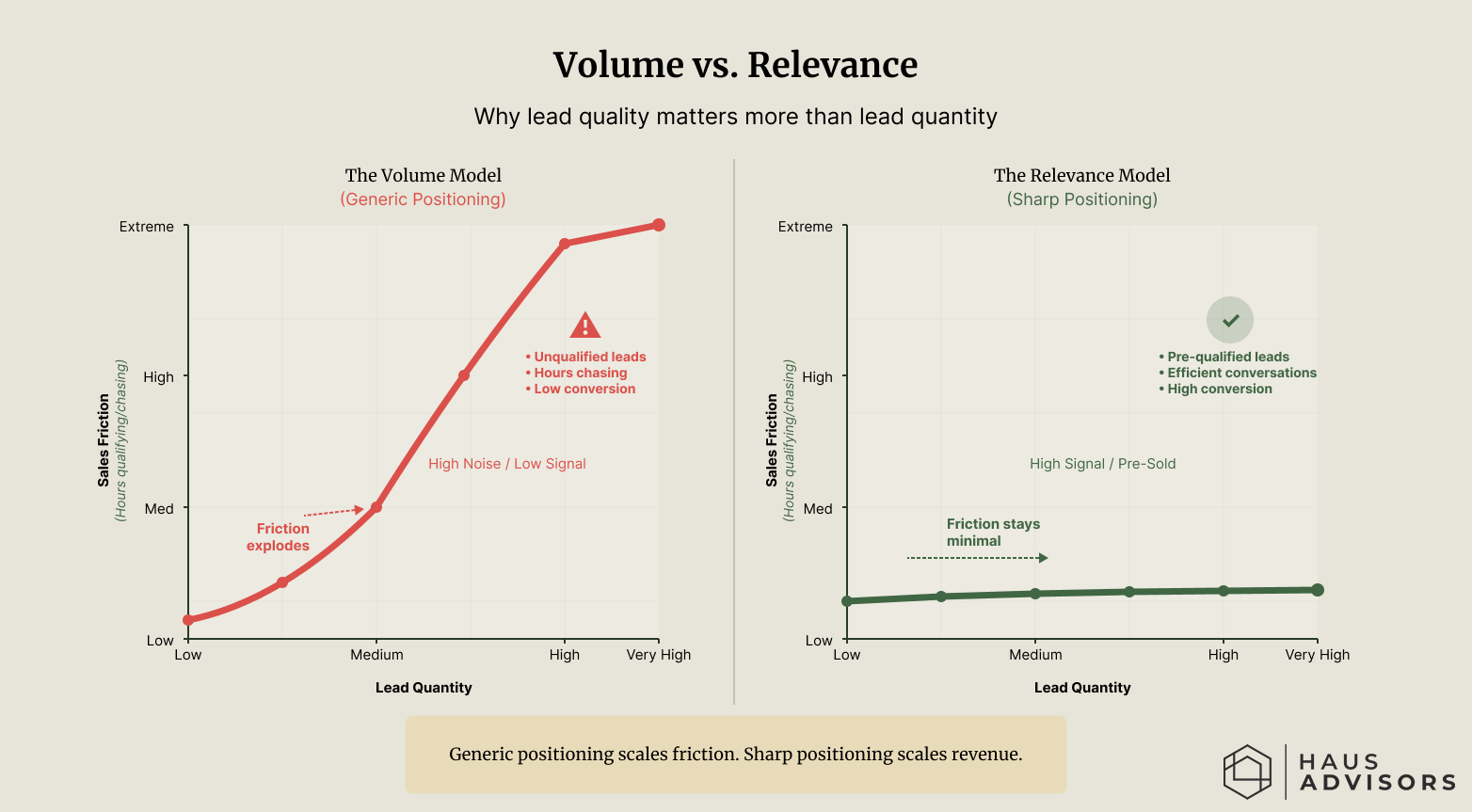
The scaling difference: When positioning is generic, adding more leads just adds more noise. Discovery calls take longer, close rates drop, and senior talent time gets consumed by unqualified conversations. When positioning is sharp, each additional lead is pre-qualified by the specificity of the signal. Volume and quality scale together. This is why relevance-driven pipeline is sustainable and volume-driven pipeline is exhausting.
The channel matters. But the rhythm of operating the channel matters more. The founder who asks "what channel should I use?" is asking the wrong question. The right question is "what activities can I sustain every week regardless of delivery load?"
The Pipeline Coverage Math
Before building the rhythm, you need to know what "enough" looks like. Most agencies operate without pipeline targets, which means they have no way to know whether their current activity level is sufficient until the pipeline is already empty.
The math is straightforward. Start with your quarterly revenue target. Divide by your average deal size to get the number of deals you need to close. Divide by your historical close rate to get the number of qualified conversations you need. Multiply by three to four for pipeline coverage (the standard buffer that accounts for deal slippage, timing delays, and lost opportunities).
Example: if you need $300K in quarterly revenue, your average deal is $75K, and you close 25% of qualified conversations, you need 16 qualified conversations to close 4 deals. At 3x coverage, you need roughly 48 opportunities in various pipeline stages at any given time.
That number gives you a target. If your pipeline coverage drops below the threshold, the rhythm needs to increase. If it stays above the threshold even during busy periods, the rhythm is working.
Most agencies I work with have never calculated this number. They've never quantified how many conversations they need or what activity level produces those conversations. They operate on feel: "the pipeline seems okay" or "the pipeline feels thin." Feel is not a forecast. The math gives you an early warning system that triggers before the pipeline is empty.
Building the Operating Rhythm
The rhythm has four components. Each one operates on a defined cadence with assigned ownership. The founder may participate in some or all of them, but the rhythm cannot depend on the founder's availability to function.
Weekly content output. Not "blog posts." Positioning-specific content that demonstrates diagnostic expertise to your target buyer. The cadence matters more than the volume. One article per month that speaks directly to your ICP's problem is more valuable than four generic posts per month that speak to nobody in particular. The key constraint: the publishing cadence cannot stop during busy delivery periods. If the founder writes the content, this means batching content during lighter periods. If a team member or external writer produces the content, this means the brief and editorial direction are documented well enough that the founder's involvement is review only.
Weekly outreach activity. Not cold spam. Personalized, positioning-specific outreach to prospects experiencing the trigger events that indicate they need your service. The volume should be modest (ten to fifteen per week) and the targeting should be precise (specific companies at specific stages facing specific challenges). The outreach carries the same positioning signal as your content. It's not "we build software." It's "we noticed you just raised your Series B and your onboarding completion rate suggests the kind of technical debt pattern we specialize in resolving."
Monthly partnership maintenance. At least one structured conversation per month with each active strategic partner. Not a vague "let's catch up." A defined review: how many introductions were made in each direction, how many converted, whether the referral criteria need updating. Partnership introductions are the highest-converting lead source most agencies have access to, and they die from neglect faster than any other channel. The monthly cadence prevents the drift that turns active partnerships into dormant LinkedIn connections.
Quarterly pipeline review. A structured analysis of pipeline health: coverage ratio against target, conversion rates by source, average deal velocity, and a specific diagnosis of any stalled opportunities. The quarterly review isn't just measurement. It's the calibration mechanism that tells you whether the rhythm is producing enough activity or needs adjustment.
Transitioning From Referrals Without Creating a Gap
The biggest operational risk in building predictable pipeline is the gap between "referrals are my only source" and "the new system is producing." If you shut off referral-dependent behavior before the new rhythm is producing, you create a pipeline vacuum during the transition.
The transition should be additive, not substitutive.
Don't replace referrals. Systematize them. Your existing referral relationships aren't random. They follow patterns: specific people refer you because of specific experiences. Document those patterns. Identify the ten people who have referred you in the past two years. Understand what triggered each referral. Then nurture those relationships intentionally rather than hoping they remember you. A quarterly check-in with your top ten referral sources, where you update them on your work and ask about their clients' upcoming needs, converts passive referrals into semi-structured introductions.
Layer one channel at a time. Don't launch content, outreach, and partnerships simultaneously. Pick the channel where you can establish a rhythm fastest (usually partnerships, because a single well-structured partnership can produce introductions within weeks) and get it running consistently before adding the next channel. Each channel you add increases the total pipeline input, which reduces your dependency on any single source, including referrals.
Use existing clients to validate new positioning. Before broadcasting new positioning to the market, test it with current clients. Tell them: "We're focusing specifically on [problem] for [buyer type]. Does that match your experience of working with us? Who in your network faces that challenge?" This accomplishes two things: it validates that the positioning resonates with people who've experienced your work, and it generates warm introductions from people who can now describe you specifically rather than generically.
The Honest Objection
Here's the strongest argument against maintaining a continuous pipeline rhythm: the founder is already maxed out. Adding weekly content, outreach, and partnership maintenance to a calendar that's already consumed by delivery and management feels impossible. The founder can't do more.
That's not an objection to the rhythm. That's an indication that the founder is the bottleneck, which is exactly the problem the rhythm is designed to solve.
Where That Logic Hits a Wall
The operating rhythm doesn't require the founder to do everything. It requires the founder to own the rhythm's design and then distribute the execution. Content can be drafted by a team member or contractor with the founder reviewing and approving. Outreach can be executed by a junior team member following a documented targeting and messaging brief. Partnership conversations can be maintained by anyone on the team who understands the referral criteria and can have a structured check-in.
The founder's role in the rhythm is architecture, not execution. They define the positioning signal, the outreach criteria, the partnership parameters, and the content direction. The team executes. The rhythm runs. The pipeline stays active even when the founder is consumed by delivery.
This is the operational difference between founder-dependent growth and system-supported growth. The first stops when the founder gets busy. The second continues because the system was designed to operate without the founder's daily involvement.
The Next Step
You don't need to build a four-channel pipeline engine this quarter. You need to test whether the Intermittency Problem is active in your business.
Start here: look at the last twelve months of your pipeline activity. Mark the months where you were actively generating demand (publishing, outreach, partnership conversations, networking). Then mark the months where demand generation stopped because delivery consumed your time.
If you see a pattern of activity bursts followed by silence, the Intermittency Problem is active. Your pipeline reflects your availability, not the market's demand. And the next revenue dip is already being built during the current busy period.
The fix is one rhythm, maintained weekly, that doesn't stop. Start with the single activity that's easiest to sustain: a monthly content piece, a weekly outreach block, or a quarterly partnership check-in. Make it non-negotiable. Protect it the way you protect a client delivery deadline. When it survives its first busy period without being deprioritized, you'll have the proof that the rhythm works. Then add the next activity.
Predictability isn't a channel you discover. It's a discipline you maintain.
The principle is simple:
There are agencies that generate pipeline when they need it, and there are agencies that generate pipeline whether they need it or not.
The first group is always one lost client away from panic. The second group forecasts with confidence.
At Haus Advisors, we help dev shops and technical agencies build the operating rhythm that produces predictable pipeline: positioning that gives the rhythm a clear signal, productized offerings that give conversations somewhere to go, and a weekly cadence that continues regardless of delivery load. If your pipeline goes empty every time you get busy, the rhythm is what's missing. Book a strategy call here →
Keep reading
Browse by topic
- Positioning & Strategy
- Lead Gen & Marketing
- Sales & Biz Dev
- Pricing & Productization
- Research & Data
- Operations & Delivery
- Client Retention & Expansion
- Leadership & Culture
For founders whose agency has outgrown referrals.
One idea a week that makes a hard growth problem obvious, usually with a chart that shows you the mechanism behind it.
Built from conversations with seventy-plus agency founders on the Behind the Agency podcast.