Value-Based Pricing for Professional Services: Why It Won't Work at Your Agency Until You Do This First
A dev shop founder I worked with had done the reading. He'd listened to the episodes, read the guides, and believed in value-based pricing for professional services intellectually. So he tried it.
He went into a proposal for a $90K custom data pipeline build and reframed everything around business outcomes: reduced reporting time, faster decision cycles, estimated revenue impact over 18 months.
The prospect nodded through the whole conversation.
Then he asked what other firms had quoted. There were two others. Both were quoting time-and-materials. One came in $30K lower.
The dev shop founder lost the deal. He called me the next week and said: "I think value-based pricing just doesn't work in our space."
It wasn't the space. It was the sequence.
Most agency founders who try value-based pricing for professional services run the same play: they have an abstract "value conversation" with a prospect, quote a project price anchored to ROI, and lose the deal to a competitor billing hourly. The mistake isn't your pricing math. It's trying to deploy value-based pricing as a negotiation tactic before doing the hard positioning work that makes clients willing to pay a premium. Value-based pricing isn't a trick you layer onto an interchangeable service. It's the structural outcome of radical differentiation. Here's how to build the prerequisite foundation so you can finally stop tracking hours.
Why Value-Based Pricing Fails at Most Agencies (And Why It's Not Your Fault)
Here's the thing none of the guides tell you: value-based pricing for professional services can't work if your clients see you as interchangeable.
When a prospect is talking to four agencies and all four can handle the scope, the buying decision defaults to price. It will always default to price. Not because the prospect is cheap, and not because you ran the value conversation wrong. Because there's no perceived reason to pay more for your version of the same thing.
This is the flaw in every article about value-based pricing that ranks above this one. They all give you the framework — anchor to outcomes, quantify the ROI, present options — as if the framework is the thing standing between you and better margins. It isn't. The framework is downstream of the positioning. You can't price based on value that the buyer can't yet see.
What "being positioned" actually looks like in practice: you have a defined niche, a specific problem you solve better than anyone else, and a track record of specific, nameable outcomes. Not a specialty listed on a website ("we focus on B2B SaaS"). Something that makes a specific type of buyer think "that's exactly the firm I need" before they've ever spoken to you.
Here's the diagnostic: are your prospects comparing you to other agencies on scope and price? If yes, you don't have pricing power yet. That's a positioning gap, not a pricing gap. No amount of ROI math in a proposal will close it.
The Positioning Prerequisite: What Has to Be True Before Value-Based Pricing Works
Pricing power is a structural outcome of specialization. It's not a negotiation skill.
I've watched founders practice the value conversation for months, get coaching on it, refine the scripts, and still lose deals to cheaper generalists. Not because the founders weren't good at selling. Because the buyers didn't arrive pre-sold on why this specific firm was worth more.
Three markers that tell you the positioning is tight enough to support value-based pricing:
One: Clients come to you because of what you're specifically known for, not because they searched for agencies and you showed up. Inbound from "we heard you're the firm that does X" is fundamentally different from inbound from "we need X and found you." The first is pre-sold. The second is shopping. If you can't tell which one most of your leads are, that's the answer.
Two: You regularly turn down work that doesn't fit. Agencies that take everything they can get aren't positioned — they're surviving. Positioning requires saying no consistently enough that the market learns what you're actually for.
Three: Clients rarely ask "can you do this?" They already know you can. The conversation starts with availability and price, not capability.
The practical test: go to the websites of your top three competitors. Could any of them say the exact same things about themselves? If the answer is yes, the positioning isn't tight enough to support premium pricing. You're still selling a category, not a specialty.
Until those three markers are true, every value conversation you have will eventually slide back to scope and hours. Not because you're doing it wrong. Because the buyer has no framework for why you're worth more than the alternative.
The Indirect ROI Framework for Technical and Specialized Agencies
The biggest objection I hear from agency founders who want to implement value-based pricing: "Our work is too hard to quantify."
Usually this comes from dev shops, brand agencies, data consultancies, and content teams. They look at conversion optimization case studies — "we improved checkout conversion by 2.3% and generated $400K in additional revenue" — and conclude that kind of ROI chain doesn't exist for them.
It does. It just takes an extra step.
The Indirect ROI Framework maps your deliverable to a business outcome across two or three links in the chain. You're not claiming direct attribution. You're building a credible case for downstream impact.
Three links that work for technical and specialized agencies:
Revenue enablement: A dev shop builds a client portal that reduces onboarding time by three weeks. Faster onboarding means clients reach value sooner, which improves retention. On a $60K average contract value, even a 10% retention lift is $6K per client per year. You don't need a direct revenue attribution line. You need to walk the client through that chain out loud.
Competitive defensibility: A brand agency redesigns a SaaS company's positioning before a category competitor launches. The defensibility value is the delta between market share held and market share lost. Hard to put an exact number on. Not hard to make real in a conversation where the founder knows what a lost customer costs them.
Operational leverage: The work lets their team work faster or smarter. A data consultancy builds a reporting infrastructure that cuts weekly analyst time by six hours per person. At five analysts and a fully-loaded cost of $100K each, that's $150K in recaptured capacity per year. That's the anchor.
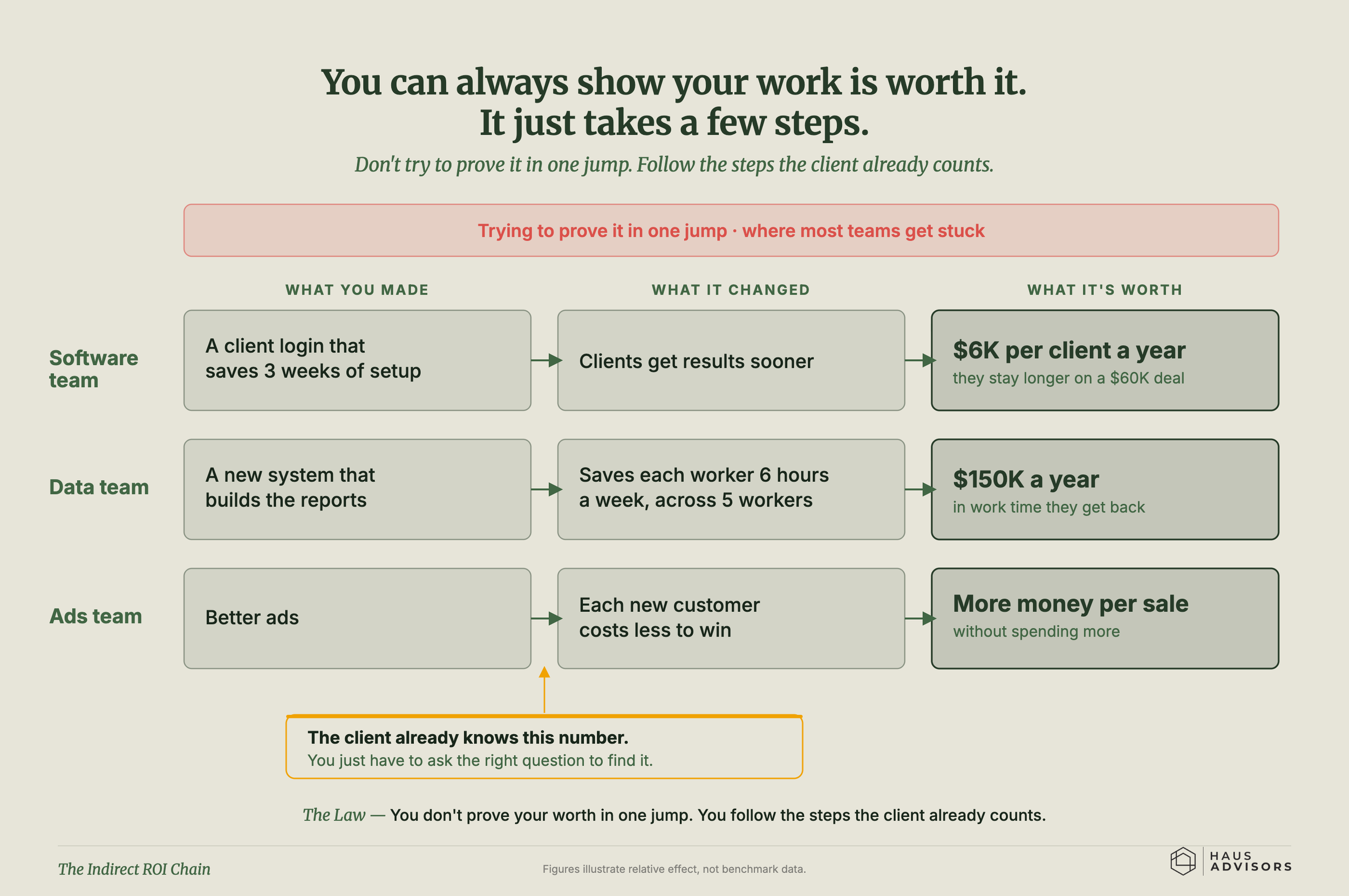
If you've ever said "our work is too hard to quantify," this is the framework that fixes that. You don't need direct attribution. You need two or three links in the chain.
When a client says "I'm not sure what this is worth," that's not a dead end. It's a signal to keep asking about business stakes. "What does your team spend time on that this would replace?" "What's the cost of making a decision on bad data versus good data?" "What happens in the business if this problem isn't solved in the next 12 months?" The Indirect ROI Framework gives you a path. The questions surface the numbers.
Anchoring the Anchor: How to Run the Discovery Conversation
Discovery isn't fact-gathering. It's a diagnostic. And it's where value-based pricing is actually won or lost — not in the proposal.
Your job in discovery: understand the problem deeply enough to know whether you can solve it, and help the client articulate the cost of not solving it. That second part is the one most agency founders skip. They gather requirements. They don't surface stakes.
The questions that surface business stakes:
"What happens in your business if this problem isn't solved in the next 12 months?"
"What would success look like to the person signing this?"
"What have you tried before, and why didn't it work?"
"Who else in the business feels the impact of this problem besides your team?"
These are diagnostic questions, not sales questions. The answers tell you whether the problem is painful enough to justify a premium engagement, and they give the client language to articulate the cost of inaction to themselves.
Then comes the anchoring sequence. You're not defending your price. You're confirming theirs.
Ask what the outcome is worth. Let them give a number or a range. Reflect it back. "So if we solve this well, the business impact is somewhere in the $400K to $600K range over the next 18 months — is that roughly right?" Let them confirm. Then anchor your fee against their number: "Our engagement would be priced at 10 to 15% of that impact. That puts us in the $40K to $60K range."
The 5–10x ROI Floor is the framework: once the client has named the value, use that multiplier to set the floor for your fee. A $500K recoverable outcome makes a $50K engagement a 10x return. You're not setting a price. You're confirming a rational investment.
One thing to adjust for: risk and certainty. If the attribution chain is indirect or the timeline is long, the multiple should reflect that. You're pricing confidence, not just potential.
Building Your Value-Based Offer Architecture
Getting the value conversation right is half the work. The other half is packaging your services so that the value conversation is built into the structure of the offer itself.
The problem with most agency pricing: it's a custom value conversation on top of a custom scope on top of custom delivery. Every engagement starts from zero. There's no architecture that makes the pricing repeatable or the value visible before the conversation happens.
Here's the three-tier model that works:
Tier 1 — The Diagnostic: A small, bounded engagement that establishes the value baseline and qualifies the client. For a dev shop, this might be a two-week architecture review. For a performance marketing agency, a paid media audit. Price it to filter, not to generate revenue. The point is mutual qualification. If you can't identify a clear opportunity in Tier 1, the larger engagement isn't right yet.
Tier 2 — Core Delivery: Where the main value is created. Price this at 10–20% of the quantified value identified in Tier 1. If the diagnostic identified $400K in addressable opportunity, Tier 2 should be priced in the $40K to $80K range. The diagnostic makes this number credible. It's not arbitrary — it's calculated.
Tier 3 — Results Retention: The ongoing relationship that captures value over time. This is where margin compounds. Consistent delivery to a client who has already seen your work, doesn't need re-qualification, and isn't comparing you to alternatives. The math on retainer economics is simpler than it looks: lower cost of sale plus higher retention equals the highest-margin work in your portfolio.
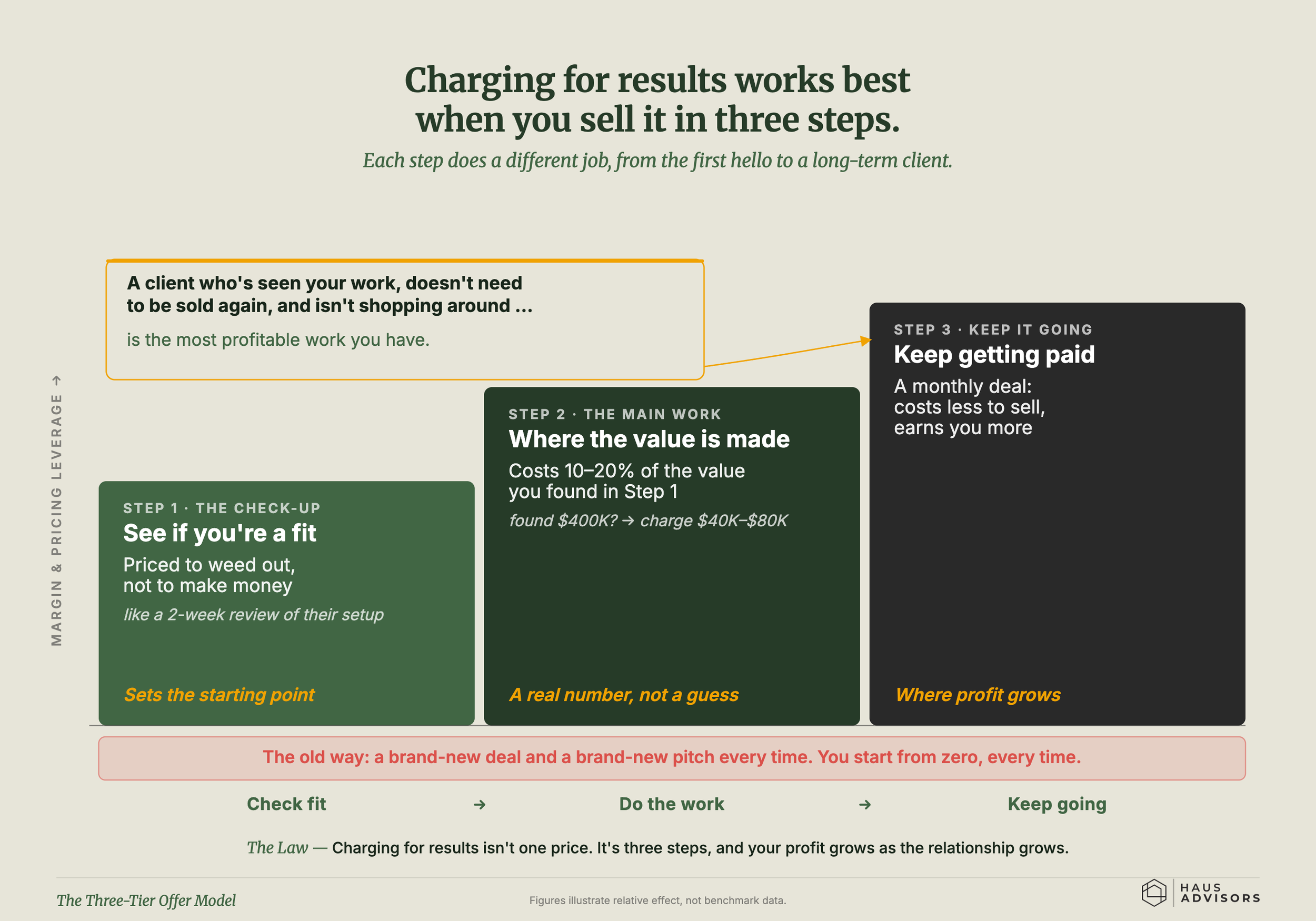
Most agencies run a custom value conversation on top of a custom scope on top of custom delivery, and start from zero every time. The three-tier model changes the architecture so margin compounds instead of resets.
One pattern to catch before it takes hold: if you find yourself saying "my hourly equivalent would be X, but I'm charging Y as a package" — that's cost-based pricing with a package wrapper. Value-based pricing is built from the client's value number, not your cost structure. If your starting point is hours, you haven't made the switch yet.
Presenting three options — Tier 1 only, Tier 1 + 2, full three-tier — anchors the client's perception of value and improves close rates without negotiating against yourself. The middle option closes most often. The top option makes the middle feel reasonable.
The Transition Playbook: Moving Existing Hourly Clients to Value-Based Pricing
Every guide on value-based pricing assumes you're starting fresh. Almost no agency founder is starting fresh.
You have existing clients on hourly or fixed-project arrangements. They have a mental model of what your work costs. Flipping to value-based pricing overnight breaks trust without explanation — and it usually fails, because long-term clients have two years of invoice data telling them what your work is "worth."
The transition sequence:
Apply value-based pricing to new clients only for the first 6–12 months. This builds your case study inventory and ROI data without disrupting existing relationships. New clients get the new model. Existing clients get continuity while you build the evidence base that makes the transition conversation credible. This isn't delay — it's sequencing.
Use renewal conversations to reopen the framing with existing clients. Don't announce a rate increase. Reopen the business conversation: "I want to make sure we're still solving the right problem and that our engagement structure makes sense given where your business is now." That's not a rate hike. That's a strategic account review. It leads naturally into a repackaged offer.
Convert tracked time into a defined outcome scope. Take the hourly arrangement and replace it with a scope defined by deliverables and outcomes rather than hours. Price the outcome at 10–20% of the value baseline you identify together. Eliminate time reporting from the relationship. This is a different offer, not a rebranded invoice.
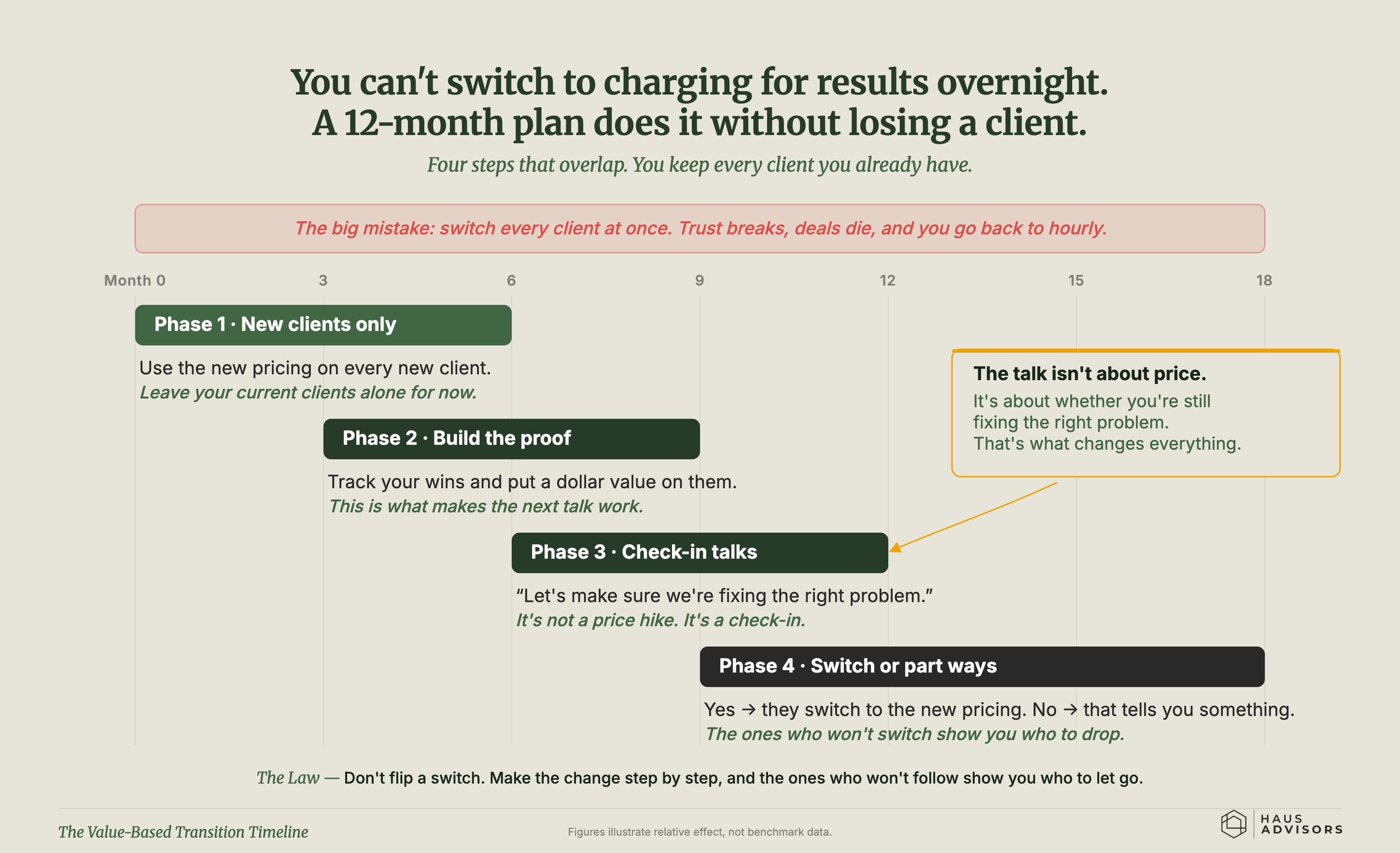
The most common mistake: flip all clients to value-based pricing at once. The result is broken trust and a fast retreat back to hourly. The sequenced approach takes 12 months and doesn't cost you a single client.
One more thing worth naming: if a client won't accept value-based pricing after a thoughtful transition attempt, pay attention to that signal. The clients most resistant to outcome-based pricing are often the ones creating the most margin pressure — they're tracking your hours and pushing back on scope. That's not a pricing problem. That's a client fit problem.
Repricing without changing the offer doesn't work. Value-based pricing requires a different conversation, a different proposal format, and different scope management. The offer has to change first.
How Haus Advisors Approaches Agency Pricing
The pricing work and the positioning work aren't separate projects. They're the same project.
Every founder who comes to Haus with a pricing problem turns out to have a positioning question underneath it. "I can't get clients to accept my rates" almost always means "clients don't yet see me as the obvious choice for their specific problem." The pricing is a symptom. The positioning is the cause.
Most founders reading this already know the real problem. It isn't the pricing model, and it isn't the ROI math. It's that the reputation, the relationships, and the judgment that make your agency worth hiring still live in your head. So you're the only one who can hold a price when a prospect pushes back, and the business only grows when you're in the room.
That's the work we do at Haus Advisors. The New-Business Engine is six months of implementation, not a strategy document. We pull what makes your agency relevant out of your head, build it into positioning, offers, and growth plays your team can run, and hand ownership to them. If you want an agency that grows without needing you in every deal, book a call to see if it's a fit.
One concept that connects all of this: the Stress Tax. When pricing is wrong — too low, too hourly, too dependent on volume — the agency has to run near full utilization just to cover costs. There's no margin for selectivity.
The founder takes projects that don't fit. The team delivers work below their capability. The feast-famine cycle locks in structurally. Getting pricing right doesn't just improve the P&L. It breaks the pattern.
Next Steps
Before you rebuild your pricing, run this check:
If you called your top three clients right now and told them your fees were going up 40%, how many would say "that's still worth it" without asking you to justify every line item?
If the answer is zero, the positioning work isn't done yet. Not because you're failing, but because positioning takes time and most agencies have never had a structured reason to do it deliberately.
If one or two would say yes without hesitation, you have pricing power with those clients already. The work is to understand why, name it, and make it the foundation of how you position everything else.
If all three would say yes, you're underpriced. That's the most actionable version of this problem and the fastest one to fix.
Whichever answer you got, the fix has the same shape. Positioning comes first, then pricing built on it, then a discovery script and an offer structure your team can hold without you on the call. If you want that built rather than described, that's what the New-Business Engine is for. Book a call to see if it's a fit.
The pricing conversation gets easier once the positioning is right. That's not motivation. It's just how the sequence works.
Keep reading
Browse by topic
- Positioning & Strategy
- Lead Gen & Marketing
- Sales & Biz Dev
- Pricing & Productization
- Research & Data
- Operations & Delivery
- Client Retention & Expansion
- Leadership & Culture
For founders whose agency has outgrown referrals.
One idea a week that makes a hard growth problem obvious, usually with a chart that shows you the mechanism behind it.
Built from conversations with seventy-plus agency founders on the Behind the Agency podcast.