Why Agency Founders Can't Break the Feast Famine Cycle (It's Not a Discipline Problem)
Most agency founders stuck in the feast famine cycle have already tried the obvious fix. They've blocked time for business development, committed to consistent outreach, and promised themselves they won't stop selling when client work gets heavy. It works for a few months. Then delivery peaks, the habits slip, and they're back in famine mode wondering what went wrong. The mistake isn't a lack of personal discipline or hustle. It's treating a structural business model flaw like a behavioral problem.
I've had this conversation with dozens of agency founders. The specifics change. The pattern doesn't.
A 12-person dev shop in Chicago. A performance marketing agency billing $900K per year. A data consultancy with three anchor clients and nothing behind them. All stuck in the same loop, all trying to fix it the same way, all getting the same result.
The fix isn't more hustle. The fix is understanding what's actually broken.
What the Feast Famine Cycle Actually Is (And Why the Name Matters)
The feast famine cycle isn't a seasonal slowdown. That distinction matters, because misdiagnosing it means treating the wrong thing.
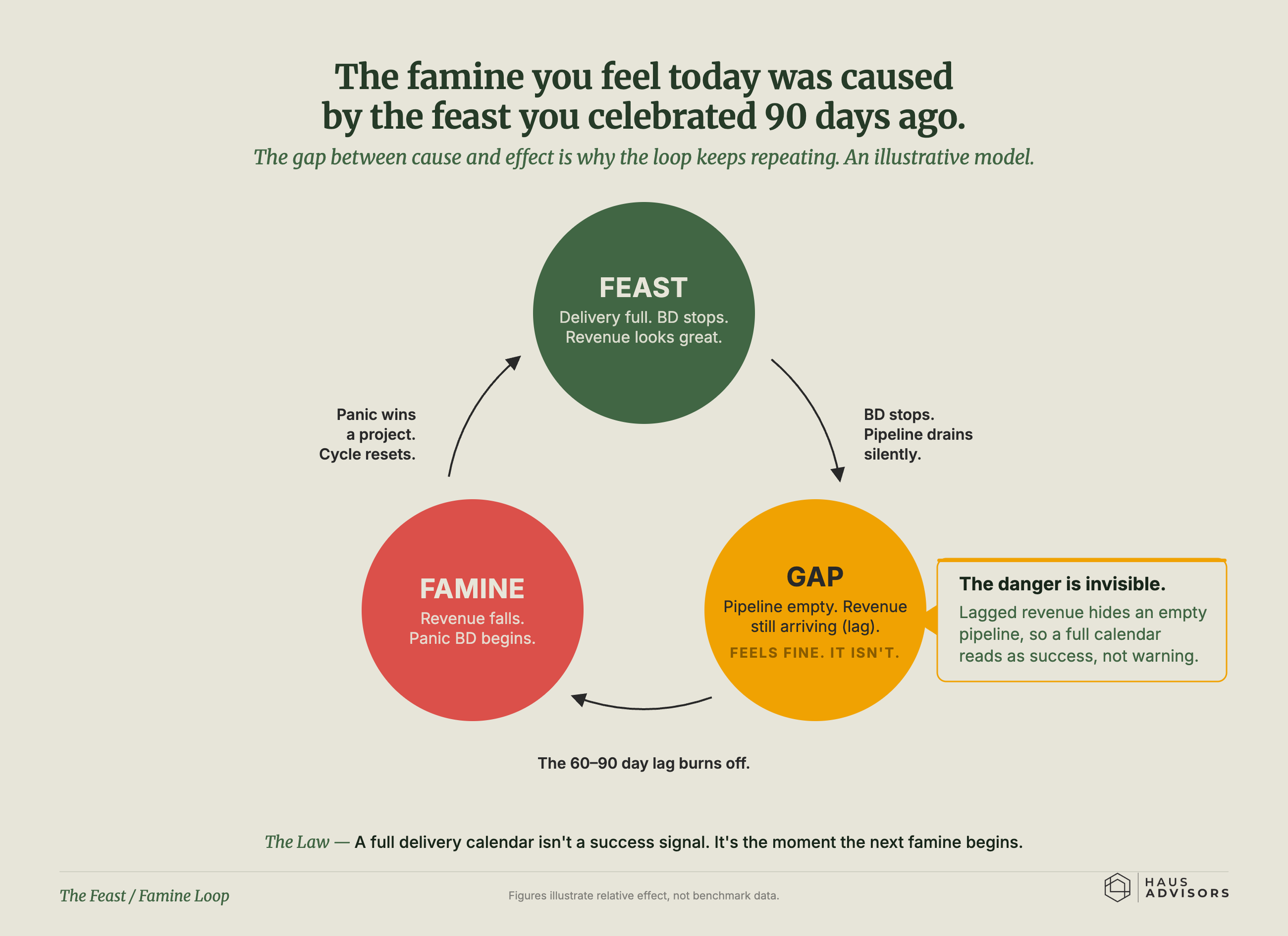
The cycle is self-reinforcing because it feels like success at every stage except the last. A full delivery calendar triggers the feast, which ends BD, which creates the gap — but lagged revenue makes the gap feel safe. By the time famine hits, the structural cause is three months in the past. The only way to break it is to treat the feast as a warning, not a reward.
Seasonal slowdowns are external. Your clients slow their buying in Q4. Budget cycles freeze in January. A particular industry goes quiet in summer. Those are real, but they're predictable and they affect your whole market at once.
The feast famine cycle is internal and structural. It runs on a 60 to 90 day lag, and it's built into the operating model of most agencies.
Here's the mechanism. During feast, delivery consumes all available bandwidth. The founder is deep in client work, the team is at capacity, and business development stops. Not intentionally. There's just no time and no urgency: revenue looks strong.
That's the Gap phase. Most founders don't notice it until it's too late. The pipeline is draining. No new conversations are starting. But the revenue is still coming in from current engagements, so everything feels fine.
Then the engagements end. Projects wrap. Retainers don't renew. And revenue falls off a cliff.
That's the Famine phase. Now the urgency is back. The founder returns to frantic outreach, cold emails, reactivating old relationships, chasing any lead that looks warm. That panic selling eventually produces new clients. Delivery ramps back up. And the cycle repeats.
The reason it feels sudden is the lag. The famine you're experiencing today was caused by the feast you had 90 days ago. It didn't sneak up on you. You were building it the entire time your calendar was full.
This is why the feast or famine cycle is so difficult to escape through willpower alone. By the time you feel the problem, you're already 90 days behind on the solution.
Why "Be More Consistent" Doesn't Fix It
Every piece of advice aimed at the feast famine agency says the same thing: be more consistent with business development. Block time every week. Don't let delivery crowd out selling. Treat pipeline like a client.
That advice is right for a freelancer. It's incomplete for an agency with structural constraints.
There's a difference between a behavior that's hard and a behavior that the system makes impossible. Telling a founder billing at 85% utilization with no BD staff to "stay consistent" is like telling someone with a broken leg to walk it off. The instruction isn't wrong in theory. It just ignores what's actually in the way.
The pricing trap is the first constraint. Underpriced agencies need near-100% utilization to hit their revenue targets. When you do the math on an agency running $600K ARR at too-low rates, there's no slack in the model. Every hour has to be billed. That guarantees there's no margin for business development, no room for strategic thinking, no capacity to build the next thing while delivering the current one.
The delivery model trap is the second constraint. Founders who are still the primary delivery resource on client engagements can't separate selling from doing. They're not failing to make time for BD because they lack discipline. They're failing because they're legitimately irreplaceable in the delivery process, and removing them from it would break the work.
The third constraint is positioning. Agencies without a clear niche have no word-of-mouth flywheel. When a former client can't describe you in a single sentence to a peer, they don't refer you. So the only way to generate leads is active outreach. Active outreach requires time. Time that disappears when delivery is heavy.
"Be more consistent" is the right answer when the system can support the behavior. Most agency founders are being told to behave their way out of a structural problem.
The Three Root Causes (Diagnose Before You Prescribe)
Every agency I've worked with that's stuck in the feast famine cycle has at least one of three root causes. Most have all three. The fix depends on the diagnosis, not a generic prescription.
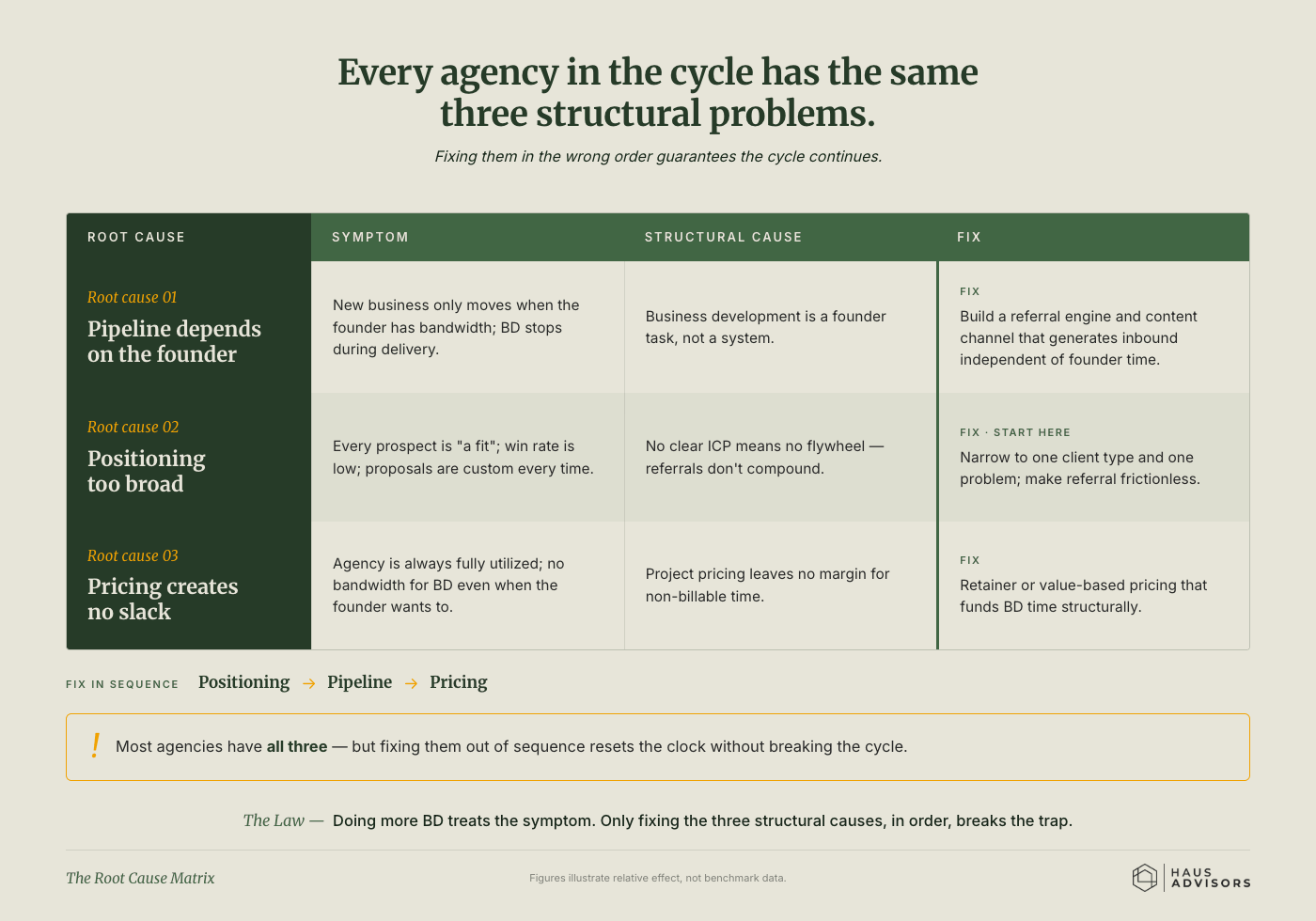
The three root causes of the feast/famine cycle are structural, not behavioral — they don't go away with more effort or better intentions. Each cause has a specific fix, but the sequence matters: positioning must come before pipeline, and pipeline before pricing, because each fix creates the conditions the next one requires. Skipping steps or treating them as parallel tracks is why most "BD pushes" fail to break the cycle.
Root Cause 1: The pipeline depends entirely on the founder.
Signs: leads come from the founder's personal network; when the founder is in delivery mode, leads stop arriving; there's no documented lead source, no intake process, no one else who can advance a conversation.
I talked to a founder last quarter whose agency did $1.1M the prior year. Every client had come from his LinkedIn network or a direct referral. When I asked what would happen to pipeline if he took a two-week vacation, he paused for a long time before answering. He knew.
The constraint here isn't effort. It's architecture. A pipeline that requires the founder's continuous personal attention is a single point of failure. Fix it by building a system that generates and advances leads without requiring the founder to personally initiate every conversation.
Root Cause 2: Positioning is too broad to generate pull.
A dev agency that says yes to e-commerce, SaaS, internal tools, and mobile apps has no natural referral engine. Their former clients can say "they do good work," but they can't say who to send. The referral dies because the referrer can't match them to the right opportunity.
Sharp positioning changes that equation. When a former client can say "if you're a fintech startup with a compliance-heavy integration project, these are your people," the referral lands. That sentence only exists when the agency has made a real choice about who they serve and what problem they solve.
Root Cause 3: Pricing creates no slack.
A performance marketing agency fully utilized at $600K ARR but unable to hire has a pricing problem. They're not growing because they can't afford to. They need one more client to afford the hire, but they don't have capacity to take on one more client, and they don't have time to sell one.
That's not a revenue problem. That's a pricing model forcing a ceiling. Fixing it requires a structure that builds margin for BD, for strategic thinking, and for the management layer the agency needs to scale.
The Stress Tax: The Hidden Cost You're Not Counting
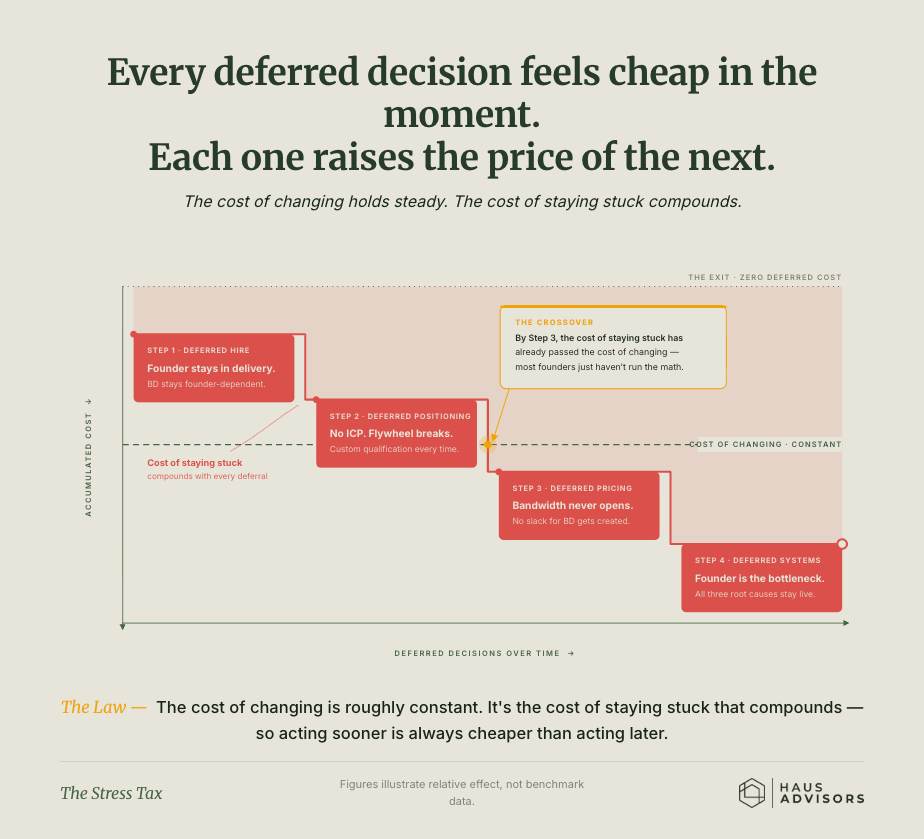
The Stress Tax is not a fixed cost — it compounds. Each decision a founder defers to survive the current quarter locks in the structural cause of the next crisis. The cost of changing (hiring, repositioning, repricing) stays roughly constant, but the cost of staying stuck grows with every cycle. Most founders who finally make the change report that it was easier than expected — the size of the gap was the illusion, not the reality.
The feast famine cycle doesn't just cost revenue. It costs decision quality.
Founders running in permanent uncertainty filter every potential investment through the same question: what if we hit famine? The answer is almost always some version of "wait."
Wait to hire. Wait to raise prices until the timing feels safer. Wait to fire the difficult client until a replacement is lined up. The infrastructure that would actually fix the constraint gets deferred again.
That pattern is what I call the Stress Tax. It's the aggregate cost of running an agency in permanent uncertainty.
The Stress Tax compounds. Every deferred hire means the founder stays in delivery longer, which means the pipeline stays founder-dependent, which means the next famine is already being built. Every deferred positioning decision means the referral flywheel stays broken. Every avoided pricing conversation means the slack never gets created.
Here's the irony: the caution feels protective. It isn't. The hesitation that feels like prudent financial management is often exactly what causes the next famine.
When I sit down with a founder and ask them to walk me through the decisions they've deferred in the last 12 months, the number is staggering. Not just the direct cost of what wasn't built or hired. The compounded value of what could have been built if the constraint had been removed 18 months ago.
The Stress Tax is invisible because it doesn't show up on a P&L. But it's real, and for most agencies I work with, it's the single largest cost in the business.
What Actually Breaks the Cycle
The feast famine cycle breaks when you fix the structural constraint, not when you improve the founder's habits.
Fix 1: Systematize the pipeline so it runs without the founder.
This means a documented weekly outreach cadence, clear lead sources with defined volume targets, and a process for advancing prospects that doesn't require the founder to personally quarterback every step.
The goal isn't to remove the founder from sales. It's to make sure the pipeline doesn't stop when the founder is deep in delivery. Even a modest systematization, where someone else is tracking leads and the founder reviews weekly instead of managing daily, creates meaningful resilience.
Fix 2: Sharpen positioning so referrals compound without active selling.
When former clients can describe you in a single, specific sentence, word-of-mouth becomes pull instead of push. The referral arrives without you asking for it, because the referring party knows exactly when to send someone your way.
This is the highest-leverage move for most agencies, and the one they're most resistant to. It requires saying no to work outside the positioning. That's uncomfortable when you're in famine mode. It's the only way out.
Fix 3: Reprice to create slack.
Even a 15 to 20% pricing increase can shift utilization targets enough to unlock 3 to 4 hours per week for business development without changing founder behavior at all. That math is worth running before trying to discipline your way to consistency.
Most agency founders underestimate what the market will bear. Not because they're uninformed, but because they haven't built the confidence to hold the conversation when a prospect pushes back.
When pricing creates slack and positioning creates pull, BD habits become sustainable. Not because the founder became more disciplined. Because the system finally supports the behavior.
Common Mistakes to Avoid
Founders who recognize the feast famine cycle usually try to solve it. The instinct is right. The execution often makes things worse.
More hustle. Running a harder outreach push during famine produces temporary leads. It doesn't address the structural cause. The next feast arrives on the same 90-day lag.
Hiring a BD person before fixing positioning looks like a hiring failure when it doesn't work. It's a positioning failure. A BD hire can execute outreach, but they can't generate pull from a positioning that doesn't resonate. If you can't close deals with your own personal credibility, adding a BD person won't fix the underlying problem.
Raising prices without updating the value conversation. This is subtler. Founders who raise rates but haven't rebuilt their positioning to justify them cave under pressure. The rate goes back down. The slack never gets created.
Treating the cycle as seasonal is a misdiagnosis that leads to waiting for external conditions to improve. The feast famine cycle is structural. Waiting for the market to improve is how founders stay stuck for years.
Fixing symptoms instead of constraints. Rebuilding the website. Running LinkedIn ads. Optimizing the CRM. All of these can produce short-term activity. But they work against the current if the underlying constraint is pricing or positioning. You're adding more water to a leaky bucket.
How Haus Advisors Approaches the Feast Famine Cycle
The feast or famine problem is the most common constraint I see in independent agencies. It's also the most commonly misdiagnosed one.
Most agencies have multiple contributing factors. The challenge isn't knowing that the cycle exists. It's knowing which constraint to fix first, in what sequence, with what specific intervention.
Most founders reading this already know the real problem. It isn't discipline, and it isn't lead generation. It's that the reputation, the relationships, and the judgment that make your agency worth hiring still live in your head. So the pipeline belongs to you, not the agency, and it stops every time delivery gets heavy.
That's the work we do at Haus Advisors. The New-Business Engine is six months of implementation, not a strategy document. We pull what makes your agency relevant out of your head, build it into positioning, offers, and growth plays your team can run, and hand ownership to them. If you want an agency that grows without needing you in every deal, book a call to see if it's a fit.
The difference matters. Strategies require the founder to figure out the execution. A system runs whether the founder is in delivery mode or not.
Next Steps
If you've read this and you're not sure which of the three root causes is your primary constraint, that's normal. Most founders can't see it from inside the cycle. It's the first thing we work out in the Program, before anything gets built.
If you already know your constraint and you've been carrying the weight of the cycle long enough, book a call to see if the Program is a fit.
Either way, start here: stop treating the feast famine cycle like a discipline problem. It isn't one. The founders who break it aren't more disciplined than you. They fixed a different thing.
Keep reading
Browse by topic
- Positioning & Strategy
- Lead Gen & Marketing
- Sales & Biz Dev
- Pricing & Productization
- Research & Data
- Operations & Delivery
- Client Retention & Expansion
- Leadership & Culture
For founders whose agency has outgrown referrals.
One idea a week that makes a hard growth problem obvious, usually with a chart that shows you the mechanism behind it.
Built from conversations with seventy-plus agency founders on the Behind the Agency podcast.