The Stress Tax: What It Costs Your Agency When You Can't See 90 Days Ahead
A founder described it to me as the feeling he gets on Sunday nights. Not about Monday's workload. About the pipeline. Or rather, about the absence of pipeline.
He'd check his CRM. Two active conversations, neither qualified. One stale proposal from six weeks ago. No new inbound in the last three weeks. A project ending in 45 days with nothing to replace it. Payroll: $140K per month regardless.
He wasn't behind on delivery. His team was excellent. His clients were happy. His operations were solid. But every Sunday night, the same wave: what happens when this project ends and nothing has replaced it?
He told me he'd been carrying that feeling for three years. Every good quarter was shadowed by the question of whether the next quarter would hold. Every new hire was a bet that the pipeline would support the additional cost. Every decision about rates, about scope, about which clients to pursue was contaminated by the fear that saying no to anything meant saying yes to an empty pipeline.
He called it "the tax." The cost of running an agency where you can't see 90 days ahead with any confidence.
The Pattern Has a Name
I call it The Stress Tax: the cumulative cost, financial and psychological, of operating without pipeline visibility. The Stress Tax isn't just the founder's anxiety. It's the series of suboptimal decisions that anxiety produces: saying yes to bad-fit clients because the pipeline is thin, hesitating to hire because you can't forecast demand, underpricing because a discounted project is better than no project, and deferring strategic work because the urgent question is always "where does the next deal come from?"
The Stress Tax is paid in four currencies.
Pricing concessions. When the pipeline is thin, the founder discounts. Not because the work isn't worth full price, but because a $60K project at a 20% discount beats a $0 project at full margin. Over a year, these concessions compound into tens of thousands of lost revenue that would have been captured if the pipeline had provided negotiating confidence.
Bad-fit clients. When the pipeline is thin, the founder says yes to projects that don't fit the agency's expertise, pricing, or working style. These projects consume disproportionate management attention, produce mediocre case studies, and often lead to scope disputes. The revenue is real. The opportunity cost (what the team could have built for a right-fit client) is invisible but larger.
Deferred hiring. The founder knows the team needs a senior engineer or a project manager. But without pipeline confidence, the hire feels like a gamble. The position stays open for months. Existing team members absorb the extra work. Delivery quality or speed declines. The hire that would have unlocked capacity is deferred because the founder can't see enough future revenue to justify the investment.
Strategic paralysis. Every growth decision (positioning work, content investment, partnership development, new service lines) requires confidence that the business can absorb the upfront cost before the returns materialize. Without pipeline visibility, every strategic investment feels risky. The founder defaults to reactive mode: responding to whatever appears in the inbox rather than building toward a deliberate direction.
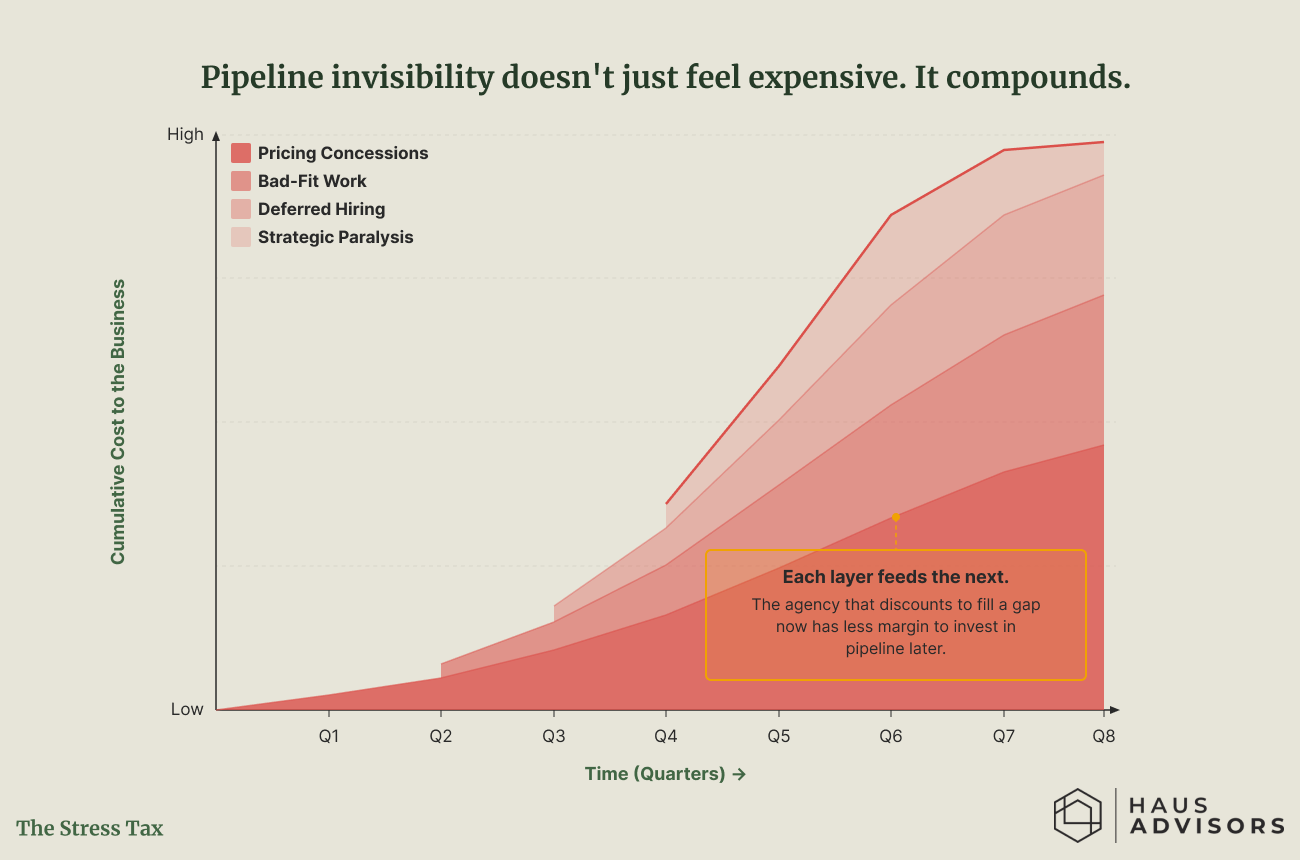
The Stress Tax: Pipeline invisibility creates four compounding costs: pricing concessions, bad-fit work, deferred hiring, and strategic paralysis. Each feeds the next. By Q5, the math is working against you.
These costs are invisible in the P&L but massive in the trajectory of the business. The agency that pays the Stress Tax for three years doesn't just lose revenue. It loses the compound effect of the strategic decisions it didn't make because the founder was managing anxiety instead of building systems.
The Diagnostic: Demand-Constrained or Supply-Constrained?
Most agency founders respond to the Stress Tax by optimizing the wrong side of the business.
They refine their development process. They upgrade their tech stack. They improve their project management workflows. They hire better developers. They invest in quality, speed, and operational excellence. All of these are supply-side improvements: making the thing you sell better.
Supply-side optimization matters. But it doesn't solve the Stress Tax, because the Stress Tax is a demand-side problem.
Here's the diagnostic that reveals which constraint is active.
The 10-Prospect Test. If ten qualified prospects requested proposals tomorrow, could you deliver quality work? You'd probably figure it out: hire contractors, extend timelines, partner with another agency, prioritize the best-fit prospects. The supply side is flexible. You can scale delivery.
Now the second question: if ten prospects don't appear next month, can you create them? Can you generate ten qualified conversations through a system you control, independent of referrals, luck, and timing?
If the answer is no, you are demand-constrained. And you cannot solve a demand problem with supply-side optimization. Refactoring your development process while the pipeline is empty is like optimizing database queries while the server is down. You're solving the wrong problem first.
Most agencies between $500K and $3M spend their improvement energy on supply-side work because it feels controllable. Code quality, sprint velocity, deployment processes: these are within the founder's domain of expertise and produce visible results. Demand generation feels uncertain, unfamiliar, and hard to measure. So the founder avoids it, invests in what they know, and continues paying the Stress Tax.
Why Tactics Don't Fix the Demand Problem
The founder who recognizes the demand constraint usually responds with tactics. They assign a project manager to "post on LinkedIn." They buy a prospect list for cold emails. They sign up for a lead generation tool. They attend a conference. Each tactic produces some activity but no predictable result.
This isn't because the tactics are bad. It's because tactics are amplifiers, and amplifiers require a signal to amplify.
If the signal is "we're a full-service digital agency," the amplifier broadcasts confusion at higher volume. LinkedIn posts about general software development trends reach a general audience. Cold emails describing broad capabilities get deleted. Conference conversations produce business cards that never convert. The tactics executed correctly. The signal they amplified was empty.
I've written in detail about this mechanism as the Prerequisite Gap: lead gen tactics underperform because the foundational elements they depend on (positioning, productized offerings, published credibility) don't yet exist. The tactics are applied correctly. The inputs they require are missing. The Stress Tax continues.
The founder's conclusion after the failed tactical experiment: "marketing doesn't work for agencies." The actual conclusion should be: "marketing works for agencies when the signal is specific enough to create relevance with a defined buyer."
The System That Replaces the Stress Tax
The Stress Tax persists because the agency lacks a demand system. Not a tactic. Not a campaign. A system that generates qualified conversations predictably, regardless of the founder's availability, network, or mood.
I've written about the complete system elsewhere as Relevance Engineering. What follows here is the summary architecture: how the five components address the specific mechanisms that produce the Stress Tax.
Positioning resolves pricing concessions. When you're the obvious choice for a specific buyer's specific problem, you don't need to discount. The buyer isn't comparing you to five generalists on price. They're evaluating whether your specialized expertise matches their situation. Positioning creates negotiating confidence by eliminating the commodity comparison.
Productization resolves bad-fit clients. When you have a defined offering with clear scope, deliverables, and pricing, prospects self-qualify. The right-fit buyer sees an offering that matches their need and says yes. The wrong-fit buyer sees an offering that doesn't match and moves on. You stop saying yes to everything because the productized offering does the filtering your anxiety previously prevented.
Publishing resolves deferred hiring. When published content generates inbound interest consistently, the founder can forecast demand with enough confidence to make hiring decisions. The content doesn't produce leads overnight. But over three to six months, a positioning-specific publishing cadence creates enough pipeline visibility that the senior engineer hire stops feeling like a gamble and starts looking like a capacity investment with visible demand to support it.
Partnerships resolve strategic paralysis. A single well-structured strategic partnership can produce three to five warm introductions per quarter. That baseline of qualified conversations, independent of the founder's outreach effort, provides enough pipeline floor that the founder can invest time in strategic work without the constant anxiety of "what if nothing comes in this month?"
Persistence resolves the cycle itself. The Stress Tax is cyclical because demand generation is cyclical: the founder markets when the pipeline is empty and stops when the pipeline is full. I've written about this as the Intermittency Problem. The cure is a rhythm that runs regardless of delivery load, maintained as an operational discipline rather than a project. The rhythm doesn't eliminate the Stress Tax overnight. It replaces it over three to six months as pipeline visibility extends from "I can see next week" to "I can see next quarter."
The Timeline Expectation
The Stress Tax didn't accumulate in a month. It won't resolve in a month. Here's a realistic timeline for agencies implementing the demand system.
Weeks 1 through 3: Positioning and productization work. Clarify who you serve, what problem you own, and package at least one entry-point offering. This produces no immediate pipeline. It creates the signal that everything else depends on.
Months 1 through 3: Publishing and partnership activation. Begin the content cadence and initiate partnership conversations. Pipeline activity increases but conversions are still sparse. This is the period where most founders quit because the effort is high and the results are invisible. The compound curve hasn't activated yet.
Months 3 through 6: First compound effects. Published content begins generating inbound interest. Partnerships begin producing introductions. The pipeline has enough activity that the founder can see 60 to 90 days ahead for the first time. The Stress Tax begins to decrease.
Months 6 through 12: System maturity. Multiple channels are producing conversations. Pipeline coverage reaches the 3x to 4x ratio. The founder can forecast with confidence. Hiring decisions, pricing decisions, and strategic investments are made from a position of visibility rather than anxiety.
The agencies that build this system don't eliminate uncertainty entirely. They replace "I have no idea where the next deal comes from" with "I can see enough pipeline to make confident decisions." That shift, from blindness to visibility, is what eliminates the Stress Tax.
The Honest Objection
Here's the strongest argument against investing in the demand system: the founder doesn't have time. They're already stretched between delivery, management, sales, and operations. Adding positioning work, content creation, and partnership development to the calendar feels impossible. The Stress Tax is caused by lack of time, and the solution requires more time.
That's the central paradox of demand-constrained agencies. The founder is too busy to build the system that would reduce the busyness.
Where That Logic Hits a Wall
But the time the founder currently spends managing the Stress Tax's consequences is substantial and invisible. The hours spent on proposals for bad-fit clients. The time invested in projects that shouldn't have been accepted. The energy consumed by anxiety that produces no output. The Sunday nights spent checking a CRM that hasn't changed.
The demand system doesn't add to the founder's workload. It redirects effort from reactive anxiety to proactive system-building. The founder who spends ten hours per month on positioning-specific content and partnership maintenance is spending less total time on demand generation than the founder who spends twenty hours per month on scattered tactical experiments, anxious CRM checking, and bad-fit client management.
The system is cheaper than the tax. It just requires investing the time upfront rather than paying the tax indefinitely.
The Next Step
You don't need to build the full demand system this quarter. You need to confirm that the demand constraint is your primary constraint.
Run the 10-Prospect Test. If ten qualified prospects appeared tomorrow, could you deliver? (Almost certainly yes.) If ten prospects don't appear next month, can you create them through a system you control? (If no, you're demand-constrained.)
If you're demand-constrained, stop investing improvement energy in supply-side optimization. The next dollar and the next hour should go toward the demand system: positioning clarity first, then productized offerings, then publishing and partnerships, then persistence as the operating discipline that keeps the system running.
The Stress Tax is real. It's expensive. And it's optional. The agencies that replaced it with a demand system didn't find a magic tactic. They built a foundation that made every tactic work.
The principle is simple:
There are agencies that pay the Stress Tax indefinitely, managing anxiety with scattered tactics that never compound. And there are agencies that invest once in a demand system that replaces anxiety with visibility.
The first group checks the CRM every Sunday night. The second group checks the forecast every quarter and sees enough pipeline to make confident decisions.
At Haus Advisors, we help dev shops and technical agencies eliminate the Stress Tax by building the demand system: positioning that creates negotiating confidence, productized offerings that filter bad-fit clients, and a pipeline rhythm that extends visibility from next week to next quarter. If Sunday nights feel like a strategy session with your CRM, the demand system is what's missing. Book a strategy call here →
Keep reading
Browse by topic
- Positioning & Strategy
- Lead Gen & Marketing
- Sales & Biz Dev
- Pricing & Productization
- Research & Data
- Operations & Delivery
- Client Retention & Expansion
- Leadership & Culture
For founders whose agency has outgrown referrals.
One idea a week that makes a hard growth problem obvious, usually with a chart that shows you the mechanism behind it.
Built from conversations with seventy-plus agency founders on the Behind the Agency podcast.