Digital Marketing Agency Valuation Multiples: The 2026 Benchmarks, and the Discount Nobody Fixes in Time
A founder I talked with last year had started getting the emails. Bigger agencies. A couple of consultancies. All circling, all friendly, all asking the same question about whether he'd ever thought about selling.
He'd thought about it. He'd looked up what digital marketing agency valuation multiples were running at, and done the napkin math more than once.
Then he said something I've heard in some form from almost every owner in his position. He knew he wasn't ready, and he knew exactly why. The systems weren't there. The business ran on him.
He was right to worry. He was also about eighteen months too late to fix the part that mattered most.
Here's the thing about every guide you'll find on digital marketing agency valuation multiples, including the good ones. They were written by people who get paid when you sell.
That's not a scandal. Brokers and M&A advisors know this market better than anyone, and their benchmark data is solid. But it explains why they all tell you the same thing: start getting ready 12 to 24 months out.
The single biggest thing holding down agency multiples can't be fixed in 24 months. Nobody whose fee depends on a deal closing next year has much reason to tell you that.
So here are the 2026 numbers, straight and ungated. Then the part the tables leave out.
2026 Valuation Multiples: The Baseline Benchmarks
Agency valuation multiples run on EBITDA, and they move with size. Bigger agencies attract more buyers, and more buyers bidding is most of what moves the number.
These ranges are consistent across FE International, Axial, Breakwater, Auxo Capital, and Lightning Path. They're worth knowing cold before anyone quotes you a number.
| Your EBITDA | Typical multiple |
|---|---|
| Under $500K | 2.5x to 4x |
| $500K to $1M | 3x to 5x |
| $1M to $2.5M | 4x to 6.5x |
| $2.5M to $5M | 5.5x to 8.5x |
| $5M+ | 7x to 12x |
Under about $500K, most buyers switch to SDE instead of EBITDA, usually 2x to 4x. SDE adds your salary back in. It's the honest measure when the owner is still paying themselves out of the business, and it's a signal in itself.
The other table, which matters more
Size sets the floor. What you sell, and how you sell it, sets everything above it.
| Type of agency | Typical multiple |
|---|---|
| Project work, generalist | 2x to 4x |
| Mixed project and retainer | 4x to 6x |
| Retainer-heavy (60%+ recurring) | 6x to 9x |
| Specialist (B2B SaaS, healthcare, fintech, performance) | 7x to 12x |
Read those two rows at the top and bottom again. Same revenue. Same profit. Three to five turns apart.
On $1 million of EBITDA, that gap is three to five million dollars. It isn't created by working harder or hiring better. It's created by what you're known for and how the money arrives.
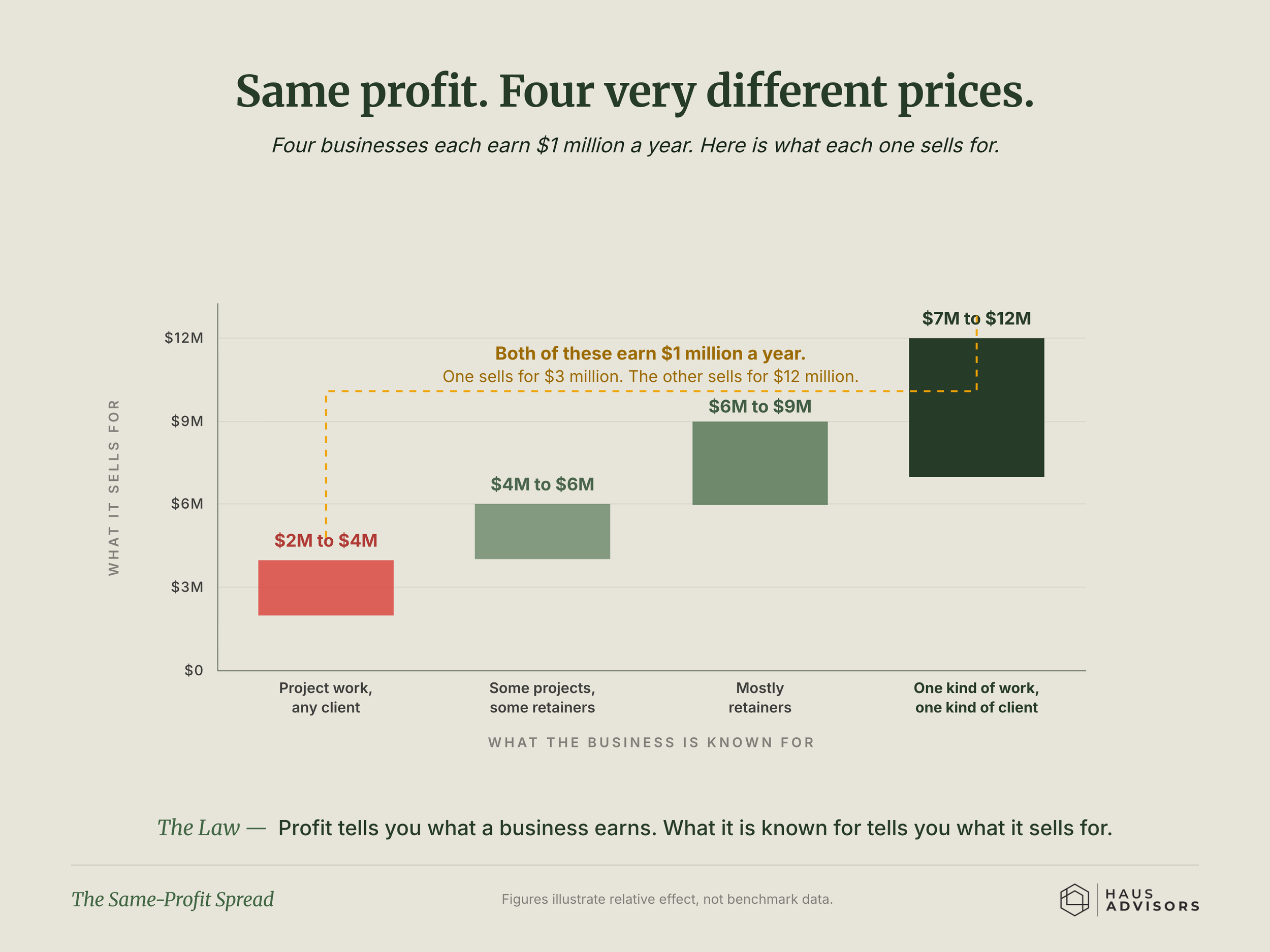
Ranges come from published agency sale data, 2026. Profit is held at $1 million in every bar, so the only thing that changes is what the business is known for.
One founder put the whole thing better than any advisor I've read. He said multiples come down to two questions: how portable is this business, and how durable will it be through the handoff. Can he take it and hand it to you, and will it still run once he's gone.
Hold onto that word portable. The rest of this article is about it.
“Your add-back schedule is often the first place your dependence on the business shows up as a number. It’s rarely the last.”
The add-back trap
Adjusted EBITDA is what buyers actually price. You add back the things that won't carry over to a new owner: your above-market salary, the car, the one-time rebrand, the legal bill from that lawsuit.
Most owners add back their own salary. That's usually fair.
Here's where it goes wrong. If you're the one bringing in the work, a buyer adds your salary right back out, because now they have to hire someone to do what you were doing. Then they wonder whether that hire can actually do it.
Your add-back schedule is often the first place your dependence on the business shows up as a number. It's rarely the last.
The Two Ways Your Agency Depends on You (Only One Shows Up on the Org Chart)
“Delivery skill transfers with an employment agreement. A reputation doesn’t transfer at all.”
Every guide on this topic names owner dependence as a problem. They're right, and the numbers behind it are real.
A key-person discount usually costs 15% to 40% of enterprise value. In multiple terms, call it half a turn to a turn and a half. A high-dependence agency trades around 4.5x to 5.5x where a comparable systemized agency gets 6x to 8x.
So far, so agreed. Here's where I part ways with the standard advice.
Every one of those guides prescribes the same fix. Build a leadership bench. Write your processes down. Hand decisions to managers who don't own equity.
That's good advice for one kind of dependence. It does almost nothing for the other, and the other is the expensive one.
The first kind: you're stuck in the work
You're in final review on everything. You take the hard client calls. The tricky technical calls route to you because they've always routed to you.
This is real, and it's genuinely painful. It's also the version everybody writes about, because it's visible on an org chart and it responds to hiring.
Owners describe it in almost the same words every time. One founder told me he was drowning, and that he just needed someone to own the things that shouldn't have been his. Another said he was slowly pulling himself out, so he could work on the business instead of in it.
The standard 12-to-24-month playbook works here. Hire senior people. Write things down. Give the work away and let it be done at 80% for a while.
If this is your version, the guides have you covered. You can stop reading them and start hiring.
The second kind: the work shows up because of you
You might have a great delivery team already. The projects ship without you. You've done the hiring, you've written the processes, and delivery genuinely runs.
And every new client still arrives because someone knew your name.
That's a different problem, and no org chart touches it. You can hire a COO and still have a business where the reason anyone calls is you personally. Hiring solves how the work gets done. It doesn't solve why the work shows up.
Buyers price this one hardest, and the reason is simple. Delivery skill transfers with an employment agreement. A reputation doesn't transfer at all.
An acquirer buying your agency is buying a machine that produces clients. If that machine is your name, your relationships, and the fifteen years you spent speaking at the same three conferences, they can't buy it. They can only rent it from you, for as long as the earnout keeps you around.
One owner said it to me almost exactly the way an acquirer would. Controlling your own destiny on the sales side is one of the first things a buyer looks at. They're not thrilled when the answer is that the work comes from referrals.
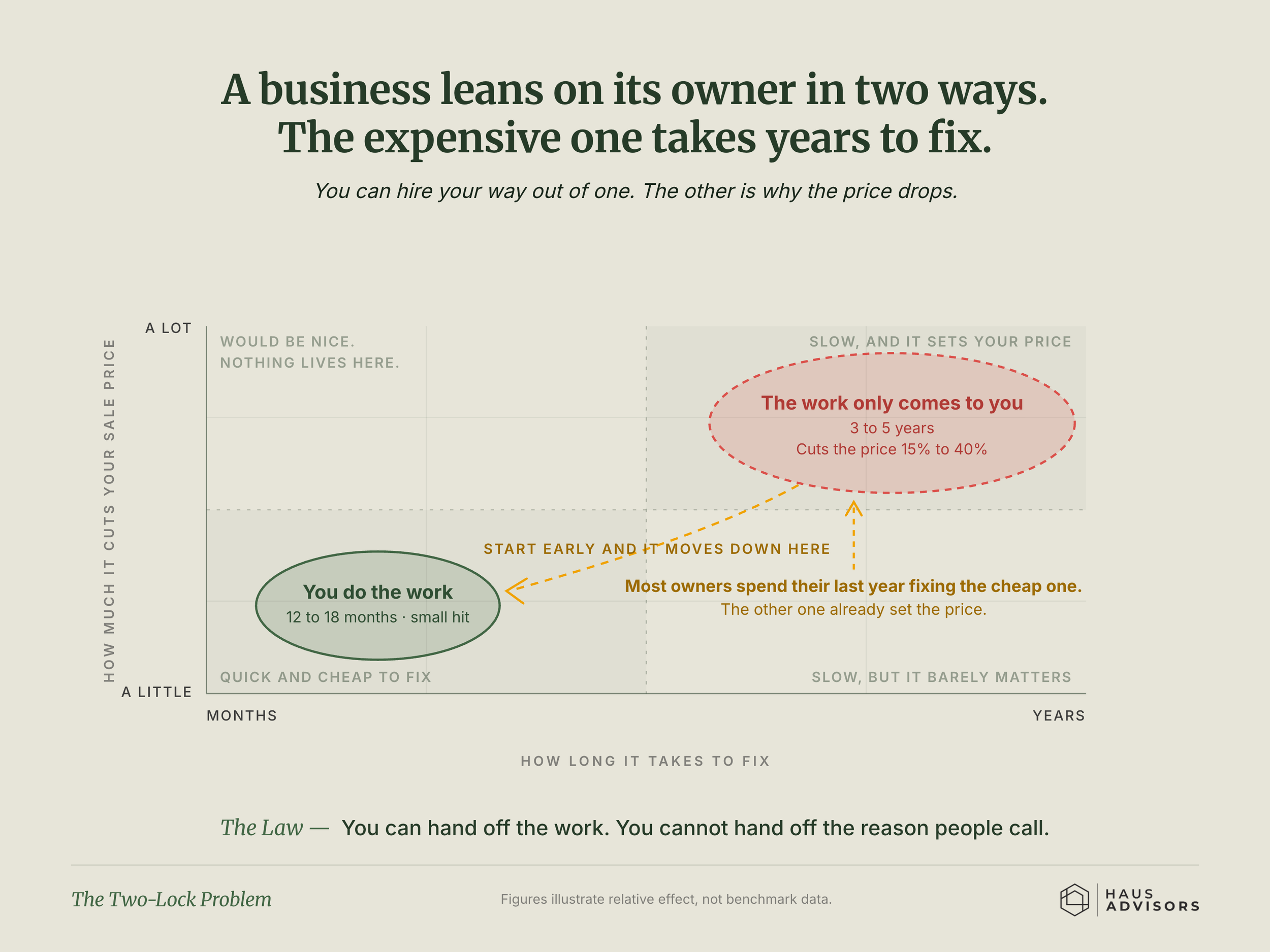
The 15% to 40% discount is well documented in agency M&A. What the published data doesn't do is split the kind you can hire your way out of from the kind you can't.
The referral reframe
“It doesn’t read “great reputation.” It reads one channel, attached to one person, with no proof it survives the handoff.”
This next part is the one that stings, so let me say the true thing first.
Your referral engine is real proof of quality. Clients don't refer people who do bad work. Twenty years of word of mouth means you've earned something most agencies never earn, and it's the reason you're profitable enough for anyone to be interested in the first place.
A buyer will love the retention. They'll be a lot less excited when they open the sourcing table and find that every deal last year came from one channel, and the channel is a person who's about to leave.
That's what diligence does to a referral business. It doesn't read "great reputation." It reads one channel, attached to one person, with no proof it survives the handoff.
I've heard the same confession dozens of times, and it always arrives with a little embarrassment attached. Eighty percent of the business from referrals, and inbound and outbound both tried and both failed. Or the blunter version, which I got almost word for word last year: we're a referral shop, we don't hunt at all, we tried hunting and it didn't work so we gave up.
None of those founders were lazy, and none of them were bad at marketing. Referrals worked. Nothing ever forced the issue, and a problem that never forces the issue is the one still sitting there on the day a buyer finally asks about it.
One owner named the cost precisely. He described how a buyer sees that 25% of revenue is tied specifically to him, which means if he doesn't stay, it goes away, and so the valuation comes down.
That's the discount, in an owner's own words, before any advisor put a number on it.
Which one do you have?
Curious if this applies to you? Take three months off, at least on paper. Ask what actually happens.
If delivery gets shaky but the phone keeps ringing, you have the first kind. Hire, document, and the guides will serve you well.
If delivery holds fine and the phone slowly goes quiet, you have the second kind. That's the one that's costing you turns, and it's the one nobody's timeline accounts for.
1. Take three months off. What goes wrong first?
2. Where do most of your own working hours go?
3. If you stepped out of delivery tomorrow, could the team ship at your standard?
4. Where did last year's new clients come from?
5. Could someone who isn't you close a new client at your usual price?
Answer all five to see your result.
The Timeline Conflict: Why 18 Months Won't Move Your Multiple
Now go back to the advice everyone gives, and notice what it assumes.
Twelve to 24 months is enough time to hire a delivery lead, write your processes down, and clean up your books. For getting stuck out of the work, it's about right.
It is not close to enough time for the second kind.
Changing what your firm is known for, publishing enough that the market credits the company instead of you, and building a pipeline that doesn't run through your phone is a three-to-five-year job. The first year mostly produces evidence, not revenue. You're proving a point of view before anyone pays you for it.
And that's the part a broker can't really tell you. If their fee depends on a deal closing soon, "come back in four years" isn't advice they can afford to give. It isn't dishonest. It just means every timeline you'll read is set by somebody else's business model.
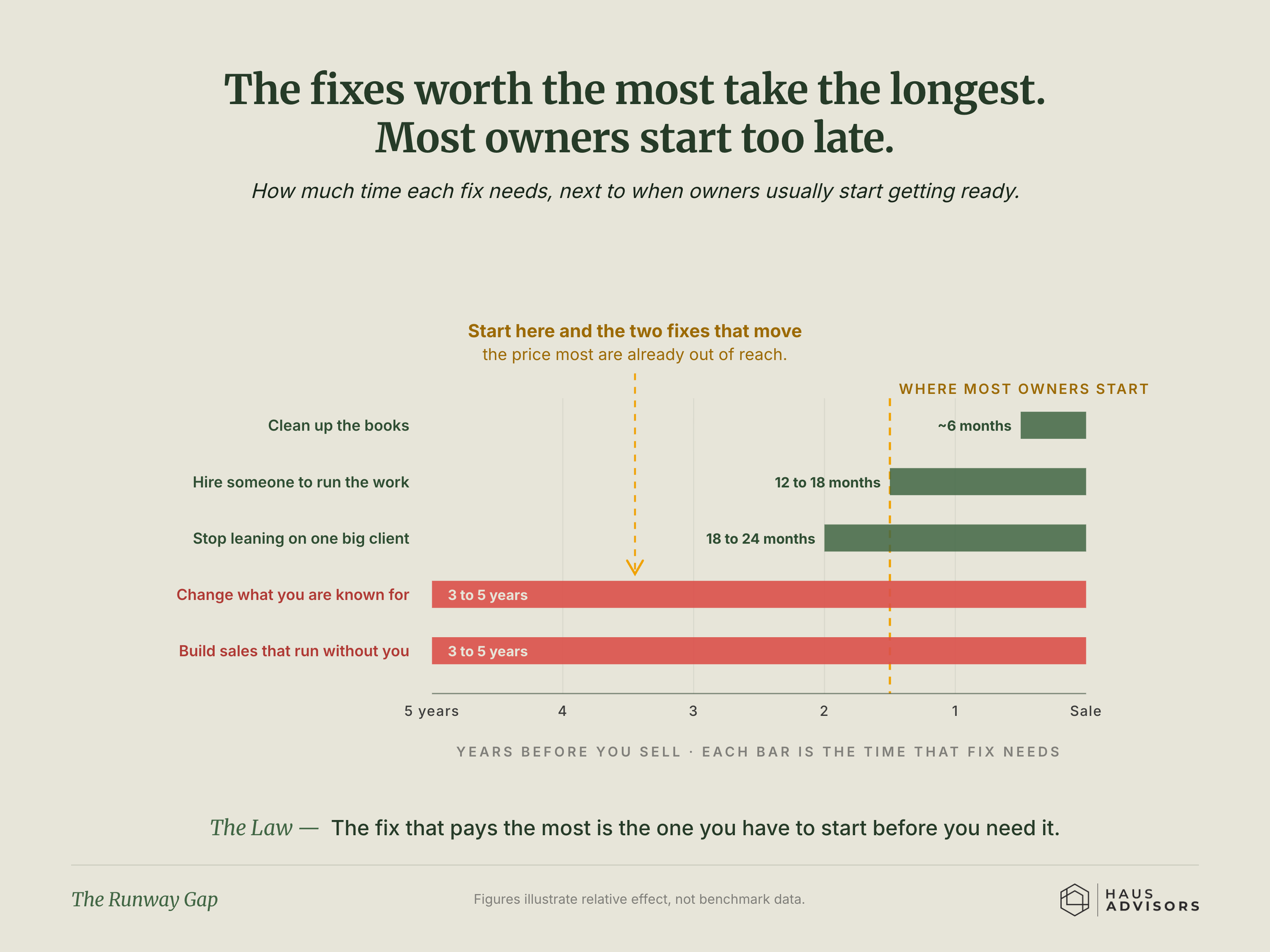
Each bar is how long that fix really takes, not how long a pre-sale checklist allows. The yellow line marks the 12 to 24 month window most agency guides tell you to plan for.
What waiting actually costs
Picture the owner who starts 18 months out and does everything the guides say.
He hires a delivery lead. He documents the process. He presents a clean org chart and a real management team, and he's proud of it, because it was hard.
Then diligence opens the sourcing table. Every deal traces back to him. The buyer doesn't argue with the org chart. They just move the number, lengthen the earnout, and hold more back in escrow.
He fixed the visible one. The expensive one was still there, and by then there wasn't time to do anything about it.
This is the case for starting when you have no reason to. Not because a sale is close, but because the fix that moves your multiple most is also the one with the longest lead time. You want to start it while you still have the years to spend.
If you want your agency to grow without needing you in every deal, that's what the New-Business Engine is built for.
Book a call to see if it's a fitBuilding an Agency That Doesn't Need Your Name
“A founder’s personal brand usually makes this problem worse.”
So what actually moves the second kind.
The goal is to make the firm the reason people call, instead of you. That sounds soft. It breaks into three pieces that are anything but.
Be known for something specific
Look back at that second table. Specialists get 7x to 12x. Generalists get 2x to 4x.
That gap exists because a specific position is something a buyer can actually acquire. "We're the agency for B2B fintech compliance" survives your departure. "We're great, ask anyone" leaves with you, because you were the anyone.
At a generalist agency, the client list and the owner's address book are the same document wearing two different names. Getting specific is what pulls them apart.
Publish so the company gets the credit
Here's a distinction worth being careful about, because it's easy to get backwards.
A founder's personal brand usually makes this problem worse. If every piece of credibility your market sees has your face on it, you've spent years proving the thing a buyer is worried about.
Published work that lives under the company's name does the opposite. The case studies, the research, the point of view that shows up in the sales process before anyone talks to a human. That's how credibility moves from a person to an asset.
It's slow. It's also the only mechanism I know of that actually works.
Make the offer sellable by someone who isn't you
A defined offer with a clear scope and a real price can be sold by a person who isn't the founder. A custom consultative sale usually can't, because the thing being sold is your judgment in the room.
If closing requires you specifically, that's not a sales problem. It's a product problem, and it shows up in your multiple.
This is the work we do in the New-Business Engine. The first phase is where we pull the positioning and the judgment out of your head, and find which of the two kinds of dependence is actually holding your number down, before anyone spends a year fixing the wrong one. The rest of the six months is the install, working on live pipeline rather than a plan.
One thing worth being direct about. We don't broker agencies, we don't run transactions, and we don't take a fee on your sale. Almost everyone else writing about this does. That's worth knowing when you're weighing whose timeline to trust, including ours.
Five Mistakes That Cost Owners a Turn or More
The buyer subtracts it again and now knows sales sit with you. It's the cheapest tell there is.
Concentration is the steepest single discount in agency deals, and the client table is usually the first thing a buyer opens. Under 10% is clean. One founder told me his agency sometimes ran with a single client at 70% of revenue, which he described, accurately, as miserable.
It's proof you're good. Those are different assets, and only one of them transfers.
You've solved the visible kind. The one that moves your multiple is still sitting there, and now it's the only thing left in diligence. Worse, you've spent the runway you needed for it.
By the time you have one, only the fast fixes are available, and the fast fixes aren't the ones that pay.
Where to Start, Based on Your Exit Horizon
The right first move depends almost entirely on your timeline, and the two answers aren't close to the same.
Three to five years out. This is the good news, and most owners reading this are here. You have the runway to fix the expensive kind. Start with what your market sees: whether your positioning stands on its own or leans on your name. Our Signal Check grades your homepage messaging on five signals and it's free. It won't value your agency, and it isn't trying to. It'll tell you whether your market presence works without you attached to it.
Twelve to 24 months out. Be honest about what's still available. You can fix delivery dependence, clean up concentration, and tighten margins, and all three are worth doing. What you can't do is rebuild where the work comes from. So the job changes: find out which kind of dependence is actually binding, fix what's fixable, and go into the room able to explain the rest instead of getting surprised by it. That's what the first phase of the New-Business Engine is built to find.
Five questions. It uses the published benchmark ranges from this article and shows you where the discounts come from.
Fill in all five to see your range.
Estimated range today
This is an estimate built from published agency sale ranges, not a valuation. Real offers turn on growth, margins, contract terms, team and a dozen things a form cannot see. Before you act on a number, get a real valuation from a broker or a CPA who works in agency deals.
The owner I opened with was right about himself. He knew the business ran on him, and he knew that made it hard to sell.
What he had backwards was the timing. He thought getting ready was something you did when buyers started calling. By then, the only things left to fix were the ones that were never holding down his number.
Keep reading
Browse by topic
- Positioning & Strategy
- Lead Gen & Marketing
- Sales & Biz Dev
- Pricing & Productization
- Research & Data
- Operations & Delivery
- Client Retention & Expansion
- Leadership & Culture
For founders whose agency has outgrown referrals.
One idea a week that makes a hard growth problem obvious, usually with a chart that shows you the mechanism behind it.
Built from conversations with seventy-plus agency founders on the Behind the Agency podcast.