Your Content Is Attracting Developers, Not Buyers. The Technical Substance Isn't the Problem. The Framing Is.
A founder showed me her agency's blog analytics. Impressive numbers: 12,000 monthly visitors, strong time-on-page, healthy organic search rankings. Her most popular article, titled something like "How to Optimize PostgreSQL Queries for Large Datasets" had been consistently driving traffic for eighteen months.
Then I asked how many of those 12,000 visitors had become clients. She checked. Zero. Not one.
The content was technically excellent. It demonstrated genuine expertise. It ranked well. And it attracted exactly the wrong audience: other developers looking for code solutions. Not a single person reading that article had the budget or authority to hire an agency. They were practitioners solving a Tuesday afternoon problem, not decision-makers evaluating a strategic partner.
Her content strategy was working perfectly at the wrong job. It was building an audience of peers instead of an audience of buyers.
The Pattern Has a Name
I call it The Audience Mismatch: the condition in which technically excellent content attracts practitioners (developers, engineers, technical ICs) instead of buyers (CTOs, VPs of Engineering, technical founders with budgets). The content demonstrates expertise. It just demonstrates it to people who aren't in a position to purchase your services.
Here's the mechanism. Most agency founders write content the way they'd want to read it: technical deep-dives, code tutorials, framework comparisons, optimization guides. This content is high quality and genuinely useful. It also targets search queries that developers type when they're trying to solve implementation problems, not queries that decision-makers type when they're evaluating whether to hire an agency.
"How to optimize PostgreSQL queries" attracts a developer at their desk. "Why your database architecture is the reason your SaaS can't scale past 10,000 users" attracts a CTO who's hitting a wall. The technical substance might be identical. The framing determines who reads it and what they do after reading.
The Audience Mismatch is especially common at agencies led by technical founders, because the founder's instinct is to prove expertise through technical depth. And technical depth does matter. But the depth needs to be framed in terms the buyer cares about (business outcomes, risk, competitive advantage) rather than terms the practitioner cares about (implementation details, code patterns, tool comparisons).
Why Generic Content Advice Makes This Worse
Because most content marketing advice is written for product companies, and product companies have a fundamentally different content objective.
When a SaaS company publishes "API Best Practices," they want developers to discover their product and sign up for a free trial. The developer audience is the right audience, because developers are the users of the product.
When an agency publishes the same article, they need decision-makers to think "these are the people we should hire for our next critical initiative." The developer audience is the wrong audience, because developers aren't the buyers of agency services. But the SaaS content playbook doesn't make this distinction. It optimizes for traffic, engagement, and SEO rankings without distinguishing between traffic that converts to revenue and traffic that just reads and leaves.
The result: agencies following generic content advice produce content that looks successful by every content marketing metric (traffic, rankings, time-on-page) and produces zero pipeline. The metrics are green. The revenue impact is zero. The founder concludes "content marketing doesn't work for agencies" when the actual conclusion should be "content marketing for the wrong audience doesn't work for agencies."
The Framing Shift
The fix isn't writing different content. It's framing the same expertise for a different reader.
Every piece of technical knowledge your agency has can be framed two ways: as an implementation guide for practitioners or as a strategic insight for decision-makers. The technical substance is the same. The angle of approach determines the audience.
Implementation framing (attracts developers): "How to Implement Offline-First Architecture in React Native"
Strategic framing (attracts buyers): "Reducing Driver Wait Times by 30%: How Offline-First Architecture Solved a $2M Supply Chain Bottleneck"
Same technical expertise. Same depth of knowledge. But the second framing attracts a VP of Operations at a logistics company who is losing $2M to a problem your agency has solved. The first framing attracts a developer who wants to learn React Native patterns. One has a budget. The other has a bookmark folder.
The strategic framing doesn't require dumbing down the technical content. It requires wrapping the technical content in a business context that the buyer recognizes. The buyer doesn't need to understand every implementation detail. They need to see that you understand their business problem and have a proven approach to solving it. The technical depth is the proof. The business framing is the hook.
Four Content Formats That Attract Buyers
Once positioning is clear (you know who you serve and what problem you own), these four formats produce content that reaches decision-makers rather than practitioners.
Business-Impact Case Studies
Most agency case studies describe what was built: the tech stack, the features, the timeline. This is a portfolio, not a sales asset. It tells the reader what you can do. It doesn't tell them what you can do for them.
A business-impact case study starts with the client's business problem, describes the diagnostic process, explains the strategic approach, and quantifies the outcome in business terms. The technology is mentioned as the vehicle, not the destination.
The shift: "How We Built a React Native App for a Logistics Client" → "Reducing Driver Wait Times by 30%: How We Solved a Supply Chain Bottleneck That Was Costing $200K Per Month"
The second version attracts a logistics executive who has a similar cost problem. The first version attracts a developer curious about React Native. The case study's function is to help the prospect see their situation reflected in your past work. Business framing makes that recognition possible.
Diagnostic Content
This is the format most agencies underuse and the one with the highest conversion potential. Diagnostic content names a problem the buyer is experiencing, explains why it's happening, and describes what happens if it goes unaddressed. It doesn't sell your services. It demonstrates diagnostic expertise.
The shift: "5 Benefits of Moving to the Cloud" → "Why FinTech CTOs Are Regretting Their Lift-and-Shift Cloud Migration (And What the Actual Migration Path Looks Like)"
Diagnostic content works because it does the same thing your best sales conversations do: it names the prospect's problem more precisely than they can name it themselves. When the reader thinks "this describes exactly what's happening to us," the trust is already built before any sales conversation happens.
This is the content format behind every diagnostic pattern in the Haus Advisors blog. Each post names a specific failure pattern, explains the mechanism, and gives the reader a way to test whether the pattern is active in their business. The format consistently outperforms generic how-to content because it speaks to a problem the buyer recognizes rather than a technique the practitioner wants to learn.
Point-of-View Content
This is where you take a position that differentiates you from the market. Not "we work with all methodologies" but "why we refuse to do fixed-bid projects for complex MVP builds." Not "choosing the right framework" but "why most agencies are wrong about when to use microservices, and what the data actually shows."
Point-of-view content filters your audience. Prospects who agree with your perspective self-select in. Prospects who disagree self-select out. Both outcomes are useful: the first produces aligned clients, the second prevents misaligned ones. The agencies that try to appeal to everyone produce content that offends no one and resonates with no one.
The risk: taking a position means some people will disagree. The benefit: the people who agree will trust you more deeply because you demonstrated the conviction to say something specific rather than something safe.
Decision-Support Content
This is content that helps the buyer make a decision they're currently stuck on. Not a decision about whether to hire you, but a decision about their business that your expertise can inform. "Build vs. buy for your integration layer." "When to rebuild your legacy system vs. when to modernize incrementally." "How to evaluate whether your development team needs outside help."
Decision-support content positions you as the advisor before you're engaged as the vendor. The buyer reads it, finds it useful, and associates your agency with the quality of thinking that helped them make a better decision. When they do need an agency, you're not one of five options. You're the one who already helped them think through the problem.
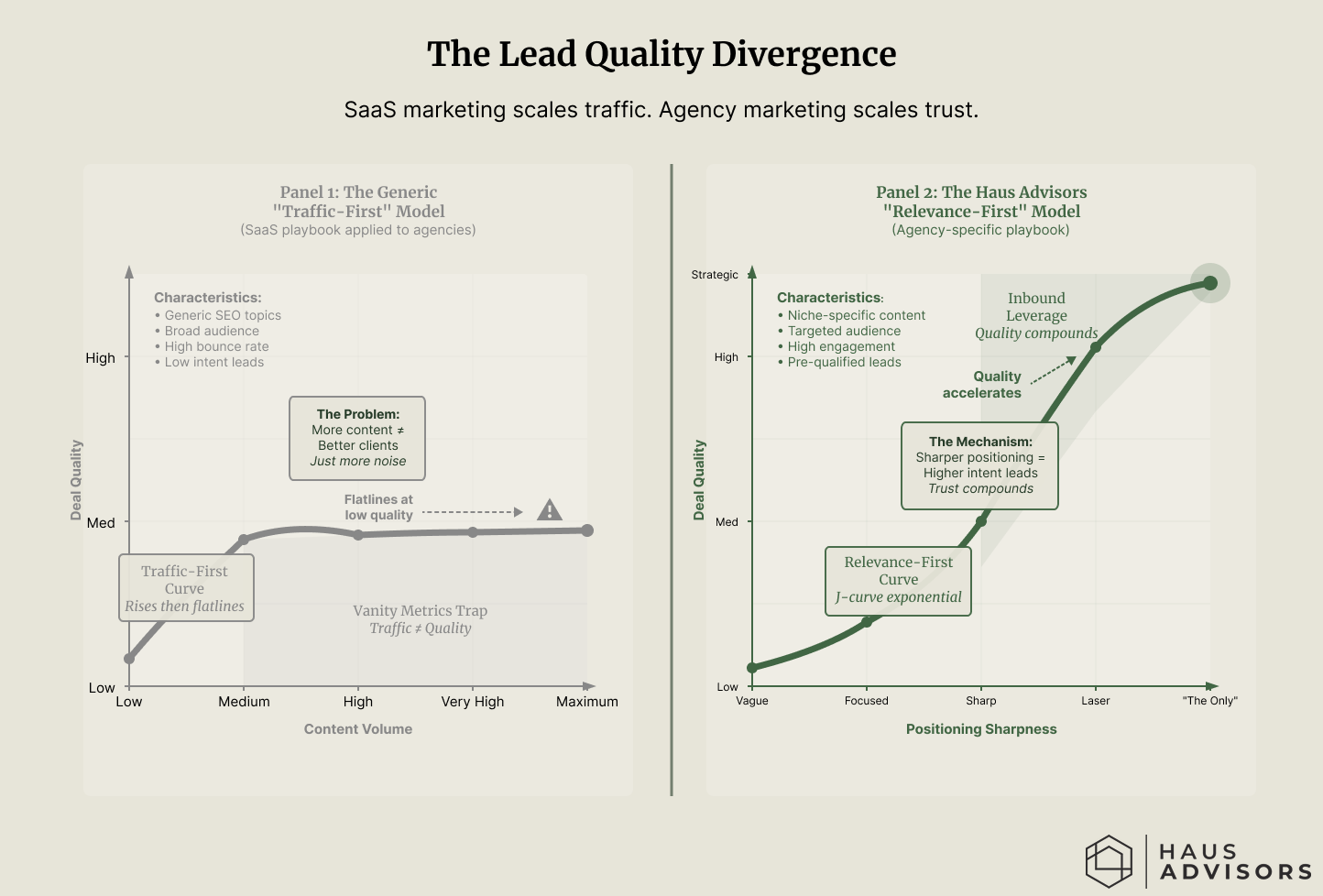
The content ROI inversion: Agencies that optimize for traffic produce high-volume, low-quality pipeline. Agencies that optimize for relevance produce low-volume, high-quality pipeline. Five articles read by the right 50 people (decision-makers with budget authority and active problems) generate more revenue than 500 articles read by 50,000 practitioners. The metric that matters isn't how many people read your content. It's how many readers have the budget and need to become clients.
Measuring What Matters
Traffic and rankings are not content success metrics for agencies. They're activity metrics. The success metrics are downstream:
Lead quality by source. Compare the average deal size of leads who found you through content versus leads from other sources. If content-sourced leads are producing smaller deals, the framing is wrong (you're attracting practitioners, not buyers). If content-sourced leads produce equal or larger deals, the framing is right.
Sales cycle compression. Prospects who have consumed your content before the first conversation should move faster through the pipeline, because the content has already built trust and demonstrated expertise. If content-engaged prospects close at the same speed as cold prospects, the content isn't doing its job.
The attribution question. Track how many prospects say some version of "I read your article about X and realized we needed to talk to you." This is the clearest signal that content is doing buyer-level work: the prospect read something that named their problem, and the recognition drove the conversation. If you never hear this, the content is reaching the wrong audience or framing the expertise at the wrong level.
The Honest Objection
Here's the strongest argument against business-framed content: it feels less authentic to write. Technical founders want to write about technology because that's what they know and care about. Reframing technical expertise as business insight feels like "marketing speak," and technical buyers see through marketing speak immediately.
That concern is worth taking seriously. Inauthentic content fails regardless of framing.
Where That Logic Hits a Wall
But business framing doesn't require inauthenticity. It requires translating your genuine expertise into the language your buyer uses to describe their problem. When a CTO says "our platform can't scale," they're describing a business constraint with technical causes. Writing about the business constraint and then explaining the technical causes isn't spin. It's meeting the buyer where they are.
The founders I've watched make this transition successfully didn't stop being technical. They started framing their technical expertise as business judgment. "We know PostgreSQL optimization" became "we know why SaaS platforms hit a wall at 10,000 users and how to fix it before it costs revenue." Same expertise. Different entry point. And the entry point determines whether the reader has a budget.
The Next Step
You don't need to overhaul your content strategy. You need to test whether the Audience Mismatch is active.
Start here: look at your three most-trafficked pieces of content. For each one, ask: who is the most likely reader of this article? A developer solving an implementation problem, or a decision-maker evaluating whether to hire an agency? If the answer is a developer for all three, the mismatch is active.
Then take your best-performing piece and rewrite the headline and opening paragraph with a business framing. Same technical substance. New angle of approach. Publish it as a new piece and compare: does the reframed version attract a different type of reader? Does it produce any inbound conversations that the original didn't?
One reframed article is enough to test the hypothesis. If it works, you have a template for every piece of content going forward: same expertise, buyer-level framing, strategic entry point. The content strategy doesn't change. The audience does.
The principle is simple:
There are agencies that create content for peers, and there are agencies that create content for buyers.
The first group builds an audience. The second group builds a pipeline.
Most founders reading this already know the real problem. It isn't the content. It's that the reputation, the relationships, and the judgment that make your agency worth hiring still live in your head. So the business only grows when you're in the room.
That's the work we do at Haus Advisors. The New-Business Engine is six months of implementation, not a strategy document. We pull what makes your agency relevant out of your head, build it into positioning, offers, and growth plays your team can run, and hand ownership to them. If you want an agency that grows without needing you in every deal, book a call to see if it's a fit.
Keep reading
Browse by topic
- Positioning & Strategy
- Lead Gen & Marketing
- Sales & Biz Dev
- Pricing & Productization
- Research & Data
- Operations & Delivery
- Client Retention & Expansion
- Leadership & Culture
For founders whose agency has outgrown referrals.
One idea a week that makes a hard growth problem obvious, usually with a chart that shows you the mechanism behind it.
Built from conversations with seventy-plus agency founders on the Behind the Agency podcast.