Why Your Ad Agency's New Business Development Isn't Working: The 5 Root Causes for Independent Shops
Most independent agency founders have tried the standard playlist: hiring a junior outbound rep, spinning up a cold email sequence, or committing to post on LinkedIn three times a week, only to watch it collapse the moment a major technical project or client fire demands their attention. If you're running a software development studio, a performance marketing shop, or a data agency, you don't have a tactics problem; you have an architecture problem.
The reality is that consistent new business development is operationally impossible when the person responsible for the pipeline is also trapped inside delivery. The conventional advice says you just need more discipline. The truth is you need different structural choices.
This article gives you the diagnostic framework to identify which of the five root causes is holding your ad agency's new business development back. Once you know your root cause, the fix becomes obvious.
Why Most Agency BD Advice Doesn't Apply to Independent Shops
The advice circulating online about advertising agency new business was built for shops that can dedicate headcount to it. A Director of BD. A dedicated account coordinator. A marketing function that isn't also responsible for fulfilling client work.
Independent agencies can't do this. Applying that playbook anyway is why most independent founders feel like BD is broken when it's actually just misaligned.
When a founder running a 12-person performance marketing agency tries to layer "post on LinkedIn three times a week" or "run a 50-contact outbound sequence" on top of a full delivery schedule, it collapses inside six weeks. Not because the tactics are wrong. Because the structural conditions aren't there.
The real question isn't which BD tactics to use. It's what a BD program has to look like when the same person running it is also the one delivering the work, managing the key client relationships, and handling the business decisions nobody else can make. That constraint changes everything about how the system has to be built.
Here's a data point that explains a lot: the average tenure of a BD hire at an independent agency is 18 months. That's about how long it takes for a BD program to start producing consistent results. Agencies fire their way through the learning curve because they didn't build the underlying conditions for BD success before making the hire. The problem isn't the hire. It's the sequence.
The 5 Root Causes of Agency BD Failure
Most agency business development strategy advice skips straight to tactics. That's prescribing before diagnosing. The five root causes below are what I see consistently when I work with independent agency founders who feel stuck on pipeline. Each one has a distinct signal and a distinct fix. Identifying yours first isn't optional: they require completely different solutions.
Every agency BD investment sits on top of this stack. If the layer beneath it isn't built, the investment above it leaks. A BD hire without positioning is a well-compensated person who can't explain why someone should hire you. An outbound sequence without pricing confidence gets you on calls you can't close. Most founders enter this stack at the top because tactics feel like action. The real work is at the bottom.
Root Cause 1: Positioning Problem
If your agency can't articulate in one sentence what you do, for whom, and what outcome you produce, no BD tactic will compensate for it. This is the foundational problem, and it's more common than founders want to admit.
You win about 1 in 5 prospects you talk to. Most discovery conversations start with the prospect asking "what exactly does your agency do?" A dev agency positioning itself as a "custom software partner" loses deals not because the work is wrong but because the prospect can't evaluate them against a specific need. They're competing against everyone and differentiating against no one.
The fix is a sharper positioning wedge, not a broader one. The instinct when business is slow is to widen the aperture. The correct move is the opposite.
Root Cause 2: Pipeline Discipline Problem
Some founders have a BD approach. They just don't execute it consistently. Strong start in January. Client work takes over in February. BD is completely idle by March. They can describe the program in theory but couldn't tell you what they did specifically last week to move the pipeline forward.
The distinction that matters here: a plan is a description. A cadence is a commitment to specific activities at specific times. Most founders have the first and think they have the second.
The fix is a lightweight operating rhythm with fixed time blocks small enough to survive a busy week. Not two hours every morning. Thirty minutes on Tuesday and Thursday that don't move.
Root Cause 3: Economics Problem
This one is underdiagnosed. A performance marketing shop with low retainers and compressed margins has almost no ability to invest in BD because every dollar spent on it comes directly from profit. So it never gets spent. The economics make consistent BD investment structurally impossible regardless of intent.
The founder knows roughly what a new client is worth but has never calculated what a new client costs to acquire. That math matters because it determines whether the agency's current pricing actually funds a real BD program or just the idea of one.
Pricing work comes before BD work. You can read more about that sequence in our guide to agency pricing models. The short version: you can't fund a BD engine on thin margins, and you can't fix thin margins without repricing. These problems are connected, and most founders try to solve BD before solving pricing.
Root Cause 4: Founder Bottleneck Problem
The founder is the best salesperson in the agency, the best client relationship manager, and the primary deliverer of client work. They're also the only one who can make the business decisions nobody else is empowered to make. In this setup, consistent BD is structurally impossible.
The tell is simple: when a good BD conversation happens, it's because the founder made time for it. When the founder gets busy, BD stops entirely. There's a direct line between the founder's calendar and the agency's pipeline.
I worked with a founder who had been running a data agency for six years. Strong network. Sharp point of view. Genuine ability to close. Her pipeline was feast-famine because she was the only person who could deliver the work, run the accounts, and manage the team. There was no version of her week that had room for consistent BD until delivery became less founder-dependent. She didn't need a BD hire. She needed to get out of delivery first.
That's the fix for this root cause. It's not a sales hire. It's the person or process that gets the founder out of delivery so there's actually time to sell.
Root Cause 5: Channel Mismatch Problem
The agency is investing in BD channels that don't match how their buyers actually make purchase decisions. The most common version: a founder grinding on cold outbound and LinkedIn content while every actual win came through a warm introduction. The channel that works gets treated as luck. The channels that don't get all the investment.
Trace where your last five clients came from. If they all arrived through someone who knew you personally, that's not an accident. That's the data.
The fix is to double down on the highest-conversion channel before adding new ones. For most independent agencies, that channel is referral. Systematizing it is where the real leverage is.
Building a BD System That Fits an Independent Agency
Once you've identified your root cause, the BD architecture for an independent agency has three layers. The sequence matters as much as the components.
The Referral Engine First
Independent agencies get 70-80% of new business from referrals regardless of what else they try. That's not a problem to fix. It's a foundation to build on deliberately.
Most founders have 5-10 high-quality referral relationships they're not actively managing. Former clients who are now at different companies. Partner agencies they've worked alongside. Connectors whose job involves knowing who does what.
These relationships exist and they're warm. They're just not being tended.
The system is simple: map your referral surface into three categories (current clients who've referred before, past clients, and partners), set quarterly touchpoints with each category, make a clear ask when the timing is right, and close the loop with a thank-you when an introduction arrives. Systematizing these relationships alone produces 2-4 qualified introductions per quarter for most founders.
The common advice in the SERP for this keyword is to stop relying on referrals and build proactive outbound. That's backwards. Referrals are still the highest-conversion new business channel for independent agencies. The problem isn't referrals. It's unmanaged referrals. Fix that first.
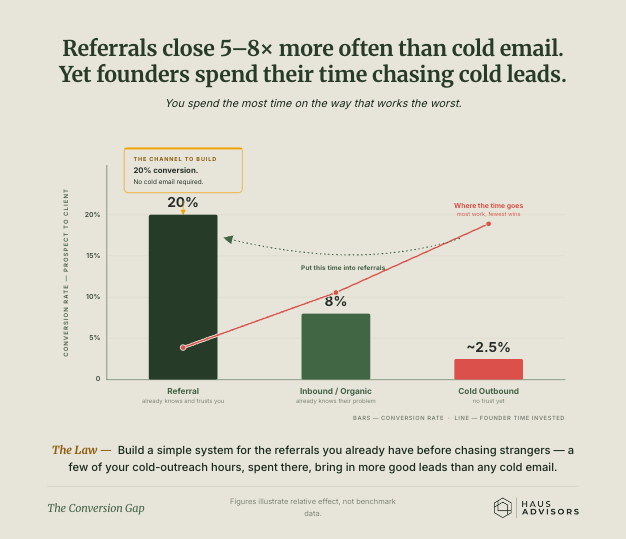
This is the channel most independent agencies underinvest in. A referred prospect arrives with trust already established. They came because someone they believe in said you're worth talking to. That's not a soft advantage. It's a 5-8x conversion multiplier over cold outreach. The founders who systematize their referral surface don't abandon outbound. They just stop letting their highest-return channel run on memory and hope.
The Inbound Layer
Content that earns organic search traffic creates a pipeline of prospects who arrive pre-educated and pre-qualified. Conversion rates on inbound leads run 3-5x higher than outbound for independent agencies, because the prospect has already decided the problem is worth solving before they ever contact you.
The constraint is time: organic traction takes 6-18 months to build. It's a parallel investment, not a near-term fix. The path to consistent inbound pipeline starts with one content format committed to for 12 months. Blog, podcast, or newsletter. Not all three.
The Outbound System
Cold outreach works for independent agencies when the positioning is sharp enough that the prospect immediately recognizes the relevance. "We help mid-market e-commerce brands reduce paid media waste" lands. "We're a full-service performance marketing agency" doesn't.
Sustainable outbound for a 15-20 person shop: 20 targeted contacts per week, a 3-touch sequence over two weeks, a weekly review. Anything more complex will collapse. The goal isn't scale. It's a sustainable operating rhythm that runs without heroic effort.
Common Mistakes to Avoid
Fixing tactics before structure. Launching a LinkedIn content program or hiring a BD coordinator before positioning is clear is the most expensive mistake in agency business development strategy. The tactics will work at a fraction of their potential until the underlying structure is right. Easy to make because tactics feel like progress.
Treating BD as a separate function. In an independent shop, BD isn't a department. It's integrated into everything: client work quality, discovery call execution, how you price and scope projects. Treating new business as something to hire for later is how it never gets built. The marketing agency sales process is already BD. You're either doing it intentionally or accidentally.
Abandoning channels too early. Outbound takes 60-90 days to produce real conversations. Content takes 6-12 months to produce organic traffic. Most founders evaluate results at 30 days and conclude it's not working. The channel isn't broken. The timeline expectation is.
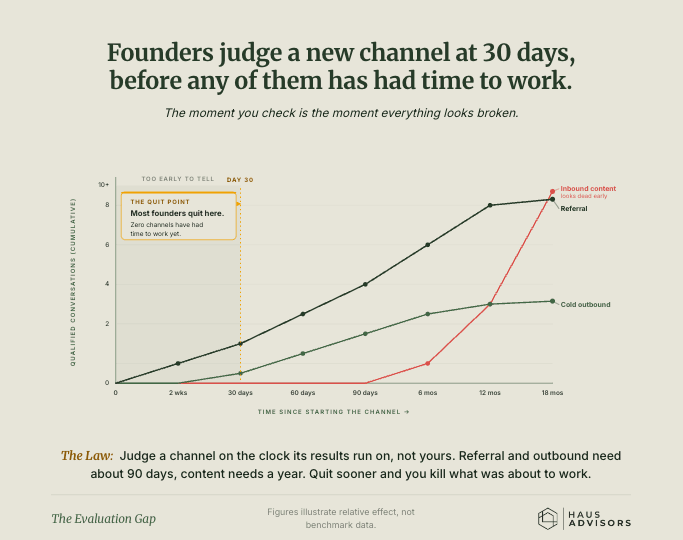
Most agency founders evaluate their BD investment at 30 days. At 30 days, referral is producing maybe one conversation. Outbound is just starting to warm. Content hasn't indexed yet. Everything looks like it's failing, not because the channels don't work, but because the evaluation window doesn't match the production timeline. The founders who build durable pipelines aren't more disciplined. They just understand that 30 days is data on whether you launched, not on whether it works.
Over-relying on outbound when the referral engine is untapped. Cold outreach is expensive in time, money, and emotional energy. Most independent agency founders have significant untapped referral surface sitting idle. Systematizing what already works is almost always the highest-leverage move before building something new.
Hiring a BD person before the founder has proven the model. A BD hire without a proven conversation framework, clear positioning, and a qualified prospect list is an expensive experiment. Close 3-5 deals through a repeatable process first. Otherwise you're paying $80K/year for someone to figure out what you haven't figured out yet.
How Haus Advisors Approaches Agency New Business Development
Independent agency founders don't have a tactics problem. They have a structure problem. Our work on advertising agency new business starts with diagnosis, not prescription, because the fix for a positioning problem looks completely different from the fix for a founder bottleneck problem.
Next Steps
You have the diagnostic framework. Here's the priority order based on which root cause you identified.
If it's a positioning problem: Stop all BD activity and fix positioning first. Nothing else will work until prospects can immediately understand why you're the right agency for them. The tactics aren't the problem. The foundation is.
If it's a pipeline discipline problem: Don't hire anyone or buy any tools. Build the weekly operating rhythm first. If you can't sustain it yourself, you can't manage someone else sustaining it either.
For an economics problem, the starting point is pricing, not BD. Calculate what a sustainable BD budget actually looks like once margins are right. Value-based pricing for professional services is where that work begins.
If the founder is the bottleneck: your first BD investment is the person or process that gets you out of delivery. Not a BD hire. Get delivery capacity independence before you invest in pipeline generation.
And if it's a channel mismatch: audit where your last 10 clients actually came from before adding anything new. Most founders discover they should be investing in referral systematization. The answer is almost always sitting in the network they're already not managing.
The Haus Bottleneck surfaces the single constraint in 30 days so you can invest in ad agency new business development with confidence rather than guesswork.
Keep reading
Browse by topic
- Positioning & Strategy
- Lead Gen & Marketing
- Sales & Biz Dev
- Pricing & Productization
- Research & Data
- Operations & Delivery
- Client Retention & Expansion
- Leadership & Culture
For founders whose agency has outgrown referrals.
One idea a week that makes a hard growth problem obvious, usually with a chart that shows you the mechanism behind it.
Built from conversations with seventy-plus agency founders on the Behind the Agency podcast.