Episode 73: The 3-Legged Stool: Why Agency Partnerships Fail Without All Three Relationships
"If you just treat yourself as a vendor from day one, trying to switch later to more of a business advisor role, it feels weird. So you wanna do that from day one." — Adam Weil
Watch
TL;DR — Key Takeaways
White label partnerships don't fail from bad code — they fail from missing relationships
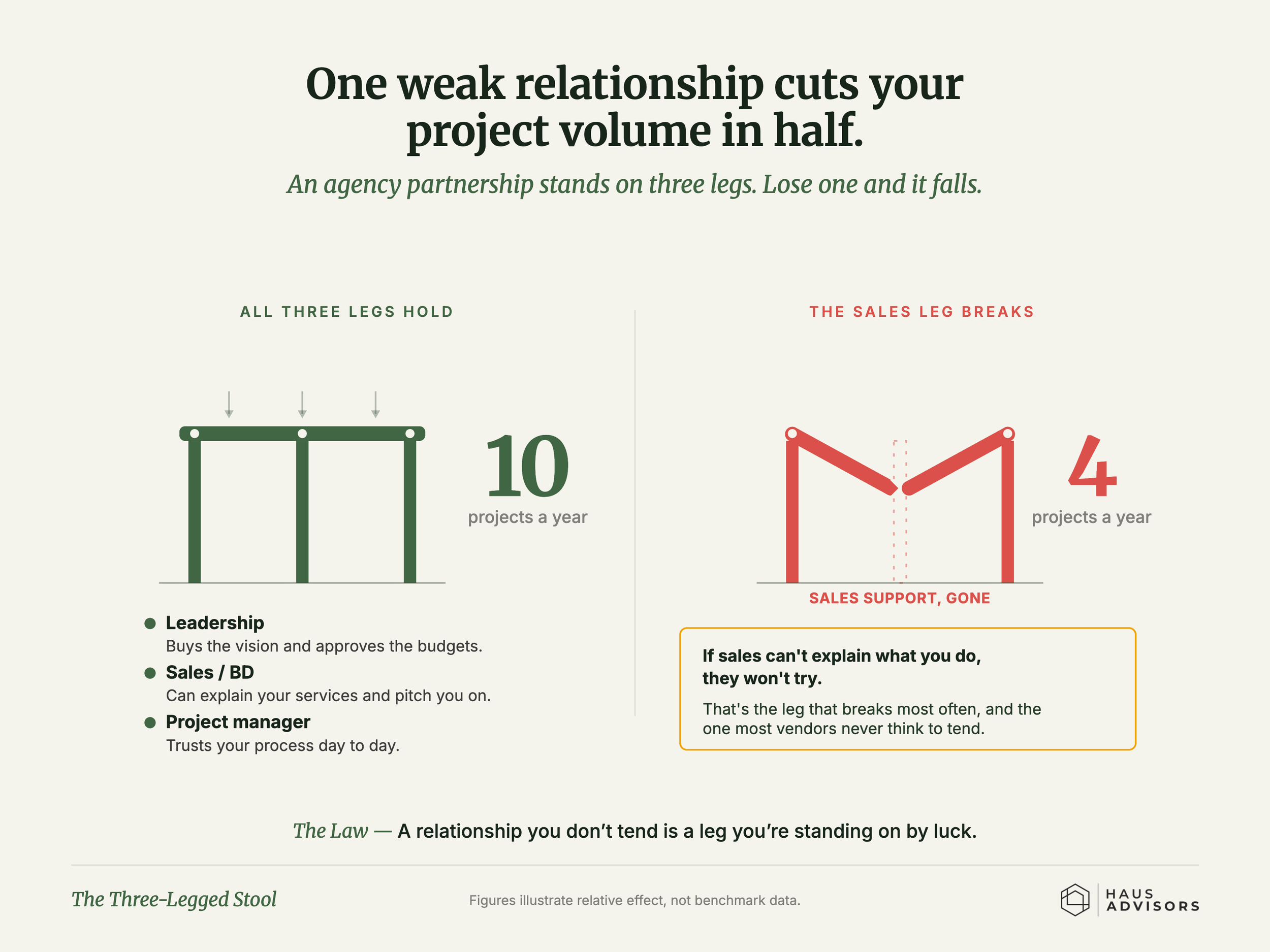
The 3-legged stool: you need a relationship with leadership, sales, AND the PM at every partner agency; if one leg goes, the whole thing falls over
Trust and timing are the two variables that control whether a referral happens — staying top of mind is the actual work
Positioning yourself as a strategic partner has to happen on day one; you can't layer it on later without it feeling forced
Free value (something genuinely useful, no ask attached) is the most underrated partnership-building tool in the playbook
Cold email once hit 20% reply rates; now it's too saturated — the shift is from demand gen to brand awareness
Audit your partner roster: agencies that aren't interested in actively growing don't deserve your full account management investment
Does This Sound Familiar?
You've got a referral agreement in place with a few other agencies. You both signed it, shook hands, and said you'd send work each other's way.
That was eight months ago. Nothing's moved.
The problem isn't bad faith. A referral agreement doesn't create a relationship, it just documents the hope of one. And without a relationship, there's no trust. Without trust at the right moment, there's no timing. And without timing, the project that was perfect for you went somewhere else.
Adam Weil has spent seven years on the other side of this dynamic, as the white label development partner that agencies either learn to rely on or forget about entirely. In this episode, he maps out exactly what separates the partnerships that generate consistent work from the ones that never get off the ground.
Take the free Bottleneck Score →
Meet the Guest
Adam Weil is a partner at White Rabbit Group, a white label development shop that works exclusively with agencies. He came to the role through an unusual path — running his own web design agency, burning through a dozen development teams across three continents, and eventually becoming a client of White Rabbit before joining as a partner in 2019. That experience of being on the agency side shapes how White Rabbit approaches every aspect of its partner relationships.
Visit whiterabbitgroup.com →
Episode Summary
1. From door-to-door sales to a $3M dev shop
Adam's path to running White Rabbit Group started with a failed college clothing company and a late-night obsession with Illustrator. Teaching himself design software in his dorm room — staying up until sunrise — gave him the first hint that he might want to work in tech. But his next move was unexpected: door-to-door alarm system sales, pure commission, no base.
That experience shaped something more durable than a skill set. "You learn to deal with rejection, to persevere, and just go to the next one," Adam said. When he eventually pivoted into web design, the willingness to do outreach — and to be bold about it — came naturally. He started freelancing, built a small shop, and hired employees. What he didn't have was a reliable development team.
2. How White Rabbit accidentally became an agency-first business
Before Adam ever joined White Rabbit Group, he was a client — and a reluctant one. He'd tried outsourcing development to South America, Eastern Europe, India, and local contractors. "I went through a dozen different development teams," he said. "They'd start off well, then I'd get handed off to someone else. Communication would be spotty. No QA. The CMS was a mess."
White Rabbit reached out via cold email and it took Adam a full year to give them a chance. Once he did, he never hired another development team. The model clicked: a stateside technical project manager for timezone communication, paired with co-founder Abilash managing the India team on-site. "Those two together, with high-quality output and some cost savings, allows an agency to upsell. I thought the whole model was brilliant."
When White Rabbit's founder Greg acquired Adam's shop in 2019, Adam joined as a partner and immediately pushed the company to double down on its agency-facing positioning. He knew exactly what it felt like to be on the other side — and he saw how much opportunity the model had for agencies that couldn't build or afford a full dev team.
3. The shift from project managers to account managers
For nearly a decade, White Rabbit ran entirely on technical project managers. It worked well enough — until Adam started asking why the agency relationships that were good weren't becoming great.
"When it comes to expanding that account, growing it, being a trusted advisor for that agency — not just a technical vendor — you need a different role," he said. They discussed hiring account managers as far back as 2022 and shot it down. The margins were good. The PMs were performing. And critically: "You don't know what you're missing until you have someone in that role experimenting."
What changed was internal. Their director of services, Marshall Bellinger, raised his hand and said he wanted to lead it. He had the right instincts — sales-minded, entrepreneurial — and they let him run with it. It's still early: "We've been around almost 10 years and only had account management for about a year and a half. We're still spread way too thin relative to the number of agencies we have."
4. The trust-and-timing principle
Adam describes agency partnerships with a deceptively simple framework: it's all about trust and timing. You can have both parties ready and willing — but if the timing isn't right when the project comes in, someone else gets the call.
"I'll reach out to someone I haven't talked to in quite a while, and a few days later they say, 'That's funny timing — we actually got a project.' That's not a coincidence. It's because I was top of mind and relevant in their mind." The implication is uncomfortable: there were probably projects in between that didn't come their way, simply because Adam wasn't in front of them.
The fix isn't complicated, but it requires a system. Stay in touch. Have something meaningful to say when you do. "Not just 'hey, how's it going?' — actually have something relevant to bring them." He recommends every agency have two to four free pieces of value they give away each year — not as marketing collateral, but as a genuine excuse to show up.
"It's not that there were no projects in the time since I last talked to them. That's not a coincidence. It's because I was top of mind."
5. Free value as outreach infrastructure
White Rabbit is currently building an AI-powered estimator — agencies can upload a brief or RFP, and it produces a detailed estimate with timeline, recommended tech stack, risks, and hour ranges. All historical project data, fed in. And they plan to give it away for free.
"That alone gives you something meaningful and relevant to say," Adam explained. "If you don't have anything else, at least have some free value you can just send them." The concept he's toying with is almost radical in its honesty: an email that says upfront it's automated, explains exactly why they're a fit based on research, passes along the free tool, and ends with zero ask. No follow-up. Just top-of-mind.
"Almost like you're handing out flyers," he said — a callback to his door-knocking days. The principle is the same: volume and goodwill, without pressure.
6. Cold email: what worked, and why it doesn't anymore
During the COVID years, Adam cracked cold email. He'd find agencies on LinkedIn — filtering for case studies but few developers — write genuinely personalized outreach, and send carefully. "I wasn't blasting a million people. I had a 20% reply rate for a solid year. Looking back, that's incredible."
That era is over. "We don't even really do cold email anymore. It's just not effective." The culprit, he thinks, is saturation — when everything went digital in 2020, everyone flooded the channel simultaneously, and inboxes built up resistance fast. AI has made it worse: personalization is now table stakes, but AI-generated personalization is easy to smell, so the bar for what reads as genuine keeps rising.
The shift he's making is conceptual: stop treating cold outreach as demand generation. Treat it as brand awareness. "If you're also posting content regularly or running paid ads, when you do send that cold email, they think, 'I've heard of you guys before.' They're more likely to open it." The outreach works harder when it's not doing all the work.
7. The 3-legged stool: the full partnership process
This is where the conversation gets operational. Adam walks through the exact sequence White Rabbit uses to turn a new agency into a long-term partner — and the framework that keeps it from stalling.
The process starts at the estimate stage. As soon as a new agency comes in with a project, Adam brings in an account manager immediately — not to close, but to introduce. "If the project closes, they're going to continue working with that account manager. I'd rather have them know each other instead of having to hand it off."
From there, the kickoff meeting is used to plant two seeds: make a strong first impression, and get the retro on the calendar. "Before the project is over, you make sure you get that retro on the calendar — because once it's over, it's hard to get it." At the retro, you're asking about their goals, their pipeline, whether this type of project is a one-off or a direction they want to grow in.
If there's interest, you propose a strategy call — within 30 days. And in the window between the retro and that strategy call, you're building what Adam calls the 3-legged stool.
"You have your leadership leg — a CEO, COO, or head of services. Your sales leg — a business development leader who needs to be able to sell what you do. And your PM leg — the project manager you work with day-to-day. You want a relationship with all three."
If any one of those legs goes missing, the stool falls. The sales team might love you but leadership keeps killing the budgets. Or the PM trusts you completely but the salesperson doesn't know how to present your services. "That's when I started to map it out," Adam said. "It was just pattern recognition. Why has this agency only brought us 4 projects this year instead of 10? Because their sales team doesn't know how to talk about us."
After the strategy call, you set up quarterly business reviews. The QBRs plus ongoing one-on-ones with each of the three stakeholders form the maintenance layer. And critically — you qualify who deserves that level of investment. "If they tell you they're not really interested in actively growing that side of the business, put them in a quarterly email check-in and keep it light. You don't want to spend all this time investing into an agency that doesn't want to grow.
Notable Quotes
"When you're outsourcing that sort of stuff, you're not just outsourcing code. It's your reputation."
"You don't know what you're missing until you have someone in that role experimenting and seeing what could come of really good account management."
"If you just treat yourself as a vendor from day one, trying to switch later to more of a business advisor role, it feels weird. So you wanna do that from day one."
"I've seen some agencies earn half a million dollars a year just from the projects they brought us — and we're doing 90% of the work or more."
Related Episodes
- Ep. 27: The 4-Direction Partner Framework That Turns 3 Deep Relationships Into a Referral Engine
- Ep. 58: How a 4-Person Shopify Agency Builds a Partner Engine That Actually Pays Off
- Ep. 49: Weekly Client Calls, Referral Networks, and 15 Years of Retention
Learn More / Get in Touch
Visit → whiterabbitgroup.com
LinkedIn → Adam Weil on LinkedIn
Want More Interviews Like This?
Subscribe to the show on YouTube →
Subscribe to my weekly newsletter →
If this resonates, here's your next step.
Pick the path that fits where you are right now. No pitch deck. No pressure. Just clarity.