Episode 71: How a B2B SaaS Agency Runs Its Own Demand Gen Playbook (and What Agencies Can Steal From It)
"The messaging and the ICP will determine the budget and the success more than the ads or the posts." — Brian Koffler
Watch
TL;DR — Key Takeaways
Paid ads work for agencies, but positioning comes first. If you can't clearly articulate what makes you different, no amount of ad spend will fix that.
Target a tight list. Diggs Marketing targets roughly 14,000 people on LinkedIn. At 20-30 clients, that list will last a long time. Smaller and more defined beats bigger and diluted.
Spend 70-80% of your budget on top-of-funnel awareness. The goal is repetition and recognition, not immediate conversion.
Bottom-of-funnel ads (book-a-call CTAs) can be toggled on and off based on capacity. Top-of-funnel never turns off.
Test content organically before putting paid dollars behind it. If it doesn't resonate without spend, it won't resonate with spend.
Commit to 6 months minimum. The ad platform needs time to learn, and so do you. A 30-day trial is a way to burn money, not a way to test a strategy.
Thought leadership ads work best when they don't read like ads. Authentic, first-person, slightly imperfect content consistently outperforms polished promotional content.
Does This Sound Familiar?
You've built a solid agency on referrals. The work is good, clients stick around, and word-of-mouth has carried you this far. But you've hit capacity a few times, the pipeline has gotten thin between engagements, and you know that referrals alone aren't a growth strategy. They're a lifeline.
So you look at paid ads. You run a few LinkedIn campaigns. Maybe you spend $3,000 over 90 days, get a handful of leads that weren't a fit, and shut it down with the conclusion that "paid ads don't work for agencies."
Here's the thing: they might work fine. It's just that they failed for reasons that had nothing to do with the ad platform. Audience too broad. Content too promotional. Positioning too vague. Not enough runway for the algorithm to learn anything useful.
Brian Koffler has run demand gen for B2B SaaS companies for years. When Diggs Marketing was ready to grow beyond referrals, he applied the same playbook to his own agency. Two years later, it's still running. The results are compounding. And the mechanics are something any agency founder can follow.
Take the free Bottleneck Score →
Meet the Guest
Brian Koffler is the founder and head of Diggs Marketing, a boutique demand generation agency focused exclusively on B2B SaaS. He runs paid LinkedIn campaigns for software companies, and in 2024 began applying that same methodology to grow Diggs itself. He joins the show to break down exactly how he built the playbook, what it costs, and what agency founders get wrong when they try paid ads for the first time.
Visit diggsmarketing.com →
Episode Summary
1. Why the transition from client work to self-service demand gen felt natural
For Brian, running ads for Diggs wasn't a leap. It was the obvious next step when referrals had taken the agency as far as they could. "My brain went to, 'How do we get business from people that don't know me personally?'" he said. The answer was the same toolkit his clients use every day.
The main difference between doing demand gen for an agency versus a B2B SaaS company isn't strategy. It's budget. Venture-backed software companies are under pressure to hit growth targets for fundraising or exit. Agencies can grow steadily, which changes the risk profile. But if you're selling to B2B leaders, the buyer psychology is nearly identical.
2. Positioning as the non-negotiable prerequisite
Before a single ad runs, Brian insists on clarity. Not a tagline. Not "we do digital marketing." Something specific enough that the right person reads it and thinks "that's exactly what I need."
He described the failure mode common to smaller agencies: generic language that could apply to any firm on the market. "You need to be remembered for something that is unique. It doesn't mean you have to do something completely unheard of. You just need a unique twist, a unique package, or a unique point of view."
The example that landed: an agency that works exclusively with hospitals, with a specific methodology for getting X result. Stack enough differentiating elements, and the content almost writes itself. Every post has a natural point of view, because you know exactly who you're writing to and what they care about. Positioning also has to hold all the way through. It needs to match the sales call, the onboarding, and the client experience. If any part of the chain breaks, the whole thing fails.
3. Building the target audience: start with your best clients
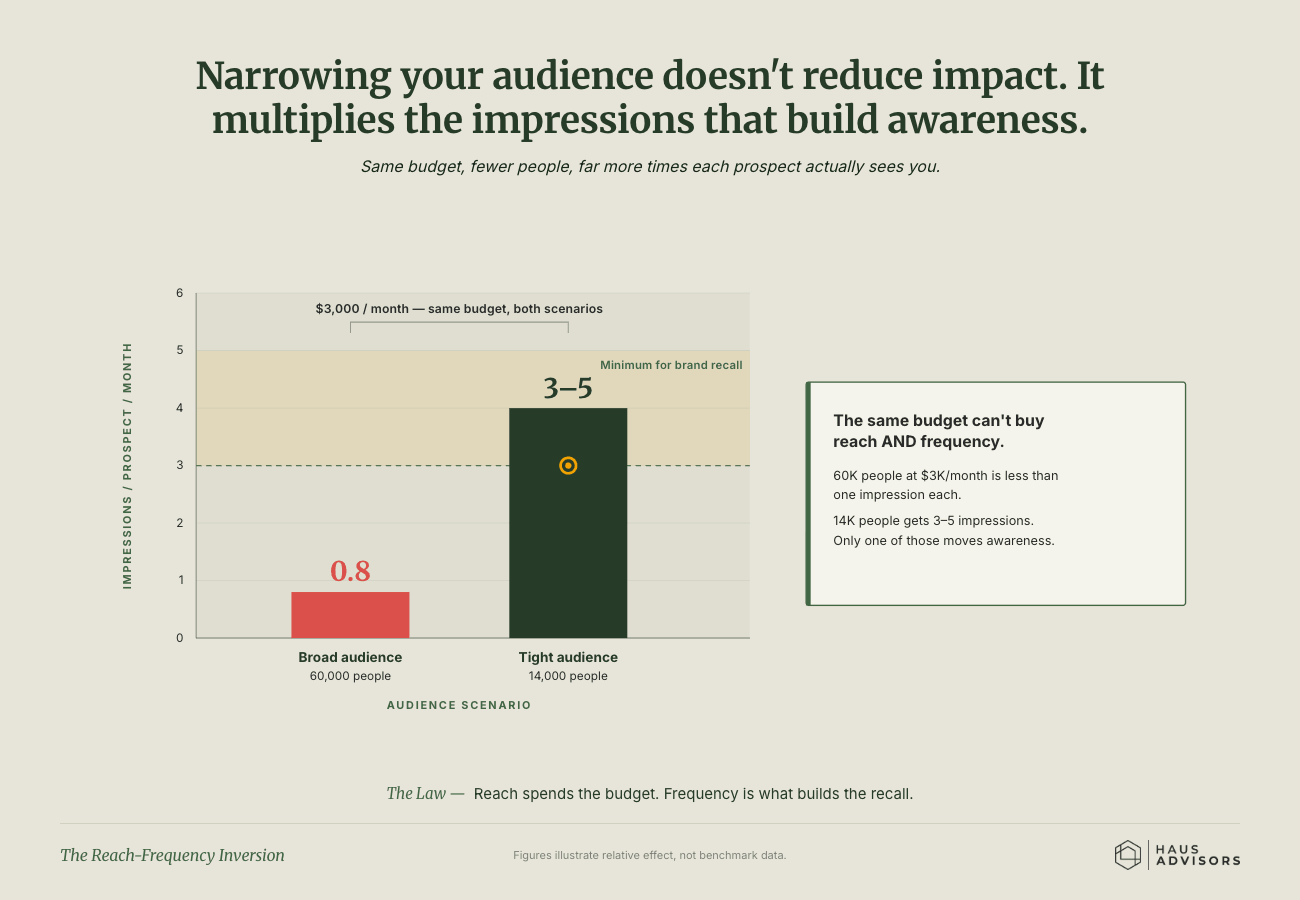
Diggs targets about 14,000 people on LinkedIn. That number came from analyzing the agency's best clients and pulling out the characteristics they shared: job title, company size, and how long they'd been in their role.
That last variable was a real signal. "People who are 6 months into their role or less are often looking for an agency like Diggs or help." New-in-seat operators are in evaluation mode. They're building or rebuilding. That's a trigger, and it made the list sharper.
Brian pushed back on the instinct to want a bigger audience. "I would personally rather have the same 14,000 people who are perfect fits see our stuff 5 times than have people who are not perfect fits see our stuff." For an agency with 20-30 clients, that list will last for years. The trap is confusing reach with relevance.
"Paid is a great amplification for things that are working. It is not a way to test if things are working." — Brian Koffler
4. The 70/20 funnel split and when to turn things off
Brian's budget allocation philosophy is simple: 70-80% toward top-of-funnel awareness, 20-30% toward warm retargeting and bottom-of-funnel conversion.
The top layer has no conversion ask. No demo request. No sales call CTA. Just content in front of the right people, repeatedly, so that when the time is right they already know who Diggs is. This layer never turns off, even when the agency is at capacity.
The bottom layer, ads with a call to action, can be modulated. When Diggs is full, Brian scales it down or turns it off entirely. He doesn't want five qualified calls in two weeks when the team can't properly service them. But the awareness machine keeps running. "Those are people who are super warm who have now been seeing our stuff and just not having the chance to convert."
The result: even without bottom-of-funnel ads running, roughly 90% of inbound calls still attribute to LinkedIn when Brian asks how they found him. The top-of-funnel work drives organic conversion on its own schedule.
5. Content that works: organic first, paid second
Brian writes consistently on LinkedIn and his team has started contributing too. About a third of his posts are educational, a third are adjacent to his buyers' world, and a third are sarcastic observations about being a VP of marketing. All of it resonates with the same person.
The rule for what gets promoted: if it performs organically, it's a candidate for paid amplification. "Paid is a great amplification for things that are working. It is not a way to test if things are working."
For thought leadership ads specifically, the quality signal is whether it reads like a human wrote it. Posts that open with "I" or "me" tend to outperform. Cell phone photos outperform polished studio shots. The more it looks like an ad, the less it performs. The format comes from a person's profile, not a brand page, and readers can feel the difference.
6. Budget, timeline, and patience
If your ICP is tightly defined and the list is small, Brian's rough minimum is $2,000 per month on one platform with one content play. If the ICP is broader, expect $4,000 to $6,000 to generate enough signal to learn from.
The mindset matters as much as the number. "If you're going to run paid ads for a month and see what happens, that's not a good mindset." Brian committed to a 6-month budget before he started Diggs' own campaigns. Not because he expected results in month 6, but because he knew he needed time to learn, adjust, and let the platform learn alongside him.
Within the first two months, the goal isn't pipeline. It's leading indicators. Which posts got engagement? Which audience segments responded? Did anyone reach out and tell you how they found you? Those data points become the hypotheses that guide the next two months. "You will have some indicators that make us have 4 more educated guesses over the next 2 months of what to do. And then we'll learn 2 other things, and it compounds."
7. The long game: pre-warmed buyers and compounding awareness
Brian described clients who had been engaging with his LinkedIn content for over a year before ever reaching out. They'd like posts, read threads, see who else comments. Then they take a new job and within two weeks they're booking a call because they already know how Diggs thinks.
That's the actual promise of this approach. Not click-to-conversion. Pre-built trust at scale. "People come knowing who you are and your point of view. I literally have people on sales calls all the time say, 'Your post about X spoke to me.'" The sales conversation starts at step 2 or 3 instead of step 1.
It's not a referral, but it's closer to a referral than a cold ad impression. And the paid motion is what gets people into that sphere who wouldn't have found Diggs organically. Once they engage, the algorithm serves them more. The relationship deepens without requiring a single direct outreach.
Notable Quotes
"The more it comes off as organic and authentic, the better it will perform."
"I will never turn off the top-of-funnel awareness piece ever, because that is what fuels future growth."
"If you expect paid ads to just work after a month or two, that's just not how it works."
"You want to produce content that speaks to an individual person, and have that person in mind."
Related Episodes
Learn More / Get in Touch
Visit → diggsmarketing.com
Email → brian@diggsmarketing.com
LinkedIn →
Want More Interviews Like This?
Subscribe to the show on YouTube →
Subscribe to my weekly newsletter →
If this resonates, here's your next step.
Pick the path that fits where you are right now. No pitch deck. No pressure. Just clarity.