Episode 72: Why Your LinkedIn Ads Aren't Working (And What Thought Leader Ads Change)
"Niche your advertising, not your agency."
Watch
TL;DR — Key Takeaways
LinkedIn's traditional ad formats can't carry a complex strategic argument -- so most agencies default to generic messages that make them look interchangeable
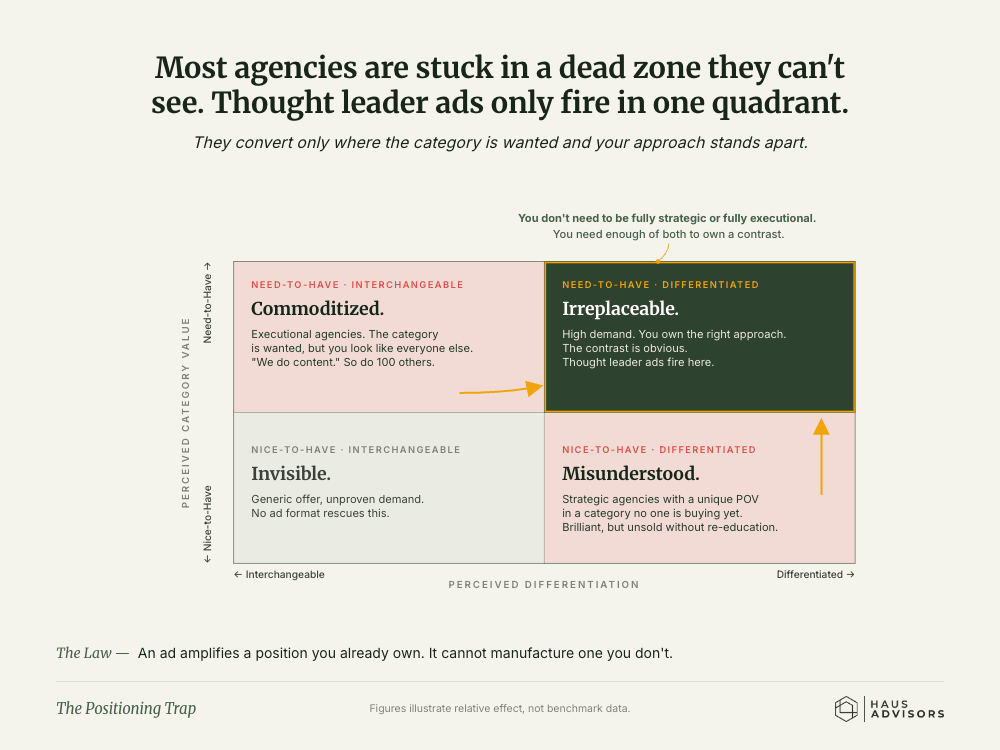
Thought leader ads change the game by letting you communicate the "wrong way vs. right way" contrast that shows your unique approach
The most effective message structure: symptom the prospect recognizes, root cause they didn't see coming, consequence if ignored, and your solution as the only logical path
After the ad, send traffic to a "niche offer page" -- not a homepage -- where you walk through the full message at a deeper level and make the engagement tangible (scope, price, next step)
Best fit for this approach: agencies that have both a strategic component and an executional deliverable, serving a market category where demand already exists
Generalist agencies can still use this by niching their advertising to one service or vertical, running specialized thought leader campaigns to each audience without exposing that segmentation to anyone else
The goal is to narrow down 100 possible solutions in the prospect's mind to one -- the solution you own
Does This Sound Familiar?
You've tried LinkedIn ads. Maybe more than once. You ran the campaign, watched the spend go up, and waited for the pipeline to respond. It didn't.
So you concluded LinkedIn ads don't work for agencies. Or that they only work at enterprise scale. Or that your targeting just wasn't dialed in enough. But what if the problem wasn't the platform -- it was the format?
Most LinkedIn ad formats cap what you can say. You get a headline, a line of copy, and an image. That's enough to say "we get you more leads," but it's not nearly enough to show why your approach is genuinely different. You end up looking like everyone else in your category, competing on vague promises instead of real expertise.
That's the problem Dylan Ciaccio identified -- and it's why he built his work around a newer format that finally gives agencies enough room to make a real argument.
Take the free Bottleneck Score →
Meet the Guest
Dylan Ciaccio is a solopreneur and founder of Focus the Lens, where he helps agencies build and run LinkedIn thought leader ad campaigns. He specializes in the message creation side -- developing the wrong-way/right-way contrast that makes these campaigns land -- and has worked with clients across deal sizes from four to seven figures.
Visit LinkedIn -- Dylan Ciaccio →
Dylan has run this format across an unusually wide spread of deal sizes, from clients with a $1,000 lifetime value up to one seven-figure engagement. That range is the reason it is worth listening to. An ad format that only works at enterprise budgets is a different claim from one that works at both ends.
Episode Summary
1. Why traditional LinkedIn ads fail agencies
Dylan opened by identifying the two things most agencies get wrong with LinkedIn ads: format and message. Traditional ad formats -- static image ads with a single generic line -- physically can't carry a nuanced argument. The result is messaging like "get more leads with LinkedIn ads," which signals generalist, interchangeable, and forgettable.
The format limitation isn't just a creative problem. It's also why LinkedIn has always been more expensive than Meta or Google. The targeting is genuinely superior for B2B, so LinkedIn charges accordingly -- but when the format prevents you from showing why you're worth the premium, the ROI math never works.
"A very generic message gets you seen as a generalist, interchangeable," Dylan said. "And so why buy from that person compared to anyone else in that category?"
2. What thought leader ads actually make possible
The shift came with LinkedIn's thought leader ad format, which allows a post from an individual (rather than a company page) to be promoted directly to a targeted audience. The format is long enough to carry a real argument -- which changes everything for agencies with a genuine point of view.
Dylan distinguished between two types of agency positioning problems. Strategic agencies struggle to show why their approach is a "need to have" rather than a nice to have. Executional agencies struggle to show what's different about their work in a crowded category. Both problems have the same solution: a message that names the wrong approach, shows the pain it causes, and positions the agency's method as the only logical alternative.
The franchise marketing agency example made this concrete. Dylan's first client served franchise brands and had identified what they called "fragmented franchise marketing" -- the problem of each franchisee running their own ads with no coordination. The agency had built proprietary software to unify everything. But they were marketing themselves as "the best franchise marketing agency," listing benefits that any competitor could claim. The thought leader ad reframed everything around the contrast: fragmented versus unified. Symptom, root cause, consequence, solution.
3. The message structure that drives the ads
Dylan walked through the post structure he uses with clients. It's layered, almost like peeling an onion. The ad opens with the symptom -- the pain point the prospect already feels and recognizes. Then it names the root cause they haven't diagnosed yet. Then it shows what happens if they don't address that root cause. Then it introduces the right approach.
"It's valuable, it's empathetic, and it helps them see your approach as the only solution," Dylan said.
This structure does something most advertising doesn't: it rules out the alternatives. Most marketing addresses a pain point and says "we fix that." But the prospect's mind immediately generates a list of other ways to fix it. Dylan's method walks them through that list and eliminates the options one by one, until your solution is the only one left standing.
"You thought you wanted X, but what you really need is Y. Some people might call it damning the demand."
4. Where to send people after the ad
David asked a practical question: what's the destination? Homepage, article, booking page?
Dylan's answer has evolved. His recommendation for most agencies is what he calls a "niche offer page" -- a long-form landing page written in an article style, but still designed to convert. It continues the message from the ad at greater depth, goes further into the root cause and solution, and then makes the engagement tangible: what working together looks like, how it's scoped, what it costs, and what the next step is.
The reason for the last part matters. Buyers can be fully bought into your perspective and still have no idea what hiring you actually involves. Without that clarity, booking a call feels like a big, scary leap. The niche offer page closes that gap -- so by the time someone books, they're not wondering what they're getting into.
5. Who this works best for
Dylan was direct about fit. This approach works best in market categories where demand already exists -- where a meaningful percentage of the target market is actively thinking about the problem, not just the few percent who might happen to be in the market at any moment.
High-demand categories let you differentiate within the category rather than create the category from scratch. More strategic agencies that have to build awareness of a non-obvious problem face a longer timeline and more reconditioning work before the ads pay off.
The sweet spot, Dylan said, is an agency with both a strategic component and an executional deliverable -- something tangible enough to trigger existing demand, but distinctive enough to stand apart on approach. "Very strategic content service" was his example: not a commodity content mill, but an agency where message development and distribution strategy are central to the work.
Deal size, he added, is less of a factor than people assume. He's seen the approach work from $1,000 LTV clients to one client with a seven-figure engagement.
6. Generalist agencies and the segmentation play
David raised a natural objection: doesn't this only work for specialists? Dylan agreed in principle -- it's hard to make a sharp "wrong way / right way" argument when you do everything for everyone.
But he offered an important nuance. Unlike organic content (where your whole audience sees the same message), paid campaigns can be targeted to a specific segment. A generalist agency with three main verticals can run three separate thought leader campaigns, each with a specialized message for that audience. The other audiences never see it. The perception of specialization is created -- and perception, Dylan argued, is what actually matters in a buying decision.
"Advertising is about perception and not reality," he said. "Here you can make sure that a specific audience sees a certain message and the others don't."
He summarized the strategic principle this way: "Niche your advertising, not your agency." If niching your entire agency feels too risky, niche the campaigns instead. You get the conversion benefits of being seen as a specialist without locking the whole business into a single lane.
Notable Quotes
"A very generic message gets you seen as a generalist, interchangeable -- and so why buy from that person compared to anyone else in that category?"
"The format is not very valuable, and it doesn't give you the ability to create a message that you need to communicate your unique position."
"You thought you wanted X, but what you really need is Y. Some people might call it damning the demand."
"Niche your advertising, not your agency."
Related Episodes
Learn More / Get in Touch
Visit →
Want More Interviews Like This?
Subscribe to the show on YouTube →
Subscribe to my weekly newsletter →
If this resonates, here's your next step.
Pick the path that fits where you are right now. No pitch deck. No pressure. Just clarity.