Why Paid Ads Don't Work for Most Agencies (And the One Case Where They Do)
A founder I talked with a few months back had done everything right. He'd hired a paid ads specialist. He'd built a dedicated landing page. He'd tested three audience segments on LinkedIn. Over three months, he spent just under $6,000 and generated 22 leads.
Twenty-two leads sounds like progress. It wasn't. Fourteen never responded to follow-up. Six scheduled calls and didn't show. Two showed up, said his work looked great, and went quiet after he sent the proposal.
He blamed the targeting. His ads person blamed the landing page. Neither of them questioned whether paid ads were the right mechanism for what he was actually trying to sell.
That's the mistake I see most often. Not running bad ads. Running the right ads for the wrong type of sale.
Paid ads work. That's not the debate. For the right product, at the right price point, with the right buying behavior on the other side, they convert reliably. The question isn't whether paid ads work. It's whether what you're selling matches how paid ads actually convert, and for most agencies, it doesn't.
The Purchase Psychology Problem No One Is Talking About
There's a number worth knowing: roughly $500.
That's approximately the price point where a stranger can see your ad, click, and buy without knowing much else about you. The cost of a wrong decision is recoverable. The research process is short. The trust gap between "I saw your ad" and "here's my credit card" is small enough that an ad can bridge it on its own.
Now think about your last five clients. What did they pay you?
For most development agencies, that number sits somewhere between $15,000 and $150,000. For an engagement that size, nobody is converting from an ad they saw while scrolling LinkedIn on a Tuesday afternoon. They might note your name. They might even click through. But the purchase decision is not happening in that moment, from that single interaction.
The math behind paid ads assumes that awareness and conversion are close together. For consumer products, they often are. For a five-figure professional services engagement, there's an enormous gap between "I've heard of you" and "here's a signed contract." Paid ads can introduce your name. They can't close that gap alone.
The Trust Gap
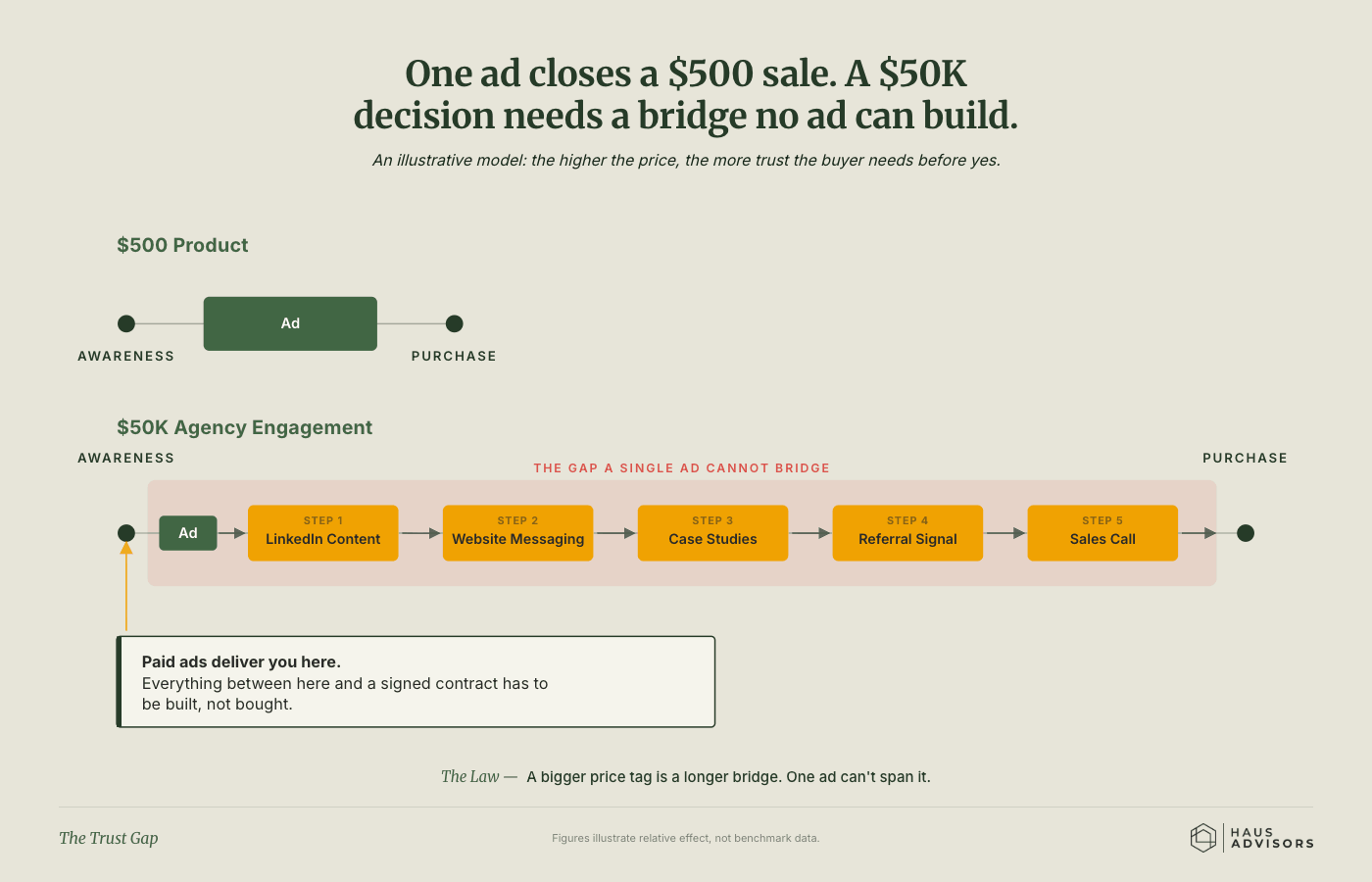
The trust gap widens as price increases. At low price points, an ad alone closes the sale. At agency price points, the gap requires a stack of trust-building touchpoints, and ads can only place a prospect at the awareness end.
Here's what actually closes a high-ticket agency deal: a prospect who has seen your thinking over time, read a case study that mirrors their exact situation, heard your name from someone they trust, and showed up to a call where everything you say matches everything they've already encountered about you.
That's not a single conversion event. It's a stack. A stack that builds across multiple touchpoints, over weeks or months, until the cost of hiring you feels lower than the cost of getting this wrong with someone else.
Paid ads can be one touchpoint in that stack. They can introduce your name to someone who'd otherwise never find you. But they can't be the case study. They can't be the referral. They can't be the body of work that demonstrates how you think. They can create the first moment of awareness, but awareness is the cheapest, least durable part of the conversion process.
The agencies that run paid ads without the rest of the stack in place don't get silence. They get what that founder got: 22 leads who don't convert. Proposals that go quiet. Conversations that feel promising and then stop. The problem isn't the ad. The ad delivered someone who wasn't ready into a funnel that wasn't ready for them.
The One Exception (And Why It Probably Doesn't Apply to You)
I want to be honest about this, because there is an exception and it's worth understanding.
I know an agency doing $8 million in revenue that runs paid ads successfully. All they sell is packaged video case study production. Fixed number of videos, fixed scope, fixed price, clear deliverable. Their ads work because what they're selling is close enough to a product that a stranger can evaluate it from the ad itself.
The conditions that made paid ads viable for them aren't a mystery. They're specific:
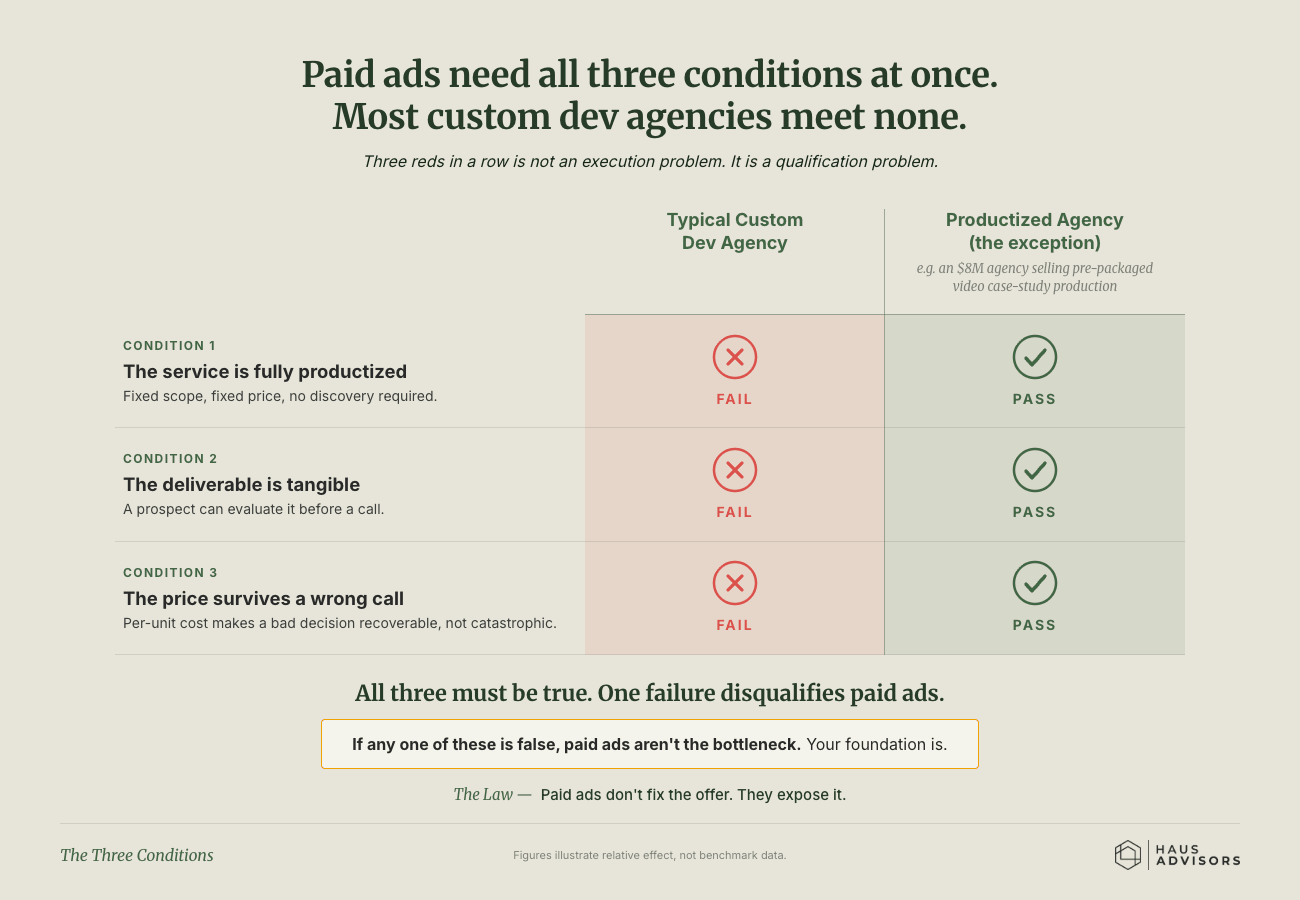
Paid ads work when all three conditions are true. Most custom development agencies meet none of them,which means the problem isn't the execution. It's the premise.
Condition 1: The service is fully productized. Fixed scope, fixed price, no custom discovery required. A prospect can understand what they're buying before a single conversation happens.
Condition 2: The deliverable is tangible. Someone can look at samples, understand exactly what they'd receive, and form a real opinion about it without a call.
Condition 3: The per-unit price is low enough that a wrong decision is recoverable. Not $500-low, but not $80,000-custom-development-low either. The risk of hiring the wrong vendor doesn't feel catastrophic.
When all three are true, paid ads can work. The trust gap is small enough for an ad to bridge.
For most agencies, none of those three are true. The service is custom. The deliverable depends on discovery. The price is high enough that buying from a stranger based on an ad is a genuinely risky decision. The trust gap doesn't shrink because you wrote better copy.
The Demand Gen Caveat
I've also talked with founders who specialize in demand generation and who have run paid ads for their own agencies. They believe in the channel. And even they describe it as a 6-to-9-month process before leads materialize, at $3,000 per month in spend.
That's a $27,000 experiment before you see a qualified client on the other side. Most agencies can't sustain that runway. And most that start quit before the flywheel turns, which means they absorb all the cost and none of the benefit.
Why Every Article About This Gets It Wrong
Search "why paid ads don't work for agencies" and you'll find the same article written a dozen different ways. The headline changes. The numbered list changes. The conclusion doesn't.
The conclusion is always: here's how to fix your ads.
Bad targeting. Weak creative. Slow landing page. Wrong attribution window. The frame is always execution, and the fix is always better execution. Not one of those articles asks whether paid ads are the right tool to begin with.
The reason is straightforward. Every piece ranking for that search is written by someone who sells ad management. Their revenue depends on you believing the problem is how you're running your ads, not whether you should run them at all. An agency that tells you paid ads structurally don't fit your type of business is an agency that doesn't get your retainer.
I don't run paid ads for clients. I don't manage ad accounts. I have no financial stake in whether you spend money on ads or not. That's the only position from which you can give an honest answer to this question, and the honest answer is that for most agencies, the reason paid ads don't work has nothing to do with targeting or creative.
It has to do with what your sale actually requires, and what paid ads can actually deliver. Those two things don't match at your price point.
What Actually Works Instead
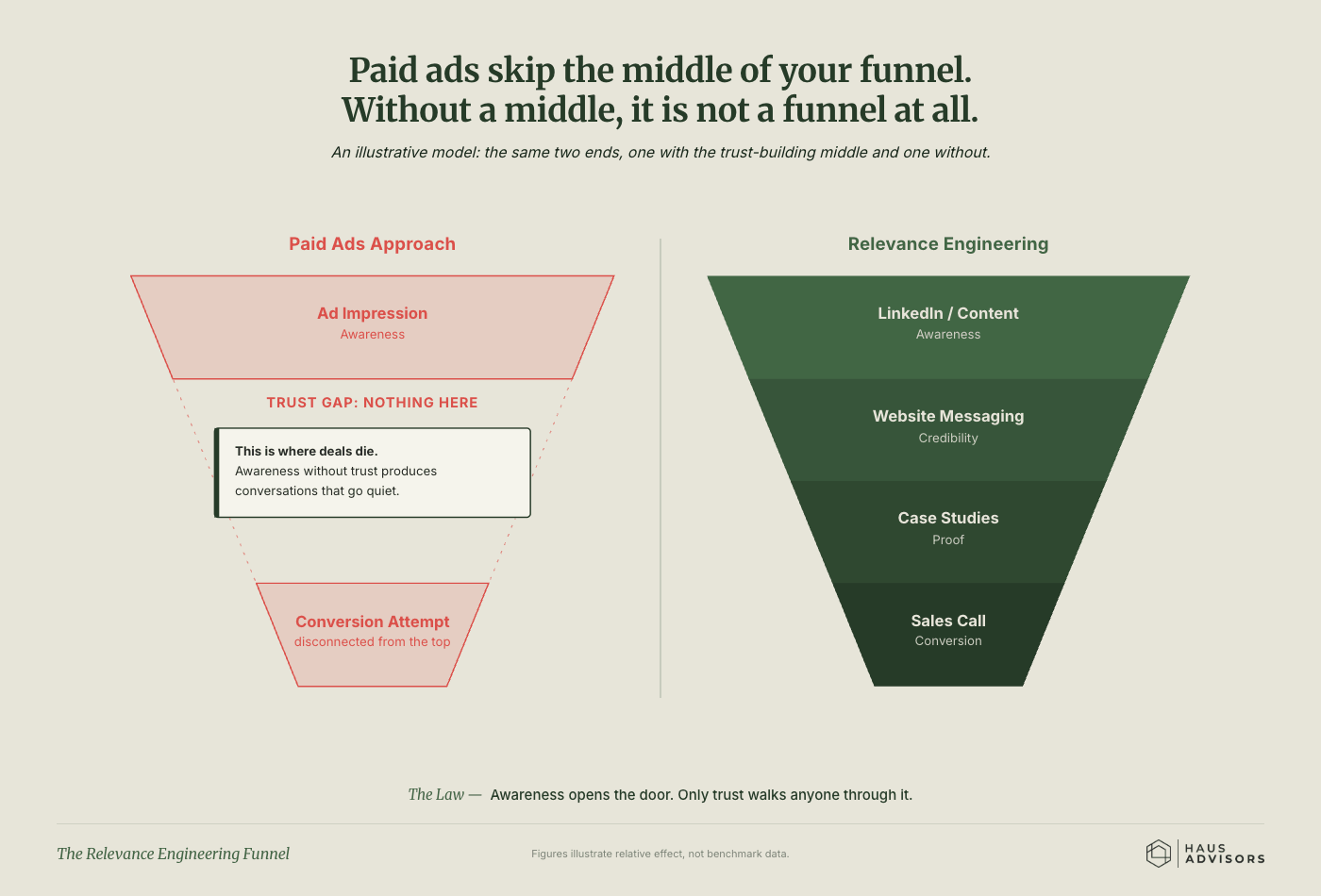
The problem paid ads are trying to solve is real. Not enough of the right people know who you are, and the ones who do find you arrive without enough context to convert.
The solution to that problem isn't a different channel. It's engineering the entire funnel around one clearly defined client profile, so that every touchpoint (LinkedIn, your website, your case studies, your referrals) compounds into the trust that closes the sale.
It's the first of six pillars in what I call Relevance Engineering. The full write-up is here, but the core move is this: identify your two or three best clients, the ones where the work was excellent and the relationship was easy, and reverse-engineer what they had in common. Not the industry. Not the tech stack. The specific business situation they were in when they hired you.
That profile becomes the lens for everything else. Your LinkedIn content speaks to that person. Your website describes their problem. Your case studies mirror their situation. Your referral conversations help people recognize when they've met someone who fits.
When all of those are pointed at the same profile, something shifts. The leads that come in arrive already warm. They've seen your thinking. They recognize their situation in your case studies. They show up to the call ready to move. That's the that paid ads are supposed to create. It just doesn't come from ads.
The Foundation That Has to Come Before Any of This
Most agencies that try paid ads aren't missing a channel strategy. They're missing the foundation that makes any channel work.
Paid ads make this visible fast. You spend money, you get clicks, and nothing converts. So you assume the problem is the ads. You try content marketing. Nothing converts. Cold outreach. Nothing converts. The continues because you keep switching channels instead of building the thing that gives every channel somewhere useful to go.
Before any lead generation works, paid or organic, three things need to be in place.
First: ICP clarity sharp enough to name 20 specific companies that fit. Not a demographic. Not "B2B SaaS companies under 200 employees." A specific type of business in a specific situation, described in the language they'd use to describe themselves.
Second: at least two case studies that speak directly to that ICP's exact problem. Not portfolio pieces. Stories that start with the situation the client was in, explain why they needed outside help, and show the measurable thing that changed.
Third: consistent messaging across every surface a prospect might encounter. If your LinkedIn posts sound like one agency and your website sounds like another, the stack of credibility never builds. Trust compounds only when the signal is the same everywhere.
This is exactly the work we do in the first phase of the New-Business Engine. We sit with you, reverse-engineer your best client relationships, and pull the ICP clarity and the case study foundation out of your head and into something your team can run. It's the work that should have come before any lead generation started. If you want your agency to grow without needing you in every deal, that's what the Program is built for. Book a call to see if it's a fit.
The Short Version
Paid ads work for agencies when all three of these conditions are true:
The service is productized. Fixed scope, fixed price, no custom discovery required. A prospect can understand exactly what they'd receive before they talk to you.
The deliverable is tangible. Someone can evaluate what they'd get without a call, and form a real opinion about whether it's right for them.
The price point is low enough that a wrong decision is recoverable. The risk of hiring the wrong vendor doesn't feel catastrophic.
If any one of those three is false, paid ads aren't the bottleneck. The foundation is.
For most development agencies, all three are false. The service is custom. The price is high. The trust gap between "I saw your ad" and "here's a signed contract" is too wide for any creative or targeting strategy to close.
That's not a flaw in your execution. It's a structural reality about how buyers make decisions at your price point.
Paid ads are not the problem. Running them before you've built the thing they're supposed to amplify, that's the problem.
Keep reading
Browse by topic
- Positioning & Strategy
- Lead Gen & Marketing
- Sales & Biz Dev
- Pricing & Productization
- Research & Data
- Operations & Delivery
- Client Retention & Expansion
- Leadership & Culture
For founders whose agency has outgrown referrals.
One idea a week that makes a hard growth problem obvious, usually with a chart that shows you the mechanism behind it.
Built from conversations with seventy-plus agency founders on the Behind the Agency podcast.