The Skills That Made You a Great Developer Are the Ones Holding Your Agency Back
A founder I work with spent three months building the most thorough proposal process I've ever seen. Every prospect received a detailed technical architecture document, a risk assessment, a phased implementation plan, and a scope matrix with dependencies mapped. It was genuinely impressive engineering work.
He lost nearly every deal.
The proposals that won were shorter, vaguer, and technically inferior. The agencies that beat him weren't better at the work. They were better at framing why the prospect should care about the work. While he was engineering the perfect solution, his competitors were having a conversation about the prospect's business problem. While he was building before selling, they were selling before building.
When I pointed this out, his response was immediate and telling: "But their proposals weren't even accurate. They were promising things they hadn't fully scoped." He was right. And that was exactly the point. He was applying engineering logic to a business development problem, and engineering logic was producing the wrong answers.
The Pattern Has a Name
I call it The Engineer's Trap: the systematic misapplication of engineering thinking to business development, producing outcomes that are technically correct and commercially ineffective. It's the reason so many technically excellent agencies are outperformed by less capable competitors who understand something the engineer doesn't: business development operates on different logic than software development.
This isn't about technical founders being bad at business. It's about a specific set of cognitive habits, ones that produce excellent engineering outcomes, that produce the opposite result when applied to positioning, sales, and growth.
Three habits in particular:
Engineers optimize for quality. Business development rewards clarity. In software, quality is the differentiator. Clean code, scalable architecture, thorough testing. These produce better outcomes and the market (eventually) rewards them. In business development, quality is invisible. The prospect can't evaluate your code quality, your architecture decisions, or your testing rigor before hiring you. What they can evaluate is whether you clearly understand their problem and can articulate why your approach will solve it. The technical founder who spends three months perfecting their proposal process instead of sharpening their positioning is optimizing for a dimension the buyer can't see.
Engineers solve for completeness. Positioning requires incompleteness. Good engineering is comprehensive. It accounts for edge cases, handles failure modes, and resists leaving gaps. Good positioning is deliberately incomplete. It says "we do this" which inherently means "we don't do that." The technical founder's instinct to cover every capability, serve every client type, and solve every possible problem is an engineering virtue applied to a business context where it produces the opposite of what's intended. "We can do anything" sounds like flexibility to the engineer. It sounds like "we specialize in nothing" to the buyer.
Engineers build before they validate. Business development requires selling before you build. In software, you architect, implement, and then ship. In business development, you position, sell, and then deliver. The sequence is reversed. Technical founders find this deeply uncomfortable because it feels like promising something you haven't built yet. So they default to building elaborate processes, detailed proposals, and comprehensive capabilities before they've validated that anyone wants to buy them. The result is beautifully engineered sales infrastructure that nobody uses because the positioning underneath it doesn't resonate.
Why This Trap Is So Sticky
Because the engineering instincts aren't wrong in the abstract. They're wrong in this context. And that distinction is almost impossible to see from inside the trap.
The technical founder who lost deals to vaguer proposals sees sloppy competitors getting rewarded and concludes the market is irrational. In a sense, he's right. The market doesn't evaluate agencies the way an engineer evaluates code. But instead of adapting to how the market actually works, he doubles down on engineering excellence because that's the domain where his judgment has always been reliable.
This creates a reinforcing loop. Technical quality doesn't produce business results. The founder interprets this as needing more technical quality. More thorough proposals. More detailed scoping. More comprehensive capability demonstrations. Each iteration is a better engineering solution to a problem that isn't an engineering problem.
The loop is reinforced by the founder's identity. They became a developer because they're good at building things. They started an agency because they're good at building things. The suggestion that building better things isn't the path to growth feels like an attack on the core skill that defines them. So they resist it, not out of stubbornness, but out of a reasonable attachment to the competence that built everything they have.
Meanwhile, the competitors who are winning deals aren't better engineers. They've simply recognized that business development is a different discipline with different rules, and they've invested in learning those rules rather than applying the rules they already know.
What the Engineer's Trap Actually Costs You
Deals lost to less capable agencies. This is the most painful cost, because you can see the gap. The prospect chose an agency whose technical work is objectively weaker. You know you would have delivered a better outcome. But the competing agency understood the prospect's business problem better, communicated a clearer approach, and made the buying decision feel lower-risk. Technical excellence lost to commercial clarity.
A "full-service" positioning that signals inexperience. The engineer's instinct for completeness produces positioning that claims broad capability: "We build web applications, mobile apps, APIs, and cloud infrastructure for startups, mid-market, and enterprise clients." To the engineer, this is accurate and comprehensive. To a sophisticated buyer looking for an agency that has solved their specific problem multiple times, it's a red flag. It signals that you've never committed to a focus, which means you've never developed deep expertise in any single problem space.
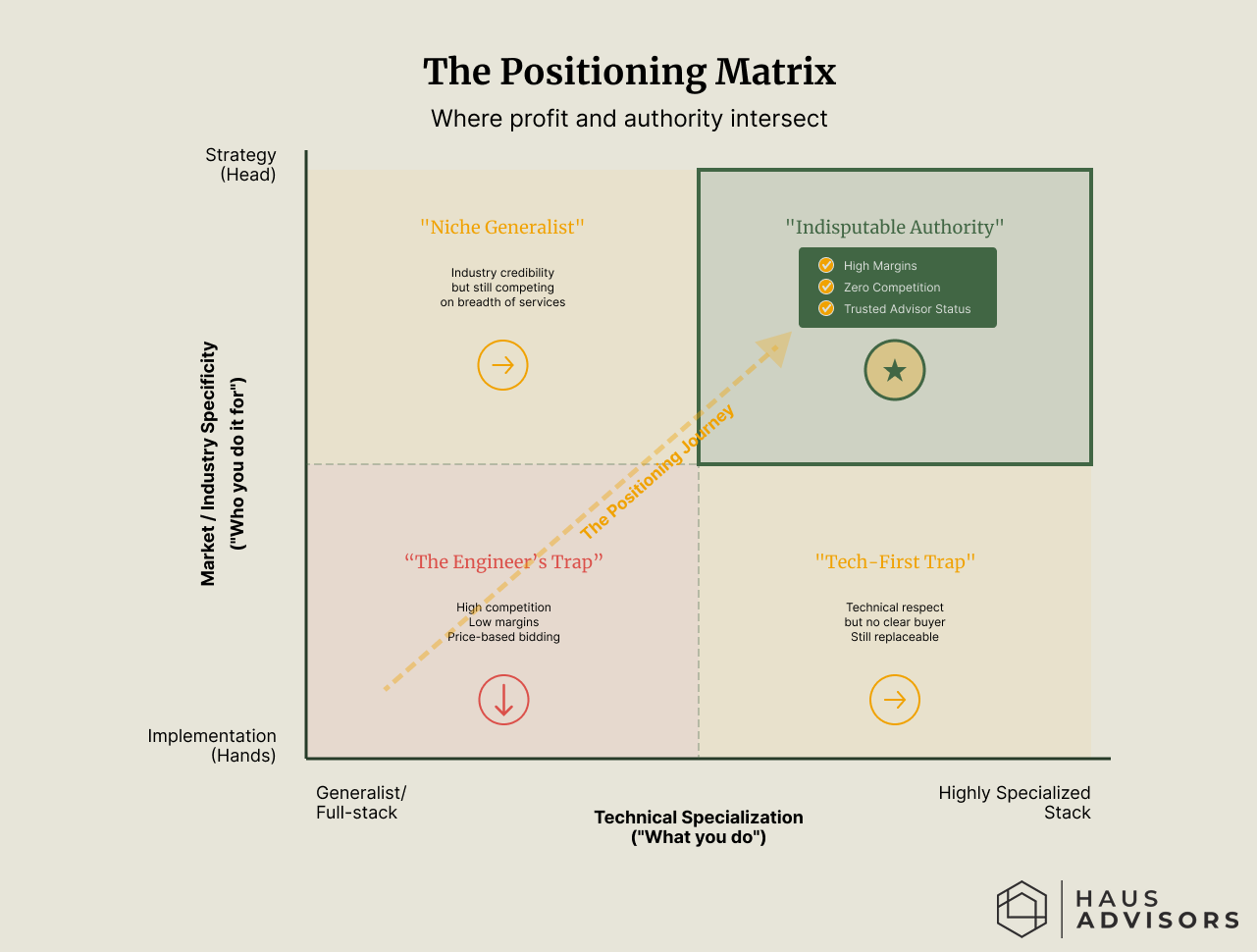
The visual argument: technical founders need to move right (narrower focus) and up (business outcomes over technical execution) to escape the trap. The diagonal is the path.
The founder bottleneck that masquerades as dedication. Technical founders who haven't separated engineering instinct from business development end up personally involved in every sales conversation, every proposal, every scoping decision. Not because they're control freaks, but because "how we do things" lives in their engineering judgment, which they haven't translated into positioning, processes, or productized offerings that others can execute. The business can only grow as large as the founder's personal bandwidth.
The "salesy" allergy that prevents investment in growth. Technical founders often describe marketing and sales as "inauthentic" or "salesy." This isn't just personal preference. It's a symptom of the Engineer's Trap. When your positioning is generic, sales does feel inauthentic, because you're trying to persuade rather than inform. You're performing enthusiasm instead of demonstrating expertise. The solution isn't to become more comfortable with sales. It's to build positioning specific enough that sales conversations feel like consulting conversations: diagnostic, expert, and focused on the prospect's problem rather than your capabilities.
Building vs. Positioning
This is the part most people miss.
Technical founders invest almost all of their non-billable time in building: better processes, better proposals, better technical capabilities, better delivery systems. These are real investments that improve the agency's operational quality.
But operational quality is invisible to the market. The prospect can't see your clean codebase. They can't evaluate your testing protocol. They can't assess your architecture decisions. What they can see is your positioning: who you serve, what problem you own, and whether you've demonstrably solved it before.
The founder who spends 100 hours improving their delivery process and zero hours improving their positioning has made the agency better at something the market can't evaluate while neglecting the thing the market evaluates first. It's like optimizing database queries on a product nobody visits because the marketing page doesn't explain what it does.
The transition isn't about abandoning engineering quality. It's about recognizing that engineering quality is table stakes, not a differentiator. The market assumes you can build things. The question it's asking is: "Do you understand my specific problem well enough to solve it?" That question is answered by positioning, not by a better proposal template.
Making the Identity Shift
The deepest challenge for technical founders isn't tactical. It's identity-level.
You became a developer because you love solving technical problems. You started an agency because you're excellent at it. The work that built your career and your business is the work you're best at, and every instinct tells you that doing more of it will produce more growth.
The identity shift required to escape the Engineer's Trap is recognizing that your role has changed. At $500K, you were the lead developer. At $1M, you were the lead developer who also sold. At $2M and beyond, you need to be the person who translates your team's technical excellence into market relevance. Not because technical work doesn't matter, but because it can't speak for itself.
This shift feels like a loss before it feels like leverage. You'll spend less time in the IDE and more time on positioning, content, and conversations. You'll feel less productive, because the output is less tangible than shipped code. You'll feel less competent, because you're a novice at business development in a way you haven't been a novice at anything in years.
That discomfort is the signal that you're doing the right work. The engineers who navigate this transition don't stop being technical. They add a new capability on top of their technical foundation: the ability to make the market understand why their engineering quality matters. That's the skill that unlocks the next stage of growth.
The Honest Objection
Here's the strongest argument against this framing: some technical founders build great agencies without ever learning to "sell." They let the work speak for itself, referrals flow, and the agency grows through reputation alone. The Engineer's Trap, by this logic, isn't really a trap. It's a preference for a different, slower, but equally valid growth path.
That's true for a small subset of agencies with extraordinary technical reputations and client networks. For the majority, it's survivorship bias.
Where That Logic Hits a Wall
The founders who grow purely on technical reputation and referrals are the ones you see because they survived. You don't see the hundreds of equally talented technical agencies that plateaued at $1M to $2M, burned through the founder's energy, and either stalled or shut down because they never built independent market presence.
The survivorship bias is compounded by timing. The agencies that grew on reputation alone often did so in a market with fewer competitors, no AI disruption narrative, and stronger referral networks. The current environment, with compressed buyer timelines, proliferating alternatives, and AI-driven skepticism about the value of external development, is less forgiving of "let the work speak for itself" as a growth strategy.
The technical founders I've watched break through the plateau didn't become less technical. They became bilingual: fluent in both the engineering domain and the business development domain. They learned to translate quality into clarity, comprehensiveness into specificity, and building into positioning. The engineering skills didn't go away. They gained a complementary skill that made the engineering skills commercially visible.
The Next Step
You don't need to transform your identity. You need to test whether the Engineer's Trap is active in how you present your agency.
Start here: pull up the last proposal you sent to a prospect. Read it with one question in mind: does this document explain your technical approach, or does it demonstrate understanding of the prospect's business problem?
If the proposal leads with architecture diagrams, tech stack details, and implementation methodology, you're building before selling. If it leads with a diagnosis of the prospect's specific problem, a description of what's causing it, and a clear explanation of the business outcome your approach will produce, you're positioning before building.
The shift is structural, not cosmetic. Same expertise, same capabilities. Different sequence. Lead with the problem. Demonstrate comprehension. Let the engineering quality become the evidence for your positioning rather than the positioning itself.
The principle is simple:
There are technical founders who try to build their way to growth, and there are technical founders who learn to position their way to growth.
The first group makes better agencies. The second group makes agencies the market can see.
At Haus Advisors, we help technical agency founders escape the Engineer's Trap by translating their technical expertise into positioning that the market can evaluate before the first call. If you're winning on delivery but losing on pipeline, the gap isn't your engineering quality. It's your ability to make that quality visible to the right buyers. The Relevance Engineering Program builds that bridge, then moves it out of your head and into the team. Book a strategy call here →
Keep reading
Browse by topic
- Positioning & Strategy
- Lead Gen & Marketing
- Sales & Biz Dev
- Pricing & Productization
- Research & Data
- Operations & Delivery
- Client Retention & Expansion
- Leadership & Culture
For founders whose agency has outgrown referrals.
One idea a week that makes a hard growth problem obvious, usually with a chart that shows you the mechanism behind it.
Built from conversations with seventy-plus agency founders on the Behind the Agency podcast.