The Most Dangerous Moment for Your Agency Is When You're Fully Booked
A founder I work with called me in a panic last spring. He'd lost a $120K client, his pipeline was empty, and he had eight weeks of payroll in the bank with no signed work behind it.
Six months earlier, he'd been fully booked. Every developer billable. Projects lined up. Revenue at an all-time high. He remembered that period as the best quarter his agency had ever had.
It was also the quarter that caused the crisis he was now living through. When he was fully booked, he'd stopped everything that generated future work: no content published, no networking, no partnership conversations, no outreach. Why would he? He was busy. The pipeline felt irrelevant when the calendar was full.
Then the $120K project ended. Then another project scope got cut. And he discovered what every agency founder discovers at least once: the pipeline doesn't care that you were busy. It only knows that you stopped feeding it.
The crisis wasn't caused by losing the client. It was caused six months earlier, during the quarter he thought was his best.
The Pattern Has a Name
I call it The Utilization Trap: the counterintuitive dynamic where full capacity creates the conditions for the next revenue crisis by eliminating the space and motivation for demand generation. It's the mechanical engine behind agency revenue volatility, and it operates on a delay that makes the cause invisible at the moment it matters most.
Here's the mechanism. Agency revenue runs on two parallel systems: delivery (the work that produces revenue today) and demand generation (the work that produces revenue three to six months from now). These two systems compete for the same finite resource: the founder's time and attention.
When utilization is high, delivery wins. It has to. Clients are paying. Deadlines are real. The founder's attention goes to the work in front of them. Demand generation, which produces no immediate revenue and whose absence creates no immediate consequence, gets deprioritized. Not deliberately. It just gets squeezed out by the urgency of delivery.
The consequence arrives on a delay. The pipeline that would have produced new work in month six was supposed to be built in month one. But month one was fully booked, so the pipeline work didn't happen. By the time the current projects end and the founder looks up, the pipeline is empty, and rebuilding it from zero takes another three to six months. That gap is the crash.
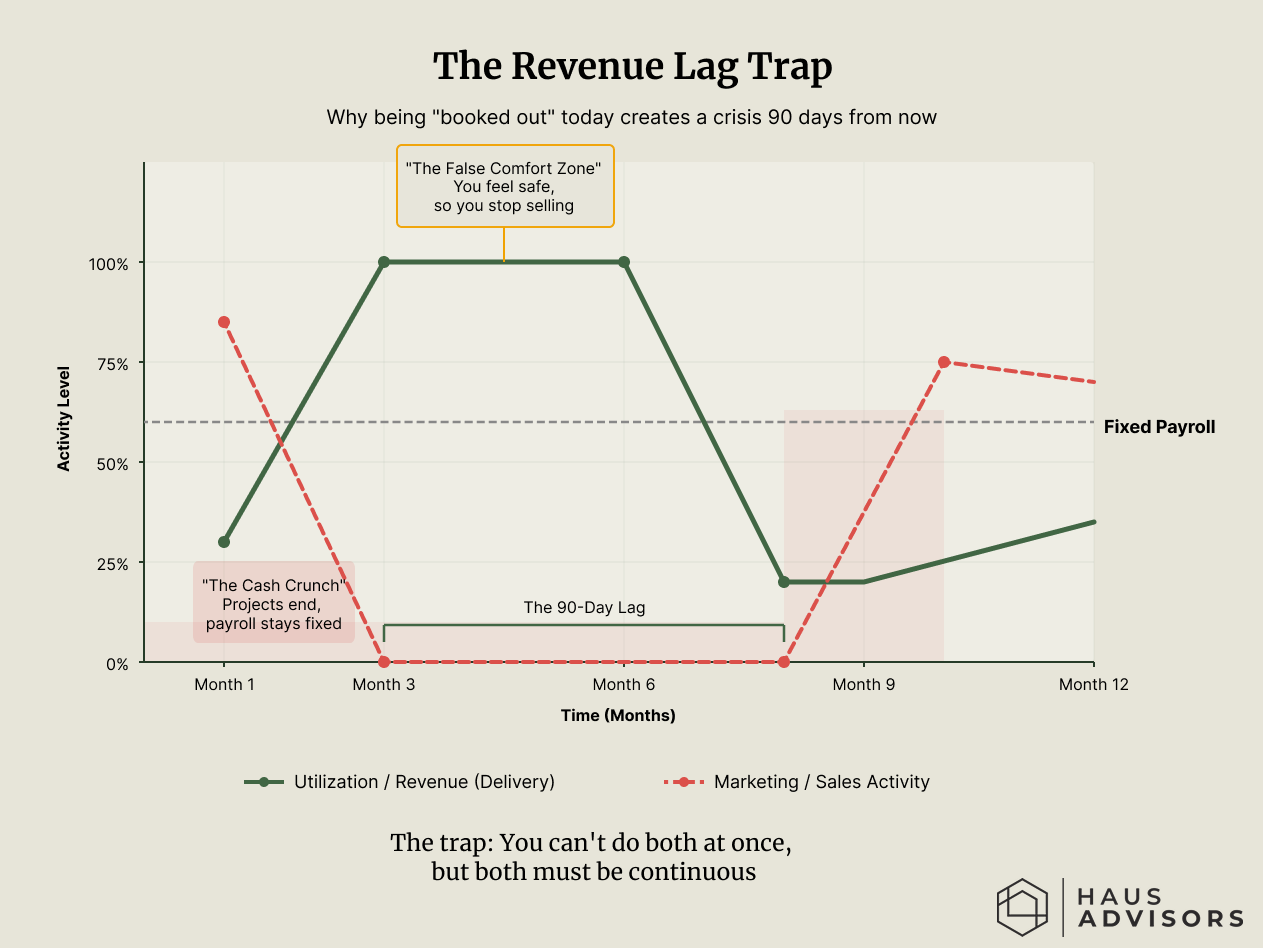
The delay mechanism: Marketing activity and utilization are inversely correlated in most agencies. When you're busiest, you stop generating demand. When projects end, you restart demand generation, but the pipeline needs months to rebuild. The crash isn't caused by losing a client. It's caused by the period of full utilization that preceded it.
The Utilization Trap is particularly insidious because it disguises the problem. When you're in the crash, you blame the lost client, the market downturn, or the slow quarter. You treat it as an external event that happened to you. But the crash was built internally, months earlier, by the decision (usually unconscious) to prioritize delivery over demand generation when both couldn't fit.
Why Full Utilization Feels Like Success
Because every signal tells you it is. Revenue is high. The team is busy. Clients are happy. There's no visible problem. The metrics that most agencies track (revenue, utilization rate, billable hours) all look healthy.
But these are lagging indicators. They tell you how the business performed last quarter. They tell you nothing about next quarter. And the leading indicator that would warn you about the coming crash (pipeline activity, content output, partnership conversations) is the one you stopped tracking because you were too busy to maintain it.
In the early stages of an agency, this cycle is manageable. The founder's personal network provides enough referrals to refill the pipeline after each crash. The crashes are shallow and the recoveries are quick. You experience it as "the nature of agency work" rather than a systemic problem.
But as the agency grows, the crashes get deeper. Payroll is higher, so the cost of empty months is more severe. The founder's referral network doesn't scale proportionally, so the recovery takes longer. The feast-or-famine cycle that felt like a minor inconvenience at $500K becomes an existential threat at $2M, because you're burning $80K to $120K per month in overhead during months with zero incoming revenue.
The standard advice at this point is financial management: build cash reserves, secure a credit line, improve invoicing processes. This advice is correct and insufficient. It manages the symptom (cash flow pressure during crashes) without addressing the mechanism (demand generation stops when utilization peaks).
What the Utilization Trap Actually Costs You
Compounding pipeline debt. Every month of full utilization with zero demand generation adds a month to the recovery timeline on the other side. Two consecutive quarters of full utilization can produce six months of pipeline drought, because the compounding effect of zero input takes longer to reverse than a single missed month. The math is unforgiving: pipeline activity compounds forward. Pipeline inactivity compounds forward too.
Strategic paralysis during downturns. When revenue crashes, the founder enters survival mode. Every decision becomes short-term: take any deal, accept any scope, drop prices to fill the bench. The positioning work, content investment, and partnership development that would prevent the next crash gets deprioritized in favor of surviving this crash. The cycle perpetuates because the crash creates the exact conditions that make long-term investment impossible.
Talent loss from instability. Senior developers want stability. When the agency lurches between frantic overwork and anxious bench time, the best people leave for environments with more predictable workloads. The talent loss makes the next cycle worse, because you're rebuilding both the pipeline and the team simultaneously.
The "we'll take anything" margin erosion. During the famine phase, agencies take projects they'd normally decline: poor-fit clients, below-market rates, scope that doesn't align with their expertise. These projects fill the bench but erode margins, damage positioning, and consume the founder's energy on work that doesn't compound into future opportunities. Each crash produces a cohort of clients that makes the agency less positioned, not more.
Managing Volatility vs. Eliminating It
This is the part most people miss.
Most revenue stability advice focuses on managing the volatility: cash reserves to survive the troughs, credit lines to bridge the gaps, retainer agreements to smooth the revenue curve. These are legitimate financial tools. They're also downstream patches on an upstream problem.
The upstream problem is that demand generation and delivery are treated as competing priorities when they need to be parallel systems. When the founder is the sole source of both client delivery and new business development, one will always cannibalize the other. Whichever is most urgent wins, and delivery is always more urgent than pipeline work, right up until the moment the pipeline is empty. Then pipeline becomes urgent, but it's too late.
Eliminating volatility requires separating these two systems so that demand generation continues regardless of delivery load.
That separation happens through three structural changes:
Positioning that generates inbound demand without founder effort. When your website, content, and market presence clearly communicate who you serve and what problem you own, prospects find you independently. This doesn't replace the founder's role in closing deals. It replaces the founder's role in generating deals. The pipeline has an input source that doesn't compete with delivery for the founder's time. That starts with getting your agency positioning decisions right. Vague positioning can't generate inbound demand no matter how good your systems are.
Productized offerings that create a staircase instead of a sawtooth. Project-based revenue is inherently volatile: it spikes when projects start and drops to zero when they end. Productized entry points (diagnostics, audits, roadmap sprints) with defined scope and recurring engagement structures convert the sawtooth pattern into something more predictable. Each productized engagement creates a natural path to the next engagement, rather than a cliff at the end of scope.
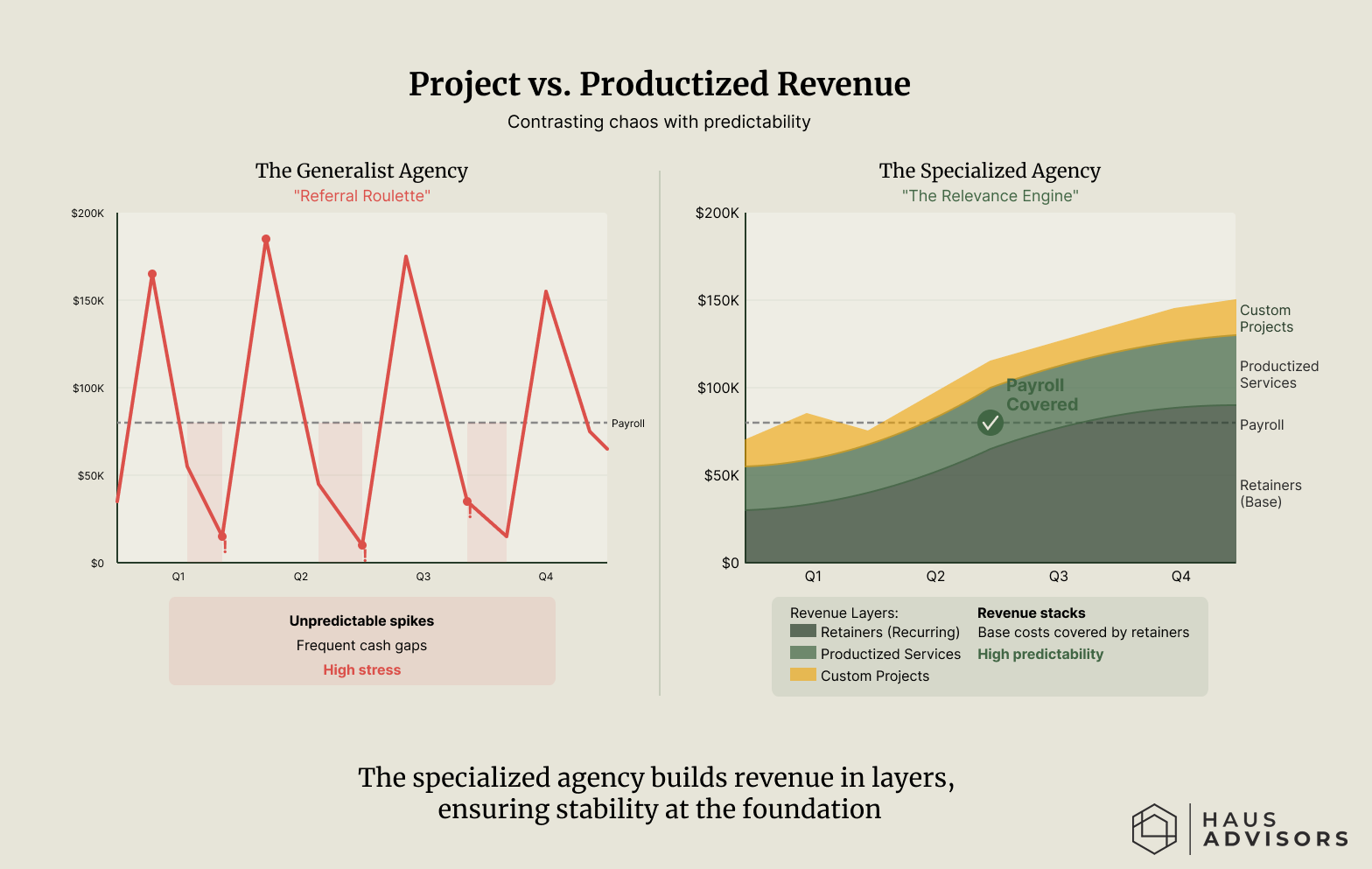
The revenue shape problem: Project-based work creates sawtooth revenue: peaks when projects are active, cliffs when they end. Productized services create staircase revenue: each engagement leads to the next. The staircase doesn't eliminate volatility. It changes the shape from cliff-drops to step-downs, giving you visibility and time to respond.
Partnerships that produce introductions on a cadence rather than at random. A structured partnership with a complementary firm (a design agency, a fractional CTO, a strategy consultant) produces introductions on a rhythm independent of the founder's personal networking. The introductions flow whether the founder is busy or not. This is the demand generation equivalent of a cron job: it runs in the background, on schedule, without manual intervention.
The Leading Indicators That Matter
If the Utilization Trap is the mechanism behind revenue volatility, the fix is tracked through leading indicators, not lagging ones.
Pipeline coverage ratio. At any given time, your pipeline should contain 3x to 4x your revenue target for the next quarter. If utilization is at 100% and pipeline coverage is below 2x, the crash is already built. You just haven't felt it yet.
Demand generation consistency. Track whether content, outreach, and partnership activity continues during high-utilization periods. If these metrics drop to zero when the team is busy, the Utilization Trap is active. The goal isn't more activity. It's consistent activity regardless of delivery load.
Revenue concentration. If a single client represents more than 25% of monthly revenue, the crash risk isn't just about pipeline. It's about a single decision by a single client creating an immediate cash flow crisis. Concentration risk and the Utilization Trap compound each other: the agency that depends on one large client and stops generating demand while that client is active is maximally exposed.
The Honest Objection
Here's the strongest argument against investing in demand generation during peak utilization: the opportunity cost is real. Every hour the founder spends on content, partnerships, or outreach during a busy period is an hour not spent on billable delivery. When the team is stretched and clients are demanding, pulling the founder's attention away from delivery feels irresponsible.
And at the very early stages, it might be. If you have three people and every hour of the founder's time is directly tied to client revenue, the math may not support splitting attention.
Where That Logic Hits a Wall
But the logic assumes that demand generation requires the founder's time in the same way delivery does. It doesn't, if the systems are built correctly.
A website with clear positioning generates inbound interest without the founder writing a new blog post every week. A partnership with a complementary firm generates introductions without the founder attending a networking event. A productized offering with defined scope generates conversations without the founder custom-scoping every prospect.
The investment is front-loaded: building the positioning, structuring the partnerships, designing the productized offerings. That does require founder time. But once built, these systems generate demand on a cadence that's independent of the founder's daily calendar.
The agencies I've watched break the feast-or-famine cycle didn't do it by working harder during the troughs. They did it by building systems during the peaks that continued generating demand after the founder's attention returned to delivery. The utilization didn't drop. The pipeline didn't die. And the next project transition, instead of being a crisis, was a planned handoff.
The Next Step
You don't need to overhaul your operations. You need to check whether the Utilization Trap is active right now.
Start here: look at the past twelve months. Identify the months where your utilization was highest, where the team was fully booked and revenue was strong. Then look at what happened to your pipeline activity during those months: content published, outreach sent, partnership conversations held, proposals generated.
If pipeline activity dropped during peak utilization, the trap is active. The next crash is already being built, and the timeline is roughly the length of your average sales cycle from the point where pipeline activity stopped.
The fix isn't to work harder during the next peak. It's to build one demand generation system that runs independently of your delivery load. One partnership that produces introductions on a cadence. One piece of positioning-driven content per month that you maintain regardless of how busy you are. One productized offering that creates a natural next step for every completed engagement.
One system. Running in the background. Not dependent on your availability. That's what breaks the cycle.
The principle is simple:
There are agencies that treat full utilization as the goal, and there are agencies that treat full utilization as the warning sign.
The first group celebrates the quarter. The second group builds the pipeline that survives the next one.
Most founders reading this already know the real problem. It isn't utilization. It's that the reputation, the relationships, and the judgment that make your agency worth hiring still live in your head. So the business only grows when you're in the room.
That's the work we do at Haus Advisors. The Relevance Engineering Program is six months of implementation, not a strategy document. We pull what makes your agency relevant out of your head, build it into positioning, offers, and growth plays your team can run, and hand ownership to them. If you want an agency that grows without needing you in every deal, book a call to see if it's a fit.
Keep reading
Browse by topic
- Positioning & Strategy
- Lead Gen & Marketing
- Sales & Biz Dev
- Pricing & Productization
- Research & Data
- Operations & Delivery
- Client Retention & Expansion
- Leadership & Culture
For founders whose agency has outgrown referrals.
One idea a week that makes a hard growth problem obvious, usually with a chart that shows you the mechanism behind it.
Built from conversations with seventy-plus agency founders on the Behind the Agency podcast.