Why Most Software Development Agencies Fail at Productization (And What to Do Instead)
Most dev agencies try to productize the wrong thing.
They look at what they actually sell (full-stack builds, custom development, ongoing engineering) and try to wrap it in fixed scope and a price tag. It doesn't work, because software is too variable. So they give up and conclude productization is for design and marketing shops, not them.
That's the wrong conclusion. The problem isn't that dev services can't be productized. The problem is they're trying to productize the part that shouldn't be productized.
Productize the diagnostic work, not the build. Technical audits, performance assessments, security reviews, migration roadmaps. These deliver real value in a defined window, don't require months of discovery, and naturally lead to bigger custom engagements once the client trusts you.
Below: which of your services are actually candidates, the four-question filter for figuring that out, and five examples from agencies that have made it work.
Why Software Development Agencies Struggle with Productization
The objection is fair. Every codebase is different. Every stack is different. Every set of business requirements is different. So how do you possibly fix-price any of it?
You don't fix-price the build. You fix-price the diagnosis.
Every SaaS company has performance problems. Every growing startup hits the same scaling walls. Every legacy system has the same kinds of security gaps. The patterns are consistent. The remediation work is custom, but identifying what's broken and what to do about it follows a repeatable process you've probably run dozens of times.
Most productization advice misses this because it comes from design and marketing agencies where the deliverables are more standardized. The examples don't translate, technical founders read them, decide productization is a marketing thing, and move on. That's where the dismissal usually ends.
It shouldn't. The agencies I've worked with that get this right see better margins on the productized work and revenue that doesn't whipsaw between feast and famine. The bigger benefit isn't the money. It's that you can take a week off without the business going sideways, because the delivery doesn't need you in every conversation.
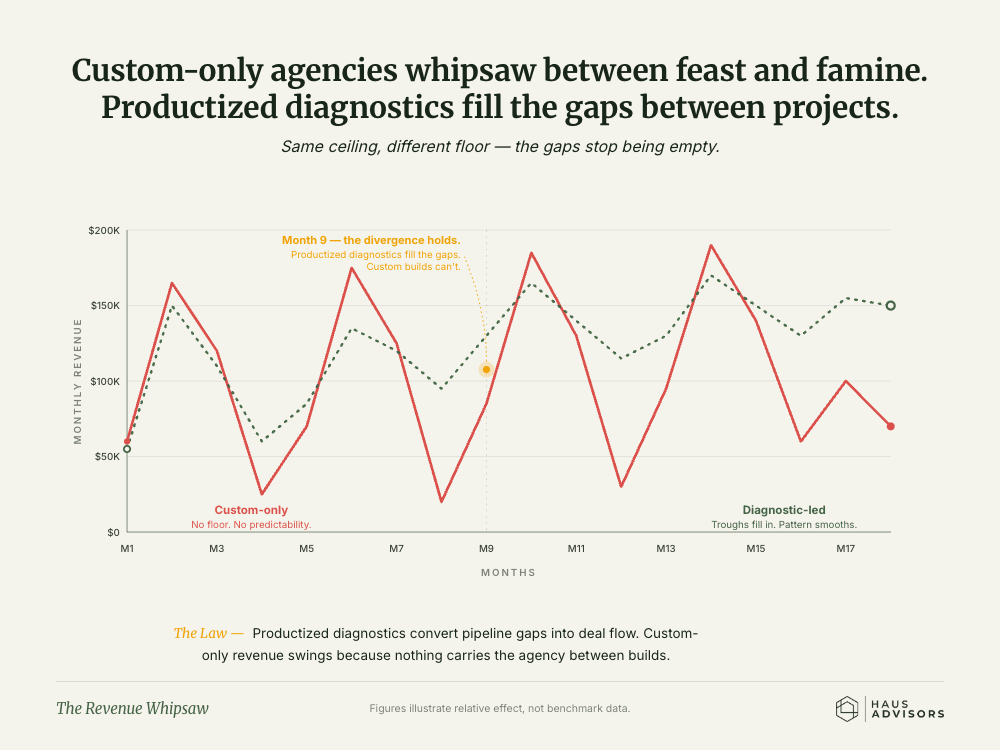
Custom-only dev agencies ride a feast-famine revenue cycle that never smooths out. Agencies that productize diagnostic work start filling the troughs.
The Real Mistake: Productizing Delivery Instead of Diagnostic Work
The mistake is trying to productize the build instead of the advisory work that comes before it.
Build work resists productization because it's variable by nature. Different environments, different requirements, different integrations. Every project has its own surprises.
Diagnostic work doesn't have that problem. Auditing code quality, finding performance bottlenecks, evaluating security posture, mapping a migration. The frameworks for finding the problems are stable across clients, even when the problems themselves vary.
This is what I call the Delivery Productization Trap. Agencies assume productization means packaging their core service when it actually means packaging the work that leads to the core service.
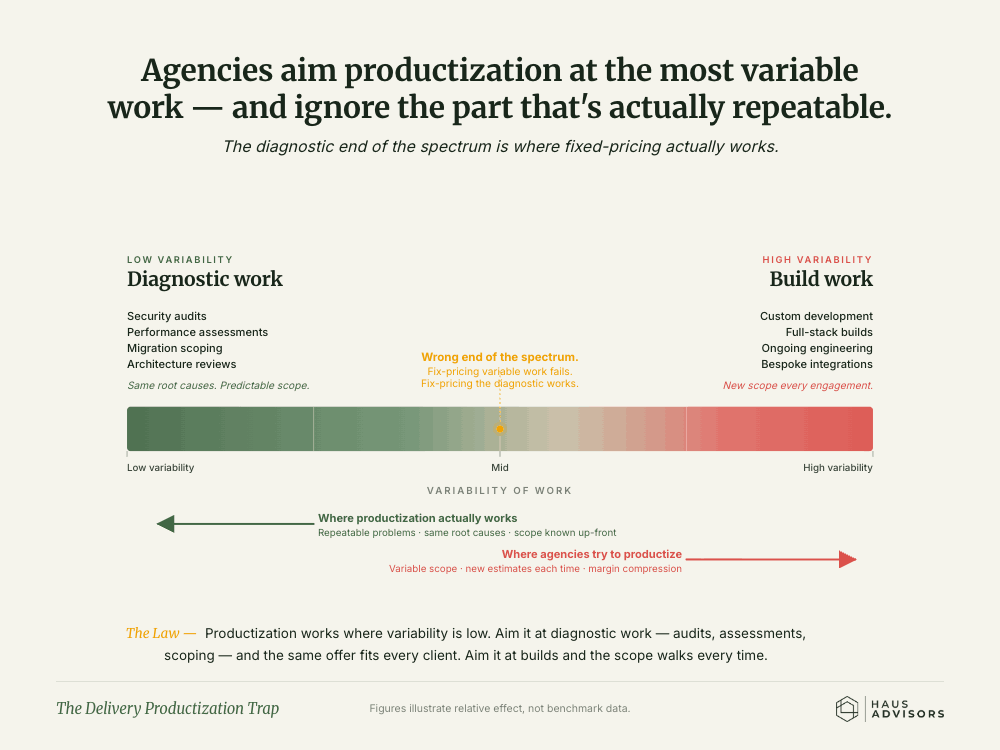
Most agencies aim their productization at the variable end of their work. The repeatable end, diagnostic work, is what actually holds a fixed price.
The agencies pulling this off aren't selling productized "full-stack development." They're selling productized technical architecture audits that scope what needs to be built. They aren't selling productized "custom builds." They're selling productized migration assessments that scope how hard the build will be.
The diagnostic qualifies the prospect, proves you know what you're doing, and scopes the custom work. It's the entry point. Not the whole thing.
The 5 Types of Dev Agency Services That Actually Work as Productized Offerings
Five categories show up over and over.
Technical audits and assessments. The diagnostic framework is the same even when the findings differ. Security reviews follow OWASP. Performance audits use a standard set of tools and metrics. Code quality reviews apply the same best practices to whatever codebase shows up. Clients are paying for the framework and the judgment, not for hours.
Framework and platform migrations. Rails 5 to Rails 7. BigCommerce to Shopify. Vue 2 to Vue 3. The implementation varies, but the assessment phase (figuring out scope, identifying risks, building the migration plan) is repeatable. You can fix-price the assessment even when the build that follows stays custom.
Performance optimization packages. Page speed, database queries, Core Web Vitals. The diagnostic process is the same regardless of stack. Clients pay for the outcome (faster site) instead of the discovery, and the diagnostic itself surfaces what needs fixing.
Technical debt remediation. Sell it as a focused sprint. Most technical debt falls into a small number of buckets: outdated dependencies, missing tests, structural mess. The assessment of what's worst and what to do first can be standardized. The cleanup that follows can stay custom.
Maintenance retainers. Tiered monthly packages with clear service levels. Basic, Standard, Premium, with defined scope on monitoring, updates, support hours. Recurring revenue that holds steady regardless of what stack you're working in.
How to Identify Which of Your Services to Productize
Most agencies try to productize too much and end up with a confusing menu. The fix is a tighter filter. Four questions.
Repeatability. Does this problem show up across at least half your clients with similar root causes? If you're solving something different every time, it's not a productization candidate. The right candidates are problems you've solved ten or more times where the diagnostic is consistent.
Scope clarity. Can you scope the engagement without three discovery calls? If you need a week of conversations before you can quote it, it's not ready. The right candidates are services where you can predict 80% of what's involved before the kickoff.
Technical standardization. Have you solved this enough times to have strong opinions and a default approach? Your confidence in the diagnostic is what makes fix-pricing work. If you're still figuring out how you'd tackle it, you can't productize it yet.
Value timing. Does the client see something tangible inside two to four weeks? Productized entry points need to deliver a quick win that earns the right to a bigger conversation. If the value only shows up after three months of work, productization isn't the right wrapper.
The services that pass all four are the ones where you can honestly say "I know what to look for, what tools to use, and what I'm probably going to find" before the engagement even starts. Everything else stays custom.
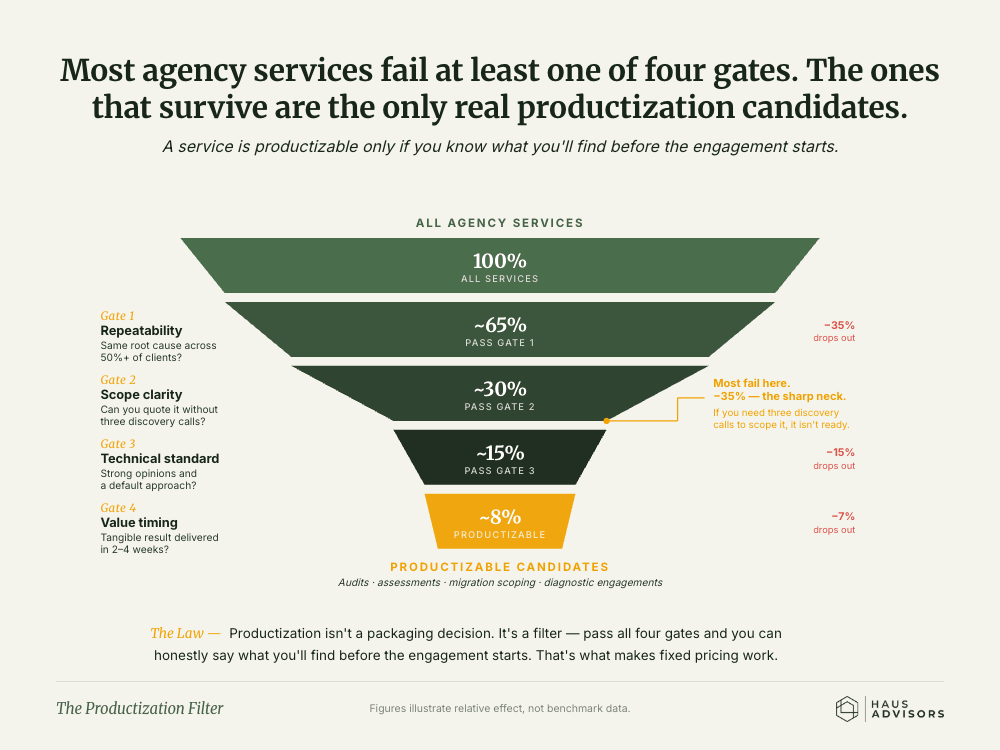
Run every service through all four gates. Most drop off at Gate 2. The ones that survive are your real productization candidates.
Real Examples: 5 Productized Service Models from Software Development Agencies
WP Speed Fix sells WordPress performance optimization as fixed-price packages, ranging from a few hundred dollars to a few thousand. They've run thousands of these, working from a standard diagnostic that surfaces the optimizations most likely to matter for any given site. The framework holds even when the site doesn't.
Ombulabs productizes technical debt payoff for Rails, React, Node, Ruby, and JavaScript. Instead of custom-scoping every upgrade, they lean on templated assessments and blind estimation built from years of doing it. The diagnostic (current versions, breaking changes, test coverage) is the same shape every time.
Migration specialists like the Magento-to-Shopify or PHP-to-Laravel shops sell a fixed-price assessment plus a separate implementation. The assessment grades the same things on every project: data complexity, custom functionality, integration surface area. The build varies. The diagnostic doesn't.
Security audit packages. Penetration testing and vulnerability assessment as fixed engagements. They work because OWASP and NIST give you a standard methodology to run, and the deliverable (findings report and remediation roadmap) follows a consistent format regardless of what gets found.
API integration specialists sell fixed-price Stripe, Salesforce, or HubSpot integrations. They keep the menu narrow, sticking to platforms they've integrated dozens of times. The assessment phase (current state, data flow, conflict points) is well-trodden territory for those specific platforms.
The pattern across all five: the diagnostic is standardized, the implementation can stay custom, and the productized piece is the front door instead of the whole house.
Productization and Positioning: Why Generic Dev Agencies Can't Productize Successfully
The agencies that fail at this are the ones that try to package services before they figure out who they're for.
A "Technical Audit" package means nothing if the prospect can't tell whether you're the right shop for their situation. "We fix onboarding conversion for growth-stage SaaS companies" makes a productized Conversion Diagnostic Sprint immediately obvious to the right buyer. "Full-service development agency" makes the same package forgettable.
Positioning has to come first. You need to know who you serve and what problem you own before you can build offerings that resonate. Generic positioning forces you to custom-scope everything, because you can't predict what any given prospect actually needs. Specific positioning makes productization possible, because you're solving the same problems for the same kinds of people over and over.
Without positioning, productized services compete on price. With positioning, they command premium rates because you're the obvious choice for that exact problem.
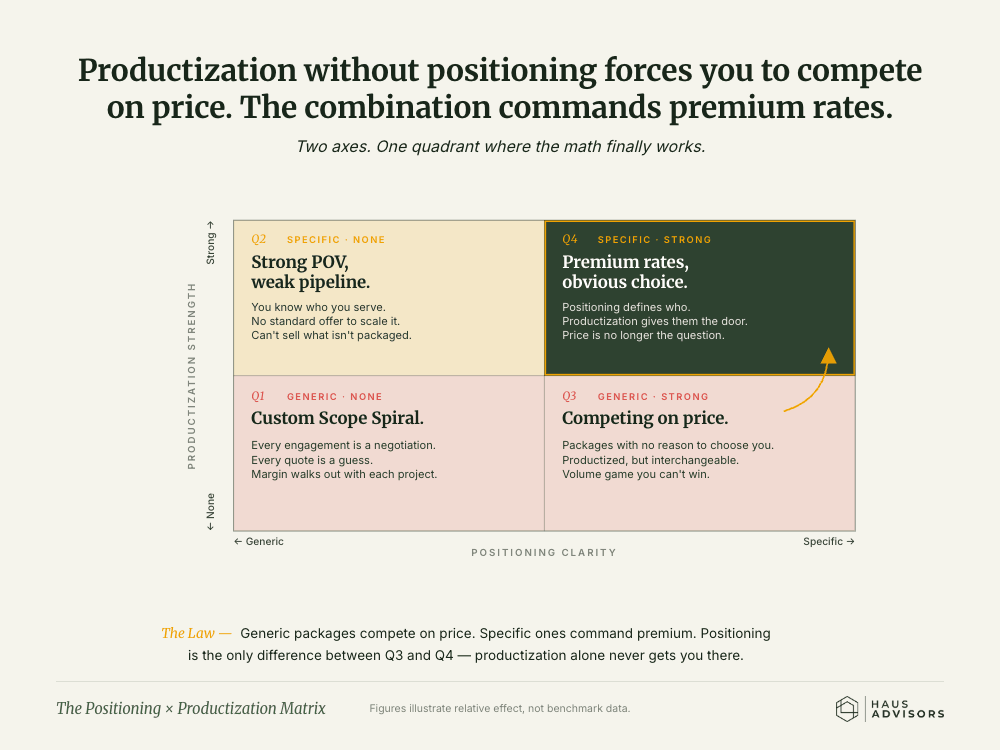
Productization without positioning lands you in a price war. The combination, specific positioning plus productized entry points, is what makes premium rates stick.
The pattern that works: narrow positioning that defines exactly who you serve, plus diagnostic offerings that solve the problems that audience hits over and over. Positioning makes productization relevant. Productization without positioning is just packaging.
This is the order we work in with the Relevance Engineering Program at Haus Advisors. Positioning defines who you serve and what problem you own. Productization creates the entry points that solve those problems with clear scope, timeline, and price. But the order matters. We pull the positioning out of the founder's head first, then build the offers on top of it, because productization without positioning underneath it doesn't hold up.
The Next Step
Most founders reading this already know the real problem. It isn't that software is too custom to package. It's that the reputation, the relationships, and the judgment that make your agency worth hiring still live in your head. So the business only grows when you're in the room.
That's the work we do at Haus Advisors. The Relevance Engineering Program is six months of implementation, not a strategy document. We pull what makes your agency relevant out of your head, build it into positioning, offers, and growth plays your team can run, and hand ownership to them. If you want an agency that grows without needing you in every deal, book a call to see if it's a fit.
Keep reading
Browse by topic
- Positioning & Strategy
- Lead Gen & Marketing
- Sales & Biz Dev
- Pricing & Productization
- Research & Data
- Operations & Delivery
- Client Retention & Expansion
- Leadership & Culture
For founders whose agency has outgrown referrals.
One idea a week that makes a hard growth problem obvious, usually with a chart that shows you the mechanism behind it.
Built from conversations with seventy-plus agency founders on the Behind the Agency podcast.