Positioning Consultant vs Brand Agency: Which One You Actually Need
Picture a $3M agency founder, eight months into a brand agency engagement she signed last spring. New website launched. Visual identity refreshed. Case studies redesigned. The pipeline hasn't moved. Sales calls still take forty-five minutes to explain what she does. She's still in every one of them. The agency did the work she paid for. The work didn't fix the problem.
If you're searching "positioning consultant vs brand agency," you're already at risk of being her in eight months. Not because either option is bad. Because you're shopping based on what you think the problem is, before testing whether the assumption holds.
I call this The Category Mistake. You don't have a branding problem. You have a diagnostic problem. Until you can name your actual constraint, you can't hire effectively against it, and most agency founders in this search are about to spend $50K to $150K and six months learning that the hard way.
“You don’t have a branding problem. You have a diagnostic problem.”
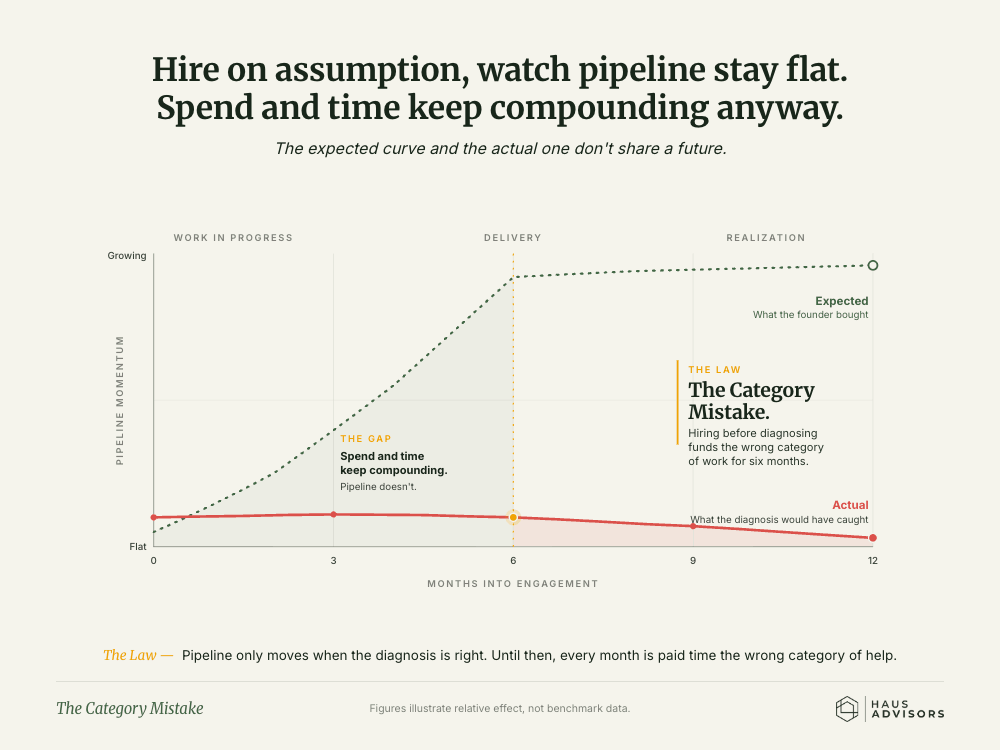
She thought she was buying practical positioning help. She got a polished strategy deck built from a product-company template, no answer to why a prospect should pick her over a cheaper agency, and six months of brand work briefed against it. The green line is the pipeline she was promised. The red line is the pipeline that actually showed up.
The consultant vs agency framing also assumes you're a product company. You're not. Agencies face structural constraints those frameworks don't account for: founder-led sales, billable utilization pressure, referral dependency that masks positioning weakness until the network runs dry, and a delivery model where strategy failure has no buffer. When a SaaS company gets positioning wrong, they iterate on copy and run more ads. When you get it wrong, the founder stays in every sales call and the delivery team waits for work that doesn't come.
This article walks through what each type of partner actually solves, where the comparison breaks for agencies, and how to diagnose your real constraint before you hire anyone.
The Real Question Underneath This Comparison
Most agency founders searching this term are trying to fix one of three constraints, and they often don't know which:
Strategic clarity: You can't articulate, in twenty seconds, why a prospect should choose you over a cheaper alternative. The pipeline issue is upstream of execution.
Execution capacity: You know your positioning and message, but you don't have the team to ship the work. The pipeline issue is downstream of strategy.
Structural services-business constraints: You have rough clarity and you're shipping work, but the pipeline is still inconsistent because the underlying business model has bottlenecks neither a consultant nor an agency is built to fix.
A positioning consultant solves the first one. A brand agency solves the second. Neither is built for the third, which is the constraint most $1M+ technical agencies actually have.
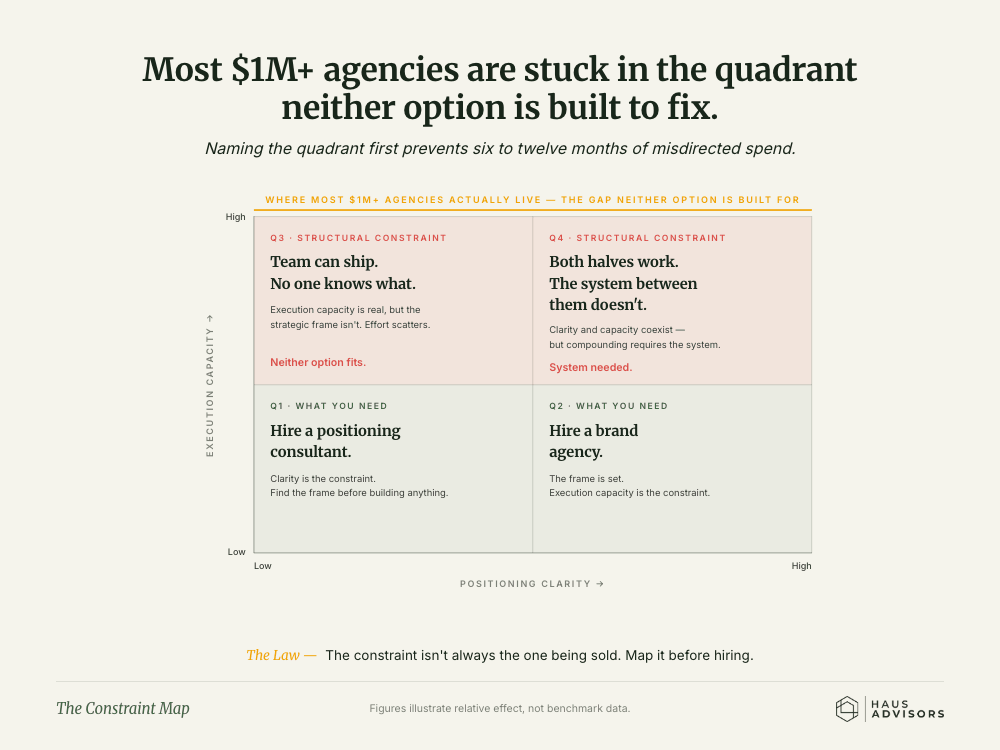
Find your quadrant before you shop for a vendor. If you're in the top half, the consultant-vs-agency question isn't yours to answer. The constraint is structural, and the fix is a system, not a deliverable.
The rest of this article exists to help you figure out which constraint is yours.
1. Why should a client choose you over a cheaper competitor?
2. Your site, case studies, and campaigns:
3. Where does new pipeline actually come from?
4. Why are you still in every sales call?
5. Which statement fits best right now?
What a Positioning Consultant Actually Solves
A positioning consultant is a strategic advisor who helps you define market position, differentiation, and core message before any creative work begins. Most operate as solo practitioners or small teams, not full agencies, and they focus on strategic questions: who you serve, what problem you own, why clients should choose you over alternatives.
Common deliverables are strategic foundations rather than visual assets: positioning briefs, messaging frameworks, ICP definitions, competitive analysis, brand strategy documents. Engagements are usually project-based (4 to 12 weeks) or short-term retainers, with fees ranging from $5K to $20K per month depending on scope and seniority.
Consultants are the right hire when your constraint is strategic clarity. Unclear differentiation. Messaging that doesn't resonate. An inability to explain value simply. Major shifts like launches, repositioning, or market expansion. The primary value is expertise and objectivity, the kind of fresh perspective that's hard to generate from inside the business.
The catch: most positioning consultants have never run agency marketing. Their frameworks are built for product companies, where differentiation is about features and benefits. Apply those frameworks to a services business and the diagnostic ends up missing the actual constraint.
What a Brand Agency Actually Solves
A brand agency is a creative execution partner. They bring brand strategy to life through visual identity, design systems, campaigns, and marketing collateral. Teams are multi-disciplinary: strategists, designers, copywriters, developers, account managers. They're built for production capacity.
Typical deliverables include logos, visual identity systems, brand guidelines, websites, packaging, campaign creative, and ongoing marketing asset production. Engagement models lean toward ongoing retainers ($5K to $25K+ per month) because the work is continuous. Campaigns need management. Content needs production. Channels need optimization.
Agencies are the right hire when your constraint is execution capacity. You know your positioning and message. You've validated the strategy. You just don't have the team to ship the work. An agency provides specialists, processes, and throughput at scale.
The risk: most agencies will execute whatever direction you give them without questioning whether the underlying positioning holds. Hire one before you've solved the strategic problem and you'll spend six to twelve months producing high-quality work pointed in the wrong direction.
Side-by-Side: Positioning Consultant vs Brand Agency
| Factor | Positioning Consultant | Brand Agency |
|---|---|---|
| Constraint solved | Strategic clarity | Execution capacity |
| Best for | Unclear positioning, market entry, repositioning | Ongoing channel management, multi-platform execution |
| Team structure | Solo practitioners or small strategic teams | Multi-disciplinary teams with function specialists |
| Engagement model | Projects or short retainers (3 to 6 months) | Long-term retainers (12+ months) |
| Deliverables | Strategy documents, positioning briefs, messaging frameworks | Visual assets, campaigns, websites, content production |
| Accountability | Deliverable completion and strategic clarity | Activity metrics and performance results |
| Cost structure | $5K to $20K/mo for senior strategic hours (15 to 25 hrs) | $5K to $25K+/mo for team capacity (30 to 50+ hrs) |
| Strategic depth | Deep on the why and what of your brand | Wide on the how and where of market activation |
The short version: hire a consultant when you can't name your problem clearly enough to brief an agency. Hire an agency when you've already validated the strategy and need throughput. The biggest single mistake in this category is reversing that order, which happens when founders pick the vendor based on what feels closer to the symptom rather than what addresses the cause.
The Third Constraint Most Agency Founders Actually Have
Here's where the comparison breaks.
If your pipeline is inconsistent, your delivery team has gaps between projects, and you're still wearing the sales hat at $1M to $8M in revenue, your constraint probably isn't strategic clarity in the consultant sense. You can describe what you do. You can describe who you serve. You can probably even articulate a reasonable differentiation story.
It's also probably not execution capacity in the agency sense. You're shipping work. You have a team. The output exists.
The constraint is structural. The way your business is built makes pipeline a function of personal network rather than a system. Founder-led sales creates a bottleneck the founder can't grow past. Referral dependency masks positioning weakness because warm intros buy you forgiveness for a fuzzy pitch. Custom scope creep eats margin. Productization is undefined, so every prospect conversation is a custom build. Publishing happens when you have time, which is never.
Generic positioning consultants don't fix this because their frameworks aren't built for services-business mechanics. Brand agencies don't fix it because they execute against the brief you give them, and the brief reflects the same fuzzy positioning the business already has.
What technical agencies need is a partner who diagnoses the structural constraint first, then builds a system around it. Not a strategy deck. Not a brand refresh. A working pipeline that doesn't depend on the founder being in every conversation.
Relevance Engineering: A System Built for Services-Business Mechanics
At Haus Advisors I've developed what I call Relevance Engineering. It's a systematic approach to structuring agencies so that, for a specific type of client, you become the only logical choice. Not through better branding. Through architectural clarity.
The framework has five pillars that work as an integrated system:
Positioning: who you serve and what problem you own
Productization: defined entry points with clear scope and pricing
Publishing: demonstrating diagnostic expertise in public
Partnerships: warm distribution through strategic relationships
Persistence: maintaining growth activities as a system, not a project
Most positioning consultants stop at pillar one. They define your ICP and differentiation, then leave you to figure out pipeline. Brand agencies live in pillar three, making content look good without checking whether the underlying positioning makes you the obvious choice for anyone specific. Neither addresses the structural mechanics of how a services business actually generates demand.
The Relevance Engineering Program is six months of implementation. It starts by naming the actual constraint and ruling out The Category Mistake before you spend money fixing the wrong thing, and it ends with your team owning the system. Nothing in between is a handoff document.
“A strategy deck without execution is theater. Execution without diagnosis is expensive guessing.”
That structure exists because diagnosis and execution can't be separated when the underlying problem is structural. A strategy deck without execution is theater. Execution without diagnosis is expensive guessing. The system is built for agencies that need both, and need them connected.
Sara Bacon at Command C ran the diagnostic before any execution work started. Her words afterward: "I came into the sprint looking for a way to clearly answer the question, why choose us over a cheaper agency? I'd been fumbling it, and I knew that was costing us. David helped us nail the answer. He quickly got who we are, delivered concise, strategic messaging, and gave us a wireframe we're already implementing across the site." That's what diagnosis-first looks like in practice. The strategic answer landed because the constraint was named correctly before anyone wrote a brief.
How to Diagnose Your Actual Constraint Before You Hire
Skip the vendor question for a minute. Answer the constraint question first.
If your constraint is strategic clarity and you're a product company or non-agency service business, a traditional positioning consultant works. Look for relevant industry experience and a portfolio of comparable clients. Expect a strategic deliverable and a self-implementation plan.
If your constraint is execution capacity and your positioning is already validated, a brand agency makes sense. Prioritize agencies that ask hard questions about your strategy before jumping into creative. Good agencies push back on unclear direction.
If your constraint is structural and you're a $1M to $8M technical agency with inconsistent pipeline, neither traditional option fits. You need a partner who diagnoses the services-business mechanics first and builds the system second.
The wrong choice costs six to twelve months and $50K to $150K in misdirected effort. The right choice gives you a pipeline that produces qualified leads whether or not the founder is the one driving every conversation.
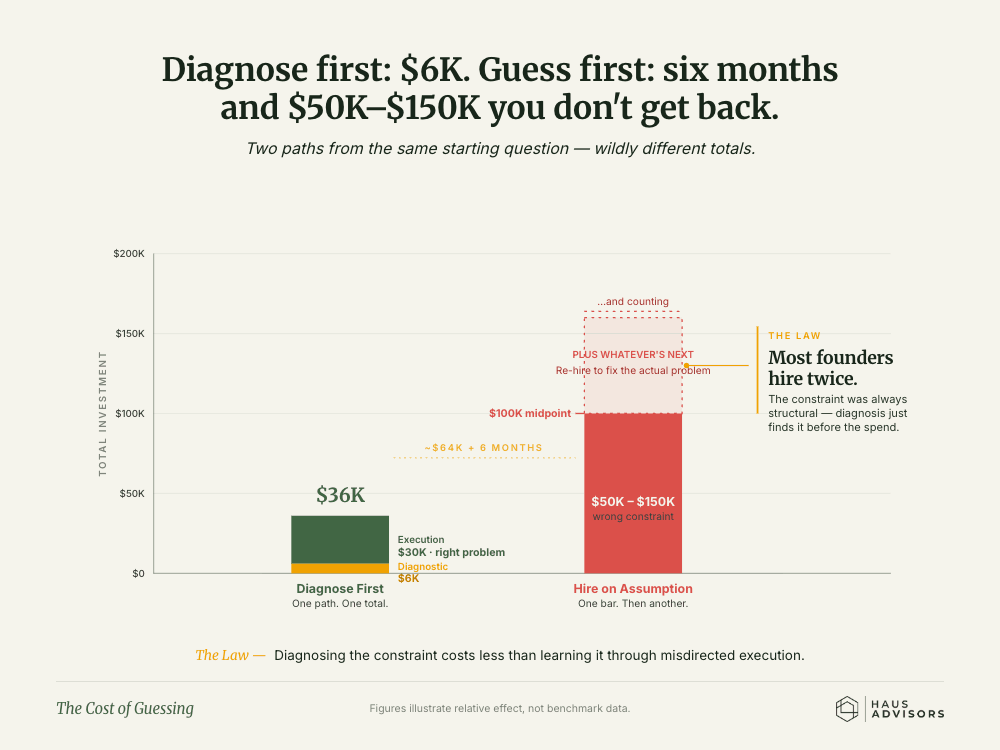
One path ends with a system your team runs. The other ends with a re-hire and the founder still in every call. The difference is whether you diagnosed before you spent, and whether what you learned ended up in the business or in a deck.
Before you spend $50K hiring against a guess, find out whether your positioning is even landing. Signal Check grades how clearly your homepage answers "why you over a cheaper option" across five signals, in about ten minutes. It won't diagnose your whole business. But if your message is the leak, it shows you fast.
Run Signal Check — freeCommon Mistakes When Hiring Positioning Consultants or Brand Agencies
Most founders hire the agency first. They feel the pain on the execution side (no pipeline, no content, no campaigns) and assume execution is the problem. Six months later the work is shipped and the pipeline is still flat. The brief was built on weak positioning, and agencies don't catch that for you.
Then there's the consultant route. Someone hires a strategist with no agency experience, gets a smart-sounding framework, and discovers the framework was built for product companies. Founder-led sales, referral dependency, services-business margins, none of it accounted for. The deliverable looks polished. It doesn't survive contact with reality.
“The deliverable looks polished. It doesn’t survive contact with reality.”
A different version of the consultant problem: treating positioning as a deliverable instead of a system. The strategist hands off a document and expects your team to translate it into go-to-market work. If you don't have the internal capacity for that translation, you'll need to hire an agency next, which brings the brand-agency-on-weak-strategy risk back into play. You've now spent on two engagements to solve one constraint.
The cheap option is its own trap. Low-cost positioning work that ignores services-business constraints costs more in the long run. Wasted execution time. Missed quarters. A founder still stuck in every sales conversation eighteen months later, wondering why the framework didn't take.
The deeper mistake underneath all of these is The Category Mistake itself. Picking the vendor before you've diagnosed the constraint. Buying the label that fits your assumption instead of testing whether the assumption is right.
Positioning Consultant vs Brand Agency: Common Questions
What is the difference between a positioning consultant and a brand agency?
A positioning consultant defines your strategy: who you serve, what you own, and why a buyer picks you. A brand agency executes the look and feel of that strategy: identity, website, campaigns, collateral. One decides the message. The other produces the assets that carry it. If your message is unclear, a brand agency will produce beautiful work against the wrong idea.
Do I need a positioning consultant or a brand agency?
Hire a positioning consultant when you cannot explain, in twenty seconds, why a prospect should choose you over a cheaper option. Hire a brand agency when your positioning is clear and you need the team to ship the work. If the pipeline is inconsistent even though both are handled, the constraint is structural, and neither one fixes that.
How much does a positioning consultant cost?
Most positioning consultants run project engagements of 4 to 12 weeks, or short retainers, at roughly $5K to $20K per month depending on scope and seniority. Brand agencies lean toward ongoing retainers, often $5K to $25K+ per month, because production is continuous. Cost tracks the model, not the outcome, so match the spend to the constraint you actually have.
Should I hire a positioning consultant or figure out positioning myself first?
Do the diagnosis first, then decide. You do not need to solve your positioning alone, but you do need to know whether positioning is even your real constraint before you buy against it. A ten-minute self-diagnostic will tell you more than three sales calls with vendors who each sell their own answer.
Can a positioning consultant help a services business, not just a product company?
Yes, but most cannot, because most positioning frameworks are built for product companies where differentiation is about features. Agencies carry constraints those frameworks ignore: founder-led sales, utilization pressure, and referral dependency that hides a positioning problem until the network runs dry. Ask any consultant how they handle those before you sign.
The Principle
There are two kinds of agency founders running this comparison.
“The symptoms were real. The diagnosis wasn’t.”
The first picks a vendor based on what feels closest to the symptom. They feel the pipeline pain, they hire the brand agency. They feel the message-clarity pain, they hire the positioning consultant. Six to twelve months later they've spent $50K to $150K and learned that the constraint was somewhere else. The symptoms were real. The diagnosis wasn't.
The second diagnoses first. They treat the consultant-vs-agency question as the wrong question and the constraint question as the right one. They name the bottleneck before they hire against it. When they do hire, the brief is sharp because the diagnosis is sharp, and the execution actually moves the pipeline.
Most founders reading this already know the real problem. It isn't which vendor to hire. It's that the reputation, the relationships, and the judgment that make your agency worth hiring still live in your head. So the business only grows when you're in the room.
That's the work we do at Haus Advisors. The Relevance Engineering Program is six months of implementation, not a strategy document. We pull what makes your agency relevant out of your head, build it into positioning, offers, and growth plays your team can run, and hand ownership to them. If you want an agency that grows without needing you in every deal, book a call to see if it's a fit.
Keep reading
Browse by topic
- Positioning & Strategy
- Lead Gen & Marketing
- Sales & Biz Dev
- Pricing & Productization
- Research & Data
- Operations & Delivery
- Client Retention & Expansion
- Leadership & Culture
For founders whose agency has outgrown referrals.
One idea a week that makes a hard growth problem obvious, usually with a chart that shows you the mechanism behind it.
Built from conversations with seventy-plus agency founders on the Behind the Agency podcast.