Your Agency's Greatest Strength Is Compounding Into Its Biggest Liability
A VP I spoke with recently helped run a 120+person creative technology agency. They had built everything: AR experiences for retail brands, AI prototypes for healthcare companies, spatial computing demos for real estate firms, generative AI tools for media companies. Their portfolio was a highlight reel of "first-of-its-kind" projects across a dozen industries.
Revenue had plateaued at $14M for three years. Not because they couldn't win work. They won constantly. The problem was that every project cost more to deliver than projected, and the gap was widening. Senior developers were spending 30 to 40 percent of each engagement learning the client's industry, regulatory environment, and business model before they could do the technical work they were hired for. The agency was billing for expertise while internally funding research.
The agency leader described it this way: "We keep winning exciting work and barely breaking even on it. Every project feels like starting from scratch. We've been doing this for eight years and somehow we're not getting faster."
The number varies. Some agencies hit this wall at $5M with 30 people. Others don't feel it until $15M. But the mechanism is identical: the diversity that drove early growth becomes the overhead that caps it.
He wasn't describing a delivery problem. He was describing a compounding problem that runs in reverse. Instead of knowledge accumulating and making each subsequent project more efficient and more valuable, the constant rotation of industries and problem types meant the team's knowledge evaporated after every engagement. Eight years of experience, but functionally starting over every quarter.
The innovation that made the agency exciting was the same force making it unprofitable at scale.
The Pattern Has a Name
I call it Contextual Debt: the compounding operational cost that accumulates when an agency applies advanced technology across a constantly shifting set of industries and problem types, preventing institutional knowledge from building and forcing every engagement to absorb a hidden "re-education tax" that the client isn't paying for.
Here's the mechanism. An innovation-led agency starts by being the first team in the market that can build a certain type of thing. AR, VR, generative AI, spatial computing, whatever the technology frontier looks like in a given year. That novelty is the positioning. They don't need an industry focus because the technology itself is the differentiator. Clients come to them saying "we need someone who can build this" and nobody else can.
This works beautifully at 15 to 30 people. The founding team carries the context. They know the technology deeply, they learn each client's industry quickly because they're personally involved in every project, and the margins are healthy because novelty commands a premium.
Then the agency scales past 50 people. Then 80. Then 100. The founding team can no longer be on every project. New developers, designers, and project managers join who are technically skilled but lack the accumulated pattern recognition the founders built. Every new project in a new industry requires these team members to learn the client's domain from scratch: the regulatory constraints, the business model, the competitive dynamics, the vocabulary, the decision-making structure.
This learning cost is invisible on any individual project. It shows up as a few extra days of discovery, a few rounds of rework when the team builds something technically correct but contextually wrong, a few awkward moments in client calls when a developer asks a question that reveals they don't understand the client's business.
But the cost compounds. Across 40 or 50 projects a year in 15 different industries, the aggregate re-education tax can consume 20 to 35 percent of total capacity. That's not a line item anyone tracks. It lives inside project budgets as "longer-than-expected discovery," "scope clarification," and "additional revision cycles." The agency blames individual project management. The real cause is structural: the operating model requires the team to become temporary experts in a new domain for every engagement, and temporary expertise is expensive to build and impossible to retain.
The result is a paradox. The more innovative the agency, the more diverse the portfolio. The more diverse the portfolio, the higher the contextual debt. The higher the contextual debt, the thinner the margins. The thinner the margins, the harder it is to invest in the R&D that fuels the innovation. The agency's core differentiator is slowly consuming the resources needed to sustain it.
The Sawtooth Pattern
You can visualize contextual debt as a sawtooth wave. Every time the agency enters a new industry, knowledge accumulation spikes during the engagement. The team learns healthcare, or fintech, or logistics. They build real expertise. Then the project ends and the next project is in a completely different domain. The knowledge resets. The team starts climbing again.
Compare this to an agency that applies the same type of innovation across a consistent industry or problem set. Their knowledge curve isn't a sawtooth. It's a compounding line. Every project adds to the base of understanding. The fifth healthcare AI project benefits from everything learned on the first four. Discovery is faster because the team already knows the regulatory landscape. Architecture decisions are better because they've seen what works and what breaks in this specific context. Client conversations are richer because the team speaks the industry's language fluently.
By the tenth project, the first agency and the second agency are doing the same type of technical work. But the second agency delivers it in 60 percent of the time, with fewer revisions, at higher margins, and with a depth of insight the first agency can't match because they've never stayed in one domain long enough to develop it.
That margin gap is contextual debt made visible. The innovation-led agency is paying a tax on every engagement that the depth-led agency eliminated years ago.
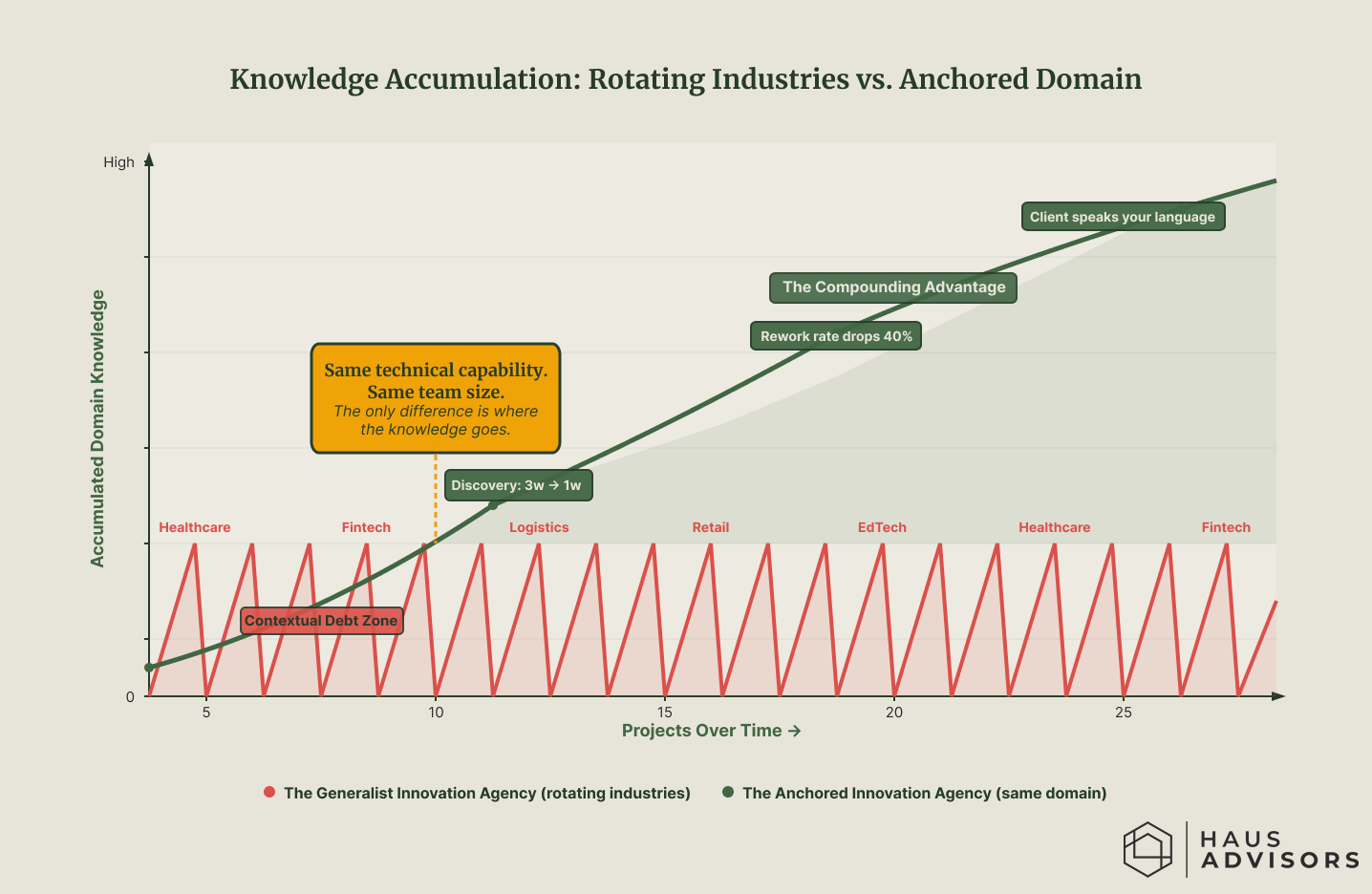
Each sawtooth represents a new industry engagement. The generalist agency's knowledge resets after every project. The anchored agency's knowledge compounds. By project 10, the technical capability is identical. The margin gap isn't.
The Ingredient Trap
Contextual debt creates a second-order problem that's even more dangerous: it forces the agency into selling ingredients rather than recipes.
When you rotate industries constantly, you can't develop a proprietary methodology for solving a specific type of problem. You don't have enough repeated exposure to any single problem set to codify what works, what fails, and why. So you sell the technology itself: "We build AI solutions." "We create AR experiences." "We develop spatial computing applications."
The client hears: "We're a team that can implement this technology." That's an ingredient. The client provides the strategy, the context, the business case. The agency provides the execution. The value of the engagement is capped by the client's own vision because the agency doesn't have the domain depth to challenge, extend, or redirect that vision.
Contrast this with an agency that has deep domain context. They don't sell AI. They sell "AI-driven patient triage systems that reduce emergency department wait times by 30 percent." That's a recipe. The technology is a component, not the product. The product is the outcome, which is only possible because the agency understands healthcare operations well enough to know where AI creates leverage and where it doesn't.
Ingredient-selling has a structural ceiling. As the technology matures and more agencies can implement it, the novelty premium disappears. The agency that sold "we build AR experiences" in 2018 was differentiated. By 2022, AR implementation was a commodity skill. The agency's value eroded not because their technical quality declined but because the scarcity of the ingredient vanished.
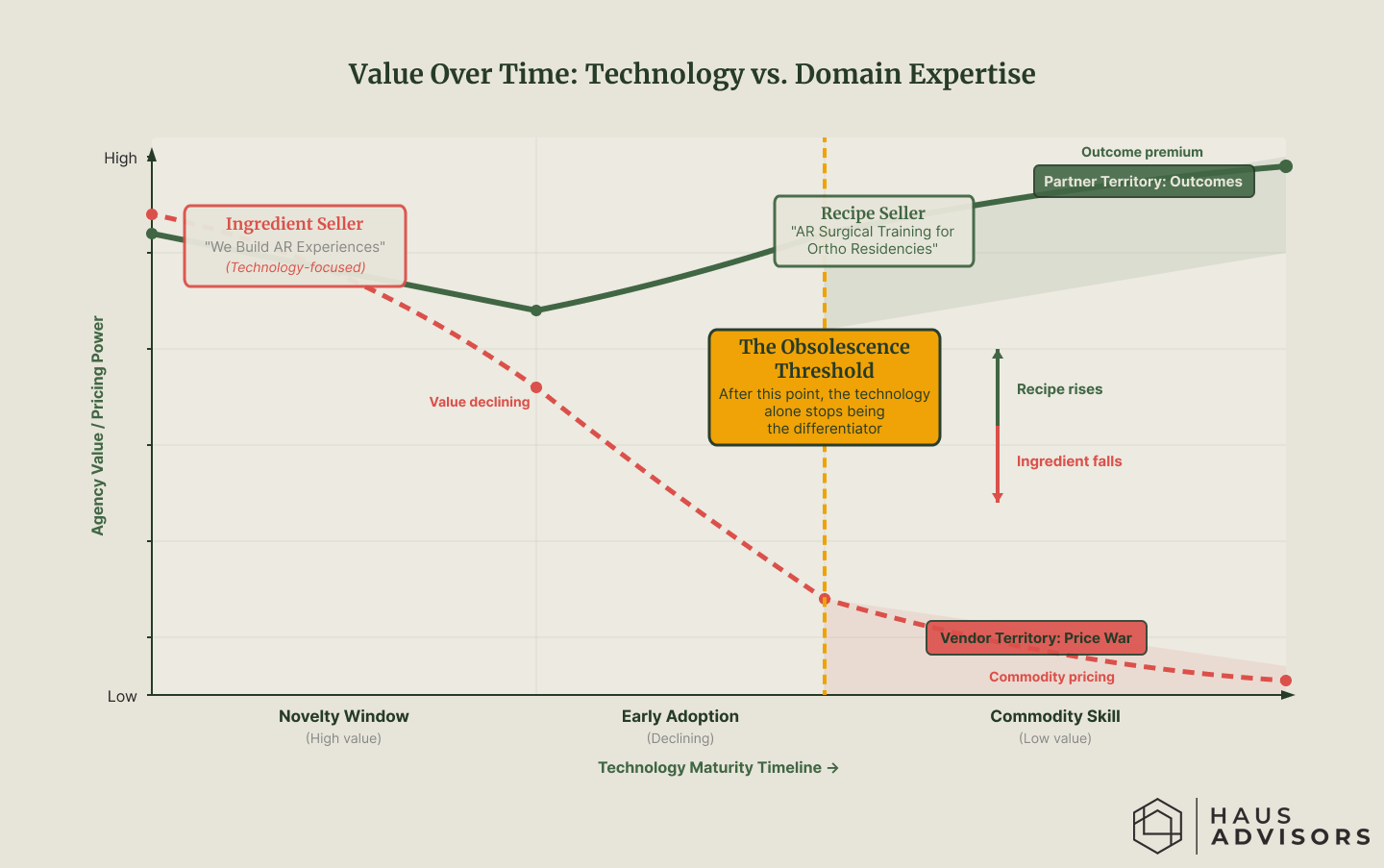
The agency selling "we build AR" rides the novelty premium until commoditization erases it. The agency selling "AR surgical training for ortho residencies" gains value as the technology gets cheaper. Same starting point. Opposite trajectories.
Recipe-selling has a structural floor. The agency that sells "AR-guided surgical training systems for orthopedic residency programs" is protected even as AR becomes commodity. Their value isn't in the technology. It's in the accumulated understanding of how orthopedic residents learn, what surgical training protocols look like, and where AR creates learning outcomes that traditional methods can't match. That knowledge took years to build and can't be replicated by a technically skilled team with no domain context.
This is the Vendor Frame applied to innovation agencies. The technology makes you a vendor. The domain expertise makes you a partner. And partners survive the commoditization cycle that destroys vendors.
Why Innovation Agencies Resist This Diagnosis
Because specialization feels like the opposite of innovation. The identity of a creative technology agency is built on being first, being versatile, being able to tackle any problem in any industry with cutting-edge tools. Choosing a domain feels like choosing a cage. It feels like trading the excitement of the frontier for the monotony of repetition.
This is the strongest version of the objection, and it deserves a direct answer.
Where That Logic Hits a Wall
The objection confuses two different kinds of variety: technological variety and contextual variety.
Technological variety is healthy. Applying new tools, new frameworks, new approaches to a persistent problem set keeps the work intellectually stimulating and the solutions genuinely innovative. The agency that builds its fifth healthcare AI product isn't bored. It's dangerous. It knows enough about the domain to see applications that a newcomer would miss. The technology changes constantly. The context compounds.
Contextual variety is the tax. Jumping from healthcare to logistics to retail to fintech means the technology might be the same but the context resets every time. The team is perpetually in "learning mode," which feels like innovation but is actually overhead disguised as novelty. The excitement of a new industry masks the cost of starting from zero.
The most profitable innovation agencies I've worked with figured out a distinction that sounds obvious but changes everything: they anchor to a persistent problem set and let the technology be the variable.
One agency anchors to "modernizing legacy data systems in financial services." The technology changes constantly: from API integrations to cloud migration to AI-driven data transformation. The work is never boring. But the context is consistent. They know how banks think, how compliance works, what data architectures financial institutions actually have. That knowledge compounds, and each new technology wave becomes an upgrade to an existing foundation rather than a fresh start in an unfamiliar domain.
Another agency anchors to "building digital tools for non-technical operators in logistics." The technology varies: mobile apps, IoT dashboards, AI-powered routing optimization. But the user is always the same: a warehouse manager, a fleet coordinator, a supply chain planner who isn't technical and needs tools that work in messy, fast-moving environments. The agency understands that user better than anyone, and every new technology they apply benefits from that accumulated understanding.
Neither of these agencies feels like they've "given up" on innovation. They innovate constantly. They just innovate within a domain where their knowledge compounds instead of evaporating.
The Two-Lane Operating System
For agencies that genuinely need technological breadth (and some do, particularly those whose clients expect a full spectrum of emerging technology capabilities), the solution isn't pure specialization. It's a structured allocation model.
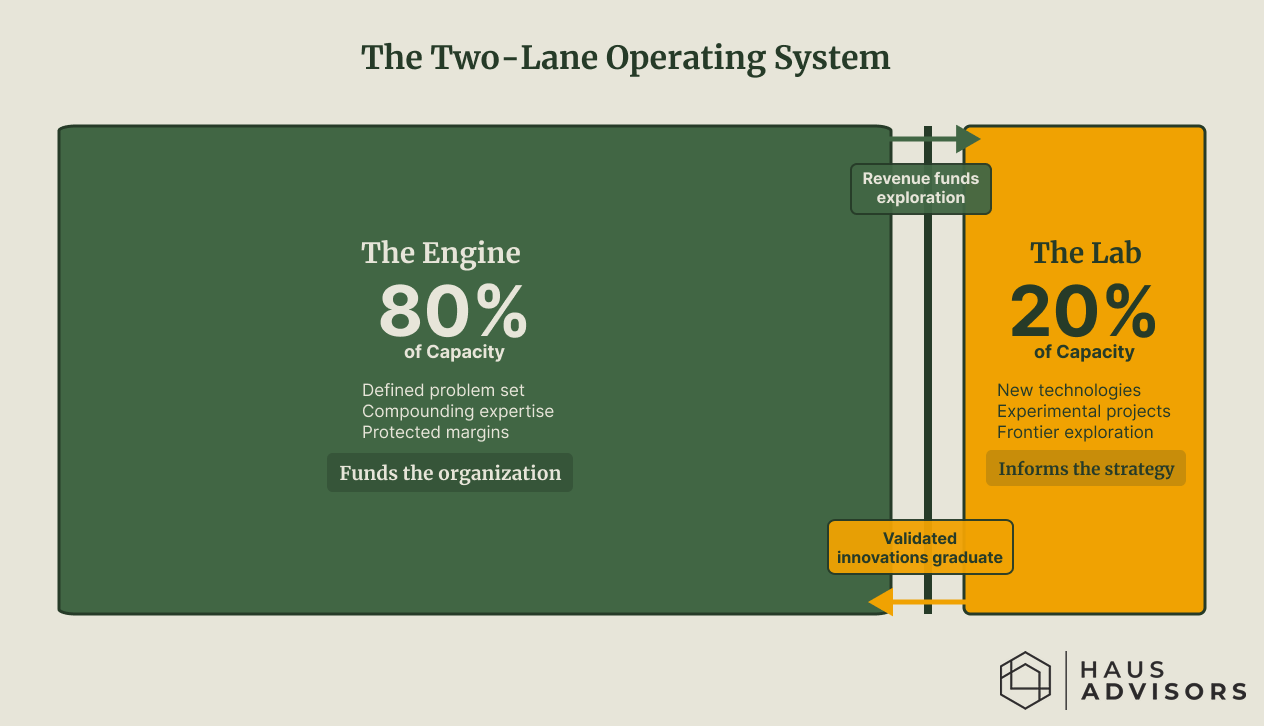
The Engine funds the organization. The Lab informs the strategy. The discipline is the boundary between them: exciting client work doesn't automatically graduate from Lab to Engine.
The Engine (80 percent of capacity). A defined problem set, industry, or client type where the agency builds deep, compounding expertise. This is where margins are protected, delivery is efficient, knowledge accumulates, and the agency's reputation concentrates. The Engine funds the organization.
The Lab (20 percent of capacity). Pure exploration. New technologies, new industries, experimental projects. The Lab is where the agency stays at the frontier, tests new tools, and identifies which innovations are worth integrating into the Engine. The Lab doesn't need to be profitable. It needs to be informative.
The critical discipline is the boundary between the two. Lab projects don't become Engine projects just because the client wants more work. The Lab tests whether a new technology or domain has Engine potential. If it does, the agency makes a deliberate decision to expand the Engine's scope. If it doesn't, the agency takes the learning and moves on.
Without this boundary, the Lab gradually consumes the Engine. Every exciting new client in a new industry feels like it deserves to become a focus area, and the agency is back to contextual variety with no compounding knowledge base. The 80/20 split isn't arbitrary. It's the minimum concentration required for knowledge to compound faster than it depreciates.
The Obsolescence Threshold
There's a timing dimension to contextual debt that makes it urgent rather than theoretical.
Every technology follows a maturity curve. Early in the curve, novelty itself is the value. The agency that can build an AR experience, or a generative AI prototype, or a spatial computing demo charges a premium simply for being able to do what others can't. This is the window where innovation-led agencies thrive without domain focus.
But the window closes. As the technology matures, more agencies develop the capability. The premium for "we can build this" collapses. What remains valuable is "we know what to build, for whom, and why." That's domain expertise. That's the recipe, not the ingredient.
Agencies that haven't built domain depth before the novelty window closes face a brutal transition. They have to find the next emerging technology to ride, or they have to compete on execution quality in a commoditized market. Both options are expensive. The first requires constant R&D investment with no guarantee the next wave arrives in time. The second means racing other competent teams on price, which is exactly the dynamic that positioning is supposed to prevent.
The agencies that built domain depth during the novelty window are insulated. When AR became commodity, the agency that specialized in "AR for surgical training" didn't lose its premium. The technology layer became cheaper, which made their solutions more accessible, which expanded their market. They rode the commoditization curve upward because their value was never in the technology alone.
This is the timing trap inside contextual debt. The longer an agency waits to anchor its innovation to a domain, the smaller the remaining window of novelty-driven premium. And the transition from "sell the technology" to "sell the domain expertise" takes 18 to 24 months of concentrated effort. You can't start the transition after the window closes. You have to start while you're still comfortable.
What Contextual Debt Actually Costs You
Margins that thin as you scale. At 20 people, the re-education tax is absorbed by the founders' personal knowledge. At 80 people, it's distributed across dozens of team members who each need ramp-up time on every new domain. The agency grows revenue but not profit, because the operational overhead of contextual variety scales faster than the team's capacity to absorb it.
A portfolio that impresses peers but confuses buyers. Fifteen case studies across twelve industries looks impressive at a conference. It's paralyzing for a buyer who wants to know: "Have you done this exact thing for a company like mine?" The innovation-led portfolio answers "we can build anything" when the buyer is asking "can you solve my specific problem?"
Senior talent that burns out. The best developers and strategists want to go deep. They want to master a domain, build on previous work, and see their expertise compound. Constant context-switching is cognitively expensive and professionally unsatisfying. The agency that rotates industries every project loses its best people to competitors who offer depth.
An acquisition profile that doesn't work. If the agency ever wants to be acquired, buyers pay for concentrated expertise in a defined market. An acquirer looking at a healthcare AI agency sees a defensible position, a referrable client base, and compounding domain knowledge. An acquirer looking at an innovation agency that's done AI projects across twelve industries sees a talented team with no structural moat. The first commands a premium multiple. The second commands an acqui-hire price.
The Next Step
You don't need to abandon your innovation identity. You need to audit where your knowledge is compounding and where it's evaporating.
Start here: list your last 20 projects. For each one, note the industry, the core technology, and the problem type. Then look for the cluster. There's almost always one. Maybe 8 of the 20 are in financial services. Maybe 12 involve modernizing legacy systems. Maybe 9 are for non-technical end users in operational roles.
That cluster is your Engine candidate. It's the domain where you've already started building compounding knowledge, even if you haven't named it or intentionally focused on it. The question isn't whether to specialize. It's whether to recognize the specialization that's already emerging from your own delivery history and build a deliberate strategy around it.
One audit. Twenty projects. One afternoon. That's where you find the line between innovation that compounds and innovation that consumes.
The principle is simple:
There are agencies that innovate across every domain and reset their knowledge with every project. And there are agencies that innovate within a domain and compound their knowledge with every project.
The first group works harder every year to maintain the same margins. The second group works smarter every year because the margins take care of themselves.
Most founders reading this already know the real problem. It isn't project management. It's that the compounding knowledge has to live in the agency, and right now it lives in the founders' heads, along with the reputation and the relationships that make the agency worth hiring. So the business only grows when you're in the room.
That's the work we do at Haus Advisors. The Relevance Engineering Program is six months of implementation, not a strategy document. We pull what makes your agency relevant out of your head, build it into positioning, offers, and growth plays your team can run, and hand ownership to them. If you want an agency that grows without needing you in every deal, book a call to see if it's a fit.
Keep reading
Browse by topic
- Positioning & Strategy
- Lead Gen & Marketing
- Sales & Biz Dev
- Pricing & Productization
- Research & Data
- Operations & Delivery
- Client Retention & Expansion
- Leadership & Culture
For founders whose agency has outgrown referrals.
One idea a week that makes a hard growth problem obvious, usually with a chart that shows you the mechanism behind it.
Built from conversations with seventy-plus agency founders on the Behind the Agency podcast.